
You can root a ZZ plant in water, but be ready to wait. A ZZ “stem” is really one large compound leaf, and cuttings first grow a small potato-like rhizome before they make much root. Let a cut leaf or single leaflet dry for a few hours, then stand the cut end about 1 inch (2.5 cm) deep in room-temperature water with the leaflets above it. Keep it warm, ideally 75–85°F (24–29°C), in bright indirect light, and change the water weekly.
Under ideal greenhouse conditions a rhizome forms in about 4 weeks; in a typical home it can take several months. Move it to a fast-draining mix once the rhizome and roots form, because mature ZZ plants rot if their roots sit in water.
Key takeaway: ZZ in water is a rooting method, not a long-term home. Warmth speeds it up more than anything else, and rooting hormone isn’t necessary.
| Factor | Recommendation | Source |
|---|---|---|
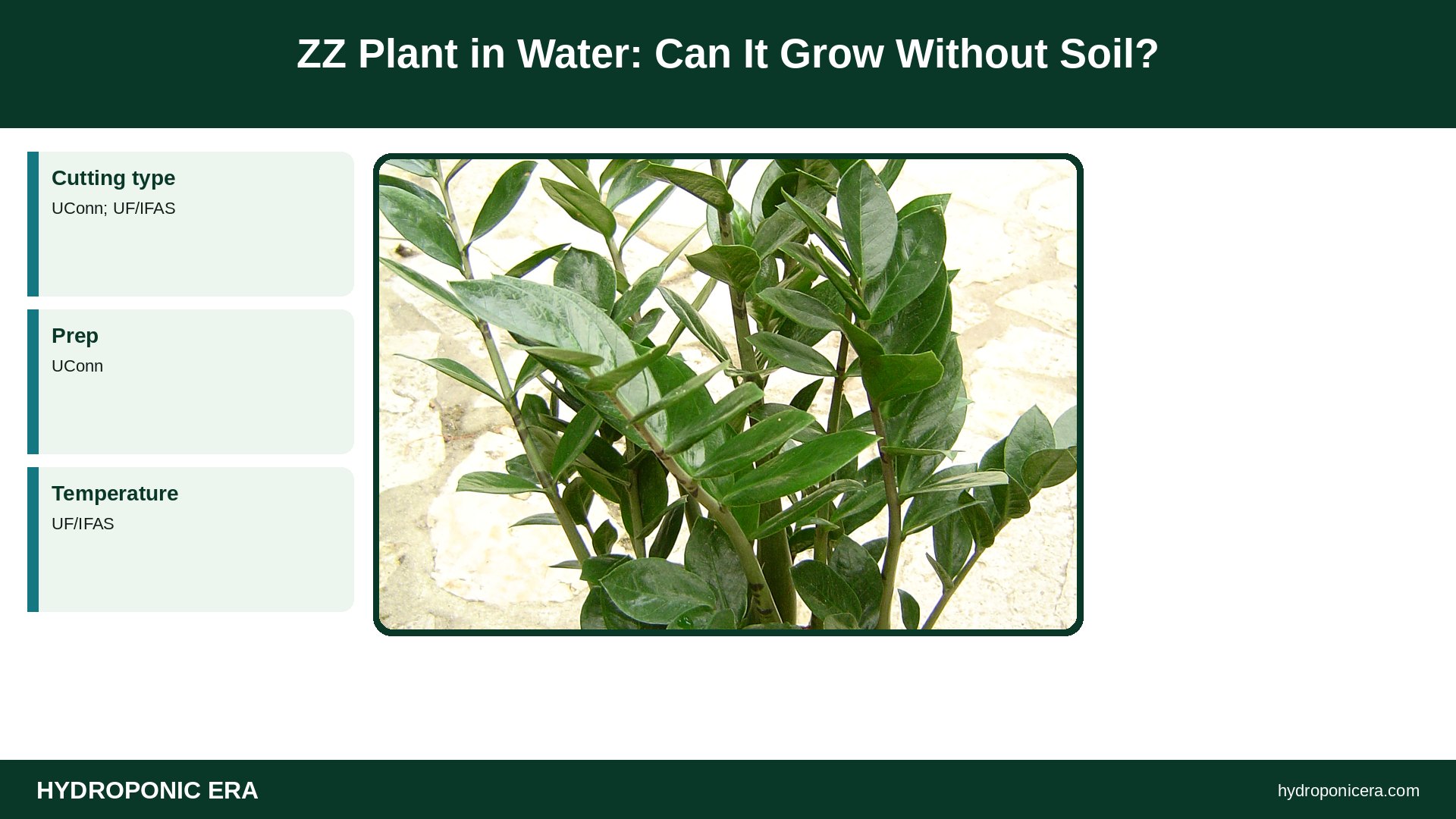
| Cutting type | Whole leaf (petiole with leaflets) or a single leaflet | UConn; UF/IFAS |
| Prep | Let the cut end callus for a few hours | UConn |
| Temperature | 75–85°F (24–29°C) for propagation | UF/IFAS |
| Light | Bright indirect; 1,000–1,500 foot-candles (about 10,800–16,100 lux) in greenhouses | UF/IFAS |
| Time to rhizome | About 4 weeks in a greenhouse; up to 9 months indoors | Chen and Henny; UConn |
| Pets | Toxic if eaten (calcium oxalate) | UF/IFAS; N.C. State |
How ZZ Plants Grow (and Why Cuttings Are Slow)
UF/IFAS Extension describes the ZZ plant (Zamioculcas zamiifolia) as an aroid, related to philodendron and anthurium, with rhizomatous roots that store water so it can survive drought in its native eastern Africa. What looks like a stem is a fleshy petiole carrying glossy leaflets, rising from thick, tuber-like rhizomes. Chen and Henny (2003) explain that ZZ is propagated mainly by dividing rhizomes or by leaf and petiole cuttings.
A cutting has no rhizome, so it must build one before it can grow a new shoot. In Chen and Henny’s greenhouse protocol, callus formed around the main vein in 2 weeks, a small rhizome appeared after another 2 weeks, roots grew from it a week later, and a new leaf emerged about a month after that. That’s roughly 2 months in near-perfect conditions of 75–90°F (24–32°C) and 60–100% humidity.
How to Root a ZZ Plant in Water, Step by Step

- Choose a mature, healthy leaf with firm, dark green leaflets.
- Cut it near the base with a clean knife. You can use the whole leaf, the top half, or single leaflets.
- Let the cut end callus for a few hours, as UConn Extension suggests for ZZ cuttings.
- Fill a narrow jar with room-temperature water.
- Submerge only the bottom 1 inch (2.5 cm) of the petiole or leaflet base. Keep the leaflets dry.
- Keep it warm and bright. UF/IFAS lists 75–85°F (24–29°C) and bright, shaded light for propagation. A spot near a bright window, out of direct sun, or under a grow light works well.
- Change the water weekly and rinse the jar.
- Look for a small, pale rhizome at the base, then roots growing from it.
How Long Does a ZZ Plant in Water Take to Root?
Expect months, not weeks, for a ZZ plant in water. UConn Extension says rhizomes start forming in about a month under greenhouse conditions, but typical household conditions can take up to 9 months. The difference is mostly warmth and light. A ZZ plant in water on a cool windowsill in winter may barely change for weeks, then suddenly push out a rhizome in spring.
A Michigan State University study found that leaf cuttings with or without a node rooted and formed a rhizome in 4 weeks at about 79°F (26°C), but bare stem pieces with no leaflets didn’t callus or root. So always keep leaflets on your cutting. The same work found the top half of a leaf made three to five small rhizomes, while the bottom half made one large one.
Leaflet vs. Whole-Leaf Cuttings

- Single leaflets: the most common way to start a ZZ plant in water. They make many plants from one leaf, but each starts tiny and takes the longest to reach a decent size.
- Whole or half leaves: fewer plants, but bigger starts. MSU found two-leaf cuttings with a node grew slightly larger plants than one-leaf cuttings.
- Division: the fastest way to a full-size plant. Chen and Henny note this is how most ZZ plants are multiplied, and UF/IFAS says more or larger rhizomes per pot shortens the time to a full plant.
Moving a ZZ Plant in Water to Soil
Pot ZZ cuttings once they have a visible rhizome and a few roots. Use a small pot with drainage holes and a fast-draining houseplant mix, such as one with extra perlite. Plant it so the rhizome sits just below the surface, water once, and let the mix dry slightly before watering again.
UF/IFAS says ZZ performs best with moderate watering every week or two, but warns not to let the roots sit in water or the plant may rot. UConn agrees that overwatering is just about the only thing that kills this tough houseplant, with yellow leaves and rotting rhizomes as the warning signs.
Can a ZZ Plant in Water Live Permanently?
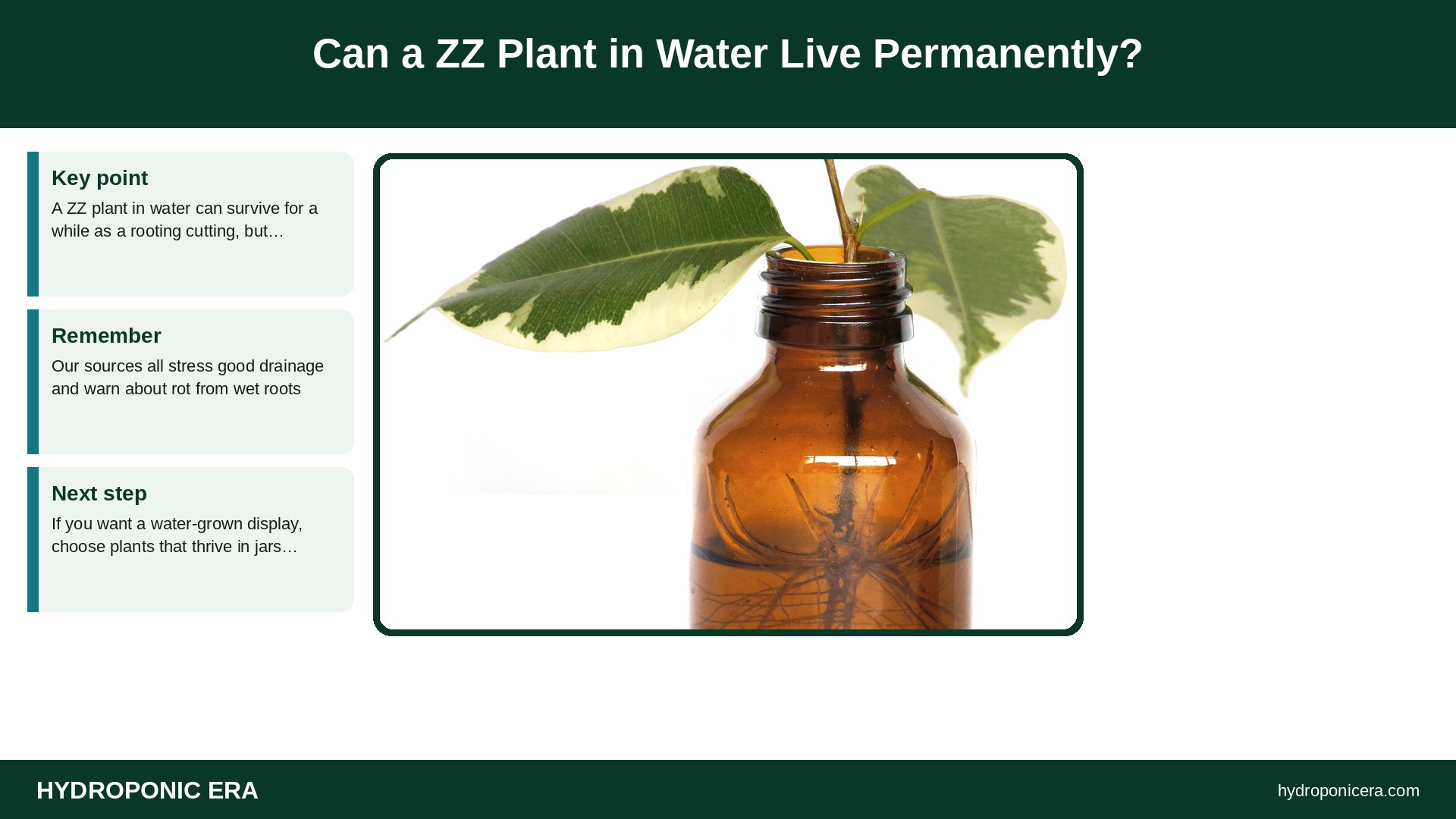
We don’t recommend it. A ZZ plant in water can survive for a while as a rooting cutting, but the plant is built to store water and dry out between drinks. Our sources all stress good drainage and warn about rot from wet roots. If you want a water-grown display, choose plants that thrive in jars, such as those in plants that grow in water, or try snake plant in water, another drought-tolerant plant.
ZZ Plant Care After Rooting
- Light: UF/IFAS says ZZ grows best in bright, indirect light and tolerates very low light. UConn warns that direct sun can scald and curl leaves.
- Temperature: UConn suggests 55–80°F (13–27°C). N.C. State says bring outdoor pots inside before temperatures fall below 60°F (16°C).
- Fertilizer: UConn suggests a balanced houseplant fertilizer at half strength once or twice during the growing season.
- Size: Indoors it is often slow, but UF/IFAS says it can reach 3–4 feet (0.9–1.2 m) tall over time.
- Pets and kids: UF/IFAS says all parts are toxic if eaten, and N.C. State rates it as a medium-toxicity plant for cats and dogs.
Troubleshooting ZZ Plant in Water
- Cut end turns soft or black: rot. Recut above the soft tissue, let it callus, and use fresh water.
- Leaflets yellow and drop: common on older cuttings; as long as the base is firm, keep waiting.
- Nothing after 2 months: a ZZ plant in water is usually just too cool. Move it somewhere warmer, or add a heat mat under the jar.
- Cloudy, smelly water: change it more often and keep only the base submerged.
Related reading: hydroponic cuttings and cloning and arrowhead plant in water, a much faster aroid to root.
FAQs
Can a ZZ plant grow in water?
Cuttings can root in water, but mature plants grow best in fast-draining soil.
How long does a ZZ plant in water take to root?
About a month in ideal warmth; often several months at home.
Can a single ZZ leaflet grow into a new plant?
Yes, it forms a small rhizome first, but it’s slow.
Why are my ZZ cuttings not rooting?
Usually too cool or too dark; warmth speeds rhizome formation.
Do ZZ cuttings need rooting hormone?
No. Chen and Henny found it isn’t necessary.
Is the ZZ plant toxic?
Yes, all parts are toxic if eaten, so keep it away from pets and children.
Sources
- Chen and Henny (2003), HortTechnology — ZZ: A Unique Tropical Ornamental Foliage Plant
- UF/IFAS Extension — Cultural Guidelines for Commercial Production of Interiorscape ZZ
- UF/IFAS Gardening Solutions — ZZ Plant
- UConn Home and Garden Education Center — ZZ Plant
- Michigan State University — ZZ Plant propagation research
- N.C. State Extension Plant Toolbox — Zamioculcas zamiifolia
- Photo credits (Wikimedia Commons, edited with titles): Zamioculcas zamiifolia 1 by User:WeFt (CC BY-SA 3.0); Zz plant by Philsacor (CC0); Sansevieria trifasciata (36268) by Nativeplants garden (CC BY-SA 4.0); Ficus cuttings with roots in a bottle, White background by Biusch (CC BY-SA 3.0); Aloe vera Lanzarote by H. Zell (CC BY-SA 3.0)