
Does diatomaceous earth for plants control pests? Yes, partly. Diatomaceous earth (DE) is a fine silica dust that kills insects by absorbing oils from their outer shell so they dry out. It works only while it stays dry and undisturbed, so it suits crawling pests and slug barriers, not wet hydroponic media or reservoirs. Choose a product labeled for pest control.
Key takeaway: Diatomaceous earth for plants is a contact dust, not a poison. It is most useful as a dry barrier or a light dusting where crawling pests travel. Water makes it stop working, and dust can irritate lungs and eyes, so use a labeled product, a dust mask and a light hand.
| Question | Short answer | Source |
|---|---|---|
| What is it? | Fossilized diatoms, mostly amorphous silica | NPIC |
| How does it kill? | Absorbs cuticle oils; sharp edges speed drying | NPIC |
| Works when wet? | No; reapply after rain or irrigation | OSU, UNH |
| Slug barrier size | 1 in (2.5 cm) deep, 3 in (7.5 cm) wide | Oregon State |
| Best product | One with an EPA registration number | NPIC |
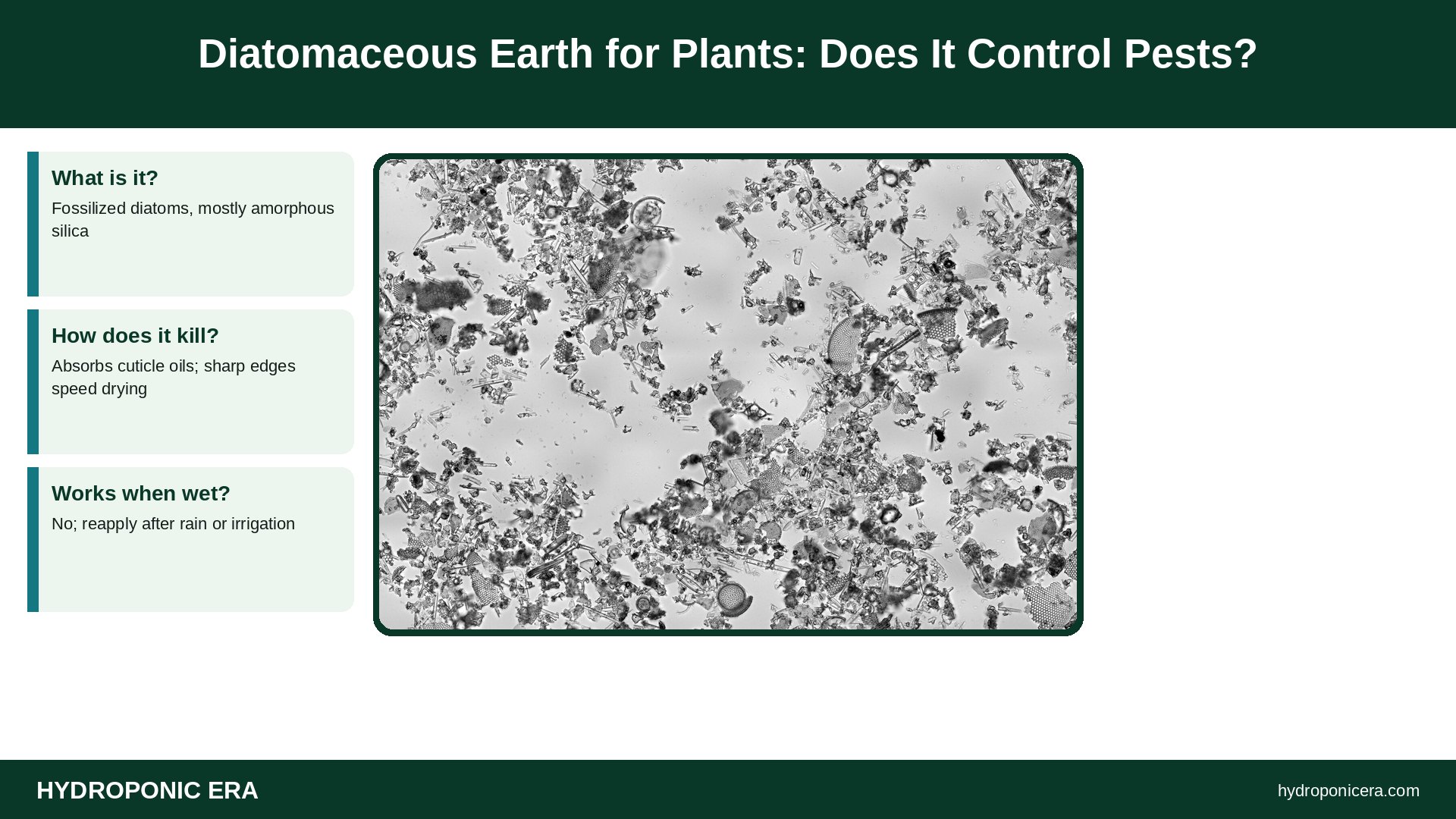
What Is Diatomaceous Earth for Plants?
Diatomaceous earth for plants is a powder mined from deposits of diatoms, tiny aquatic organisms whose skeletons are made of silica. The National Pesticide Information Center (NPIC) explains that most DE is amorphous silicon dioxide, with very low levels of crystalline silica. Pesticide products containing it were first registered in 1960 to kill insects and mites, and today more than 150 products are registered for use in buildings, farms, gardens and kennels.
How Does Diatomaceous Earth Kill Insects?
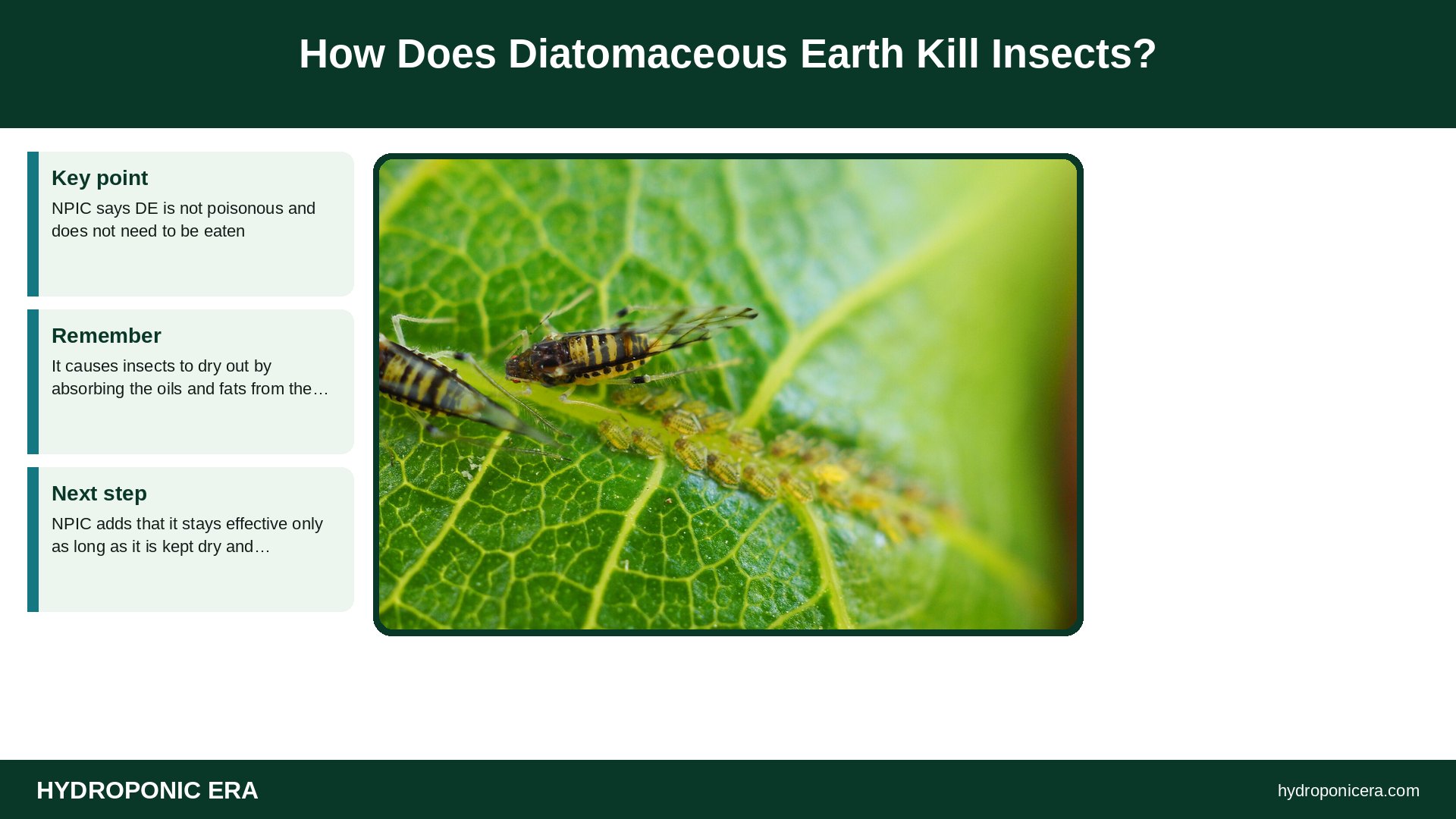
NPIC says DE is not poisonous and does not need to be eaten. It causes insects to dry out by absorbing the oils and fats from the cuticle of their exoskeleton, and its abrasive edges speed up the process. NPIC adds that it stays effective only as long as it is kept dry and undisturbed. That one sentence explains most failures: a dusting that gets watered, misted or rained on stops working.
Which Pests Does Diatomaceous Earth for Plants Help With?
Registered DE products are labeled for crawling pests such as cockroaches, crickets, fleas, ticks and spiders, according to NPIC. In a garden, diatomaceous earth for plants is most practical against pests that walk across the dust:
- Slugs and snails: Oregon State Extension suggests a band 1 inch (2.5 cm) deep and 3 inches (7.5 cm) wide around plants.
- Ground-crawling insects that travel over soil, mulch or bench surfaces.
- Soft-bodied pests on dry surfaces, where the dust stays in place.
It is a weak choice for pests hidden inside leaves or roots, or for anything on plants that are watered overhead. For sap-feeders, see our guide to aphids and mites in hydroponics.
How Do You Apply Diatomaceous Earth for Plants?
- Read the label. NPIC says registered products list how much to use, where, and any required protective equipment.
- Wear a dust mask, eye protection and long sleeves, as NPIC recommends.
- Apply on a calm, dry day to dry soil, mulch or leaves.
- Use a duster or squeeze bottle for a thin, even film; a heavy pile is not better.
- Target where pests travel: plant bases, bed edges and bench legs.
- Keep it off open flowers where pollinators land.
- Reapply after rain or irrigation, since Oregon State and UNH both note it stops working when wet.
- Keep children and pets away until the dust settles.
When Should You Use Diatomaceous Earth for Plants?
Use diatomaceous earth for plants when three things are true: the pest crawls, the surface will stay dry for a while, and you can keep the dust out of the air you breathe. Garden beds during a dry spell, the rims of outdoor containers and the base of raised beds fit that pattern. Skip diatomaceous earth for plants that are misted, overhead watered or grown in constantly wet media, because the dust will not stay active there. Indoors, a thin line along a shelf or windowsill where crawling insects travel is more practical than coating foliage.
Is Food Grade Diatomaceous Earth OK for Pest Control?
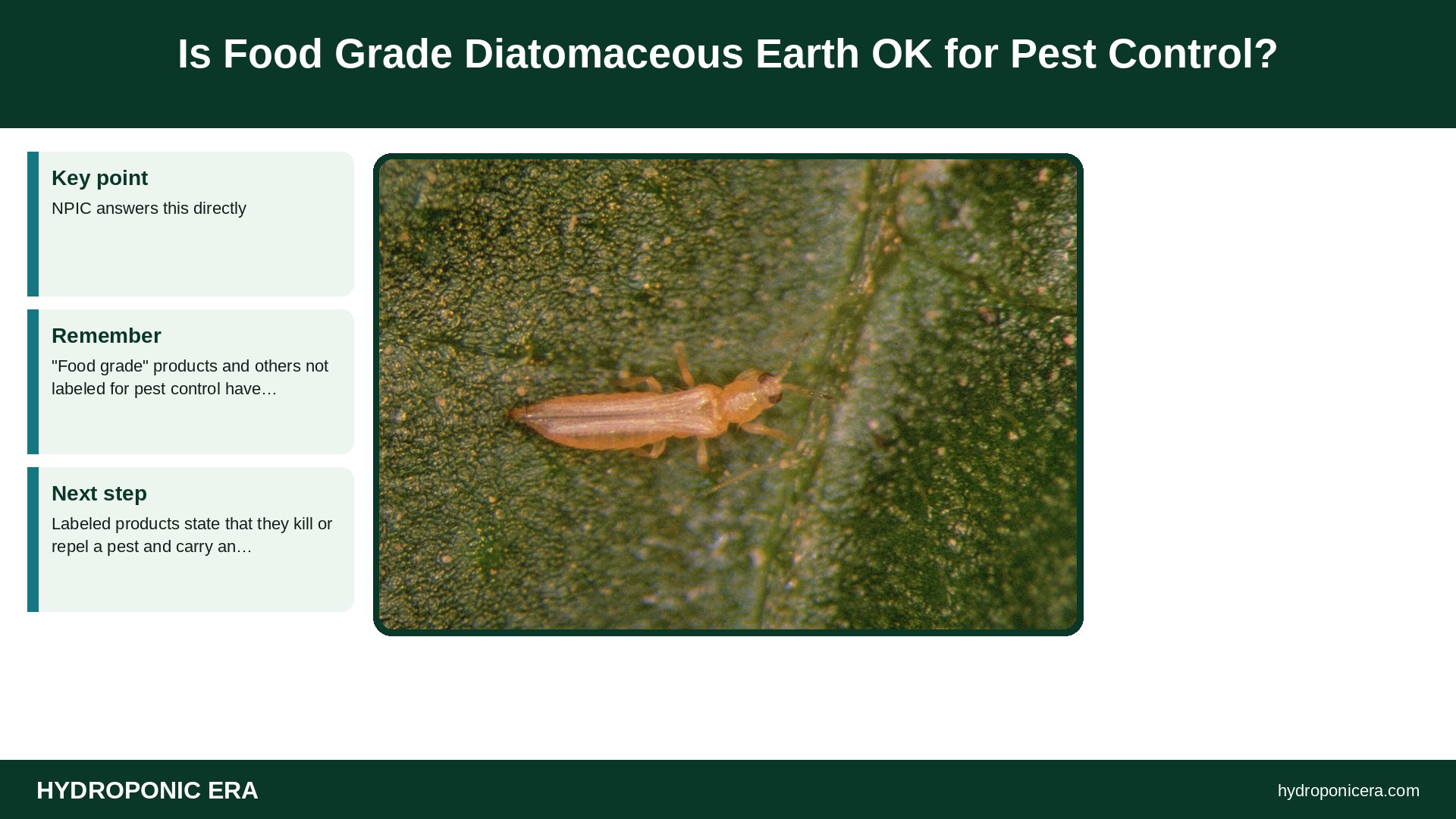
NPIC answers this directly. “Food grade” products and others not labeled for pest control have not been evaluated for pest-control risks, so their effectiveness and risks for that use are untested. Labeled products state that they kill or repel a pest and carry an EPA registration number, and regulators assign a signal word: CAUTION for low toxicity, WARNING for moderate and DANGER for high. NPIC notes the FDA treats DE as generally recognized as safe when up to 2% is added to food, but spreading a concentrated dust raises inhalation concerns. Pool-filter DE is a different, processed product and is not sold for garden pest control.
Is Diatomaceous Earth Safe for People, Pets and Bees?
NPIC reports that inhaled DE can irritate the nose and nasal passages, and very large amounts can cause coughing and shortness of breath. It can also irritate eyes and dry the skin. Long-term inhalation of crystalline silica is linked to silicosis, while the amorphous form is associated only with mild, reversible lung inflammation. NPIC calls DE practically non-toxic to fish and aquatic invertebrates.
For pollinators, LSU AgCenter notes DE is effective on insects that forage on the ground and would have little impact on bees and other flying insects. Because it is a contact dust, keeping it off blossoms is still the sensible rule.
Can You Use Diatomaceous Earth in Hydroponics?
Mostly no. Hydroponic media, rockwool and net cups stay wet, and NPIC says DE works only while dry. Never add it to a reservoir; it does not dissolve well in water and would only cloud the system and coat pumps and drippers. In a hydroponic grow room, it is better used on dry floors and bench edges than on plants. For flying pests that breed in wet media, see fungus gnats in hydroponics and use sticky traps to monitor numbers.
Why Isn’t Diatomaceous Earth for Plants Working?
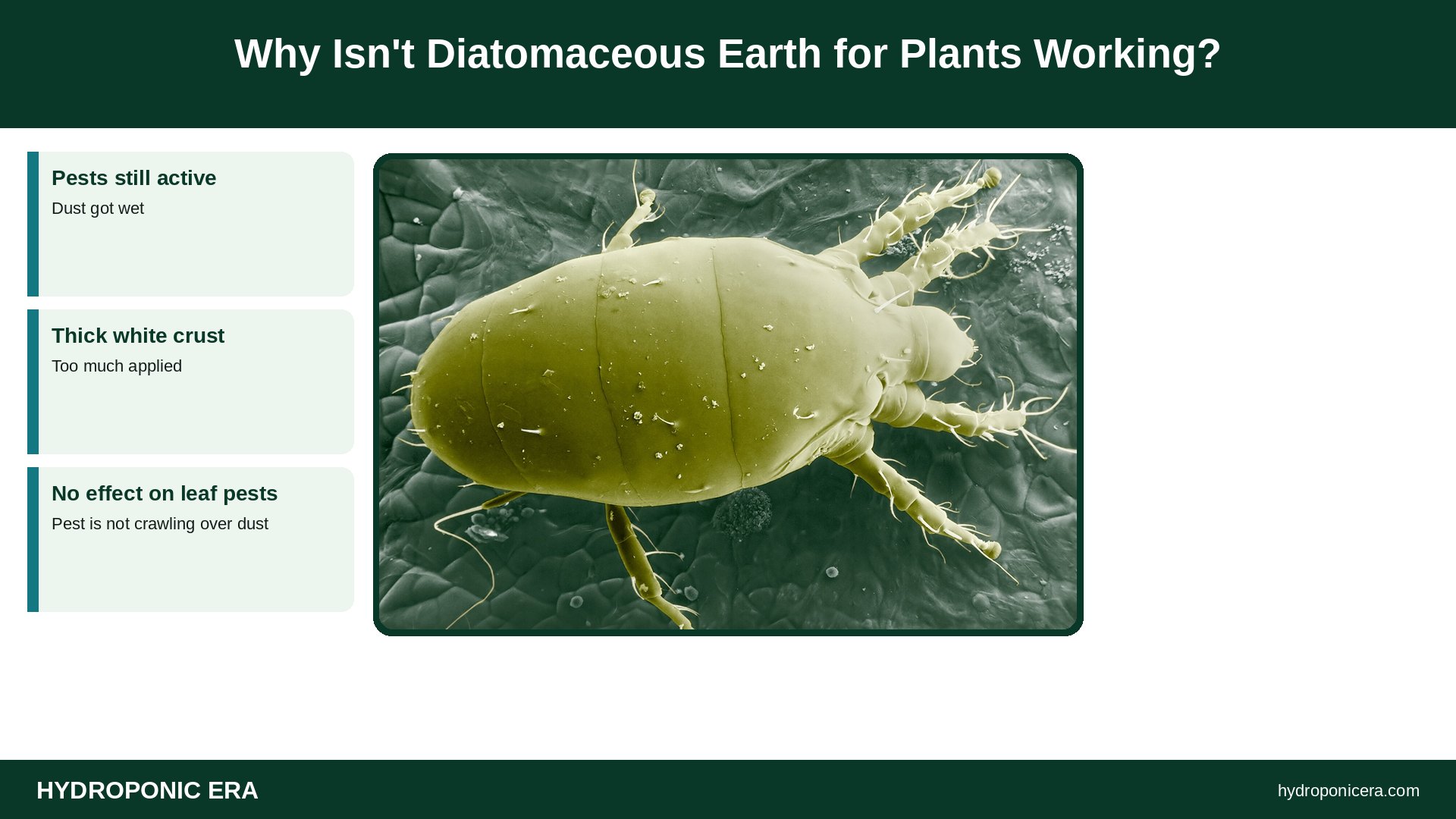
| Problem | Likely cause | Fix |
|---|---|---|
| Pests still active | Dust got wet | Reapply when dry |
| Thick white crust | Too much applied | Brush off; use a thin film |
| No effect on leaf pests | Pest is not crawling over dust | Switch to a labeled spray |
| Coughing while applying | Dust in the air | Mask; apply on a calm day |
Oregon State lists other slug tools such as copper bands and baits, and UNH stresses that removing hiding places and watering earlier in the day matter as much as any product.
FAQs
Does diatomaceous earth for plants kill fungus gnats?
It can only affect insects that contact dry dust. Gnat larvae live in moist media, where DE stops working.
Does rain wash diatomaceous earth for plants away?
Water makes it ineffective; reapply once surfaces dry.
Does diatomaceous earth break down?
NPIC says microbes and sunlight do not degrade it.
Can I mix it with water and spray?
Only if the product label allows a wet application.
Is diatomaceous earth for plants organic?
It is a mined mineral, but check the product label for approval.
Sources
- NPIC — Diatomaceous Earth General Fact Sheet
- NPIC — Is food grade diatomaceous earth okay for pest control?
- Oregon State University Extension — How to Control Slugs in Your Garden (EM 9155)
- UNH Extension — What can I do to control the slugs in my garden?
- LSU AgCenter — Organic Pesticides Versus Pollinators
- Photo credits (Wikimedia Commons, edited with titles): Diatomaceous Earth BrightField by Zephyris (CC BY-SA 3.0); Aphids on a leaf, 2025 early summertime Alconbury Weald by ISAAC THE BOY (CC BY 4.0); Frankliniella occidentalis 5364132-LGPT by Frank Peairs, Colorado State University, Bugwood.org (CC BY 3.0); Polyphagotarsonemus latus, USDA BARC by Erbe, Pooley: USDA ARS Electron and Confocal Microscopy Unit (Public domain); Striped ladybird with aphids (4560537745) by Ton Rulkens from Mozambique (CC BY-SA 2.0)