
Are dwarf baby tears hard to grow? Dwarf baby tears (Hemianthus callitrichoides ‘Cuba’) are one of the harder carpet plants. Tropica rates the plant high for light and CO2, at about 15–25 mg/L. Plant small clumps a few centimeters apart in fine soil, keep it near 75–79°F (24–26°C) and trim often so the lower layer does not die.
Key takeaway: Dwarf baby tears, sold as HC Cuba, is the tiny carpeting plant with leaves only 3 to 4 millimeters across. Flowgrow says Tropica imported it from Cuba in 2004 and calls it the smallest aquarium plant in the world. It can form a carpet in 3 to 4 weeks, but only with strong light, added CO2 and steady fertilizer.
| Factor | Target | Source |
|---|---|---|
| Light | High | Tropica; Flowgrow |
| CO2 | High, about 15–25 mg/L (Tropica); 20–40 mg/L (Flowgrow) | Tropica; Flowgrow |
| Temperature | 64–82°F (18–28°C); best 75–79°F (24–26°C) | Flowgrow |
| pH | 5–7 | Flowgrow |
| Nitrate | 10–50 mg/L | Flowgrow |
| Height after two months | About 1.2–2 in (3–5+ cm) | Tropica |
| Carpet time | About 3–4 weeks in good conditions | Flowgrow |

How Do You Grow Dwarf Baby Tears in an Aquarium?
Grow dwarf baby tears as many tiny clumps in a fine, rich substrate. Tropica says that if planted in small clumps a few centimeters apart, it spreads quickly and covers the bottom like a carpet. Flowgrow adds that it forms a dense, bright green carpet within 3 to 4 weeks in a well-lit foreground.
- Split each pot or tissue culture cup into small portions of a few stems.
- Plant them about 1 in (2.5 cm) apart with fine tweezers.
- Use a fine-grain aquarium soil so the shallow roots anchor.
- Fill the tank slowly to avoid uprooting plantlets.
- Start CO2 and full lighting from day one.
The 2Hr Aquarist knowledge base also recommends planting separate small strands rather than bunches. Try a “dry start” only if you can keep humidity high (our guidance).

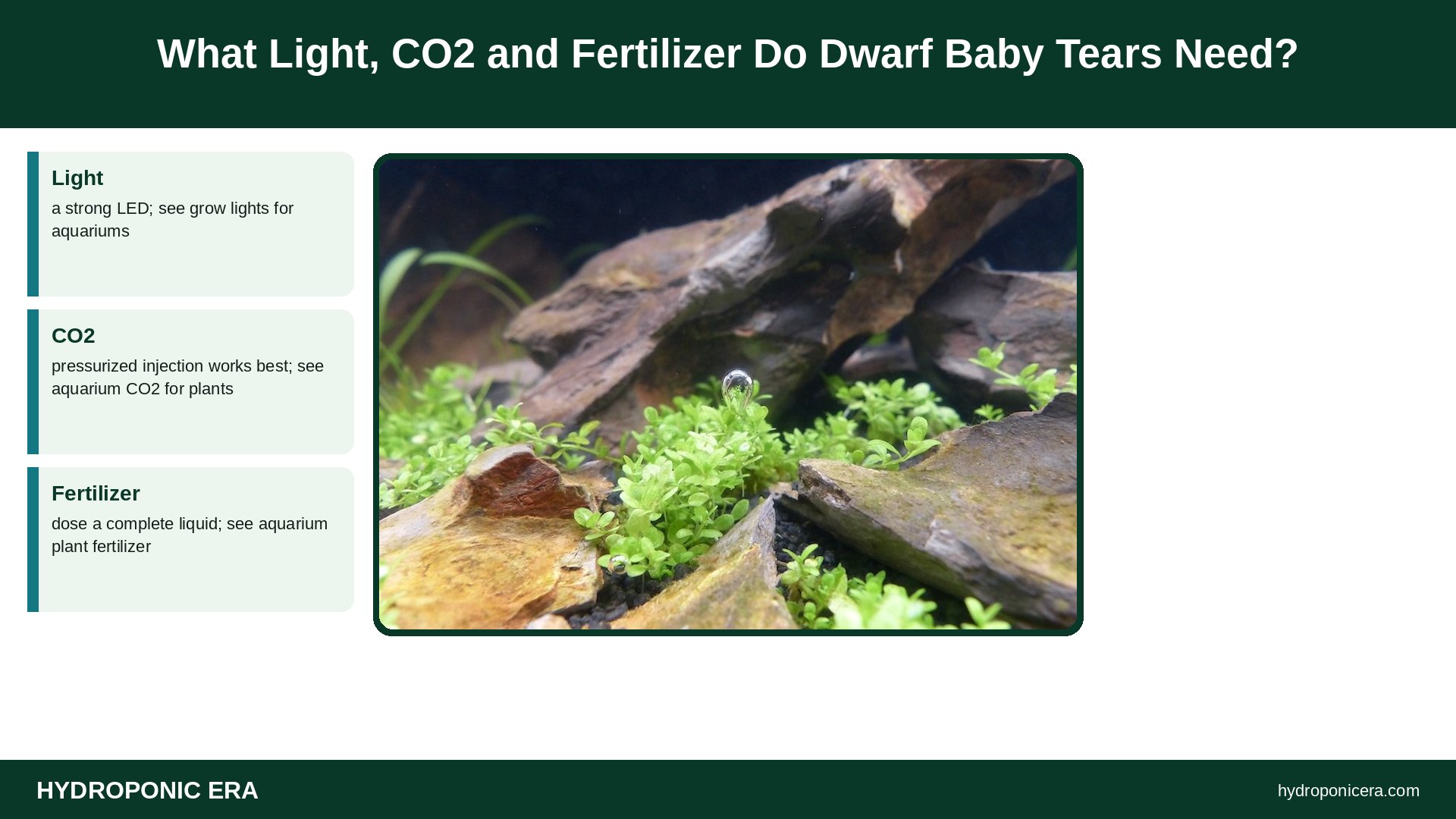
What Light, CO2 and Fertilizer Do Dwarf Baby Tears Need?
Dwarf baby tears need high light and high CO2. Tropica defines high CO2 demand as about 15 to 25 mg/L, and Flowgrow lists 20 to 40 mg/L. The 2Hr Aquarist guide suggests at least 40 µmol of light at the substrate. Flowgrow says the plant is prone to iron deficiency and needs enough nitrate.
- Light: a strong LED; see grow lights for aquariums.
- CO2: pressurized injection works best; see aquarium CO2 for plants.
- Fertilizer: dose a complete liquid; see aquarium plant fertilizer.
- Root zone: add aquarium root tabs in inert gravel.
Flowgrow says CO2 is not always required, but the plant grows much healthier with it. The 2Hr Aquarist knowledge base reports that growing it without CO2 usually fails.
Why Are Dwarf Baby Tears Melting or Not Growing?
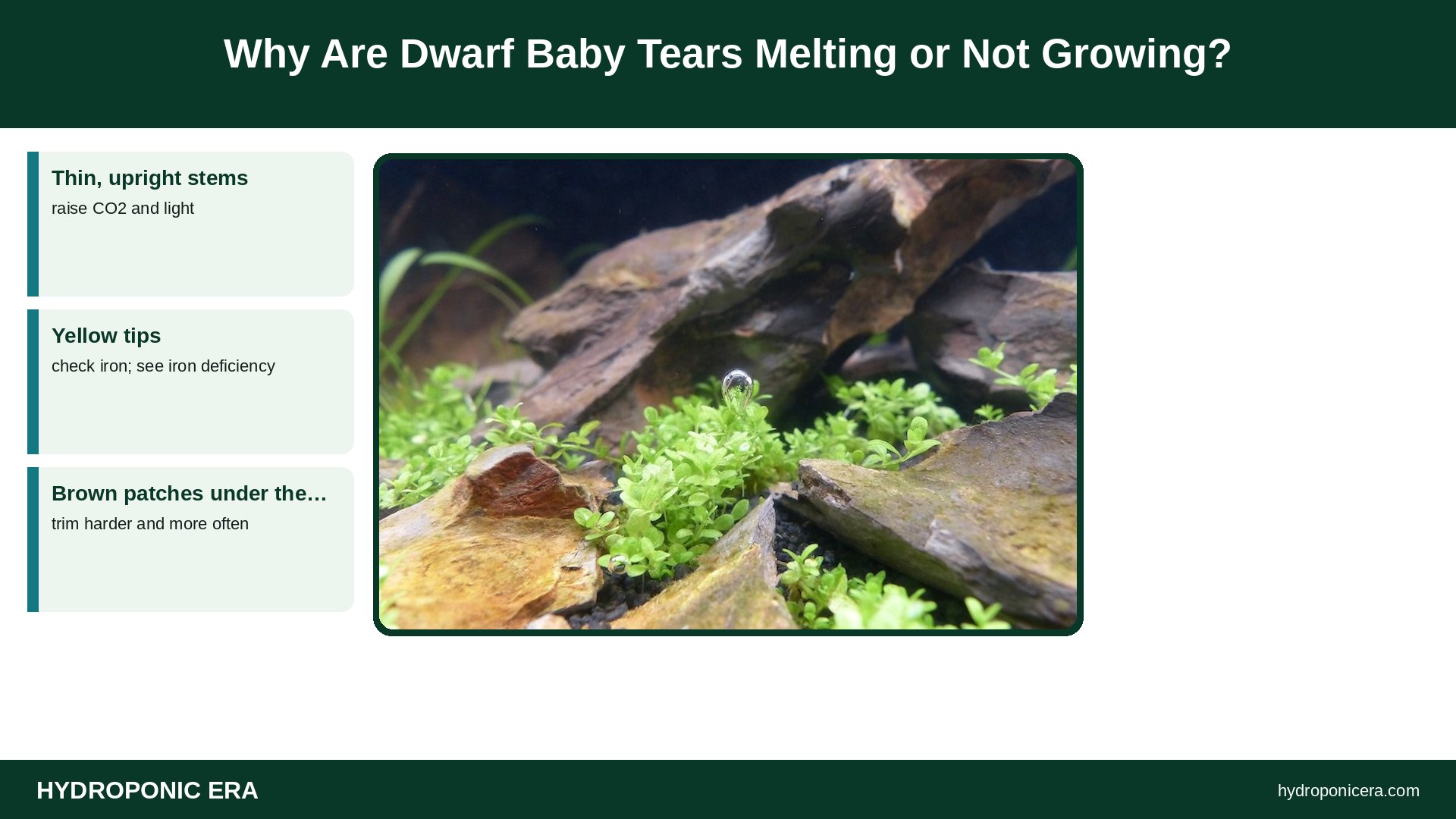
Dwarf baby tears usually fail from low CO2, low light, rotting lower layers or uprooting. The 2Hr Aquarist guide says low CO2 gives thin stems, small new leaves and upward growth instead of creeping. Flowgrow lists yellow shoot tips as an iron deficiency symptom. Tropica warns that an untrimmed carpet starves its lower parts of light, causing root death.
- Thin, upright stems: raise CO2 and light.
- Yellow tips: check iron; see iron deficiency.
- Brown patches under the carpet: trim harder and more often.
- Floating clumps: replant deeper or let the carpet knit together.
Algae is the other big risk for HC Cuba under strong light. Keep flow steady across the substrate.
How Do You Trim and Propagate Dwarf Baby Tears?
Trim HC Cuba often with curved scissors, cutting the top layer flat. Tropica says regular trimming prevents the lower parts from losing light and dying. Trimmings can be replanted as new small clumps to fill gaps. The 2Hr Aquarist guide notes HC Cuba is shallow-rooted and needs more frequent trimming than Monte Carlo.
- How often: every 2 to 4 weeks once the carpet fills in (our guidance).
- Replanting: push small portions into bare spots.
- Waterline growth: Flowgrow notes it can grow emersed in humid open tanks.
Where Does HC Cuba Come From?
Flowgrow reports that Holger Windeløv found the plant near Havana in a rocky river during the dry season. The cushion-like population grew in gravel about 20 in (50 cm) above the waterline, and in the rainy season it is likely submerged in up to 3.3 ft (1 m) of fast water. That history explains why it grows both underwater and emersed.
- Nursery plants: most are grown emersed and have rounder leaves.
- Submerged growth: leaves turn smaller and a bit narrower, so expect a short transition.
- Flowers: tiny white flowers sometimes appear in the leaf axils.
Expect some melting of old emersed leaves in the first two weeks as new submerged leaves take over (our experience). Tissue culture cups transition fastest because they start pest-free and algae-free.
Dwarf Baby Tears vs. Monte Carlo: Which Is Easier?
Monte Carlo is easier. Tropica suggests Micranthemum ‘Monte Carlo’ as a less demanding alternative when conditions are hard to create. The 2Hr Aquarist guide says HC Cuba has smaller leaves and grows slightly faster but needs much more CO2. It also says cooler water helps, and growth gets much harder above about 84°F (29°C).
- Choose HC Cuba: for nano tanks and the finest carpet.
- Choose Monte Carlo: for warm tanks or lower CO2; see our Monte Carlo guide.
FAQ About Dwarf Baby Tears
What is the scientific name?
Hemianthus callitrichoides ‘Cuba’, now also listed as Micranthemum callitrichoides.
Do dwarf baby tears need CO2?
In practice yes; growth without it usually fails.
How fast do they carpet?
About 3–4 weeks in good conditions, per Flowgrow.
What temperature is best?
About 75–79°F (24–26°C).
Why do they float up?
Shallow roots; plant small clumps in fine soil.
Are they good for nano tanks?
Yes; Tropica and Flowgrow both recommend them for small tanks.
Sources
- Tropica — Micranthemum callitrichoides ‘Cuba’
- Flowgrow — Hemianthus callitrichoides ‘Cuba’
- 2Hr Aquarist Knowledge Base — How to Grow HC Cuba
- Photo credits (Wikimedia Commons and Flickr, edited with titles): O² in the HCC by Joel Carnat via Flickr (CC BY 2.0); O² bubble by Joel Carnat via Flickr (CC BY 2.0)