
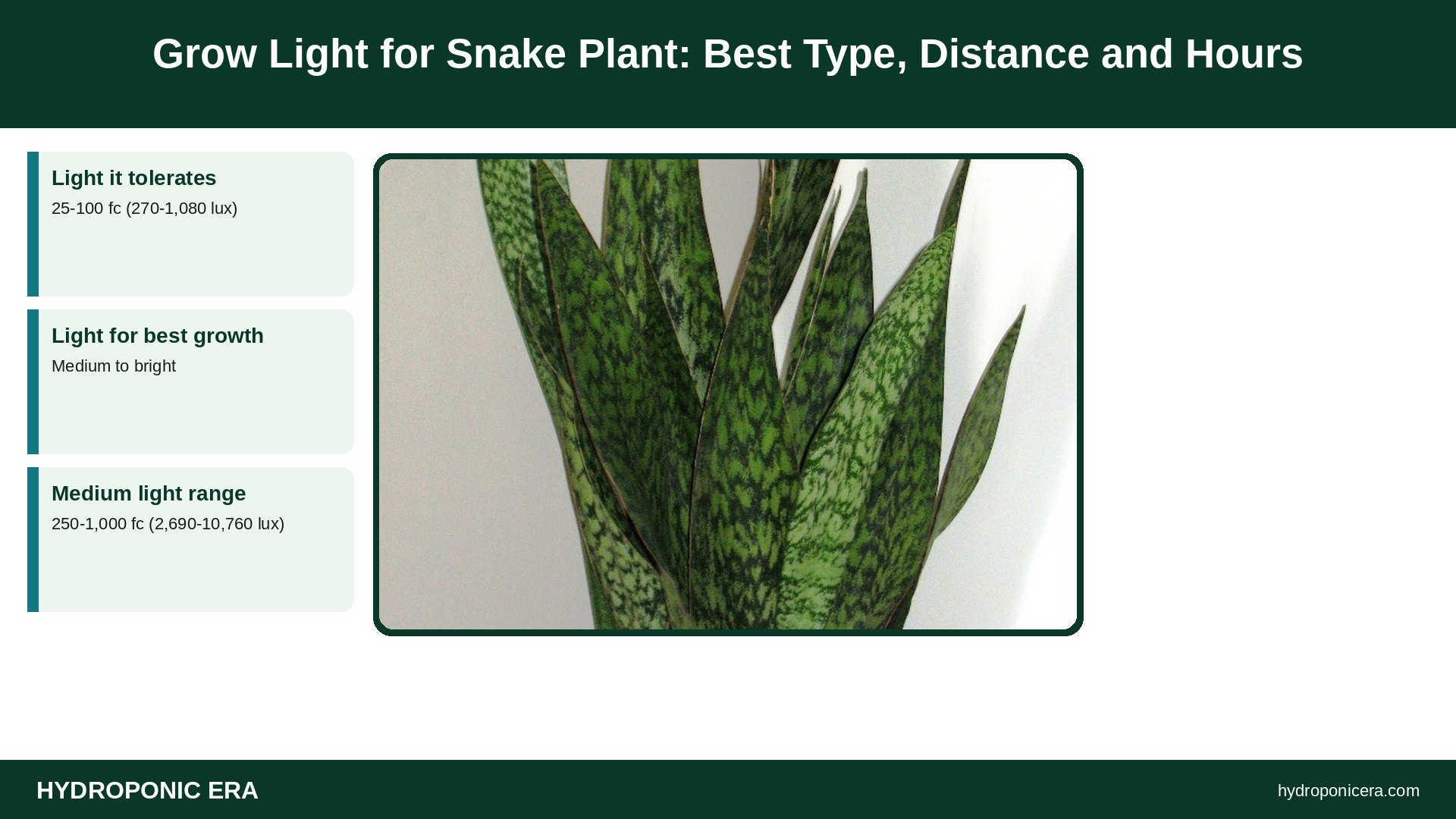
Does a snake plant need a grow light? Not to survive, but it grows better with one. A snake plant tolerates 25 to 100 foot-candles (270 to 1,080 lux) yet grows best in medium to bright light. A grow light for snake plant care works well at 12 to 24 in (30 to 61 cm) for 10 to 14 hours.
Key takeaway: Snake plants have a reputation for living in dark corners, and they can. But a plant that only survives makes few new leaves, leans and can rot when watered like a growing plant. This guide uses Missouri, Maryland, Clemson, Iowa State and NC State guidance to set up a grow light for snake plant growth.
| Setting | Target | Source |
|---|---|---|
| Light it tolerates | 25-100 fc (270-1,080 lux) | Maryland Extension |
| Light for best growth | Medium to bright | Missouri Extension |
| Medium light range | 250-1,000 fc (2,690-10,760 lux) | Missouri Extension |
| LED distance | 12-24 in (30-61 cm) | Iowa State |
| Daily hours | 12-14 h; min 10, max 16 | Iowa State |
| Lowest safe temperature | About 50°F (10°C) | NC State |
| Winter watering | Every 1-2 months | NC State |
Does a Snake Plant Need a Grow Light Indoors?
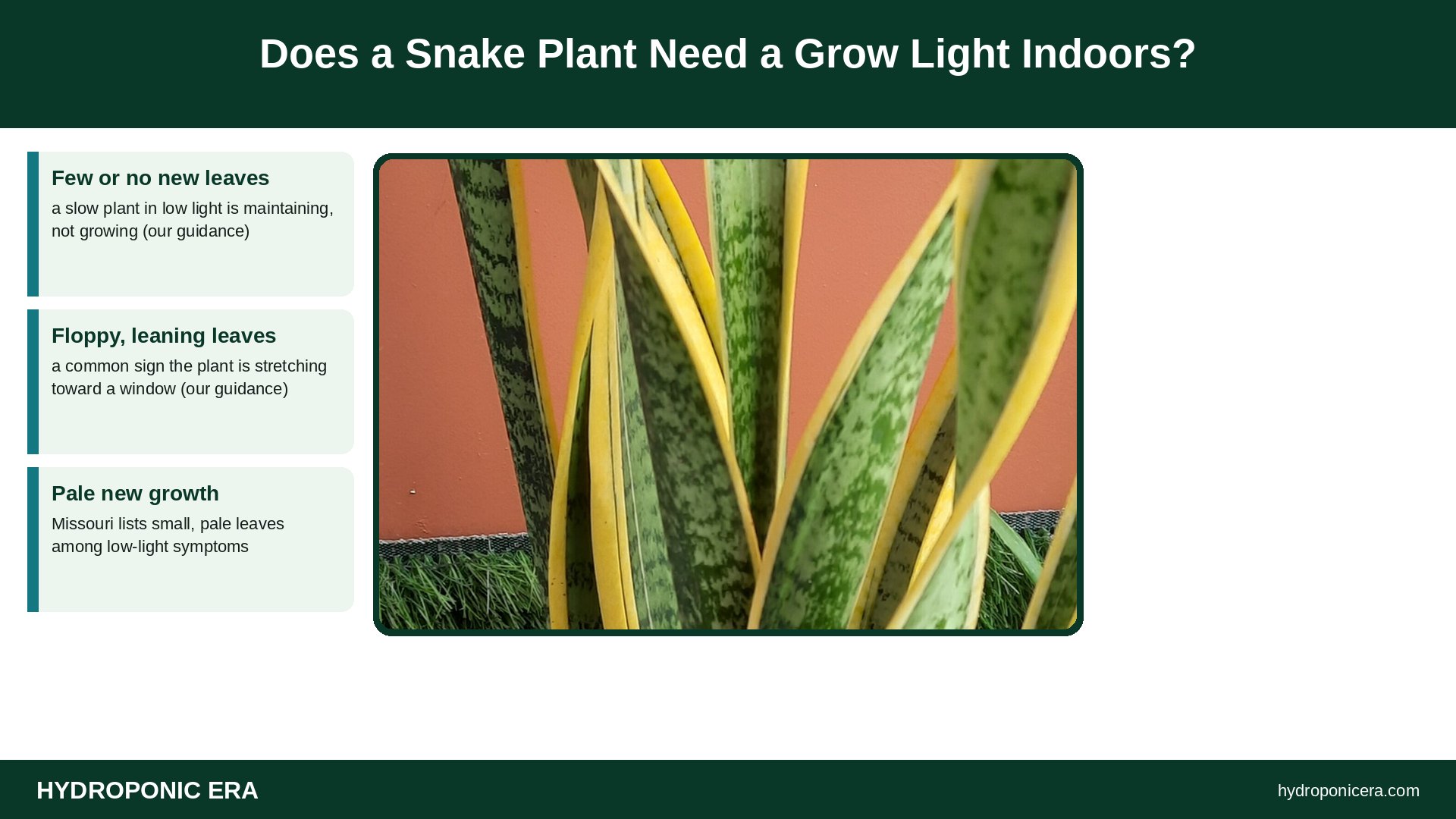
It does not need one, but it benefits. Maryland Extension places snake plant in its low-light group, 25 to 100 foot-candles (about 270 to 1,080 lux), and Clemson lists Sansevieria trifasciata as a low-light plant. NC State’s plant toolbox, which now lists it as Dracaena trifasciata, says it tolerates very low light and can also take 2 to 6 hours of direct sun.
Missouri Extension draws the key line: Sansevieria tolerates poor light but grows best in medium to bright light. That is the case for a grow light for snake plant pots in dim rooms.
- Few or no new leaves: a slow plant in low light is maintaining, not growing (our guidance).
- Floppy, leaning leaves: a common sign the plant is stretching toward a window (our guidance).
- Pale new growth: Missouri lists small, pale leaves among low-light symptoms.
Low light also slows water use. Dark corners plus regular watering is a classic path to root rot, which NC State names as the main risk of overwatering. A grow light for snake plant pots helps the plant use the water you give it.
How Far Should a Grow Light Be From a Snake Plant?
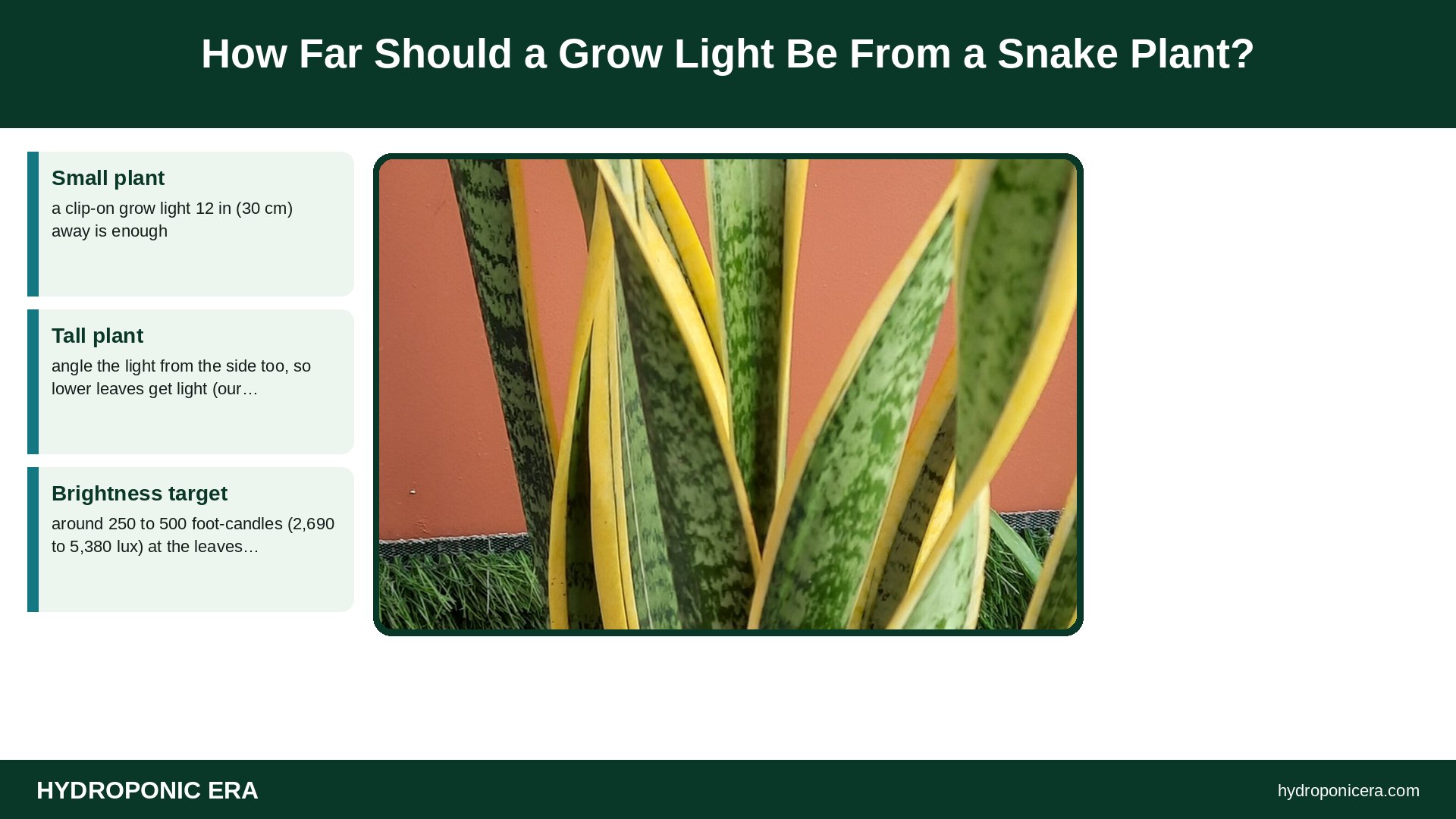
Hang a grow light for snake plant pots, if it is an LED, about 12 to 24 in (30 to 61 cm) above the leaf tips, as Iowa State advises for LED fixtures. Use 6 to 12 in (15 to 30 cm) for fluorescent tubes. Missouri’s table shows a fluorescent fixture giving 260 to 600 foot-candles at 1 ft (30 cm) but only 110 to 330 at 2 ft (61 cm), so distance changes brightness a lot.
- Small plant: a clip-on grow light 12 in (30 cm) away is enough.
- Tall plant: angle the light from the side too, so lower leaves get light (our guidance).
- Brightness target: around 250 to 500 foot-candles (2,690 to 5,380 lux) at the leaves gives good growth (our guidance, inside Missouri’s medium range).
Snake plants handle strong light better than most houseplants, since NC State lists 2 to 6 hours of direct sun. Still, Clemson warns that sudden jumps in light can bleach leaves, so move a grow light for snake plant pots closer in steps. Compare readings with our lux to PPFD conversion guide.
How Many Hours of Grow Light Does a Snake Plant Need?
Run a grow light for snake plant pots 10 to 14 hours a day. Iowa State recommends 12 to 14 hours for most indoor plants, with a minimum of 10 and a maximum of 16. Maryland Extension also says plants should get no more than 16 hours of light in total.
- Dark room with no window: 12 to 14 hours.
- Room with a north or east window: 10 to 12 hours as a top-up (our guidance).
- Use a plug-in timer so the dark period stays regular.
- Never run the light 24 hours; plants need darkness.
Missouri suggests 16 to 18 hours when plants get no outdoor light, but a slow grower like snake plant does fine with less (our guidance). See our hydroponic light schedule guide for timer tips.
Should You Change Watering Under a Grow Light?
Yes, a little. More light means more growth and faster drying, but snake plant is still a succulent-like plant. NC State says to let the soil dry between waterings from spring to autumn and to water only every 1 to 2 months in winter. Under a grow light for snake plant pots, check the soil every 2 weeks and water when it is dry most of the way down (our guidance).
- Pot: use one with a drainage hole and a gritty mix (our guidance).
- Temperature: NC State says it tolerates about 50°F (10°C); keep it above that.
- Pests: NC State lists mealybugs and spider mites.
Which Grow Light for Snake Plant Pots Works Best?
A full-spectrum white LED is the simplest grow light for snake plant pots. It runs cool, fits a living room and covers the light colors plants use (our guidance). Clemson advises against incandescent bulbs because they make plants leggy. A shelf of plants can share LED strip grow lights, and the same light works for cacti, as in our grow lights for succulents guide. Rooting a leaf? See snake plant in water.
FAQ About a Grow Light for Snake Plant Care
Can a grow light for snake plant care replace a window?
Yes; 10 to 14 hours of LED light at 12 to 24 in (30 to 61 cm) is enough.
Is a grow light for snake plant pots worth it in winter?
Yes, if new leaves stall or the plant leans toward a window.
Can snake plants get too much grow light?
Sudden strong light can bleach leaves; raise the lamp and adjust slowly.
Do regular LED bulbs work for snake plants?
A bright white LED close to the plant helps; a grow light covers more area.
Should a grow light run all night?
No; keep total light to 16 hours or less.
Will a grow light make my snake plant flower?
Sometimes; older, well-lit plants can bloom, though it is not guaranteed (our guidance).
Sources
- University of Missouri Extension — G6515: Lighting Indoor Houseplants
- University of Maryland Extension — Lighting for Indoor Plants
- Clemson Cooperative Extension — HGIC 1450: Indoor Plants – Cleaning, Fertilizing, Containers & Light Requirements
- Iowa State University Extension — How to Set Up Supplemental Lights for Indoor Plants
- NC State Extension — Dracaena trifasciata (Plant Toolbox)
- Photo credits (Wikimedia Commons, edited with titles): Sansevieria in pot by Mokkie (Public domain); Snake Plant (Dracaena trifasciata) by Prathvi Acharya (CC BY-SA 4.0)