
Can you grow longevity spinach hydroponically? Yes. Longevity spinach hydroponics has strong research support. A Korean study grew *Gynura procumbens* by drip into vermiculite at pH 6.0 to 7.0 and EC 1.0 to 2.0 dS/m, and a 2025 aquaponics trial found deep water culture gave the highest yield. Stem cuttings root in about four weeks.
Key takeaway: Longevity spinach hydroponics is a good fit for anyone who wants a fast, leafy perennial green indoors. *Gynura procumbens*, also called sambung nyawa, is a tropical Asian medicinal plant that a 2020 *Korean Journal of Soil Science and Fertilizer* paper describes as widely used in traditional medicine in Malaysia, Indonesia, Thailand, China and Vietnam.
| Factor | Longevity Spinach Target | Source |
|---|---|---|
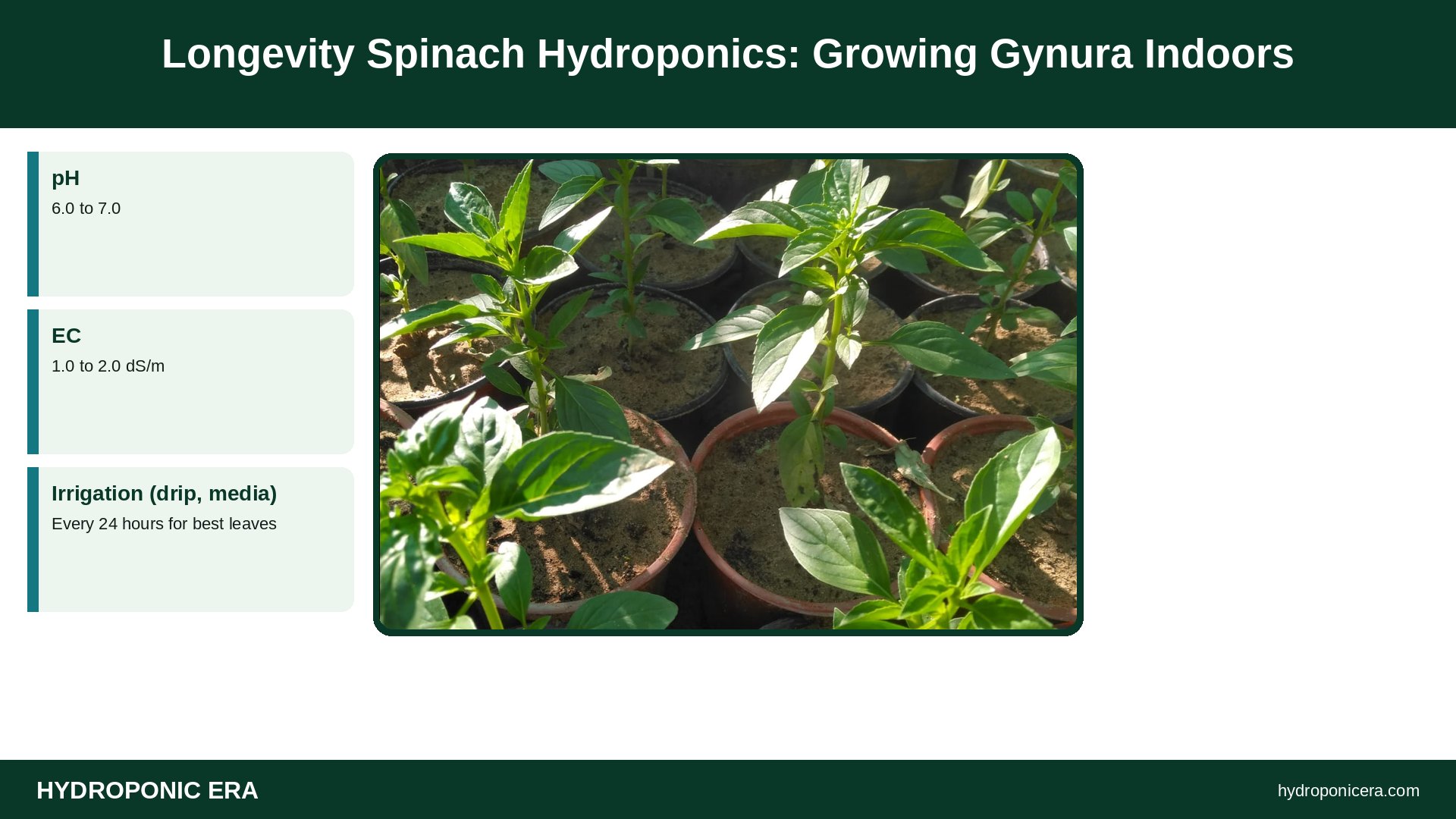
| pH | 6.0 to 7.0 | Korean J. Soil Sci. Fert., 2020 |
| EC | 1.0 to 2.0 dS/m | Korean J. Soil Sci. Fert., 2020 |
| Irrigation (drip, media) | Every 24 hours for best leaves | Korean J. Soil Sci. Fert., 2020 |
| Shade | 35% shade net best overall | Korean J. Soil Sci. Fert. (shading study) |
| Best aquaponic method | Deep water culture | Environmental Quality Management, 2025 |
| Best rooting medium (still system) | Rockwool | Jurnal Biosains, 2020 |
| Cutting to measurable growth | 28 days | Jurnal Biosains, 2020 |
Can You Grow Longevity Spinach Hydroponically?
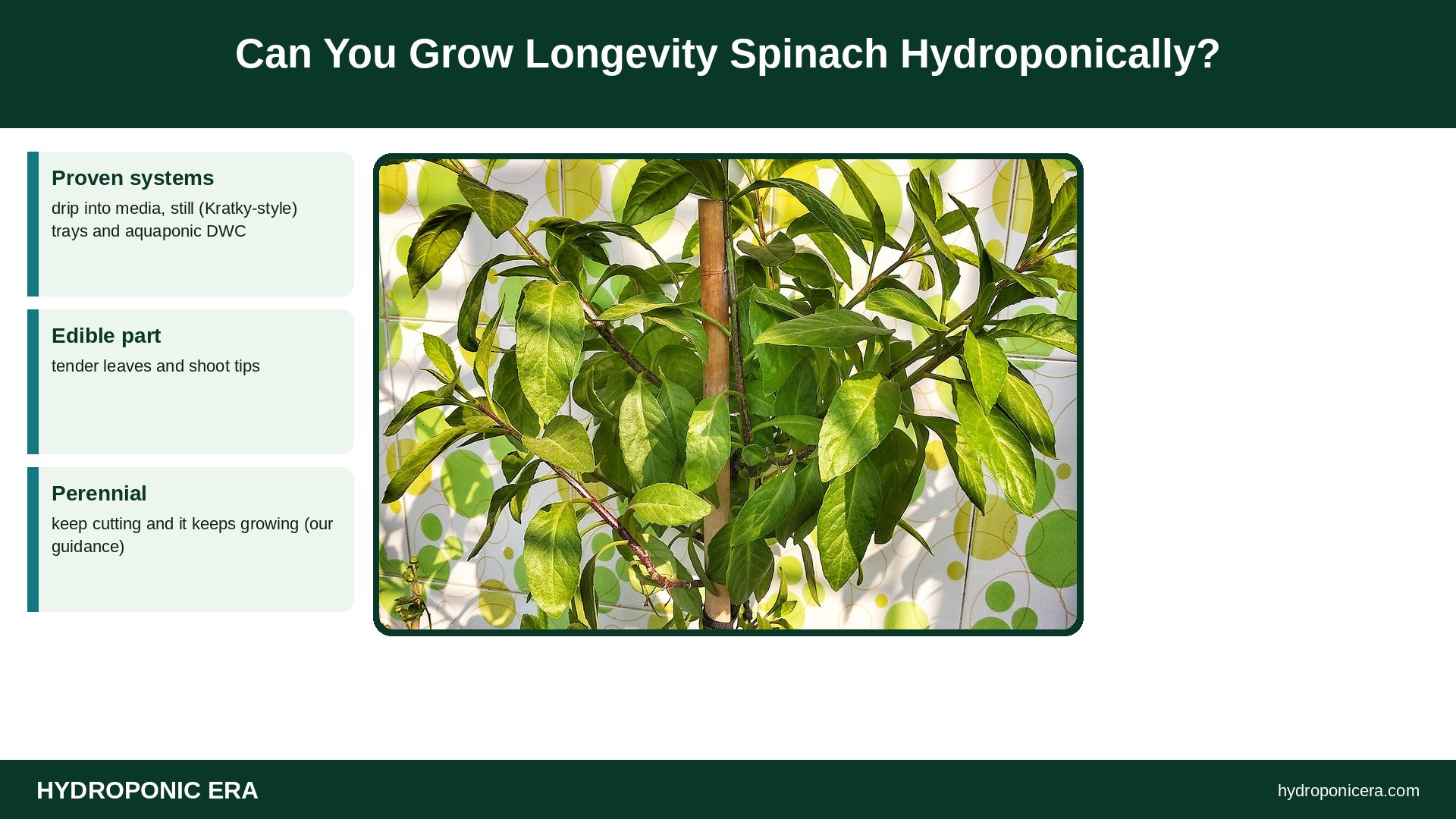
Yes. Three studies show longevity spinach hydroponics works. Korean researchers grew it by drip hydroponics in vermiculite, an Indonesian team grew cuttings in a non-circulating system, and a 2025 *Environmental Quality Management* trial grew it alongside tilapia in backyard aquaponics. In the Indonesian work, every hydroponic substrate beat soil for growth.
- Proven systems: drip into media, still (Kratky-style) trays and aquaponic DWC.
- Edible part: tender leaves and shoot tips.
- Perennial: keep cutting and it keeps growing (our guidance).
- Related greens: Malabar spinach and New Zealand spinach, which also handle heat.
What pH, EC and Temperature Does Hydroponic Longevity Spinach Need?
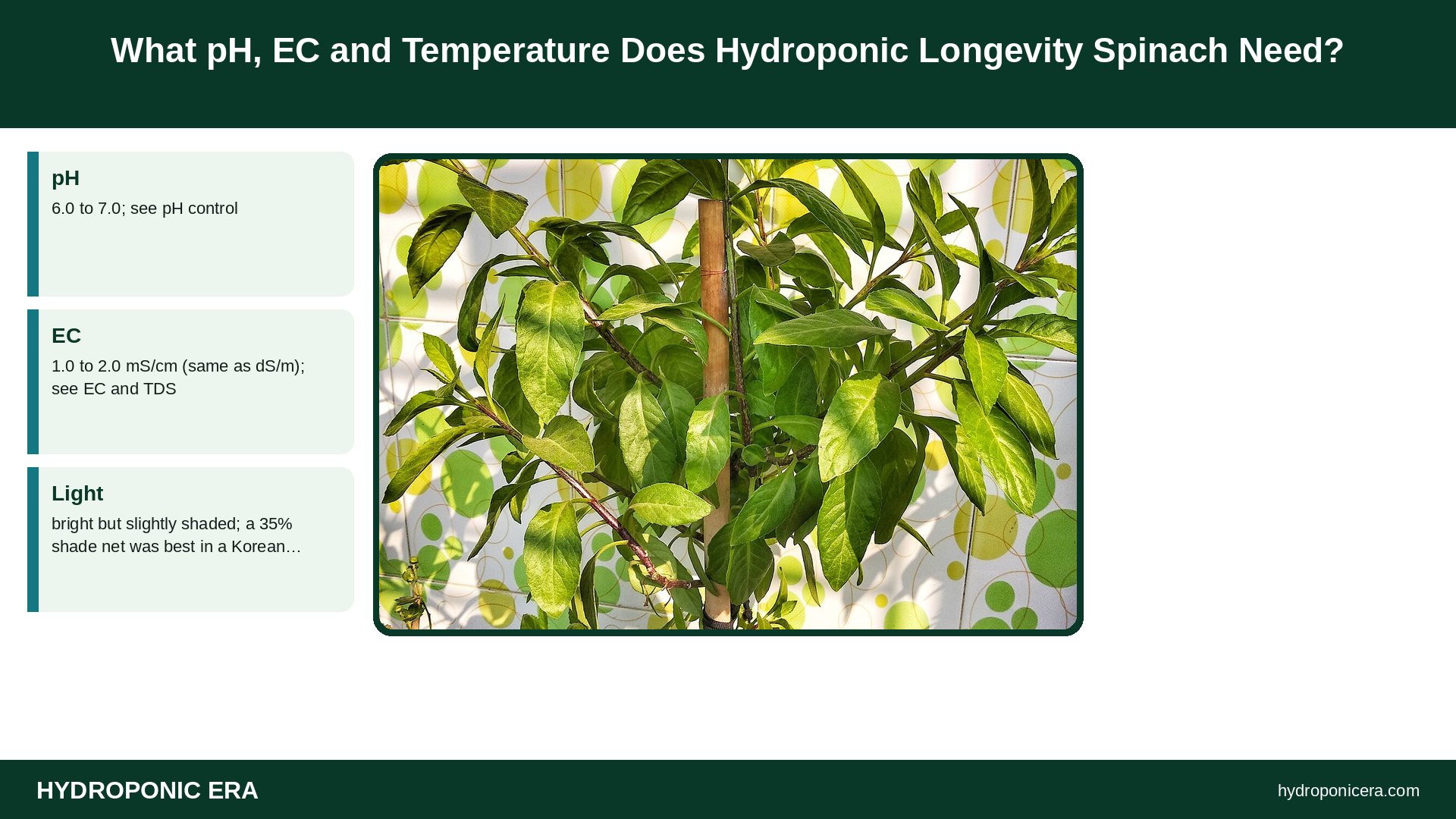
Keep pH at 6.0 to 7.0 and EC at 1.0 to 2.0 dS/m, the range in the 2020 Korean study. That mild feed means longevity spinach hydroponics runs on a standard leafy-green nutrient. It is a tropical plant, so keep air at 70 to 90°F (21 to 32°C) and never below 60°F (16°C) (our guidance).
- pH: 6.0 to 7.0; see pH control.
- EC: 1.0 to 2.0 mS/cm (same as dS/m); see EC and TDS.
- Light: bright but slightly shaded; a 35% shade net was best in a Korean shading study.
- Temperature: warm, humid conditions; protect from cold drafts (our guidance).
The shading study found height rose with heavier shade, up to 63 in (159.5 cm) at 75% shade, but roots shrank, so do not over-shade.
How Do You Start Longevity Spinach From Cuttings?
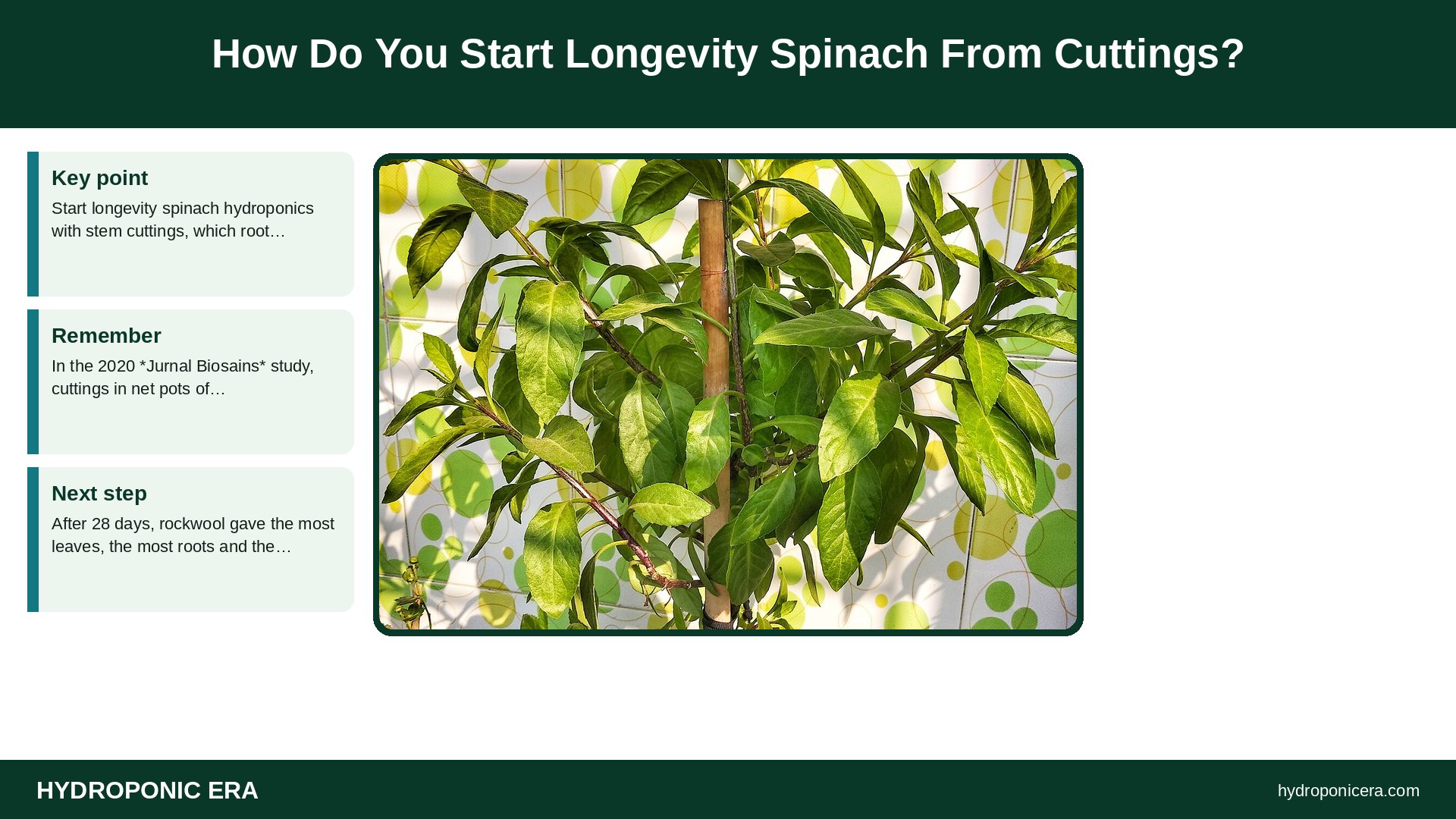
Start longevity spinach hydroponics with stem cuttings, which root easily. In the 2020 *Jurnal Biosains* study, cuttings in net pots of rockwool, tree fern fiber or sawdust sat with the bottom 0.8 in (2 cm) in AB mix nutrient at 6 ml per liter. After 28 days, rockwool gave the most leaves, the most roots and the highest fresh weight.
- Cut 4 to 6 in (10 to 15 cm) tips with two or three nodes (our guidance).
- Strip the lower leaves.
- Set cuttings in rockwool cubes in net pots.
- Keep the bottom 0.8 in (2 cm) of the pot in nutrient, as in the study.
- Move rooted plants into your main system after about four weeks.
This is the simplest way to start longevity spinach hydroponics; see the Kratky method for still systems.
Which System Works Best for Longevity Spinach Hydroponics?
Deep water culture is the best tested choice for longevity spinach hydroponics. In the 2025 aquaponics trial, DWC beat media beds and NFT, with growth about four times that of the other grower types over 8 weeks, while water stayed suitable for hybrid tilapia. For media systems, the Korean team found a 24-hour drip cycle gave the best leaf size, weight and marketability.
- DWC: add an air stone; see deep water culture for beginners.
- Aquaponics: pairs well with tilapia aquaponics.
- Media beds: vermiculite or coco with daily drip.
- Kratky: works for cuttings and small plants.
How Long Does Hydroponic Longevity Spinach Take to Harvest or Bloom?
Expect first light harvests about 6 to 8 weeks after rooting (our guidance). The 2025 aquaponics trial ran 8 weeks to measure yield. Longevity spinach hydroponics rewards frequent picking: cut shoot tips above a node and side shoots follow. Flowers appear less often indoors and are not the harvest (our guidance).
- First cut: when plants have 10 to 15 leaves (our guidance; rooted cuttings had about 15 at 28 days).
- Regular picks: every 2 to 3 weeks (our guidance).
- Quality trade-off: the Korean study found longer 72-hour drip cycles raised polyphenols and vitamin C but cut yield.
- Use: eat leaves raw in salads or lightly cooked.
What Problems Should Longevity Spinach Growers Watch For?
Legginess and root stress are the most common longevity spinach hydroponics problems. The shading study showed that heavy shade made plants taller but weakened roots. The irrigation study found yield dropped as irrigation intervals got longer. In DWC, warm water holds less oxygen, so aerate well (our guidance).
- Leggy stems: reduce shade or add light; pinch tips.
- Small leaves: check EC and keep it near 1.0 to 2.0.
- Root rot: see pythium root rot.
- Aphids and mites: check leaf undersides weekly (our guidance).
FAQ About Longevity Spinach Hydroponics
Is longevity spinach real spinach?
No; it is *Gynura procumbens*, an unrelated tropical leafy plant.
What pH does longevity spinach need?
6.0 to 7.0, per a Korean hydroponic study.
What EC is best?
1.0 to 2.0 dS/m (mS/cm).
Which system is best for longevity spinach hydroponics?
Deep water culture, in a 2025 aquaponics trial.
How do I propagate it?
Stem cuttings in rockwool root within about four weeks.
Does longevity spinach hydroponics need full sun?
Light shade is better; 35% shade performed best in one study.
Sources
- Korean Journal of Soil Science and Fertilizer, 2020 — Effect of Irrigation Frequency on Growth and Functional Ingredient Contents of Gynura procumbens Cultivated in Hydroponics System
- Korean Journal of Soil Science and Fertilizer — Effect of Shading on Growth and Functional Ingredient Contents of Gynura procumbens Cultivated in Hydroponics System
- Environmental Quality Management, 2025 — Evaluation of Hydroponic Methods for Cultivation of Gynura procumbens (Longevity Spinach) in an Aquaponic System
- Jurnal Biosains, 2020 — Effect of Various Substrates in Non-Circulating Hydroponic Systems and Soil Media on the Growth of Gynura procumbens
- Photo credits (Wikimedia Commons, edited with titles): Gynura procumbens by AbasoloaileenND (CC BY-SA 4.0); Gynura procumbens (Diabetes plant) (1) by Shahidul Hasan Roman (CC BY-SA 4.0)