
Does an alocasia need a grow light indoors? Usually, yes. A grow light for alocasia plants fills the gap between dim rooms and the dappled light this tropical plant prefers. Aim for about 500 to 1,000 foot-candles (5,380 to 10,760 lux), with an LED 12 to 24 in (30 to 61 cm) away for 12 to 14 hours.
Key takeaway: Alocasias are sold as houseplants, but in the wild they grow under a tropical canopy with far more light than a typical living room. When light runs short, leaves yellow, stems stretch and the plant may sulk. This guide uses NC State, Florida State Horticultural Society, Clemson, Iowa State and Maryland guidance to set up a grow light for alocasia growth.
| Setting | Target | Source |
|---|---|---|
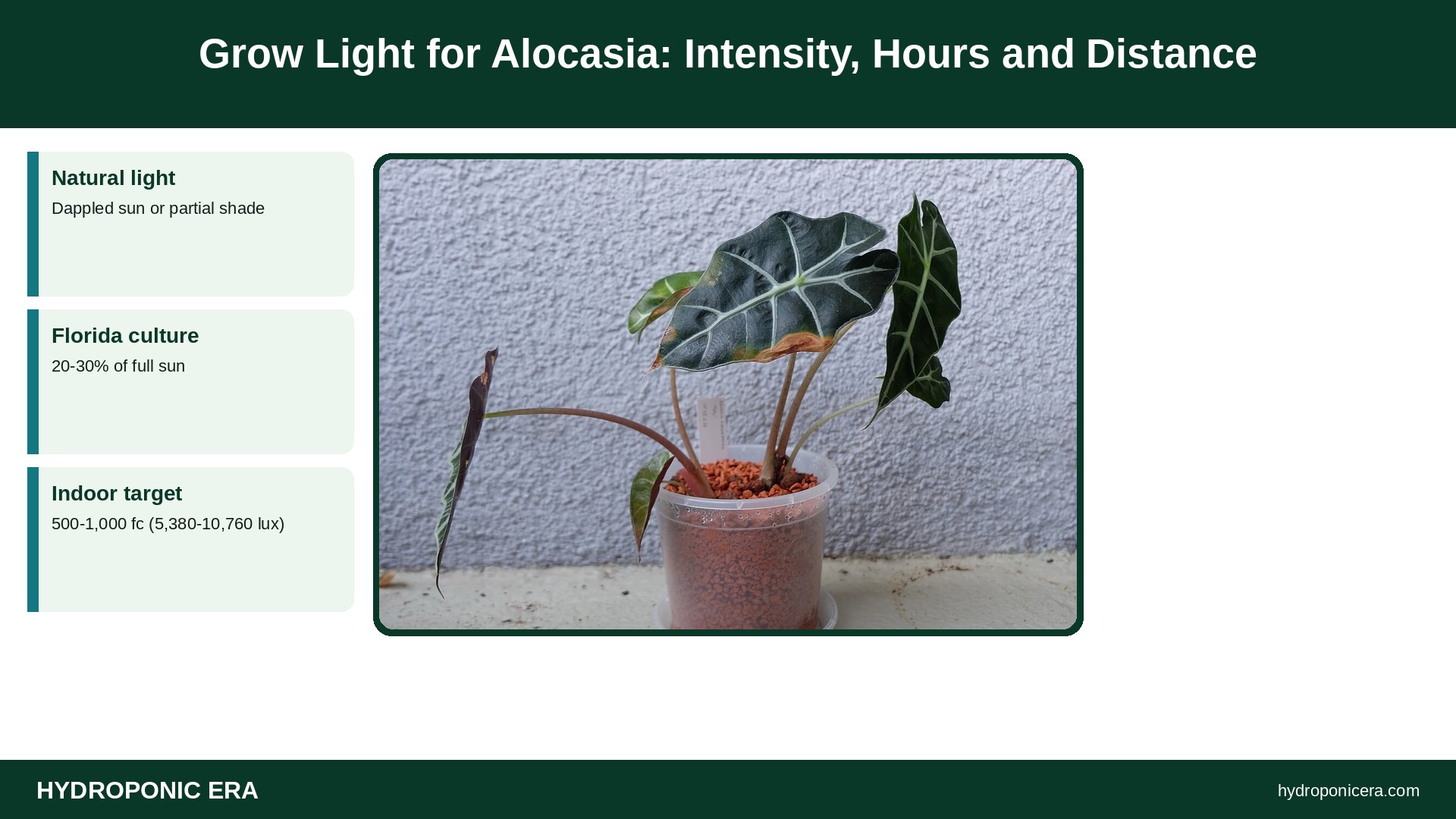
| Natural light | Dappled sun or partial shade | NC State |
| Florida culture | 20-30% of full sun | Reark, Proc. FSHS 1953 |
| Indoor target | 500-1,000 fc (5,380-10,760 lux) | Our guidance |
| Indoor minimum | About 150 fc (1,610 lux) | NC State acclimatization |
| LED distance | 12-24 in (30-61 cm) | Iowa State |
| Daily hours | 12-14 h, max 16 | Iowa State; Maryland |
| Best temperature | 68-77°F (20-25°C) | NC State |
Does an Alocasia Need a Grow Light Indoors?
In most homes, yes. NC State’s plant toolbox lists alocasia for dappled sunlight or partial shade, with 2 to 6 hours of direct sun. A 1953 paper in the Proceedings of the Florida State Horticultural Society, on growing alocasias in Florida, said light given should be 20 to 30% of full sun. Maryland Extension puts full sun near 10,000 foot-candles (107,600 lux), so that is roughly 2,000 to 3,000 foot-candles (21,500 to 32,300 lux) in a Florida shade house.
Indoors, Clemson says even a well-lit room is often below 100 foot-candles (1,080 lux). That gap is why a grow light for alocasia plants pays off.
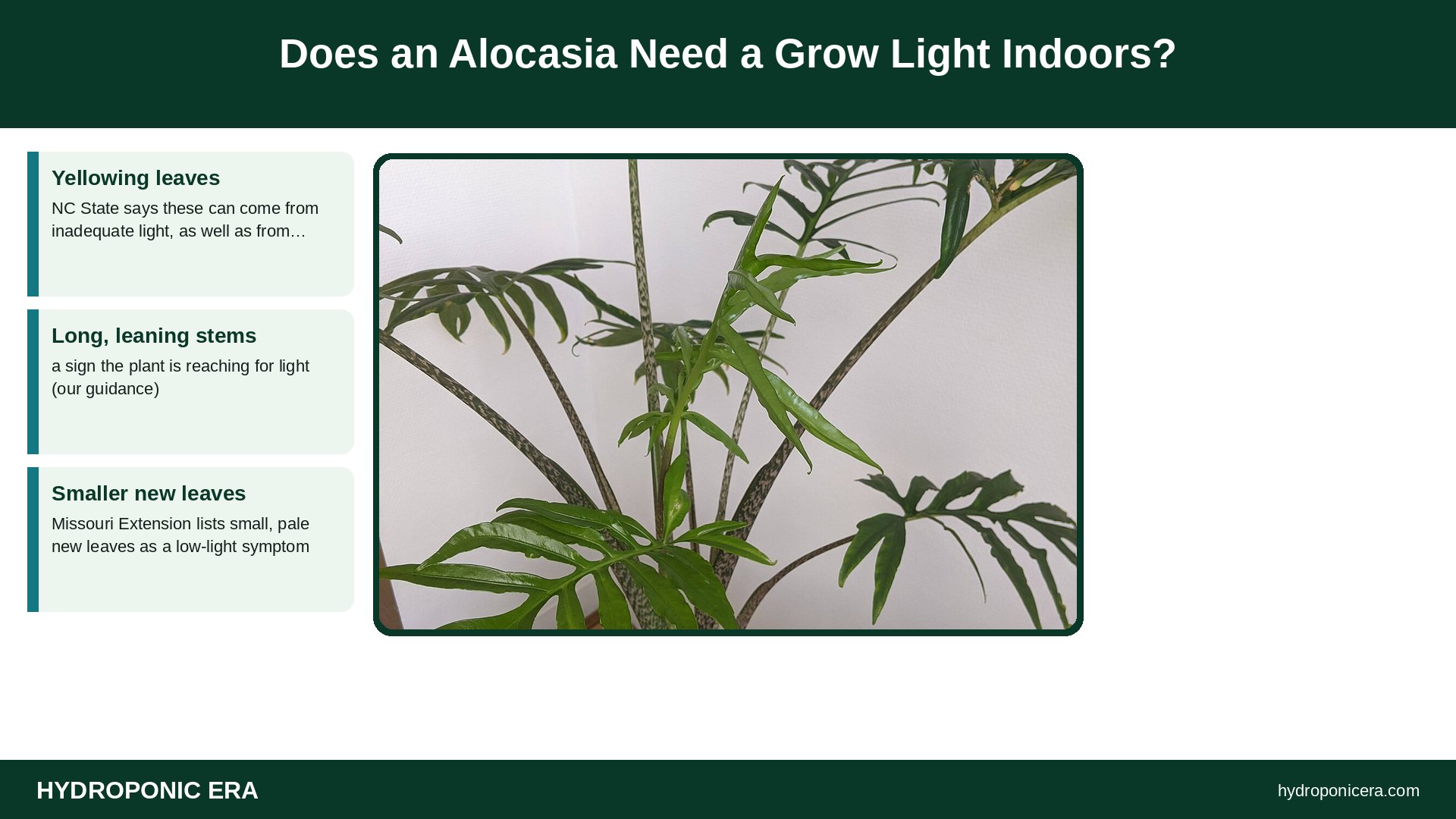
- Yellowing leaves: NC State says these can come from inadequate light, as well as from too much or too little water.
- Long, leaning stems: a sign the plant is reaching for light (our guidance).
- Smaller new leaves: Missouri Extension lists small, pale new leaves as a low-light symptom.
NC State’s acclimatization guide adds a floor: sun-grown foliage plants need at least 150 foot-candles (about 1,610 lux) for 10 to 12 hours indoors.
How Many Hours of Grow Light Does an Alocasia Need?
Run a grow light for alocasia plants 12 to 14 hours a day. Iowa State gives that range for most indoor plants, with a minimum of 10 hours and a maximum of 16. Maryland Extension also says plants should get no more than 16 hours of light in total, and Clemson says 16 hours of light and 8 of darkness suits most plants.
- No window light: 14 hours.
- Some window light: 12 hours (our guidance).
- Set the lamp on a plug-in timer.
- Keep at least 8 hours of darkness each night.
In winter, NC State advises reducing water. Many alocasias slow down or drop leaves in cool, dark months, and a grow light for alocasia pots can keep them growing if the room stays warm (our guidance). For timer tips, see our hydroponic light schedule guide.
How Far Should the Grow Light Be From an Alocasia?
Hang an LED 12 to 24 in (30 to 61 cm) above the top leaf, as Iowa State recommends for LED fixtures. Fluorescent tubes go closer, at 6 to 12 in (15 to 30 cm). Alocasia leaves can reach 12 to 36 in (30 to 91 cm) long, per NC State, so a single small bulb rarely covers a big plant (our guidance).
- Small alocasia, such as ‘Polly’: a clip-on grow light 12 in (30 cm) away.
- Large alocasia: a hanging LED panel or two lights from different angles (our guidance).
- Check brightness: a phone light meter app gives a rough reading; see our lux to PPFD conversion.
Change light slowly. Clemson warns that sudden jumps in light can bleach or scald leaves. Start a grow light for alocasia pots at the far end of the range and move it closer over 2 to 3 weeks (our guidance).
What Else Does an Alocasia Need Under Lights?
Warmth and steady moisture matter as much as a grow light for alocasia plants. NC State says alocasia grows best at daytime temperatures of 68 to 77°F (20 to 25°C). The Florida paper warned that temperatures below 50°F (10°C) are harmful and below 40°F (4°C) injurious, and that plants should never dry out.
- Soil: NC State suggests moist, well-drained, humus-rich soil; root rot follows overwatering.
- Feeding: NC State says to water and fertilize regularly in the growing season.
- Humidity: a grow light dries leaves faster, so group plants or use a tray of wet pebbles (our guidance).
- Toxicity: NC State lists calcium oxalate crystals in all parts; keep away from pets.
More light means faster growth, so check the soil more often once a grow light for alocasia pots is running (our guidance).
Which Grow Light for Alocasia Plants Works Best?
A full-spectrum white LED is the easiest grow light for alocasia pots. It runs cool near big leaves and looks natural in a room (our guidance). A shelf of small plants can share LED strip grow lights. The setup mirrors our grow lights for monstera guide, since both are large-leaved aroids. Clemson advises against incandescent bulbs because they make plants leggy. Propagating from corms? See alocasia in water.
FAQ About a Grow Light for Alocasia Plants
Can an alocasia grow only under a grow light?
Yes, with a strong LED 12 to 24 in (30 to 61 cm) away for 12 to 14 hours.
Why are my alocasia leaves yellow under a grow light?
Check water first; NC State links yellowing to water problems as well as low light.
Can a grow light for alocasia pots burn leaves?
Yes, if it is too close or added suddenly; raise it and adjust slowly.
Does an alocasia need a grow light in winter?
It helps most then, when days are short and dim.
How much light is too much?
Bleached or brown patches mean the light is too strong or too close.
Is a grow light for alocasia worth it for small varieties?
Yes; a clip-on LED is cheap and enough for compact types.
Sources
- NC State Extension — Alocasia (Plant Toolbox)
- Proceedings of the Florida State Horticultural Society (1953), J. B. Reark — Cultivation of the Genus Alocasia in Florida (PDF)
- NC State Extension — Acclimatization of Foliage Plants (PDF)
- Clemson Cooperative Extension — HGIC 1450: Indoor Plants – Cleaning, Fertilizing, Containers & Light Requirements
- Iowa State University Extension — How to Set Up Supplemental Lights for Indoor Plants
- University of Maryland Extension — Lighting for Indoor Plants
- University of Missouri Extension — G6515: Lighting Indoor Houseplants
- Photo credits (Wikimedia Commons, edited with titles): Alocasia x amazonica ‘Polly’ by Tim Kortekamp (CC BY-SA 4.0); Alocasia brancifolia as an indoor house plant by Unknown (CC BY-SA 4.0)