
The best hydroponics course for most US beginners is a short university program: the University of Arizona’s online Introduction to Hydroponics ($299, self-paced) or Oregon State’s Introduction to Hydroponics ($285, asynchronous). For careers, look at CEA Works ($500 for four courses) or Arizona’s annual CEA Short Course. None is a license; they build skills.
| Option (checked Oct 8, 2026) | Cost | Format | Best for |
|---|---|---|---|
| University of Arizona: Introduction to Hydroponics | $299 | Online, self-paced; 8 modules, about 8–10 hours | Beginners wanting a university badge |
| Oregon State: Introduction to Hydroponics | $285 | Asynchronous online; 30 continuing education hours | Hands-on home learners (“new dates coming soon”) |
| CEA Works (GLASE, Cornell, Ohio State, SUNY Broome, Agritecture) | $500 for all 4 courses | Online, on-demand | Greenhouse and indoor farm careers |
| UA CEAC Greenhouse Crop Production Short Course | See event page | 3 days in Tucson or live on Zoom | Growers and professionals |
| Free Extension publications | Free | Self-study | Budget learners |
| Build a small system | Low | Hands-on | Everyone |

Do You Need a Hydroponics Course?
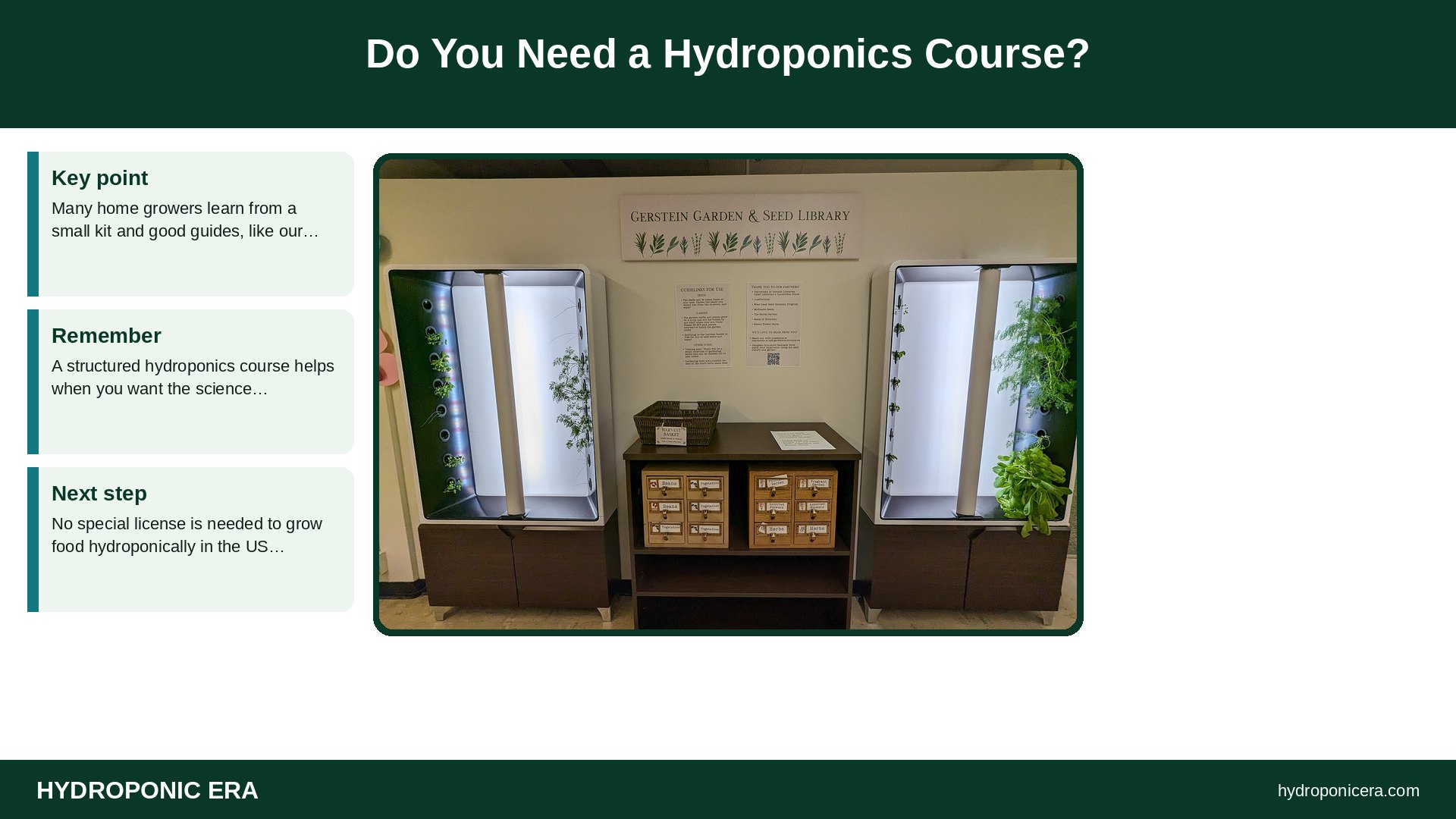
Not to start growing. Many home growers learn from a small kit and good guides, like our Kratky method walkthrough. A structured hydroponics course helps when you want the science behind pH, EC, systems and substrates, when you’re considering a farm, or when you want a credential for a job in greenhouse or indoor agriculture. No special license is needed to grow food hydroponically in the US, though selling produce can involve business, food safety and local rules. A certificate is about skills and credibility, not legal permission.
What Does the University of Arizona Course Cover?
Arizona’s Introduction to Hydroponics costs $299 and runs fully online and self-paced. The course page lists 8 modules: principles of hydroponics, deep water culture and NFT, drip and other systems, common and alternative substrates, and nutrient solutions, including EC, pH, recipes and concentrated stocks. Most learners finish in 8–10 hours. You need 80% on each module quiz, and passing the final exam earns a Digital Badge of Completion from Arizona Online Professional Studies. It’s taught by Dr. Triston Hooks, the hydroponic specialist at Arizona’s Controlled Environment Agriculture Center.
What About Oregon State’s Hydroponics Course?
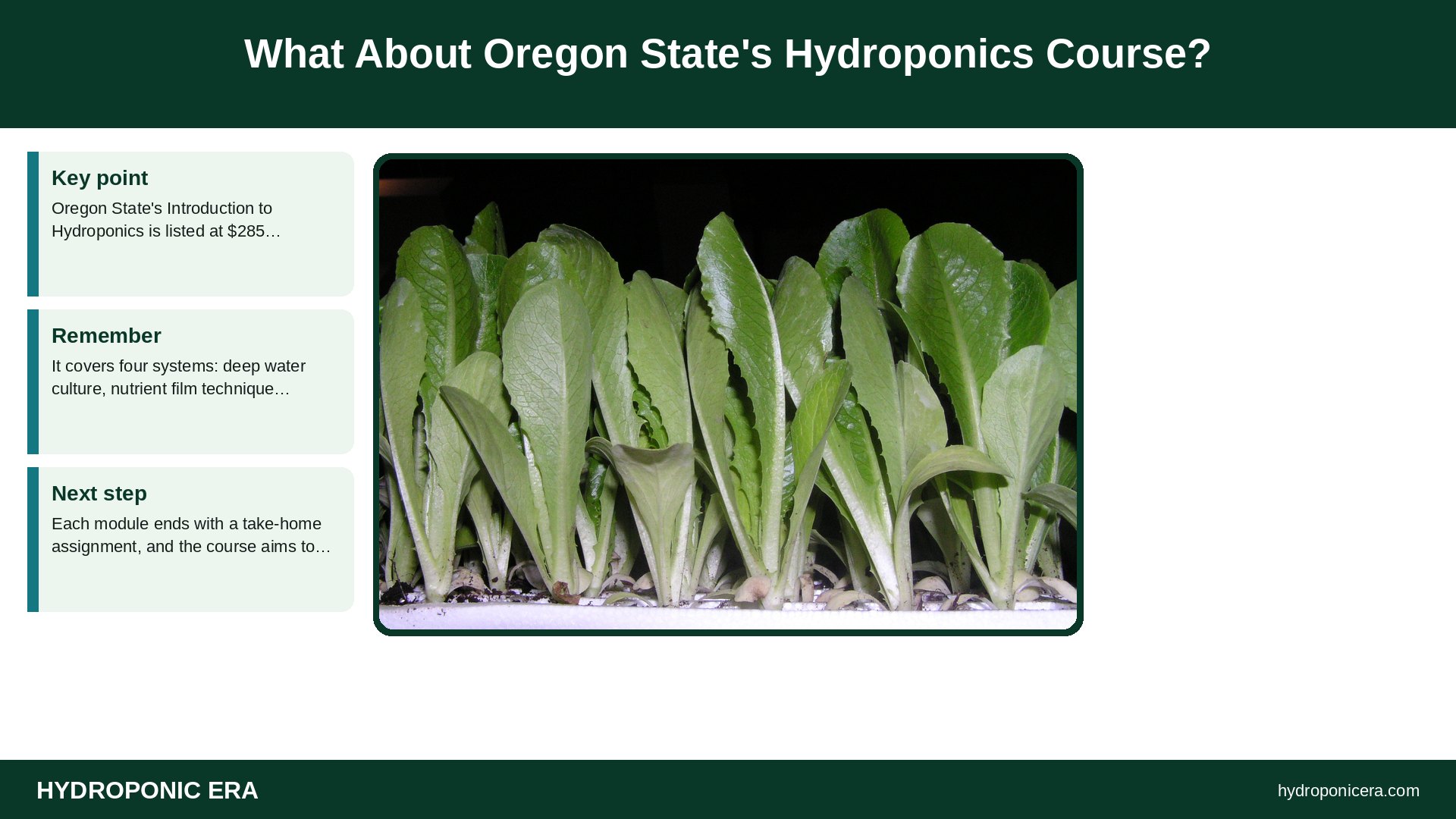
Oregon State’s Introduction to Hydroponics is listed at $285, asynchronous and online, with 30 continuing education hours. It covers four systems: deep water culture, nutrient film technique, buckets and ebb and flow. Each module ends with a take-home assignment, and the course aims to keep hobby-level builds “cheap and accessible.” When we checked, the page said “New dates coming soon,” so this hydroponics course may not be open right away.
Which Hydroponics Course Is Best for a Career?
CEA Works is a USDA NIFA-sponsored program developed with GLASE, Cornell University, SUNY Broome, Ohio State University and Agritecture. It’s building certificates for Head Growers, Assistant Growers and CEA Farm Business Managers. Its first four on-demand courses are Overview of Crop Production in CEA, Plant Physiology of CEA Crops, Root Zone Management, and CEA Business Planning 101, available as a $500 bundle with no prerequisites.
The University of Arizona’s CEAC also runs an annual Greenhouse Crop Production and Engineering Design Short Course. The 25th edition ran April 15–17, 2026 in Tucson, with live Zoom access and hands-on lessons and tours for in-person attendees. Watch the event page for the next date.
How to Choose a Hydroponics Course in 6 Steps
- Define your goal: home garden, small farm or industry job.
- Check who teaches it: a university program or extension service is usually a safer bet than an unknown seller.
- Read the syllabus: look for pH, EC, nutrient management, systems, pests and food safety.
- Confirm format and dates: self-paced, scheduled, or in person.
- Know what you get: a badge, continuing education hours or a certificate.
- Compare cost to your budget: a $300 course plus a $100 starter system beats a $2,000 program you won’t finish.
Those six steps help you pick a hydroponics course that fits your goals and time.
Are There Free Ways to Learn?
Yes. Extension publications are free and research-based. The University of Kentucky’s hydroponic lettuce crop profile covers systems, markets, labor and breakeven costs, and Ohio State offers example hydroponic budgets. Pair free reading with practice: build a small system, keep a log of pH, EC and growth, and learn from mistakes. Our guides to pH control, EC and TDS and mixing nutrient solution make a solid free hydroponics course outline.
What Should a Good Program Teach?
Compare any syllabus against the core skills that decide whether plants thrive. A solid introductory program should cover:
- Systems: deep water culture, NFT, drip, ebb and flow, and when each fits.
- Nutrients: EC, pH, recipes, stock solutions and how to correct drift.
- Substrates: rockwool, coco coir, perlite and their water and air balance.
- Environment: light, temperature, humidity and airflow.
- Plant health: spotting deficiencies, root diseases and pests early.
- Food safety: clean water, sanitation and safe harvest handling, especially if you’ll sell.
Career programs should add crop scheduling, labor planning, record keeping and business math.
What Does a Good 90-Day Learning Plan Look Like?
Here’s a simple plan that pairs study with practice. In month one, finish an introductory program or the free guides above, and set up a small deep water culture or Kratky system with lettuce or basil. In month two, log pH, EC and water temperature every few days, and try one change at a time, such as a different nutrient strength. In month three, grow a second crop, compare results, and decide whether you want to scale up, try a new system, or take an advanced course. By then, you’ll know which topics you need help with.
Is a Hydroponics Certificate Worth It?
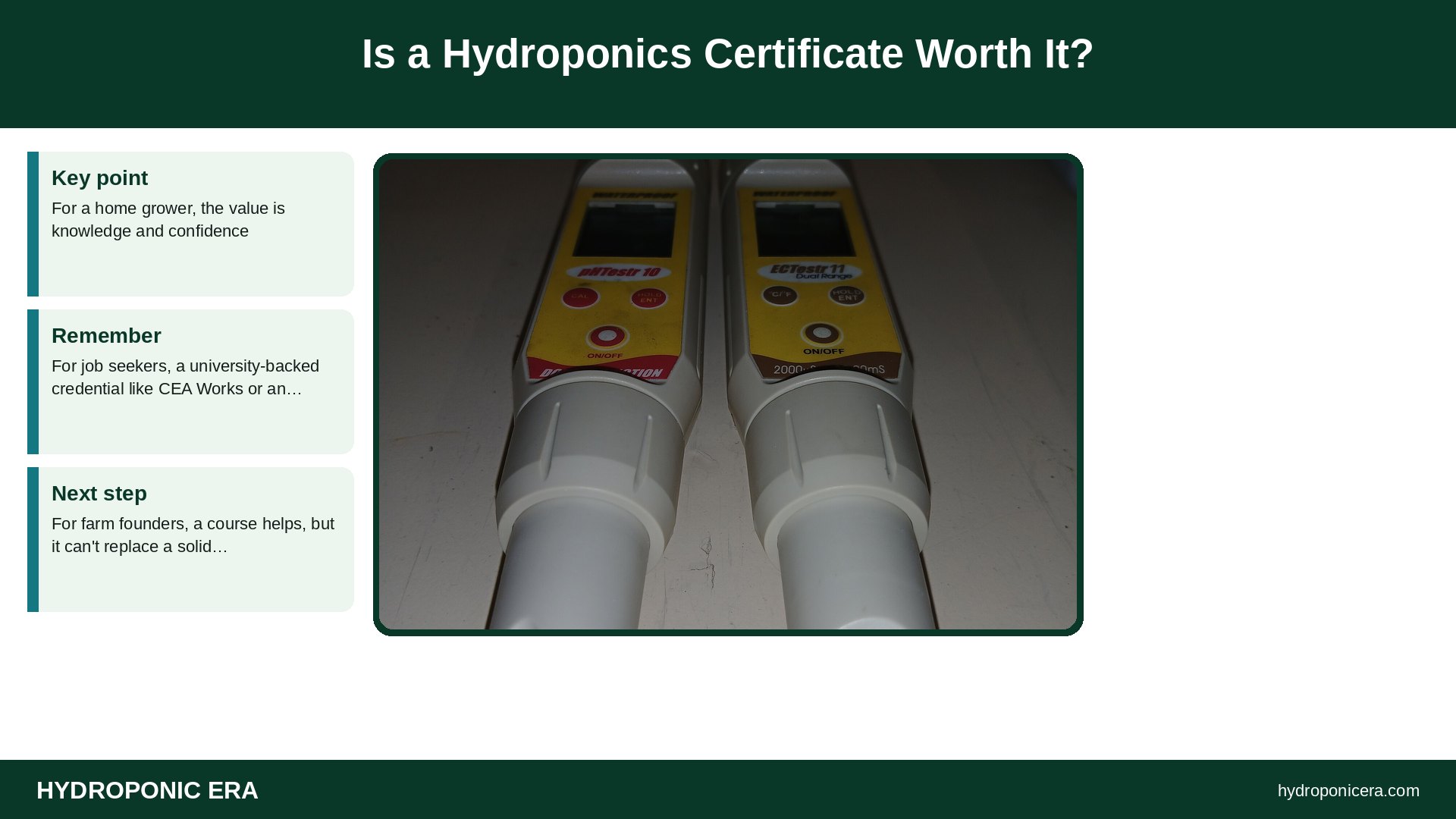
It depends on your goal. For a home grower, the value is knowledge and confidence. For job seekers, a university-backed credential like CEA Works or an Arizona badge can show initiative, but employers still value hands-on growing experience. For farm founders, a course helps, but it can’t replace a solid hydroponic farm business plan and real sales.
Common Mistakes
| Mistake | Better move |
|---|---|
| Believing you need a “hydroponics license” | Growing doesn’t require one; check local rules before selling |
| Choosing on price alone | Check the instructor and syllabus |
| Taking a course without practicing | Grow while you learn |
| Ignoring dates | Confirm enrollment is open |
FAQs: Hydroponics Course
Is there an online hydroponics course from a university?
Yes. The University of Arizona and Oregon State both list online introductory courses.
How long does a hydroponics course take?
Arizona says most learners finish in 8–10 hours; Oregon State lists 30 continuing education hours.
Do I get a certificate?
Arizona awards a digital badge after the final exam. CEA Works is developing technical certificates.
Can I take a hydroponics course for free?
Free Extension publications and guides cover the basics, though they don’t award credentials.
Related HydroponicEra Guides
- How to start a small hydroponic farm
- Hydroponic farm business plan
- How to choose a hydroponic kit
- Hobby vs commercial hydroponics
Sources
- University of Arizona — Introduction to Hydroponics
- Oregon State University — Introduction to Hydroponics
- GLASE — CEA Works
- University of Arizona CEAC — CEA Short Course
- University of Kentucky (2016) — Hydroponic Lettuce, CCD-CP-63 (PDF)
- Ohio State University — Hydroponic Crop Program: Economic Budgets
- Photo credits (Wikimedia Commons, edited with titles): Somers Middle School Planting Native Garden (8952713158) by Forest Service Northern Region from Missoula, MT, USA (Public domain); Gerstein Science Information Centre aeroponics towers by Jason Zhang (CC BY-SA 3.0); Lettuce Plugs by Apapac at English Wikipedia (Public domain); PH- und Leitfähigkeitsmessgeräte by Rotkaeppchen68 (CC0)