
Basil leaves turning black usually point to one of five causes. The most common are cold injury below about 50°F and fridge storage. Downy mildew and bacterial leaf spot (Pseudomonas cichorii) cause black spots too, and thrips damage can look similar. Check the leaf underside, the temperature log and where the spots started. Then fix the cause.
| Clue | Likely cause | First fix |
|---|---|---|
| Leaves blacken after a cold night or in the fridge | Chilling injury (below 50–54°F) | Keep basil warm; store near 55°F |
| Yellow patches between veins, gray-purple fuzz underneath | Downy mildew | Remove plants; grow DMR varieties |
| Water-soaked spots that turn dark | Bacterial leaf spot | Remove leaves; stop splashing |
| Dark specks plus silvery scars | Thrips frass and feeding | Check with a hand lens |
| Wilting with brown streaks in the stem | Fusarium wilt | Discard; sanitize the system |
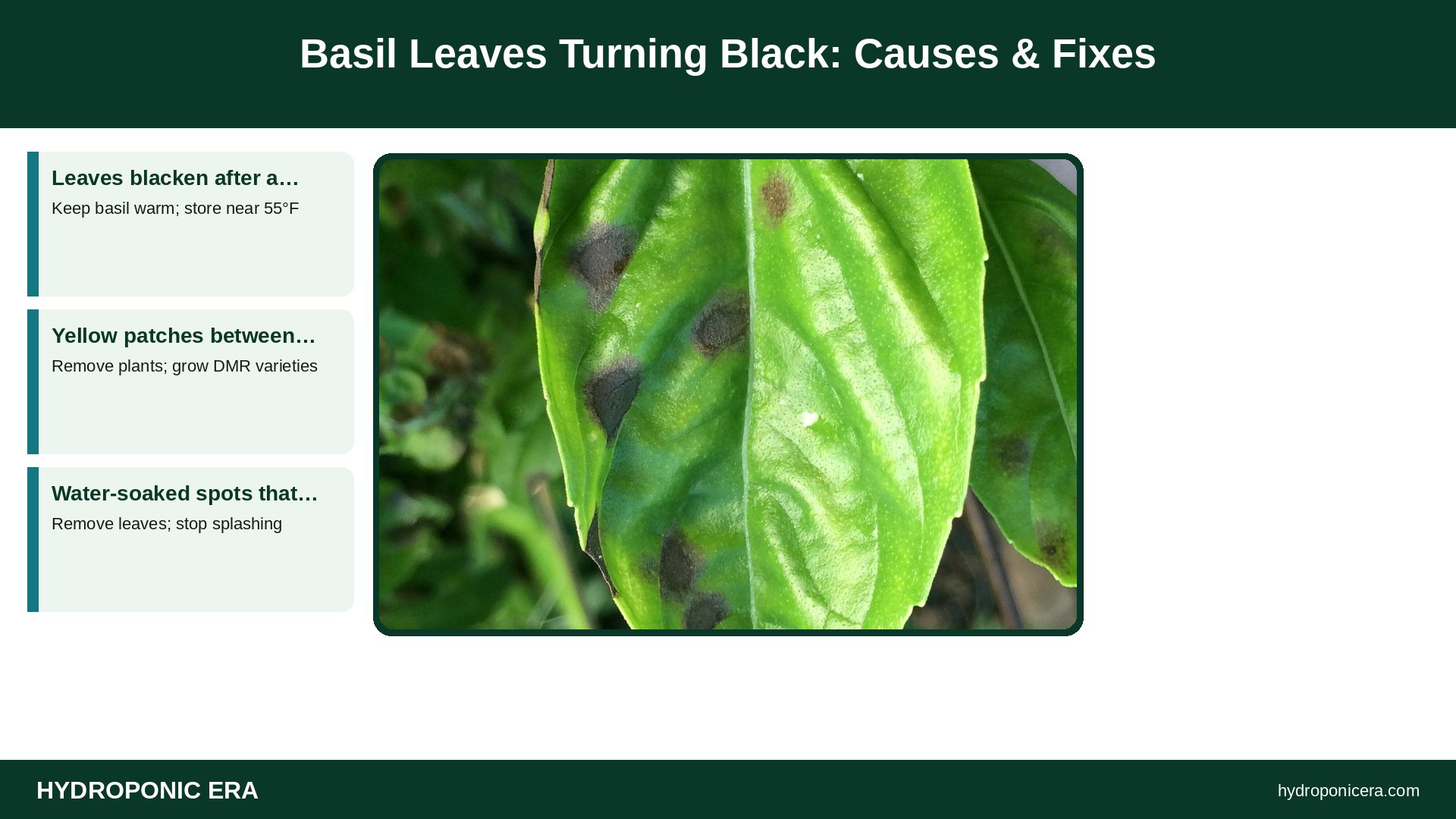
Why Are My Basil Leaves Turning Black?

Basil is a warm-season herb that’s sensitive to cold and humidity, and black leaves are its most common distress signal. Rutgers Cooperative Extension says basil is susceptible to chilling injury, with symptoms including blackening of leaves, stem discoloration and loss of aroma. A 2023 review in Frontiers in Plant Science notes that storage below 54°F injures basil leaves and temperatures below 50°F can cause severe injury.
Disease is the other big group. University of Minnesota Extension describes basil downy mildew as yellowing in areas bounded by major veins, followed by irregular black spots as leaves age, with fluffy gray spores underneath. Bacterial leaf spot and pest damage round out the list. Here’s how to sort out basil leaves turning black, one cause at a time.
Cause 1: Is Cold Injury Turning Basil Leaves Black?
Cold is the top reason for basil leaves turning black indoors. If the blackening appeared after a cool night, a draft, an air-conditioner vent or a cold window, chilling is the likely cause. The damage often shows as dark, glossy or bronzed patches that spread across the leaf, sometimes with wilting. It isn’t contagious and won’t spread from plant to plant.
- Keep the grow area and nutrient solution comfortably warm; see reservoir temperature for hydroponics.
- Move plants away from cold glass and vents in winter.
- Pinch off damaged leaves; new growth should come in clean once conditions improve.
Cause 2: Why Do Basil Leaves Turn Black in the Fridge?
This is the classic case of basil leaves turning black after harvest. Rutgers says the optimal storage temperature for basil is 55°F, and cites UC Davis research showing basil held at 50–68°F for 10 days looked markedly better than basil held at 32°F. A typical home fridge sits at or below 40°F, which is too cold. Store cut basil stems in a glass of water at room temperature away from direct sun, or use it within a day or two. Rutgers recommends 90–95% relative humidity for basil in commercial coolers.
Cause 3: Is It Basil Downy Mildew?
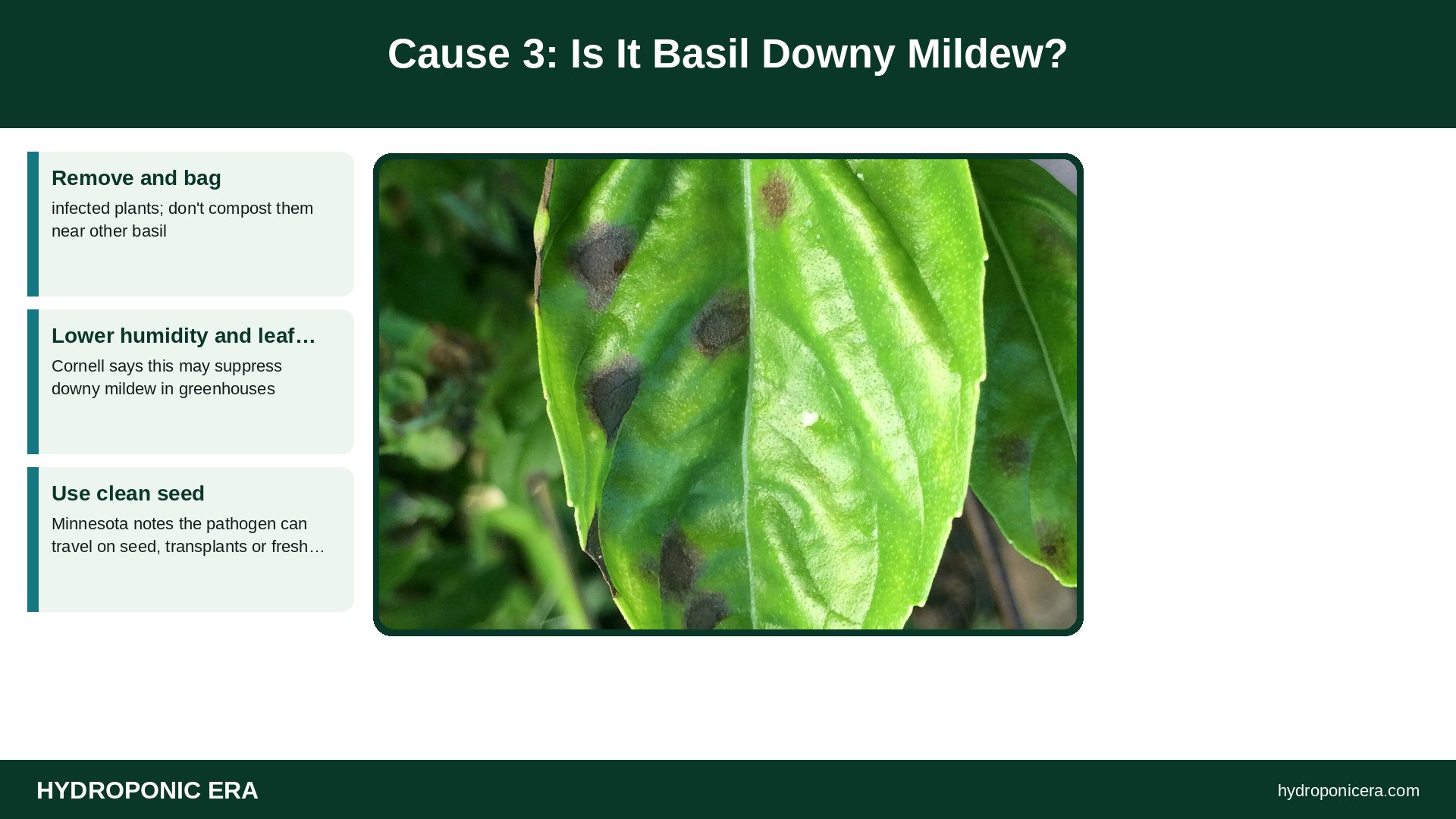
Flip a leaf over; the underside tells you whether basil leaves turning black have a disease cause. Cornell’s vegetable program says the downy mildew pathogen produces purplish-gray spores only on the lower leaf surface, and the yellowing above is often in sections delimited by veins because the pathogen can’t grow past major veins. University of Florida IFAS adds that under high humidity, yellow areas rapidly turn dark brown to black. Infection starts on lower leaves and moves up, and it can spread rapidly to complete yield loss, according to Minnesota Extension.
- Remove and bag infected plants; don’t compost them near other basil.
- Lower humidity and leaf wetness. Cornell says this may suppress downy mildew in greenhouses.
- Use clean seed. Minnesota notes the pathogen can travel on seed, transplants or fresh leaves.
- Switch varieties. Minnesota lists Rutgers Devotion DMR, Rutgers Obsession DMR, Rutgers Passion DMR, Rutgers Thunderstruck DMR, Amazel, Prospera and Prospera Compact DMR (good for containers).
- Skip homeowner sprays. Minnesota says products available to homeowners are not effective against this pathogen.
Downy mildew is the most serious reason for basil leaves turning black, so act the day you see fuzz.
Cause 4: Is Bacterial Leaf Spot Making Basil Leaves Turn Black?

UMass Extension says Pseudomonas cichorii causes a bacterial leaf spot on basil. The spots start small and water-soaked, then darken. NC State Extension notes the disease is favored by wet, humid conditions, spreads by splashing water and handling infected tissue, and is reported to be seed-borne. UMass adds that high humidity, long leaf wetness and high nitrogen favor it.
- Remove spotted leaves and badly affected plants.
- Avoid overhead watering and misting; water at the base or let the system feed roots only.
- Space plants for airflow so leaves dry quickly.
- Don’t overfeed nitrogen; see hydroponic nutrients for beginners.
- Disinfect benches, tools and net pots between crops, as the New England Vegetable Management Guide advises.
Cause 5: Could Pests or Other Problems Be the Cause?
Not every case of basil leaves turning black is a disease. Cornell warns that thrips frass and feeding damage from a severe infestation can be mistaken for downy mildew because of their dark color, but they lack the fuzzy spores. Look for tiny, rice-shaped yellow larvae and silvery scarring; see thrips in hydroponics. Cornell also notes that sunburn and other physiological injury can resemble downy mildew without the angular pattern.
If whole plants wilt and the stem shows brown internal streaks, think Fusarium wilt. The New England guide says basil Fusarium wilt can persist in a hydroponic system for many years and lists Aroma 2, Nufar, Newton and Rutgers Obsession as having some resistance. See Fusarium wilt in hydroponics.
How Do You Prevent Basil Leaves Turning Black?
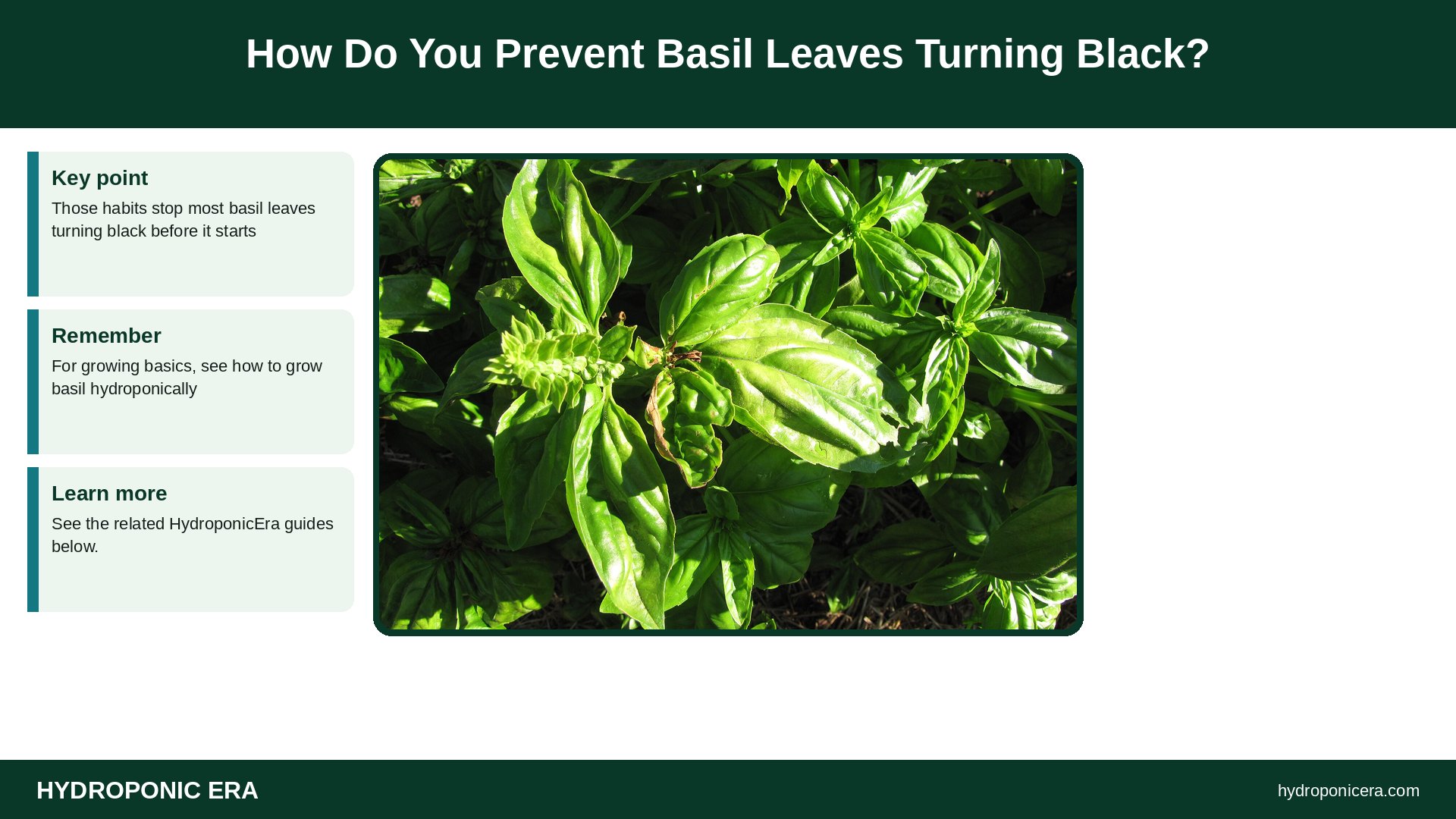
- Keep basil above about 55°F day and night.
- Store harvested basil at room temperature in water, not in the fridge.
- Start with clean seed and, if downy mildew is common in your area, DMR varieties.
- Keep leaves dry: no misting, good airflow, sensible spacing.
- Scout leaf undersides weekly with a hand lens.
Those habits stop most basil leaves turning black before it starts. For growing basics, see how to grow basil hydroponically.
FAQs: Basil Leaves Turning Black
Can you eat basil leaves turning black?
Mildly cold-damaged leaves are safe but lose flavor and texture. Discard leaves that are slimy, moldy or diseased.
Why are basil leaves turning black at the tips?
Tip blackening often follows cold exposure or salt buildup. Check temperature first, then your nutrient strength.
Will basil recover from black leaves?
From cold injury, yes: remove damaged leaves and new growth should be fine. From downy mildew, plants rarely recover.
Does overwatering cause basil leaves turning black?
Wet leaves and high humidity favor bacterial and downy mildew spots. Wet roots without oxygen cause root rot, which shows as wilting.
Is purple basil less likely to have basil leaves turning black from downy mildew?
Minnesota Extension notes lower disease levels in red-leaf and lemon basil types.
Related HydroponicEra Guides
- How to grow basil hydroponically
- How to grow holy basil hydroponically
- Botrytis gray mold in hydroponics
- AeroGarden troubleshooting
Sources
- University of Minnesota Extension — Basil downy mildew
- Cornell Vegetables — Basil Downy Mildew
- UF/IFAS — Downy Mildew of Basil (PP271)
- Rutgers NJAES — Ultra-Niche Crops Series: Basil Postharvest Handling and Food Safety (FS1283)
- Frontiers in Plant Science (2023) — Preharvest and postharvest techniques that optimize the shelf life of fresh basil: a review
- UMass Extension — Basil – Pseudomonas
- NC State Extension — Basil Problem: Bacterial Leaf Spot
- New England Vegetable Management Guide — Basil Disease Control
- Photo credits (Wikimedia Commons, edited with titles): Sweet basil – Ocimum basilicum – Pseudocercospora leaf spot by Scot Nelson (CC0); Starr-110822-8253-Ocimum basilicum-leaves with basil downy mildew Peronospora belbahrii-Hawea Pl Olinda-Maui (25010109901) by Forest and Kim Starr (CC BY 3.0 us); -2020-07-10 Purple basil (Ocimum basilicum) seedlings, Trimingham by Kolforn (Kolforn)
I’d appreciate if you could mail me (Kolforn@gmail.com) if you want to use this picture out of the Wikimedia project scope.This file is licensed under the Creative Commons Attribution-Share Alike 4.0 International license.
You are free:
to share – to copy, distribute and transmit the work
to remix – to adapt the work
Under the following conditions:
attribution – You must give appropriate credit, provide a link to the license, and indicate if changes were made. You may do so in any reasonable manner, but not in any way that suggests the licensor endorses you or your use.
share alike – If you remix, transform, or build upon the material, you must distribute your contributions under the same or compatible license as the original.https://creativecommons.org/licenses/by-sa/4.0CC BY-SA 4.0 Creative Commons Attribution-Share Alike 4.0 truetrue (CC BY-SA 4.0)