
Fusarium wilt hydroponics problems start when a soilborne fungus, Fusarium oxysporum, enters roots and blocks the plant’s water-conducting tissue. Look for yellowing and wilting, often on one side, plus brown streaks inside the stem. There’s no cure for infected plants, so remove them, disinfect the system, and use resistant varieties and clean starts.
| Crop | Pathogen | Key facts | Best defense |
|---|---|---|---|
| Tomato | F. oxysporum f. sp. lycopersici, races 1–3 | Dark brown vascular streaks; favored by warm weather (UC IPM) | Resistant varieties; a few resist all three races |
| Lettuce | F. oxysporum f. sp. lactucae (incl. race 4) | No effective fungicides or resistant varieties for race 4 (AHDB) | Avoidance and hygiene |
| Basil | F. oxysporum f. sp. basilici | Can persist in a hydroponic system for many years (UMass) | Clean seed; Aroma 2, Nufar, Newton, Rutgers Obsession |

What Does Fusarium Wilt Look Like in Hydroponics?

UC IPM describes tomato Fusarium wilt this way: the fungus enters through the rootlets and invades the xylem. Branches and leaves “become yellow and wilt,” sometimes only on one branch or one side, creating a “yellow flag” effect. A “dark brown vascular discoloration extends far up the stem,” and infected plants usually die. Symptoms often first show during fruit sizing.
To check, cut a lower stem lengthwise. Healthy tissue is pale green or white; Fusarium-infected tissue shows brown streaks. UC IPM notes that Fusarium and Verticillium wilts look similar and may need lab culturing to confirm, so send samples to your state’s plant diagnostic lab for a firm answer on Fusarium wilt hydroponics issues.
How Does Fusarium Spread in a Hydroponic System?
Fusarium is mainly a soil fungus, but water carries it. The UK’s AHDB says lettuce Fusarium wilt spreads by water, soil and crop debris on tools, trays and footwear, and over longer distances by infected transplants and potentially seed. It adds that soilless hydroponic production “has not been significantly affected to date unless heavily infected plant material has been used,” but warns that “the pathogen can be transmitted in water.”
That’s the key risk in Fusarium wilt hydroponics: in a recirculating system, one infected plant can share its spores with every root in the loop. For basil, the New England Vegetable Management Guide warns Fusarium wilt “can persist in the soil or hydroponic system for many years.”
Fusarium Wilt Hydroponics: 7 Proven Control Steps
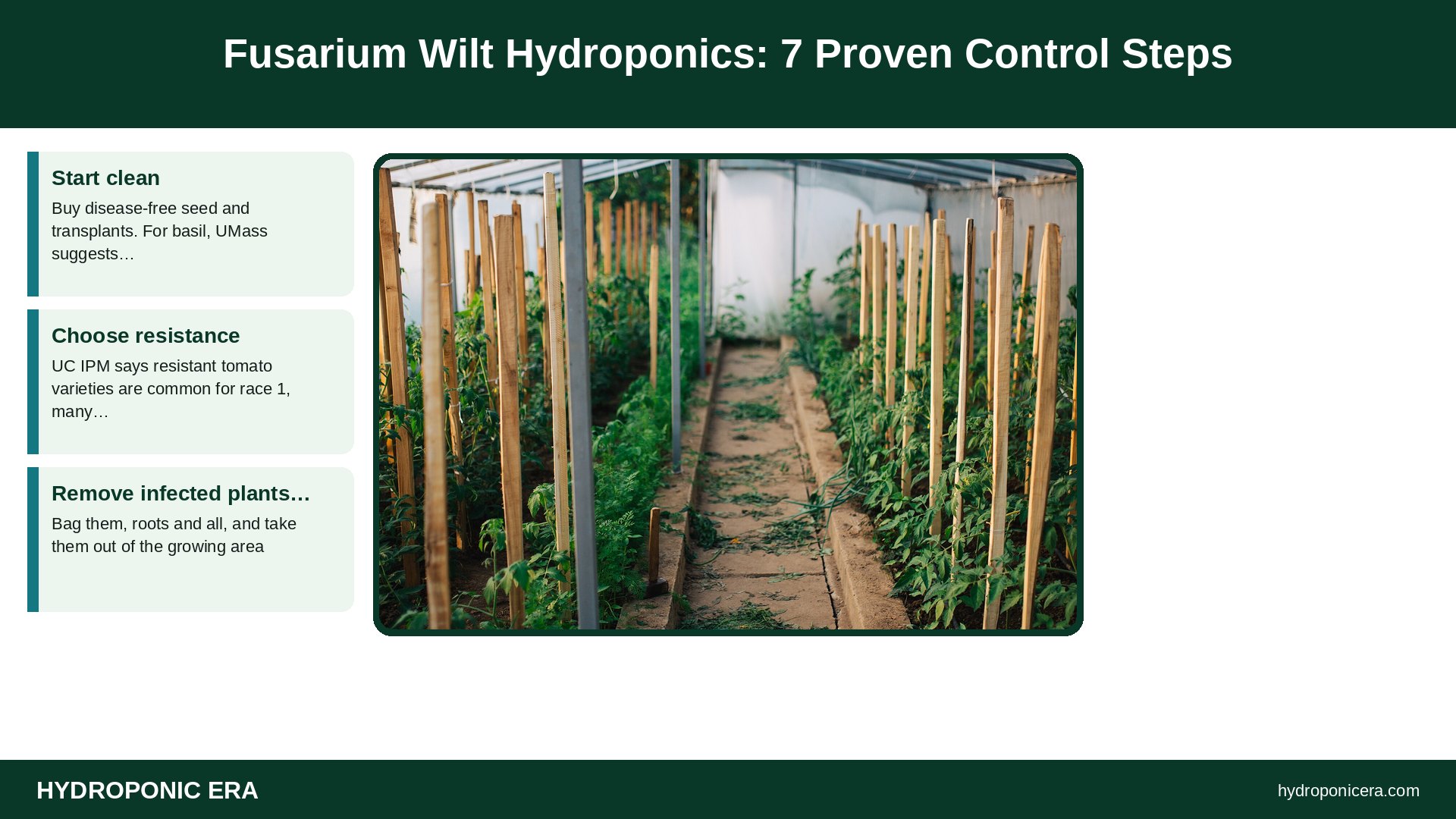
- Start clean. Buy disease-free seed and transplants. For basil, UMass suggests disease-free seed or seed treated with hot water or dilute bleach.
- Choose resistance. UC IPM says resistant tomato varieties are common for race 1, many also resist race 2, and a few resist all three. For basil, Aroma 2, Nufar, Newton and Rutgers Obsession have some resistance.
- Remove infected plants fast. Bag them, roots and all, and take them out of the growing area.
- Isolate the system. If possible, drain and stop recirculating the affected reservoir.
- Disinfect thoroughly. AHDB stresses removing organic debris before disinfecting surfaces, then sterilizing equipment and trays.
- Consider water treatment for larger recirculating systems (see below).
- Keep root zones cool. UC IPM says the tomato disease is favored by warm weather, and AHDB gives an optimum soil temperature of 24–28°C (75–82°F) for lettuce wilt.
Following all seven steps won’t guarantee a clean crop, but it greatly reduces Fusarium wilt hydroponics risk.
Can You Treat Fusarium Wilt?

Not once a plant is infected. AHDB says lettuce wilt control is “extremely difficult” because there are “no effective fungicides, no available resistant varieties and soil sterilisation has limited efficacy,” so “avoidance is the best strategy.” A USDA-ARS presentation from Salinas, California, adds that broad-spectrum resistance in lettuce germplasm is still unknown and that warmer air and soil temperatures favor infection.
For home growers, treat Fusarium wilt hydroponics as a prevention problem. If you use any product, check that it’s labeled for your crop and use in your state, and follow the label.
How Do Commercial Growers Disinfect Recirculating Water?
A chapter on disinfecting recirculating nutrient solutions in the open-access Springer book Aquaponics Food Production Systems reviews several methods:
- Heat: about 95°C for at least 10 seconds kills most disease organisms.
- UV-C: a cited dose of about 100 mJ/cm² for bacteria and fungi, after filtration, since turbidity reduces effectiveness.
- Ozone: effective but requires equipment and safety measures.
- Chlorination: 1–5 mg/L for 2 hours cut Fusarium oxysporum by 90–99.9%, though some spores survived.
These systems suit commercial operations. For small home systems, draining, cleaning and replanting with clean stock is usually more practical for Fusarium wilt hydroponics control.
How Do You Prevent Fusarium Wilt Hydroponics Problems at Home?
Small systems don’t need UV units or heat exchangers. A simple routine covers most of the risk:
- Quarantine new plants. Keep store-bought transplants out of your main system for a week or two and watch for wilting.
- Start from seed when possible. AHDB notes infected transplants are a major way the disease spreads.
- Clean between crops. Scrub reservoirs, channels and net pots to remove root debris, then disinfect and rinse.
- Use fresh media. Don’t reuse rockwool or coco from a crop that wilted.
- Keep tools separate. Wash pruners and hands after handling sick plants, and don’t carry garden soil indoors on shoes or tools.
- Split systems. Growing tomatoes, lettuce and basil in separate reservoirs limits how far any outbreak can spread.
Keep notes on varieties, dates and symptoms. If Fusarium wilt hydroponics problems return, those records help a diagnostic lab or Extension agent pin down the source.
Is It Fusarium, Pythium or Something Else?

| Sign | Fusarium wilt | Pythium root rot | ToBRFV |
|---|---|---|---|
| Roots | May look fairly normal early | Brown, slimy, sloughing | Usually normal |
| Stem inside | Brown vascular streaks | Usually normal above crown | Normal |
| Leaves | One-sided yellowing and wilt | Whole-plant wilt | Mosaic, mottling |
See our guides to Pythium root rot and tomato brown rugose fruit virus for those problems, and white fuzz on roots for harmless root fuzz.
Common Fusarium Wilt Hydroponics Mistakes
| Mistake | Better move |
|---|---|
| Leaving a wilted plant in the system | Remove it immediately |
| Reusing trays and net pots without cleaning | Clean off debris, then disinfect |
| Assuming any wilt is Fusarium | Cut the stem; send samples to a lab |
| Ignoring warm reservoirs | Keep roots cool |
| Growing mint family plants beside basil | UMass says they can be symptomless carriers |
FAQs: Fusarium Wilt Hydroponics
Can Fusarium wilt hydroponics problems spread to all plants?
Yes, in a shared recirculating system the pathogen can travel in water.
Can infected plants recover?
No. UC IPM says infected tomato plants usually die.
Does hydrogen peroxide cure Fusarium?
No proven cure exists for infected plants. The Springer chapter notes hydrogen peroxide is especially helpful for cleaning watering systems, while other methods have largely taken over for disinfection.
Which crops get Fusarium wilt hydroponics problems most?
Tomato, lettuce and basil are common hosts, each with its own form of the fungus.
Related HydroponicEra Guides
- Pythium root rot in hydroponics
- How to grow hydroponic tomatoes
- How to grow basil hydroponically
- Damping off seedlings in hydroponics
Sources
- UC IPM — Fusarium Wilt / Tomato
- AHDB — Lettuce Fusarium wilt and root rot
- USDA-ARS via UC ANR (Dec. 5, 2023) — Lettuce Fusarium Wilt (PDF)
- UMass New England Vegetable Management Guide — Basil Disease Control
- Aquaponics Food Production Systems (Springer) via FarmHub — 4.5 Disinfection of the Recirculating Nutrient Solution
- Photo credits (Wikimedia Commons, edited with titles): Fusarium wilt symptom tobacco by R.J. Reynolds Tobacco Company Slide Set (CC BY 3.0 us); K7725-1-sm by Keith Weller, USDA-ARS (Public domain); Greenhouse filled with tomato plants and a bucket on the path by Shixart1985 (CC BY 2.0); Spathiphyllum wallisii hydroponically grown by Kephalian (CC BY-SA 4.0)