
Here’s how to grow blueberries hydroponically: plant a container-friendly bush in a 5–7 gallon pot of acidic soilless mix (peat, coir, pine bark, perlite), feed it through drip with an acid-forming nutrient, keep runoff pH at 4.5–5.5, and give it a real winter rest. It’s a long-term fruit project, not a quick crop.
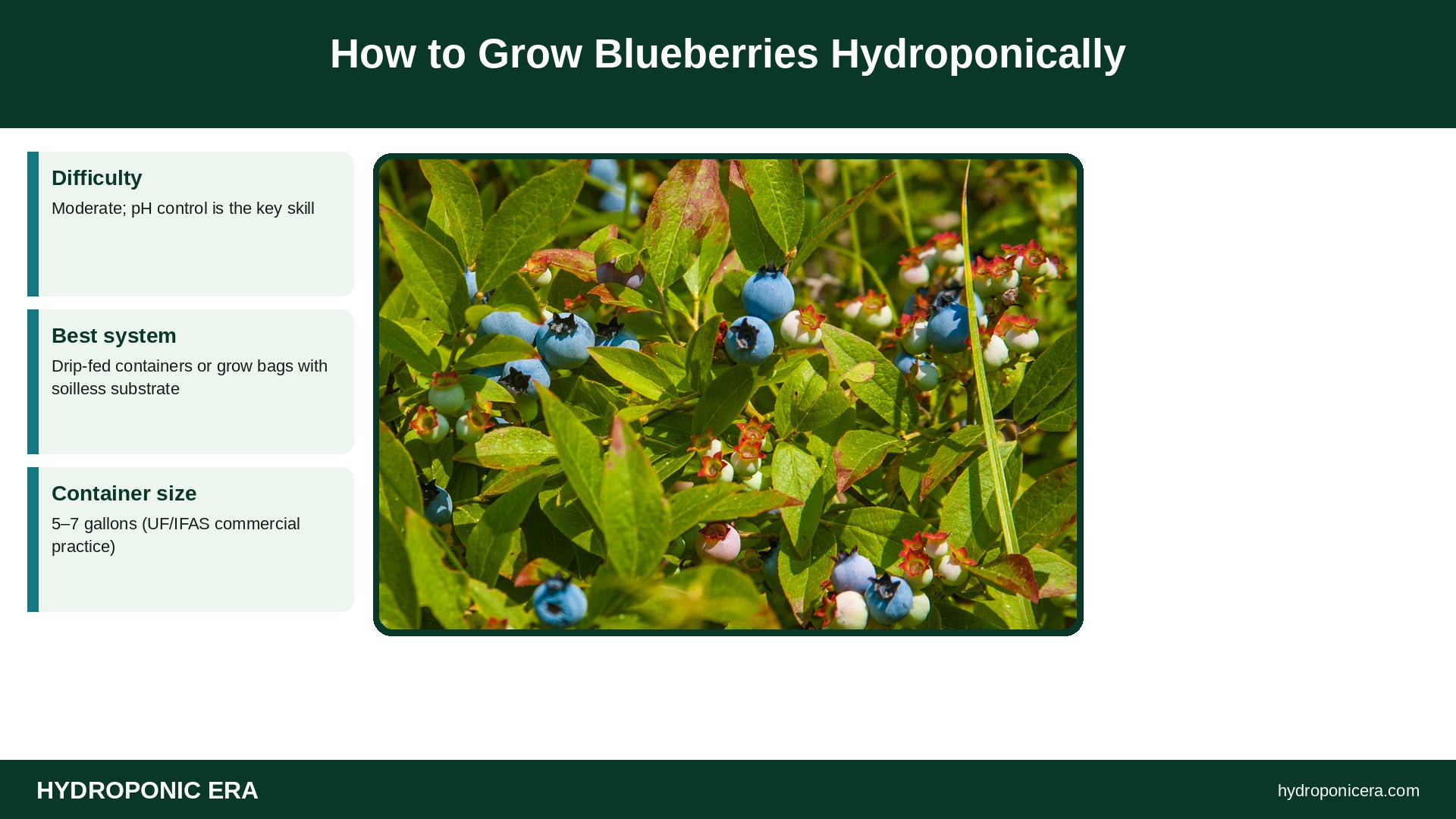
| Question | Quick answer |
|---|---|
| Difficulty | Moderate; pH control is the key skill |
| Best system | Drip-fed containers or grow bags with soilless substrate |
| Container size | 5–7 gallons (UF/IFAS commercial practice) |
| Target pH | 4.5–5.5 in the runoff (leachate) |
| Salinity limit | Leachate EC below 2.0 dS/m, lower for young plants |
| Fertilizer type | Acidifying, ammonium-based (for example, ammonium sulfate) |
Can You Grow Blueberries Hydroponically?

Yes. In fact, commercial farms are already doing it. University of Florida IFAS Extension describes a growing number of container-based blueberry farms that grow southern highbush blueberries in soilless substrates, because the crop needs well-drained, acidic, organic soils that many regions simply don’t have.
So learning how to grow blueberries hydroponically is really learning substrate culture: an inert, acidic mix in a container, with all nutrients delivered in the water. Deep water culture and NFT are not used for this woody, long-lived shrub. Nebraska Extension notes blueberries can produce fruit for over 30 years, so think of your setup as a permanent planter.
What Do Blueberries Need That Other Crops Don’t?
- Very low pH. UF/IFAS targets leachate pH of 4.5 to 5.5. Wisconsin Extension calls 4.5 to 5.0 ideal for soil-grown plants.
- An acid-forming nitrogen source. UF/IFAS says acidifying fertilizers such as ammonium sulfate should be used. Nebraska Extension also recommends ammonium sulfate.
- Low salt. UF/IFAS keeps leachate salinity below 2.0 dS/m. Wisconsin warns that blueberry roots are sensitive to fertilizer salt injury.
- Air at the roots. UF/IFAS notes blueberry substrates generally have more than 30% air-filled porosity.
- A dormant season. Nebraska Extension explains that blueberries go dormant as days shorten and temperatures drop in fall.
Get these five right and you’ve solved most of how to grow blueberries hydroponically.
What Setup Is Best for How to Grow Blueberries Hydroponically?
UF/IFAS describes the commercial setup in detail, and it scales down well for a patio:
| Part | What UF/IFAS describes | Home version |
|---|---|---|
| Container | 5–7 gallon pots or bags; wider than tall | One 5–7 gallon pot per bush |
| Drainage | Abundant holes to prevent root rot | Pot with many holes, raised off the ground |
| Substrate | Peat or coir fibers plus perlite, pine bark or coconut pith | 1:1 peat and pine bark, or 2:2:1 coir, peat, perlite (Wisconsin) |
| Irrigation | Drip with one emitter and 2–4 stakes | Small drip kit on a timer |
| Runoff | 15–25% leaching fraction | Aim for a little runoff each day |
See our guides to drip systems, coco coir and perlite.
How to Grow Blueberries Hydroponically Step by Step

- Pick the right type. Northern gardeners can choose compact half-high cultivars; Wisconsin lists ‘Northblue’, ‘Northsky’, ‘St. Cloud’, ‘Polaris’ and others for zones 3–5. Nebraska Extension lists container picks such as ‘Patriot’, Peach Sorbet and Pink Icing. Southern growers use southern highbush types.
- Mix an acidic substrate. Wisconsin suggests one part sphagnum peat and one part shredded pine bark, or two parts coir, two parts peat and one part perlite.
- Pot it up. Start in a 5-gallon container and move to a larger one as the plant matures.
- Install drip. Short, frequent fertigation events, as UF/IFAS recommends, keep moisture steady without waterlogging.
- Feed with an acidifying nutrient. This is where how to grow blueberries hydroponically differs most from lettuce. Use a blueberry or acid-loving plant formula, or an ammonium-based hydroponic mix. Start weak.
- Measure runoff weekly. Collect drainage and check pH and EC with calibrated meters. See EC and TDS.
- Give it winter. Let the plant go dormant outdoors or in a cold garage, and protect the roots from hard freezes.
Those seven steps cover how to grow blueberries hydroponically from potting day to the first winter rest.
How Do You Control pH and Salts?

This is the make-or-break part of how to grow blueberries hydroponically. UF/IFAS explains that soilless substrates have no pH buffering, so pH can swing quickly with water alkalinity, fertilizer and plant uptake. Most tap water contains carbonates and bicarbonates that push pH up.
- If pH creeps up: UF/IFAS neutralizes water alkalinity with sulfuric, phosphoric or nitric acid. Home growers usually use a pH Down product. See pH Up and pH Down.
- If pH drops too low: UF/IFAS suggests very light lime, under 0.8 oz per gallon of substrate.
- If EC climbs: Rinse the pot with plenty of acidified water, as UF/IFAS advises. Wisconsin also recommends an occasional drench to remove salts.
Test your source water first. Our pH control guide walks through it.
How Much Light Do Blueberries Need?
Nebraska Extension says containerized blueberries should get at least 4 hours of direct sunlight, with protection from high winds. More sun generally means more fruit. If you grow indoors in the off-season, use a strong LED fixture; see PPFD and DLI. In practice, the easiest way how to grow blueberries hydroponically is outdoors in summer, with the pot moved to shelter for winter.
Do Hydroponic Blueberries Need Winter Chill?
Most do. Nebraska Extension explains that temperate fruits slow down and go dormant as days shorten and temperatures fall, and that fully dormant plants become quite cold hardy. Container roots are more exposed, though. Wisconsin advises burying containers or mulching them heavily for winter. Indoors, a bush kept warm all year usually won’t flower well, so plan a cool rest period. Skipping dormancy is a common reason people give up on how to grow blueberries hydroponically.
What Mistakes Happen When You Grow Blueberries Hydroponically?
| Mistake | Result | Fix |
|---|---|---|
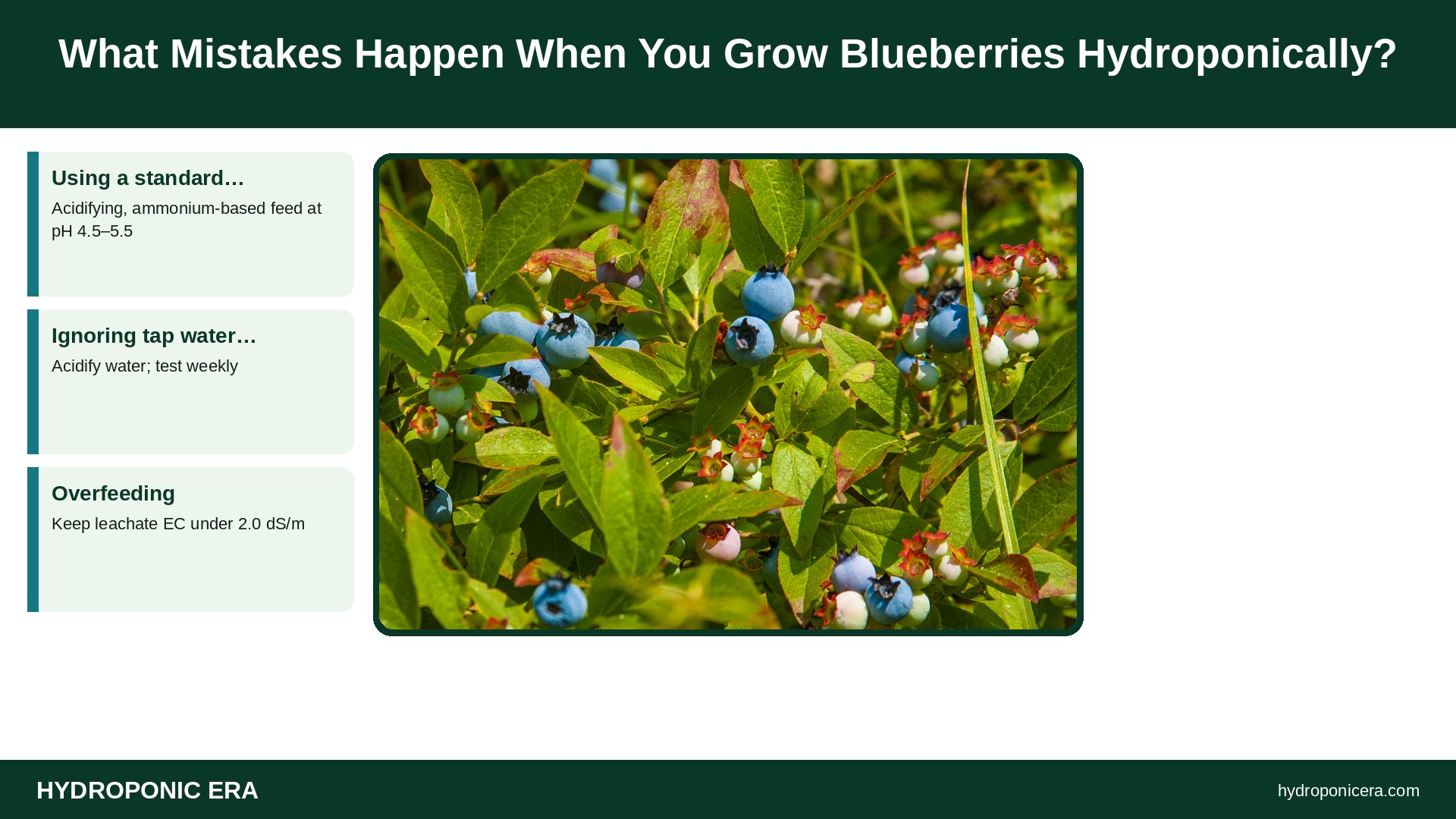
| Using a standard lettuce nutrient at pH 6+ | Yellow leaves, poor growth | Acidifying, ammonium-based feed at pH 4.5–5.5 |
| Ignoring tap water alkalinity | pH drifts upward | Acidify water; test weekly |
| Overfeeding | Salt injury, leaf burn | Keep leachate EC under 2.0 dS/m |
| Pots without drainage | Root rot | Many holes, 15–25% runoff |
| Keeping plants warm all winter | Few flowers | Give a dormant season |
Notice that most of these errors are about chemistry, not equipment. Once you master pH, how to grow blueberries hydroponically becomes routine. Root rot is the other big risk; see Pythium root rot.
FAQs: How to Grow Blueberries Hydroponically
How long until hydroponic blueberries fruit?
UF/IFAS has observed commercial-level yields in the first year in some container trials. Home results vary with plant size, cultivar and care.
What pH do I need to grow blueberries hydroponically?
Keep the runoff at pH 4.5 to 5.5, per UF/IFAS. Measure the leachate, not just the feed water.
Can I grow blueberries hydroponically indoors year-round?
It’s hard. Most cultivars need a cool dormant period to flower well, so an outdoor or cold-garage rest is usually part of the plan.
How big do container blueberries get?
It depends on the cultivar. Nebraska Extension lists ‘Patriot’ at about 3 feet tall and Peach Sorbet at about 1½ feet, which is why compact types are popular when people learn how to grow blueberries hydroponically on a patio.
Is learning how to grow blueberries hydroponically worth it?
If your soil is alkaline, yes. Containers let you control pH and salts precisely. Strawberries are a faster fruit to start with; see hydroponic strawberries.
Related HydroponicEra Guides
Sources
- UF/IFAS Extension — Introduction to Southern Highbush Blueberry Cultivation in Containers (HS1476)
- University of Wisconsin Extension — Growing Blueberries in Containers
- Nebraska Extension — Growing Blueberries in Raised Beds and Containers (EC3078, PDF)
- Photo credits (Wikimedia Commons, edited with titles): Wild Blueberry Bush by Paul VanDerWerf from Brunswick, Maine,… (CC BY 2.0); 366 Highbush Blueberry – Vaccinium corymbosum,… by Judy Gallagher (CC BY 2.0)