
Quick Answer: PPFD and DLI hydroponics
PPFD and DLI hydroponics (photosynthetic photon flux density) is how many photosynthetically active photons hit a square meter each second (µmol·m⁻²·s⁻¹). DLI (daily light integral) is the total of those photons over a full day (mol·m⁻²·day⁻¹). For hydroponic plants, DLI is often the better “daily dose” target, while PPFD tells you whether your fixture height and intensity are in a useful range. Measure at canopy height, calculate DLI from PPFD × photoperiod, then match crop ranges—from leafy greens to fruiting vines—without bleaching leaves or driving tip burn.
Continue with best grow lights for hydroponics, indoor hydroponic garden, and crop guides for lettuce, basil, cucumbers, and spinach.
Key Takeaways
- Virginia Cooperative Extension SPES-720 explains PPFD and DLI and provides recommended DLI ranges for many crops, including lettuce, spinach, basil, tomato, and cucumber.
- DLI ≈ PPFD × hours × 0.0036 (when PPFD is in µmol·m⁻²·s⁻¹ and the photoperiod is constant).
- Wattage and “full spectrum” marketing claims are not substitutes for canopy PPFD.
- Higher DLI generally increases biomass up to a crop- and environment-specific limit; heat, CO₂, water, and nutrients must keep up.
- Kentucky’s hydroponic lettuce materials discuss leafy DLI targets in the mid-teens mol·m⁻²·day⁻¹ range for quality production contexts.
- Raising light without airflow can increase tip-burn risk on greens—see Ca/Mg draft.
- Map light targets to system choice and crop: greens ≠ cucumbers.
Related HydroponicEra guides
- Best grow lights for hydroponics
- Lettuce hydroponics
- Cucumbers hydroponically (draft)
- Spinach hydroponically (draft)
- Hydroponic garden beginner guide
PPFD and DLI hydroponics in plain language
PPFD is instantaneous intensity—like how bright the photosynthetic shower is right now at the leaf.
DLI is the daily total—like how much rain fell all day. Two rooms can share the same DLI with different strategies: higher PPFD for fewer hours, or moderate PPFD for more hours (within crop photoperiod limits).
Virginia Tech’s introductory DLI guide is written for growers who need decision-useful units rather than lux marketing numbers. Lux and foot-candles weight human vision; quantum sensors for PPFD weight plant-usable photons in the roughly 400–700 nm band.
How to calculate DLI for PPFD and DLI hydroponics setups
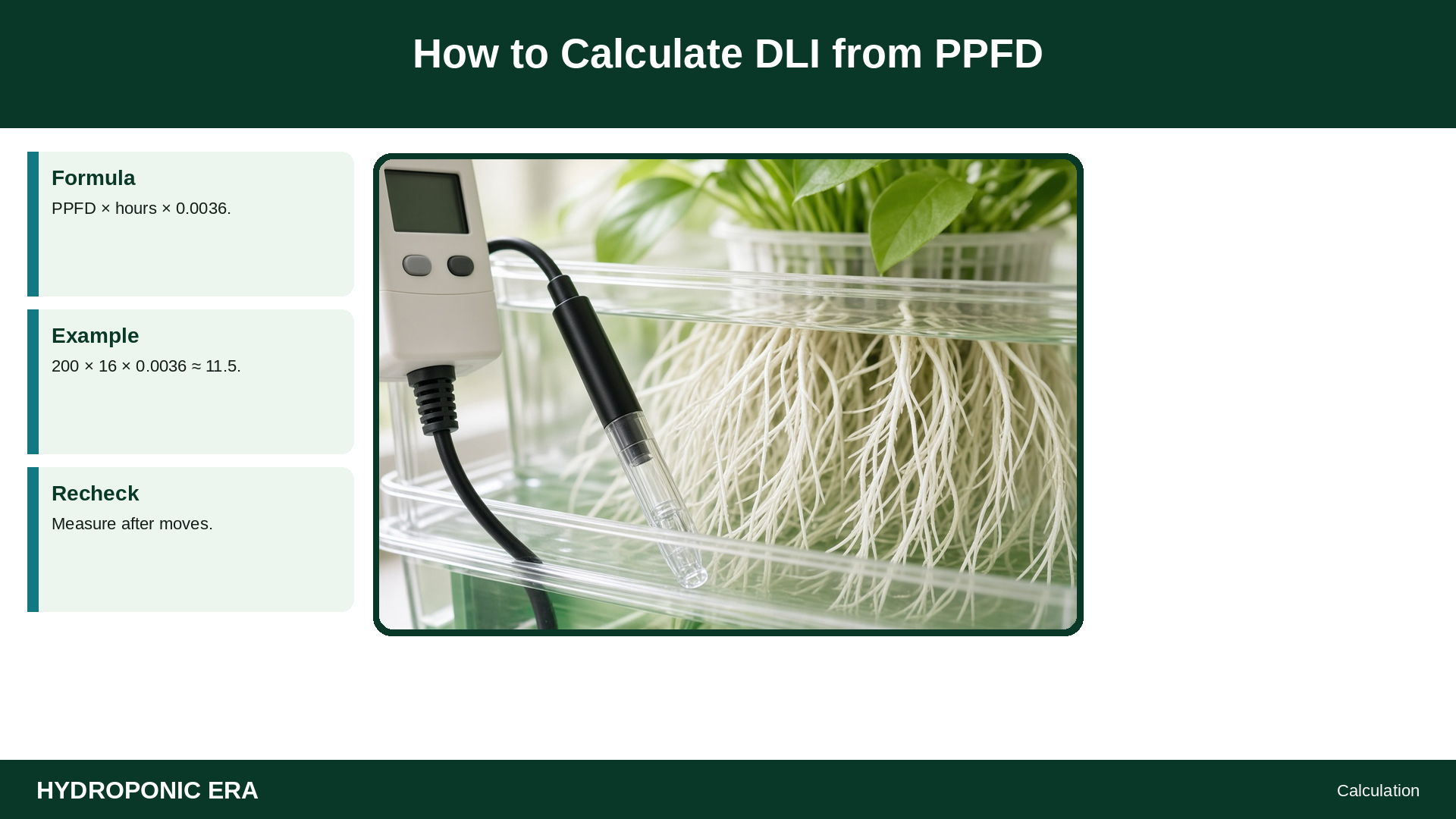
If PPFD is roughly constant during the light period:
DLI (mol·m⁻²·day⁻¹) = PPFD (µmol·m⁻²·s⁻¹) × photoperiod (hours/day) × 0.0036
Why 0.0036? Because there are 3600 seconds in an hour, and 1 mol = 1,000,000 µmol, so 3600 / 1,000,000 = 0.0036.
| PPFD | Hours | Approx DLI | Beginner reading |
|---|---|---|---|
| 150 | 16 | ~8.6 | Low for many fruiting crops; possible for some greens/seedlings |
| 200 | 14 | ~10.1 | Modest leafy territory |
| 250 | 16 | ~14.4 | Solid leafy / herb zone for many setups |
| 400 | 16 | ~23.0 | Entering stronger fruiting demand |
| 500 | 16 | ~28.8 | High; watch heat, bleaching, tip burn |
These are arithmetic examples for learning the formula—not a promise that every cultivar wants the top of the table.
Crop DLI Ranges from Extension Guidance
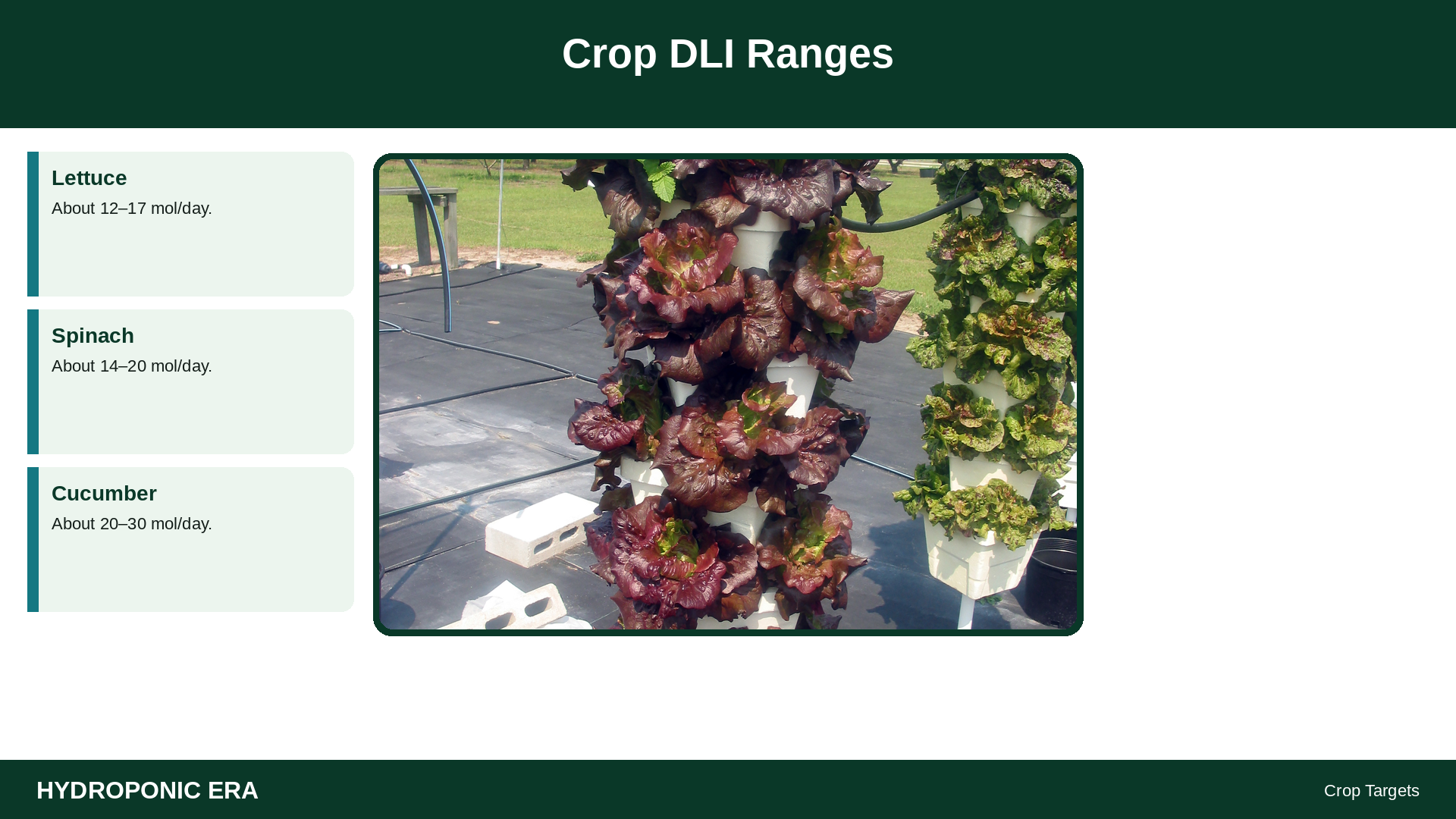
Virginia Tech SPES-720 publishes recommended DLI ranges such as:
| Crop (from VT table) | Recommended DLI range (mol·m⁻²·d⁻¹) | HydroponicEra crop notes |
|---|---|---|
| Seedlings / cuttings | 5–10 | Prevent stretch without frying plugs |
| Microgreens | 9–12 | See microgreens guide on site |
| Lettuce | 12–17 | Aligns with many CEA leafy programs |
| Spinach | 14–20 | Keep cool while raising light |
| Basil | 15–25 | Flavor and compactness improve with adequate light |
| Tomato / cucumber | 20–30 | Fruiting vines need serious daily light |
Kentucky CCD’s hydroponic lettuce publication discusses optimal leafy DLI in roughly the 12–17 mol·m⁻²·day⁻¹ conversation for production quality, with lower minimums possible when growth is slower. Use extension ranges as planning bands, then validate with your meter and plant response.
How to Measure PPFD in a Home System
- Place a quantum sensor (or a trusted phone/sensor tool you understand the limits of) at canopy height, not on the floor.
- Measure center and edges—LED boards are rarely perfectly even.
- Note fixture height and dimmer percentage.
- Record photoperiod hours from the timer.
- Calculate DLI.
- Adjust height/dimming/hours, then re-measure.
- Watch plants for 3–7 days: stretch, bleaching, cupping, tip burn, or happy compact growth.
If you only own a consumer light meter in lux, treat conversions as rough estimates. For serious fruiting crops, a proper quantum reading is worth it.
Important Variables Beyond the Number
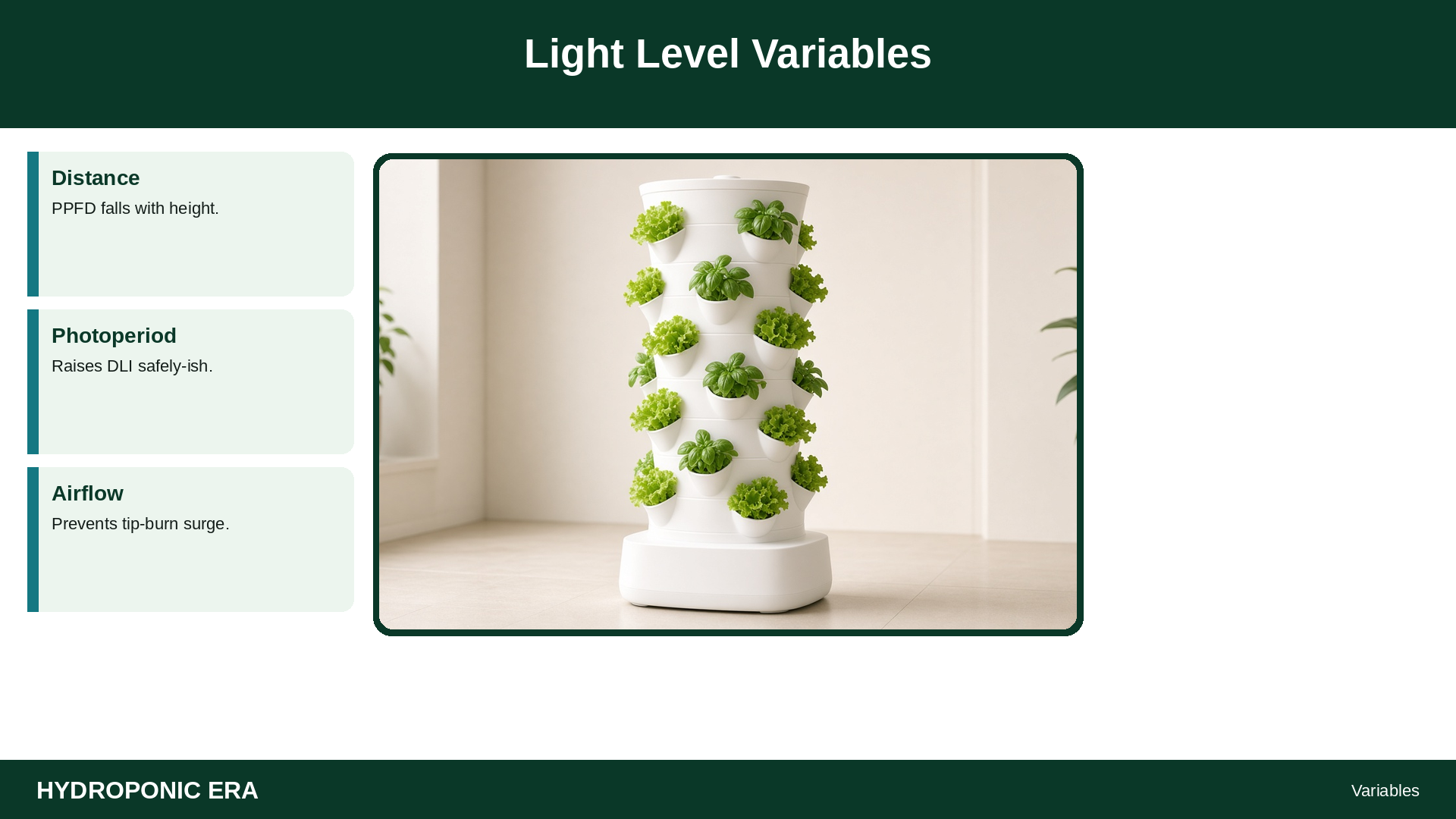
| Variable | Why it changes results | Action |
|---|---|---|
| Fixture distance | PPFD falls quickly with distance | Re-measure after every height change |
| Canopy density | Inner leaves starve | Prune/train; raise uniformity |
| Photoperiod | Raises DLI without raising PPFD | Stay within crop daylength tolerance |
| Temperature / RH | High light + heat stress | Coordinate climate |
| CO₂ / nutrients / water | Limit response to extra light | Do not light-starve or overfeed blindly |
| Airflow | Tip burn risk on greens | Move air gently through canopy |
Common Lighting Mistakes
- Buying by wattage alone
- Measuring PPFD on the empty floor before plants exist
- Running fruiting PPFD on spinach in a hot tent
- Extending photoperiod so long that plants never respire/rest appropriately for the crop
- Ignoring edge dimming—outer plants stretch while centers bleach
- Raising DLI overnight by 50% with no acclimation
- Assuming “more blue” marketing replaces enough total DLI
Troubleshooting Light Problems
| Plant signal | Possible light cause | What to try |
|---|---|---|
| Tall, weak stems | Low PPFD/DLI | Increase intensity or hours; lower fixture carefully |
| Bleached upper leaves | PPFD too high / too close | Raise light or dim; acclimate |
| Good color but no fruit | DLI still low for fruiting crop | Recalculate; compare to 20–30 band for tomato/cucumber (VT) |
| Tip burn after light upgrade | Growth surge + Ca distribution limits | Airflow; moderate EC; Ca/Mg guide |
| Uneven growth across tray | Poor uniformity | Reposition fixtures; rotate trays |
Decision Steps for Beginners
- Pick the crop’s DLI band from a trusted table (VT SPES-720 is a strong start).
- Choose a photoperiod you can run consistently.
- Solve for the average PPFD needed: PPFD ≈ DLI / (hours × 0.0036).
- Install lighting and measure real canopy PPFD.
- Adjust until measured DLI approaches the band.
- Only then fine-tune spectrum preferences or fancy controllers.
Example: You want ~15 mol·m⁻²·day⁻¹ for lettuce over 16 hours. PPFD ≈ 15 / (16 × 0.0036) ≈ 260 µmol·m⁻²·s⁻¹ average at the canopy. Measure; do not assume the online LED chart matches your tent.
Greenhouse note: SPES-720 also walks through supplemental lighting when sunlight DLI is too low after glazing losses. Indoor home tents are usually 100% electric light—your meter is the sunlight.
Final PPFD/DLI Checklist
- Definitions understood (instant vs daily total)
- Formula available and practiced once
- Crop DLI band selected from extension guidance
- Canopy measurements taken at multiple points
- Photoperiod logged on a timer
- Climate and nutrients ready for the new light level
- Plant response reviewed before another big jump
Building a Simple Light Map for Your Tent or Shelf
Draw a top-down grid of your canopy (even a 3×3 sticky-note grid works). Measure PPFD in each cell at the height of the tallest leaves. Write the numbers down. Calculate DLI for each cell using the same photoperiod. You will immediately see whether edge plants live in a different light climate than center plants.
Use the map to decide among three fixes: raise overall dimming and accept a lower DLI, add another bar for uniformity, or rotate plants every few days. Fruiting vines on trellises need a vertical mindset too—measure mid-canopy, not only the apical tip.
When you change crops, change the target band before you change Instagram settings. A cucumber DLI band is not a spinach band. If you grow mixed canopies under one lamp, the higher-light crop usually wins and the lower-light crop stresses—or you compromise both. Separate shelves when possible.
Finally, acclimate. Jumping from a seedling DLI of ~8 to a fruiting DLI of ~25 in one night is a stress test, not a flex. Raise intensity over several days while watching leaf posture and color.
Photoperiod, Crop Biology, and Practical Limits
DLI math allows long photoperiods, but plants also have biological preferences. Leafy greens often accept long days; some crops quality-shift if nights disappear entirely. Flowering responses in certain species are photoperiod-sensitive. When in doubt, use a stable schedule in the 14–18 hour band for many indoor greens and adjust with measurements rather than jumping to 24/0 as a default.
Shade and reflection matter. Dark walls waste photons; matte reflective surfaces improve edge PPFD. However, reflective materials that create hot spots can bleach leaves nearest the walls. Re-map after changing tent liners.
Maintenance: dust on bars lowers real PPFD. Wipe fixtures during reservoir changes. Replace aging diodes/drivers per manufacturer guidance if output falls and plants stretch despite the same dimmer setting.
Link light upgrades to nutrition carefully. A sudden DLI increase raises growth rate and water use; EC may climb faster between top-offs. Check the nutrient burn and water-change guides the same week you raise intensity.
Connecting Light to Water and Nutrients
Light drives photosynthesis and growth; growth drives nutrient and water demand. After raising DLI, expect faster reservoir drawdown. Increase monitoring frequency for a week. If leaves pale at correct EC, you may be light-limited on micronutrients or still under target DLI—measure both before guessing. If tips burn at higher DLI with rising EC, you likely need dilution and airflow, not another light increase.
Measurement habits for PPFD and DLI hydroponics
Make PPFD and DLI hydroponics useful by measuring the same way each week.
| Step | Do this | Why |
|---|---|---|
| Pick canopy points | Center + edges at plant height | Edges often run dimmer than Instagram center shots |
| Record PPFD | Note µmol·m⁻²·s⁻¹ at each point | Instant intensity map |
| Record photoperiod | Hours lights are truly on | DLI needs time |
| Estimate DLI | Use a trusted calculator/formula workflow | Daily dose drives crop planning |
| Adjust | Dim, raise, or extend carefully | Watch leaf stress after changes |
- Virginia Tech and other extension sources discuss PPFD/DLI concepts for controlled environments—use published frameworks as orientation for your crop class.
- PPFD and DLI hydroponics targets differ for leafy greens vs fruiting crops; do not copy one screenshot for everything.
- Heat at the leaf can limit how hard you can push light—airflow matters.
PPFD and DLI hydroponics: practical review sheet
Use this review sheet to keep PPFD and DLI hydroponics actionable after you finish the main guide.
- What did you measure today related to PPFD and DLI hydroponics?
- What did you change with your hands (not just what you bought)?
- What will you re-check in 24–48 hours about PPFD and DLI hydroponics?
- Which linked HydroponicEra guide should you reread next?
- What cleaning or logging step did you skip last cycle?
| Item | Today | Next check |
|---|---|---|
| Environment | ||
| Solution (pH/EC) | ||
| Roots / pests / biofilm | ||
| Plant response |
Print or duplicate this table in your notes app. The goal is not paperwork—it is fewer repeated mistakes around PPFD and DLI hydroponics.
When results are unclear, slow down and restate the problem in one sentence that includes PPFD and DLI hydroponics, then list the last three changes you made. Most home-system failures come from stacked changes without logs. Keep PPFD and DLI hydroponics paired with basic hygiene: clean reservoirs, honest meter calibration, and root inspection. If you cannot explain your last adjustment, do not add another product. Re-read the troubleshooting section and apply one change at a time while you watch how PPFD and DLI hydroponics interacts with pH, temperature, and oxygen.
When results are unclear, slow down and restate the problem in one sentence that includes PPFD and DLI hydroponics, then list the last three changes you made. Most home-system failures come from stacked changes without logs. Keep PPFD and DLI hydroponics paired with basic hygiene: clean reservoirs, honest meter calibration, and root inspection. If you cannot explain your last adjustment, do not add another product. Re-read the troubleshooting section and apply one change at a time while you watch how PPFD and DLI hydroponics interacts with pH, temperature, and oxygen.
When results are unclear, slow down and restate the problem in one sentence that includes PPFD and DLI hydroponics, then list the last three changes you made. Most home-system failures come from stacked changes without logs. Keep PPFD and DLI hydroponics paired with basic hygiene: clean reservoirs, honest meter calibration, and root inspection. If you cannot explain your last adjustment, do not add another product. Re-read the troubleshooting section and apply one change at a time while you watch how PPFD and DLI hydroponics interacts with pH, temperature, and oxygen.
PPFD and DLI hydroponics: habits that compound
These habits keep PPFD and DLI hydroponics practical between deep cleans and big changes.
- Keep notes when you work on PPFD and DLI hydroponics so small changes stay visible across weeks.
PPFD and DLI hydroponics FAQs
Is PPFD or DLI more important?
Use both. PPFD sets intensity and fixture distance; DLI sets the daily dose plants accumulate.
Can I use lux instead?
Lux is better than nothing for rough checks, but it is not plant-weighted like PPFD. Prefer a quantum sensor for serious work.
Do cucumbers need more light than lettuce?
Yes, generally. VT lists cucumber and tomato in a higher DLI band (~20–30) than lettuce (~12–17).
Will 24-hour light maximize DLI safely?
Not always. Some crops tolerate long photoperiods; others quality-suffer. Raise DLI thoughtfully and watch plant response rather than defaulting to 24/0.
Why did my leaves burn after I raised the light?
Possible photo-bleaching, heat, or growth-rate tip burn. Dim slightly, improve airflow, and verify EC is not also high.
Sources
- Virginia Cooperative Extension — SPES-720: Calculating and Using Daily Light Integral (DLI)
- Virginia Cooperative Extension — SPES-720 PDF
- University of Kentucky CCD — Hydroponic Lettuce Production in Controlled Environments (PDF)
- University of Florida IFAS — HS1422: Growing Lettuce in Small Hydroponic Systems
- University of Florida IFAS — HS405: Hydroponic Vegetable Production in Florida
- Oklahoma State University Extension — Hydroponics
12 thoughts on “PPFD and DLI Light Levels for Hydroponic Plants”