
Quick Answer: calcium magnesium deficiency
calcium magnesium deficiency shows up most often as tip burn on fast-growing leafy greens and blossom-end rot (or blossom-end disorders) on fruiting crops—even when a bottle of “Cal-Mag” is already in the cabinet. True shortages happen, but many cases are uptake and distribution problems: unstable irrigation, weak transpiration, high humidity with poor airflow, pH outside the availability band, or nutrient antagonism from an unbalanced solution. Fix the environment and solution basics first, then adjust calcium and magnesium deliberately—not by stacking random supplements every day.
Related reading: nutrient lockout and pH swings, pH control, hydroponic nutrients, and nutrient burn (draft sibling).
Key Takeaways
- Penn State Extension’s hydroponic nutrition guide explains essential nutrient roles, including deficiency and excess patterns for growers managing soilless solutions.
- UC IPM describes lettuce tipburn as related to calcium in rapidly expanding leaf tissue and strongly influenced by environmental conditions that limit calcium movement with the transpiration stream.
- NC State Extension and Wisconsin Horticulture describe blossom-end rot as a calcium-related disorder in fruit often linked to irregular water supply—not simply “no calcium in the soil.”
- Magnesium deficiency commonly yellows older leaves between veins (interveinal chlorosis) because magnesium is mobile in the plant; calcium disorders more often hit new growth or fruit tips.
- Oklahoma State’s EC/pH hydroponic guide reminds growers that pH and total strength govern whether nutrients stay plant-available.
- Do not confuse tip burn from high EC (nutrient burn) with tip burn from calcium distribution failure—measure EC and review recent environment before dosing.
- Airflow around the canopy matters for leafy tip burn almost as much as the fertilizer label.
Related HydroponicEra guides
- Why hydroponic leaves turn yellow
- Grow lettuce hydroponically
- Grow hydroponic tomatoes
- Grow peppers hydroponically
- Grow cucumbers hydroponically (draft sibling)
What calcium magnesium deficiency looks like in plants
Calcium helps build stable cell walls and supports growing points. When calcium delivery to rapidly expanding tissue fails, those tissues can collapse or necrose—classic tip burn on lettuce and related greens, and blossom-end disorders on tomato, pepper, and some other fruits.
Magnesium sits at the center of the chlorophyll molecule and supports photosynthetic function. When magnesium is short or unavailable, older leaves often yellow between the veins while veins stay greener—because the plant can move magnesium from old leaves toward new growth.
Penn State’s hydroponics nutrition principles document is a practical map of nutrient function, deficiency, and excess. Use it as a vocabulary check: match symptoms to mobility patterns before buying another bottle.
Tip burn and calcium magnesium deficiency patterns
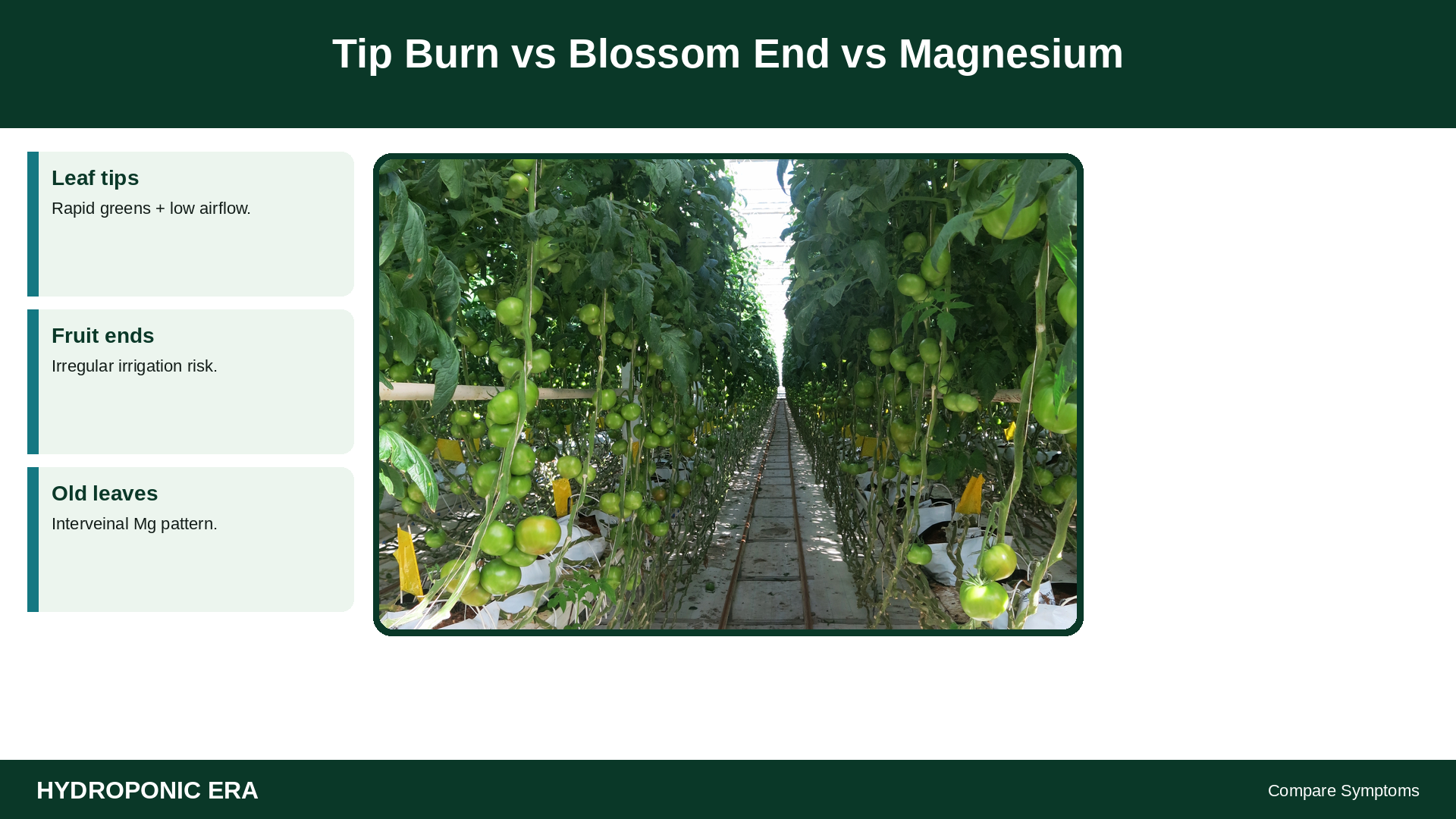
| Issue | Where it shows | Common hydroponic drivers | First checks |
|---|---|---|---|
| Leaf tip burn (Ca-related) | Margins/tips of young expanding leaves | Fast growth, low transpiration, poor airflow, high humidity, high EC stress | Airflow, humidity, EC, irrigation stability, Ca in solution |
| Blossom-end rot / end disorder | Fruit blossom end | Irregular water supply, root stress, high salts, Ca delivery failure | Irrigation consistency, roots, EC, Ca supply |
| Mg deficiency pattern | Older leaves, interveinal yellowing | Low Mg in solution, imbalance with K/Ca, pH issues | Solution recipe, pH, EC, antagonism |
| Nutrient burn tips | Leaf edges crispy with high EC history | Overfeeding | Measure EC; dilute; see nutrient burn guide |
UC IPM’s lettuce tipburn guidelines emphasize that tipburn is associated with calcium in young leaf tissue and that cultural conditions matter. NC State’s blossom-end rot publication and Wisconsin Horticulture’s blossom-end rot article both stress water relations and calcium movement into fruit—not a one-line “add calcium” fix.
Why Hydroponic Plants Still Get Ca/Mg Problems
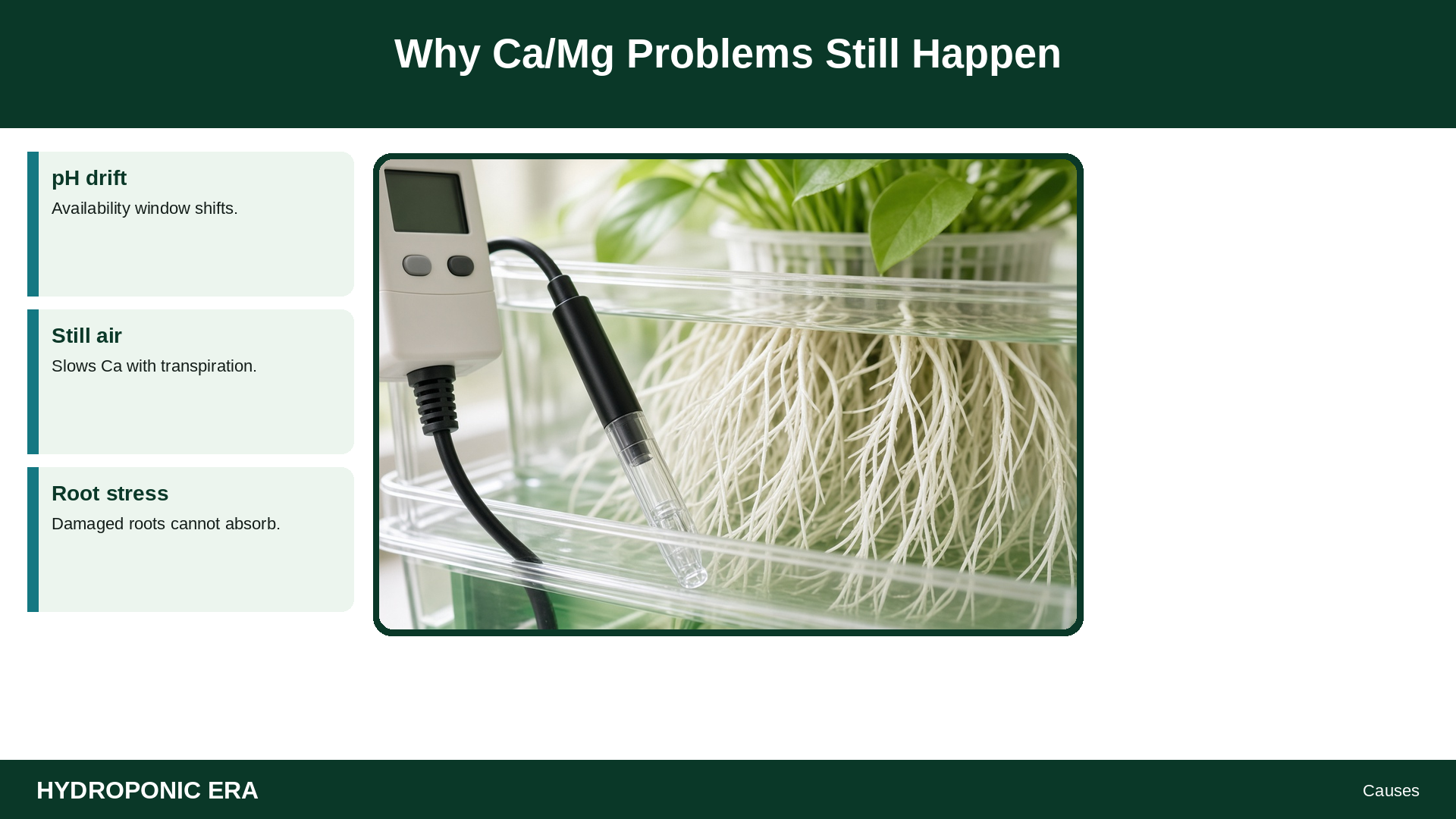
- Unbalanced recipes: A complete fertilizer should supply Ca and Mg, but some programs under-supply one relative to potassium or nitrogen push.
- pH drift: Outside the soilless availability band, uptake efficiency changes. Keep solution pH near about 5.0–6.0 per Oklahoma State hydroponic guidance.
- High total EC: Excess salts can stress roots and disrupt orderly uptake—symptoms can mimic deficiency.
- Weak transpiration / still air: Calcium largely moves with the water stream. Humid, stagnant canopies slow delivery to inner leaves.
- Irrigation gaps in media systems: Wet-dry extremes hinder calcium delivery to fruit (classic blossom-end rot driver in extension fruit guides).
- Root damage: Brown, oxygen-starved roots cannot take up what you dosed—see brown roots and dissolved oxygen.
- Misdiagnosis: Lockout looks like deficiency. Confirm with meters before treating: lockout guide.
Step-by-Step: Diagnose and Correct
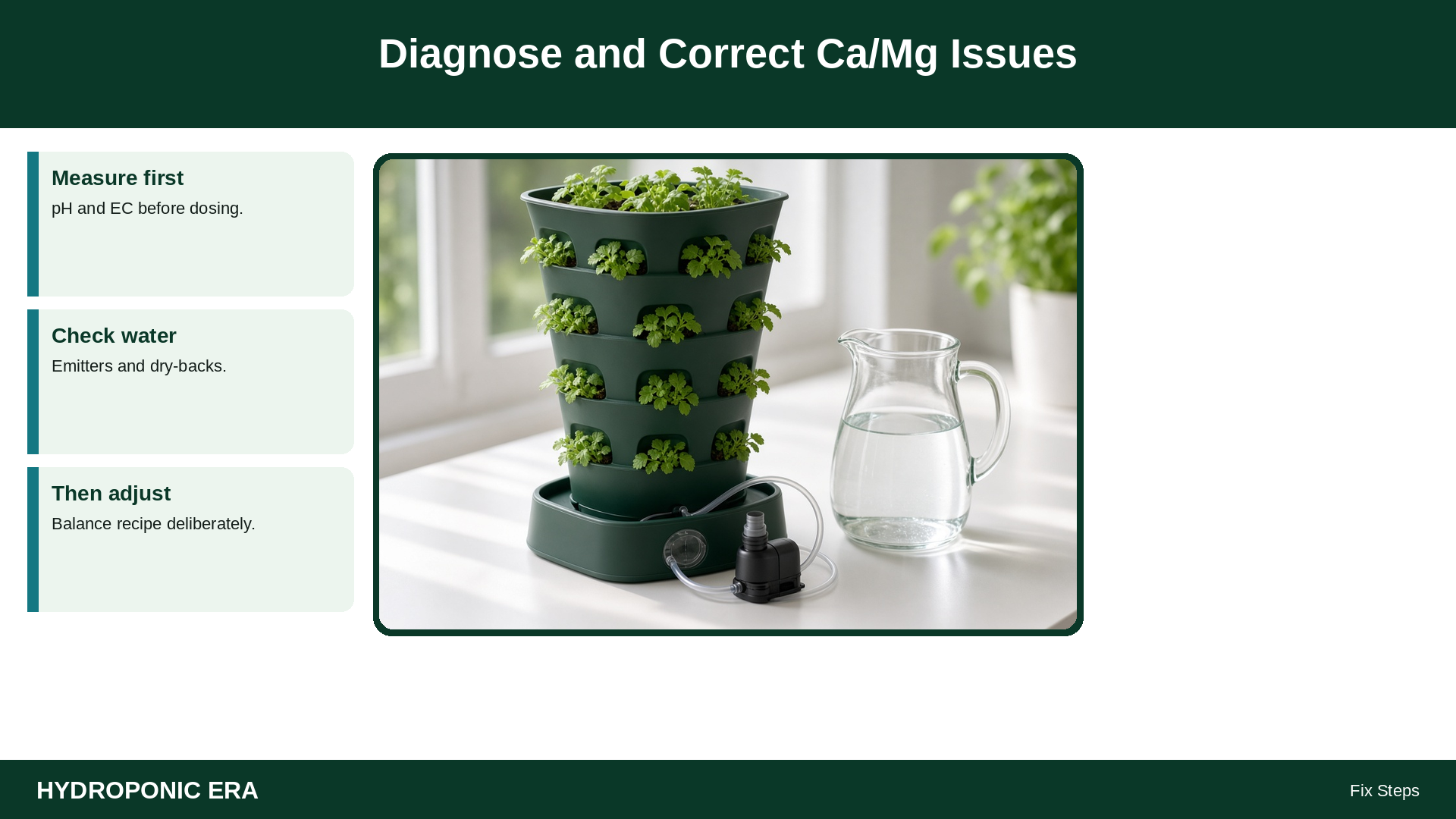
- Photograph and locate symptoms (new vs old leaves; fruit end vs leaf tip).
- Measure pH and EC now, not from last week’s memory.
- Inspect roots and irrigation for slime, dry-out, or clogged emitters.
- Check environment: canopy airflow, humidity, temperature swings, light intensity jump.
- Read your fertilizer label for calcium and magnesium content. Confirm you are not running a Ca-free vegetative experiment by accident.
- If EC is high and tips are burned, correct burn/overfeed first—adding more Cal-Mag can worsen salt stress.
- If EC is reasonable but Ca symptoms persist, stabilize irrigation and airflow, then adjust Ca within a complete program.
- If older leaves show interveinal yellowing consistent with Mg, correct Mg supply and review K:Mg balance rather than only spraying foliage once.
- Reset the reservoir when chemistry is chaotic—see water-change guidance.
- Change one major variable at a time and reassess over several days.
Important Variables Table
| Variable | Why it matters for Ca/Mg | Beginner action |
|---|---|---|
| pH | Availability window | Hold ~5.0–6.0; log drift |
| EC / strength | High salts stress uptake | Match crop stage; avoid spikes |
| Airflow | Supports transpiration stream for Ca | Gentle canopy air movement |
| Humidity | Very high RH can reduce Ca movement | Avoid stagnant wet canopies |
| Irrigation rhythm | Fruit Ca delivery | No wild dry-downs in media |
| Root health | Uptake capacity | Oxygen + clean reservoirs |
| Recipe balance | Ca, Mg, K interactions | Use complete hydro formulas |
Common Mistakes
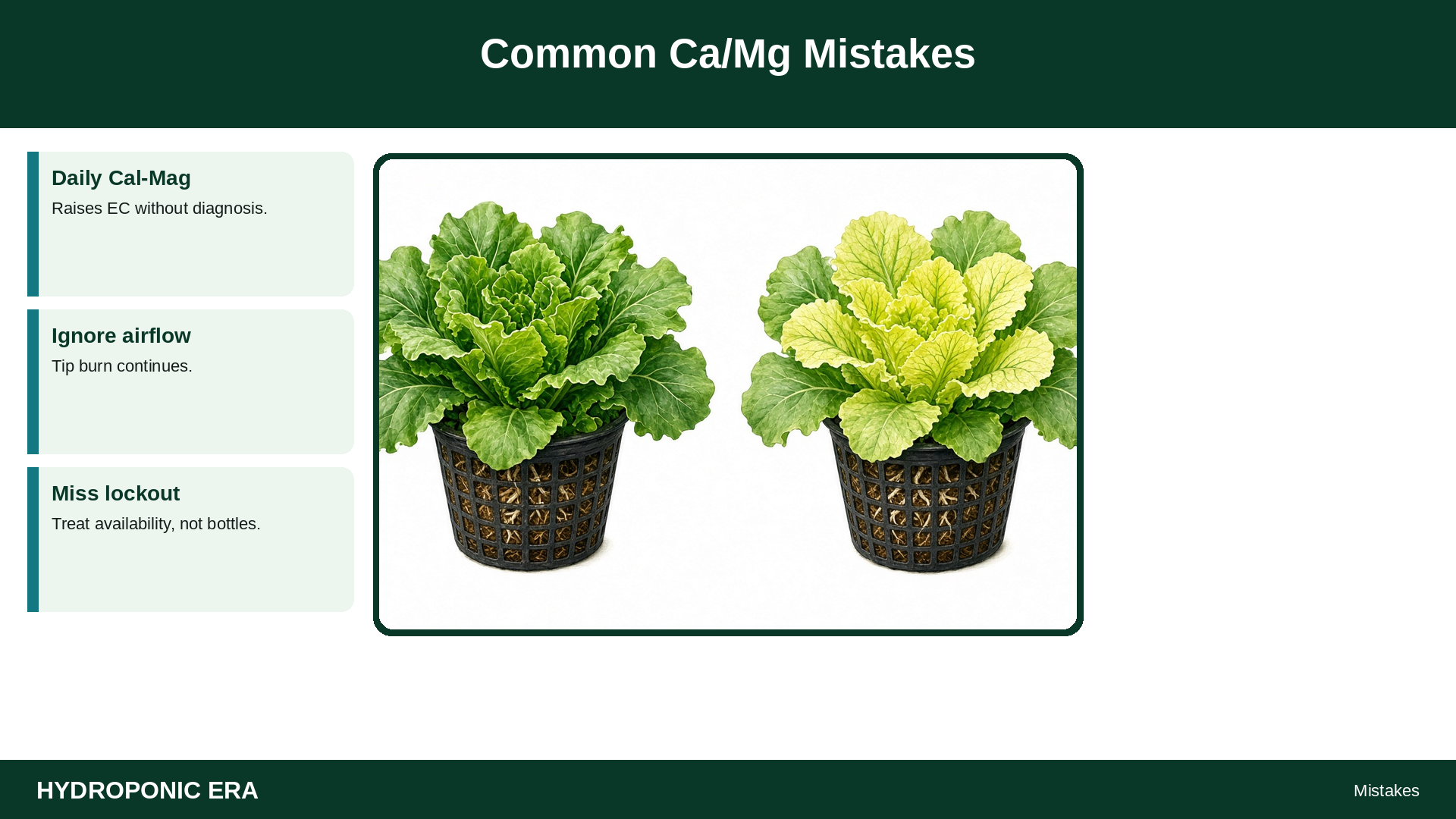
- Pouring Cal-Mag daily without measuring EC
- Treating nutrient burn as calcium deficiency
- Ignoring airflow while maxing LED intensity on lettuce
- Letting media alternate bone-dry and flooded during fruiting
- Chasing Mg yellowing while pH is out of range
- Assuming RO water plus incomplete fertilizer is “fine forever”
- Confusing natural leaf senescence with Mg deficiency
Troubleshooting Decision Table
| You see… | Check first… | Likely next step |
|---|---|---|
| Lettuce inner tip burn after a light upgrade | Airflow, RH, EC, growth rate | Improve air; moderate intensity/EC; confirm Ca in recipe |
| Tomato blossom-end rot with recent dry-outs | Emitters, media moisture, roots | Stabilize irrigation; verify Ca; avoid salt spike |
| Old-leaf interveinal yellow on otherwise strong plant | Mg in formula, pH, K levels | Rebalance Mg; correct pH |
| Tip burn + EC much higher than target | Overfeed | Dilute / reset; follow nutrient burn guide |
| Deficiency look + wild pH swings | Lockout | Stabilize pH/EC; do not stack micros blindly |
What to Check in Your Own System
- Written targets for pH and EC for this crop stage
- Whether symptoms match new growth (Ca) vs old growth (Mg mobility pattern)
- Whether a recent environment change preceded symptoms
- Whether roots are white/cream and firm
- Whether “Cal-Mag” additions raised EC without fixing the cause
Practical Correction Framework (No Fabricated PPM Claims)
Extension sources describe mechanisms and disorders clearly; exact ppm targets vary by crop recipe and fertilizer brand. A safe beginner framework:
- Use a complete hydroponic nutrient line designed for your water type (RO vs tap).
- Keep pH in the soilless band and EC appropriate for crop stage.
- For tip burn on greens: prioritize airflow + moderate growth rate before mega-dosing calcium.
- For blossom-end disorders: prioritize irrigation consistency and root health, then calcium supply.
- For Mg patterns: correct magnesium in the solution recipe and rebalance rather than only foliar spraying once.
Missouri Extension’s blossom-end rot publication (g6204) and related university fruit guides reinforce the water-calcium relationship for fruiting crops. Hydroponics does not exempt you from that physiology—it simply makes irrigation mistakes more measurable.
Final Ca/Mg Checklist
- Symptoms mapped to tissue age and organ (leaf vs fruit)
- pH and EC measured today
- Roots and irrigation verified
- Airflow/humidity considered for leafy tip burn
- Complete fertilizer providing Ca and Mg
- No daily panic dosing
- Linked issues ruled out: lockout, burn, root disease
Crop-Specific Notes (Greens vs Fruit)
Lettuce and spinach: Watch inner expanding leaves. Tip burn after a light upgrade is a signal to improve airflow and moderate growth rate, not only to pour Cal-Mag. UC IPM’s tipburn framing is especially relevant here.
Tomatoes, peppers, cucumbers: Watch the blossom end of fruit during rapid sizing. Extension blossom-end rot guides repeatedly tie disorders to water relations and calcium movement. In hydroponic drip or Dutch bucket culture, verify emitters daily during peak fruiting. A clogged stake can create a “local drought” even when the reservoir is full.
Herbs like basil: Magnesium yellowing on older leaves can appear when recipes are imbalanced or pH drifts. Confirm with meters and the nutrient label before assuming disease.
Build a simple two-column journal: “environment changes this week” and “symptom changes this week.” Correlation is not proof, but it prevents magical thinking. If symptoms began the same day EC jumped from a stacked additive, treat salt stress first. If symptoms began after a heat wave with stagnant air, treat climate and transpiration drivers first.
Lab Testing vs Home Diagnosis
Home growers rarely need tissue labs for first-pass diagnosis. Meters, irrigation checks, and symptom location solve most cases. Tissue or solution lab tests become useful when symptoms persist after environment and recipe basics are stable, or when you manage a commercial recipe and need verification. Until then, master the checklist in this article before spending on assays.
Diagnostic table: calcium magnesium deficiency vs look-alikes
Use this table before you assume every leaf spot is calcium magnesium deficiency.
| Pattern | Often points to | First checks |
|---|---|---|
| Tip burn on fast leafy growth | Ca uptake / environment / growth rate | pH, humidity, EC, root health, cultivar vigor |
| Blossom end disorders on fruit | Ca movement into fruit | Consistent water status, pH, transpiration habits |
| Interveinal yellowing on older leaves | Possible Mg-related pattern | Recipe completeness, pH lockout, EC extremes |
| Crispy margins after big EC jump | Nutrient burn | Dilute/reset; do not add more Cal-Mag blindly |
- Many “Cal-Mag problems” are uptake and distribution problems, not empty bottles.
- Fix pH and root oxygen before stacking supplements when calcium magnesium deficiency is only a guess.
- Log changes for 48 hours; leaf tissue does not rewrite overnight.
If multiple nutrients look wrong at once after a pH swing, review nutrient lockout guidance alongside calcium magnesium deficiency habits.
calcium magnesium deficiency: practical review sheet
Use this review sheet to keep calcium magnesium deficiency actionable after you finish the main guide.
- What did you measure today related to calcium magnesium deficiency?
- What did you change with your hands (not just what you bought)?
- What will you re-check in 24–48 hours about calcium magnesium deficiency?
- Which linked HydroponicEra guide should you reread next?
- What cleaning or logging step did you skip last cycle?
| Item | Today | Next check |
|---|---|---|
| Environment | ||
| Solution (pH/EC) | ||
| Roots / pests / biofilm | ||
| Plant response |
Print or duplicate this table in your notes app. The goal is not paperwork—it is fewer repeated mistakes around calcium magnesium deficiency.
When results are unclear, slow down and restate the problem in one sentence that includes calcium magnesium deficiency, then list the last three changes you made. Most home-system failures come from stacked changes without logs. Keep calcium magnesium deficiency paired with basic hygiene: clean reservoirs, honest meter calibration, and root inspection. If you cannot explain your last adjustment, do not add another product. Re-read the troubleshooting section and apply one change at a time while you watch how calcium magnesium deficiency interacts with pH, temperature, and oxygen.
When results are unclear, slow down and restate the problem in one sentence that includes calcium magnesium deficiency, then list the last three changes you made. Most home-system failures come from stacked changes without logs. Keep calcium magnesium deficiency paired with basic hygiene: clean reservoirs, honest meter calibration, and root inspection. If you cannot explain your last adjustment, do not add another product. Re-read the troubleshooting section and apply one change at a time while you watch how calcium magnesium deficiency interacts with pH, temperature, and oxygen.
calcium magnesium deficiency: habits that compound
These habits keep calcium magnesium deficiency practical between deep cleans and big changes.
- Keep notes when you work on calcium magnesium deficiency so small changes stay visible across weeks.
- Revisit calcium magnesium deficiency after any reservoir reset, media change, or heat wave.
- Teach one other person your calcium magnesium deficiency checklist—explaining it catches gaps.
calcium magnesium deficiency FAQs
Is tip burn always a calcium deficiency?
No. It is often a calcium distribution problem during rapid growth, and it can also overlap with high-EC tip burn. Measure and inspect before treating.
Will Cal-Mag fix blossom-end rot overnight?
Usually not. Extension fruit guides emphasize consistent moisture and calcium delivery over time. Stabilize irrigation and solution first.
How do I tell Mg deficiency from iron deficiency?
Magnesium issues often appear on older leaves with interveinal yellowing. Iron issues more often affect new growth. Confirm with pH and recipe checks; Penn State’s nutrient function guide helps frame these patterns.
Can high potassium cause magnesium problems?
Nutrient antagonisms are real in solution culture. If Mg symptoms appear while you push potassium hard, rebalance rather than only adding more of everything.
Should I foliar spray calcium?
Foliar calcium is sometimes used in specialty contexts, but it is not a substitute for root-zone stability—especially for fruit disorders driven by water relations. Fix the system first.
Sources
- Penn State Extension — Hydroponics Systems and Principles of Plant Nutrition
- UC IPM — Lettuce Tipburn
- NC State Extension — Blossom-End Rot of Tomato, Pepper, and Watermelon
- Wisconsin Horticulture — Blossom End Rot
- University of Missouri Extension — G6204: Blossom-End Rot of Tomatoes
- Oklahoma State University Extension — Electrical Conductivity and pH Guide for Hydroponics
- Oklahoma State University Extension — Hydroponics
- University of Florida IFAS — HS1422: Growing Lettuce in Small Hydroponic Systems
9 thoughts on “Calcium and Magnesium Deficiency in Hydroponics: Tip Burn and Blossom End Rot”