
Grow Peppers Hydroponically
Introduction
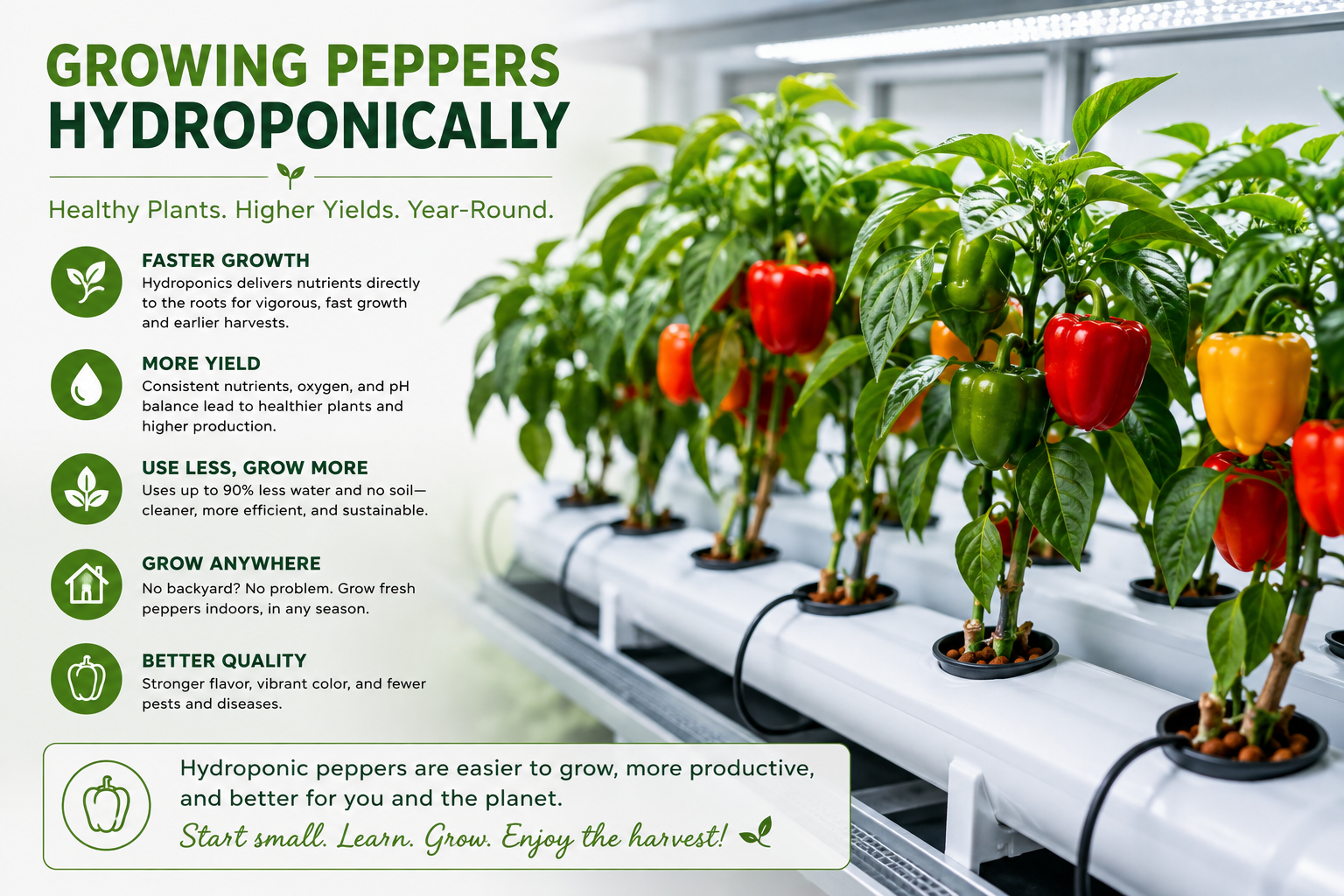
Learning how to grow peppers hydroponically is an excellent next step for anyone who has already grown herbs or leafy greens. Peppers are productive fruiting plants that can produce colorful, flavorful harvests for many months when they receive the right combination of light, nutrients, temperature, water, and pollination.
Unlike traditional soil gardening, hydroponic systems allow you to control the growing environment much more precisely. You can provide the roots with water and nutrients directly while maintaining consistent growing conditions throughout the season. This makes it possible to grow peppers hydroponically indoors, in a greenhouse, or in another controlled growing environment.
Peppers do require more attention than lettuce, basil, or mint because they need strong lighting, adequate root space, support, and successful pollination before they can produce fruit. However, once the plants become established, they can continue flowering and producing peppers for an extended period.
In this guide, you’ll learn how to grow peppers hydroponically from seed through harvest. We’ll cover pepper varieties, hydroponic systems, seed starting, transplanting, nutrient management, lighting, temperature, humidity, pollination, fruit development, common problems, harvesting, and long-term plant care.
Why Grow Peppers Hydroponically?
There are several reasons growers choose to grow peppers hydroponically instead of using traditional soil.
Better Control Over Nutrients
In soil, nutrients can become unavailable because of soil pH, drainage problems, or other factors. Hydroponic systems deliver dissolved nutrients directly to the root zone, allowing you to monitor and adjust the nutrient concentration.
Consistent Water Supply
Peppers need consistent access to moisture, especially when flowering and developing fruit. A properly designed hydroponic system can provide regular water without the extreme wet-and-dry cycles that sometimes occur in containers.
Faster and More Controlled Growth
When roots have access to oxygen, water, and nutrients under suitable conditions, pepper plants can grow vigorously. Controlled lighting and temperature can also extend the growing season.
Indoor Year-Round Production
One of the biggest advantages of learning to grow peppers hydroponically is that you’re not completely dependent on outdoor weather. With adequate artificial lighting and environmental control, peppers can be grown during seasons when outdoor production would be difficult.
Efficient Water Use
Hydroponic systems can recirculate water rather than allowing large quantities to drain away. This can significantly reduce water consumption compared with conventional growing methods.
Choosing the Best Pepper Varieties
The variety you choose has a major effect on plant size, fruit size, production time, and total harvest.
When you want to grow peppers hydroponically, choose varieties according to the amount of available space and the type of peppers you want to eat.
1. Bell Peppers
Bell peppers produce large, thick-walled fruit that can mature to red, yellow, orange, or other colors depending on the variety.
Advantages:
- Large, attractive fruit
- Excellent flavor
- Good production under strong lighting
- Suitable for hydroponic systems
The main disadvantage is that bell peppers generally take longer to mature than smaller pepper varieties.
2. Banana Peppers
Banana peppers are productive and relatively easy to manage.
They are a good option for beginners because they can produce fruit earlier than many large bell pepper varieties.
3. Lunchbox Peppers
Lunchbox peppers are small, sweet peppers that are especially useful when growing space is limited.
They are often compact and productive, making them an excellent choice for people learning to grow peppers hydroponically indoors.
4. Jalapeños
Jalapeños are popular hot peppers that can produce numerous fruits under good growing conditions.
They are suitable for hydroponic gardens because they can continue producing new flowers and fruit once established.
5. Habaneros
Habaneros produce very hot, flavorful peppers. They generally require a longer growing period but can become highly productive mature plants.
Best Pepper for Beginners
If this is your first attempt to grow peppers hydroponically, consider starting with a compact lunchbox, banana, or jalapeño variety. These can be easier to manage than large bell pepper plants.
Best Hydroponic Systems for Peppers
Peppers eventually develop substantial root systems and can become top-heavy. Therefore, your hydroponic system needs to provide adequate root space and physical support.
Drip Hydroponics
A drip system is one of the best choices for people who want to grow peppers hydroponically.
Nutrient solution is delivered directly to the growing medium through drip emitters.
Advantages:
- Excellent control over irrigation
- Suitable for large plants
- Easy to scale
- Works well with coco coir or similar media
- Good for multiple plants
A large container, such as a 7- to 10-gallon pot, provides useful root space for mature plants.
Deep Water Culture
Deep Water Culture (DWC) places plant roots in an oxygenated nutrient solution.
Advantages:
- Simple design
- Excellent access to water and nutrients
- Good for individual pepper plants
The main challenge is maintaining suitable water temperature and oxygen levels.
Nutrient Film Technique
NFT systems circulate a thin film of nutrient solution through growing channels.
NFT can work for peppers when the system is properly designed, but mature pepper plants can develop large roots that may be difficult to manage in small channels.
Best Choice
For beginners, a drip system with a large container is generally one of the easiest approaches for growing large pepper plants.
Starting Pepper Seeds
If you want to grow peppers hydroponically from seed, start with clean, high-quality seeds from a reliable source.
Pepper seeds can take longer to germinate than many leafy greens.
Step-by-Step Seed Starting
- Fill a clean seed-starting tray with a suitable sterile growing medium.
- Plant each pepper seed approximately ¼ inch deep.
- Keep the medium consistently moist but not saturated.
- Maintain a warm temperature around 75–80°F.
- Provide gentle lighting after seedlings emerge.
- Give seedlings approximately 14–16 hours of light per day.
- Thin seedlings if multiple plants emerge in the same cell.
- Keep the strongest healthy seedling.
Pepper germination can take approximately 7–14 days, although some varieties may take longer.
Don’t Overwater Seedlings
Young pepper roots need oxygen. Constantly saturated growing media can reduce oxygen around the roots and encourage root problems.
The goal is to maintain moisture while still allowing adequate air around the developing root system.
When to Transplant Pepper Seedlings
Pepper seedlings are ready for their hydroponic system when they have developed several true leaves and a healthy root system.
A useful guideline is approximately:
- 3–4 inches tall
- 6–8 true leaves
- Healthy white roots
- Strong central stem
- No signs of disease or severe stress
Avoid transplanting extremely small seedlings into a large production system too early.
Once the plant is established, it can begin developing the larger root system needed for heavy fruit production.
How to Transplant Peppers Into Hydroponics
To successfully grow peppers hydroponically, transplanting needs to be done carefully.
Step 1: Prepare the Container
Fill a suitable 7- to 10-gallon container with your chosen growing medium.
Step 2: Position the Seedling
Place the seedling and its growing plug into the center of the container.
Avoid damaging the roots during transplantation.
Step 3: Add the Drip Line
Position the drip emitter near the plant’s root zone.
As the plant grows, you may need additional emitters to distribute moisture more evenly.
Step 4: Add Plant Support
Install a stake, trellis, or support system immediately.
Pepper plants become heavier as fruit develops, and branches can bend or break.
Step 5: Begin With Mild Nutrients
Use a lower nutrient concentration immediately after transplanting and gradually increase it as the plant establishes.
Nutrient Management for Hydroponic Peppers
Nutrient management is one of the most important parts of learning to grow peppers hydroponically.
Peppers have different nutrient requirements during vegetative growth and fruit production.
Early Vegetative Growth
A starting EC range around:
1.0–1.4 mS/cm
can be appropriate depending on the cultivar, growing conditions, and nutrient formulation.
A slightly higher nitrogen proportion can support leaf and stem development.
Flowering and Fruiting
Once plants begin flowering and fruiting, nutrient requirements generally increase.
A commonly used target range is approximately:
1.8–2.5 mS/cm
However, don’t increase EC suddenly. Gradual adjustments are safer because plant response depends on temperature, light intensity, humidity, and water consumption.
pH
A useful hydroponic pepper pH range is approximately:
5.8–6.5
Regularly monitor pH because nutrient availability depends strongly on the solution’s pH.
Calcium and Magnesium
Calcium is particularly important during fruit development.
A balanced hydroponic nutrient program should provide adequate calcium and magnesium. If using a nutrient system that does not supply enough of these elements, a suitable supplement may be required.
How Often Should You Check Nutrients?
During active growth, check EC and pH several times per week.
During heavy fruiting, frequent monitoring becomes even more important because plants can consume water and nutrients rapidly.
Avoid making large corrections unless measurements clearly indicate a problem.
Lighting Requirements for Hydroponic Peppers
Strong lighting is essential if you want to grow peppers hydroponically and produce substantial fruit.
Peppers require considerably more light than herbs such as mint.
Recommended Photoperiod
A practical indoor schedule is approximately:
16–18 hours of light per day
followed by a consistent dark period.
LED Grow Lights
Full-spectrum LED grow lights are an excellent option for indoor peppers because they provide strong light while generally using less electricity than older lighting technologies.
Light Position
Keep lights at an appropriate distance according to the manufacturer’s recommendations.
Seedlings require less intensity than mature plants.
As the plant develops, gradually provide stronger light while watching for signs of light stress.
Signs of Insufficient Light
Low-light pepper plants may become:
- Tall
- Thin
- Weak
- Sparse
- Slow-growing
- Poorly productive
If plants stretch toward the light, improve light intensity or positioning.
Temperature for Hydroponic Peppers
Peppers are warm-season plants.
Maintaining suitable temperatures is especially important during flowering.
Recommended Air Temperature
Day: 72–85°F
Ideal daytime range: approximately 75–80°F
Night: approximately 65–70°F
Temperatures that become too low can slow plant growth and reduce flower development.
Extremely high temperatures can also interfere with flowering and fruit set.
Nutrient Solution Temperature
Root-zone temperature matters when you grow peppers hydroponically.
A practical target is approximately:
68–72°F
Avoid allowing nutrient solution temperatures to become excessively warm because warm water holds less dissolved oxygen and can increase the risk of root problems.
Humidity and Air Circulation
Maintain approximately:
50–70% relative humidity
During flowering, somewhat lower humidity can be beneficial.
Good air circulation is also important.
Use an oscillating fan to create gentle movement through the leaves and branches. Air movement can help strengthen stems and move pollen between flowers.
Avoid extremely strong airflow that continuously bends or damages plants.
How to Pollinate Hydroponic Peppers
Pollination is one of the biggest differences between growing leafy greens and learning to grow peppers hydroponically.
Pepper flowers contain both male and female reproductive structures, so peppers are generally self-fertile. However, indoor environments may not provide enough natural movement to transfer pollen effectively.
Method 1: Electric Toothbrush
A small electric toothbrush can be used to create gentle vibration.
Place the vibrating end near the flower or flower stem for approximately 1–2 seconds.
The vibration helps release pollen.
Method 2: Soft Brush
Use a small, clean soft brush.
Gently touch the inside of the flower and move between flowers to help transfer pollen.
Method 3: Air Movement
A fan can create enough movement to help distribute pollen.
However, indoor growers often combine airflow with occasional manual pollination for more reliable fruit set.
How Often Should You Pollinate?
During active flowering, gently pollinate flowers every few days.
Consistent pollination is especially useful when there are many flowers developing simultaneously.
Pepper Flower and Fruit Development
After successful pollination, a small pepper fruit begins developing behind the flower.
The fruit may initially be very small and easy to overlook.
Typical Development
Depending on the variety and growing conditions:
- Flowers may appear around 6–8 weeks after transplanting.
- Fruit can begin developing shortly after successful pollination.
- Green fruit may take several weeks to reach mature size.
- Colored varieties can require additional time to turn red, yellow, or orange.
The exact timeline varies significantly by cultivar.
Should You Remove Early Flowers?
Some growers remove the first few flowers from young pepper plants.
The purpose is to encourage the plant to build a larger root and leaf system before supporting heavy fruit production.
This approach can be useful when the plant is still small.
However, once the plant is well established and actively growing, allowing flowers to develop can provide earlier harvests.
Supporting Pepper Plants
Mature pepper plants can become surprisingly heavy.
Fruit adds additional weight to branches, particularly with large bell pepper varieties.
Use:
- Stakes
- Trellises
- Plant clips
- Soft ties
Avoid tightly tying stems because they expand as the plant grows.
Providing support early is easier than trying to support a large plant after branches become overloaded with fruit.
Common Problems When Growing Peppers Hydroponically
Even though hydroponics gives you more control, problems can still occur.
Blossom End Rot
Blossom end rot appears as a dark, sunken area near the bottom of developing fruit.
It is commonly associated with inadequate calcium delivery to developing fruit, often influenced by inconsistent water availability or root-zone stress.
What to Do
- Maintain consistent irrigation.
- Check root health.
- Avoid major EC fluctuations.
- Maintain appropriate pH.
- Ensure adequate calcium in the nutrient solution.
Simply adding more calcium does not always solve the problem if the plant cannot consistently move calcium to developing fruit.
Flowers Falling Without Producing Fruit
If flowers appear but fruit does not develop, possible causes include:
- Poor pollination
- Excessive heat
- Cold nighttime temperatures
- Nutrient imbalance
- Plant stress
- Excessive nitrogen
Solution
Improve airflow, manually pollinate flowers, maintain suitable temperatures, and review your nutrient program.
Yellow Leaves
Yellowing leaves can have several causes.
Possible causes include:
- Nutrient deficiency
- Root problems
- Incorrect pH
- Excessive irrigation
- Aging leaves
- Nutrient imbalance
Don’t automatically assume yellow leaves mean nitrogen deficiency.
Check pH, EC, root condition, irrigation, and environmental conditions before making major nutrient changes.
Powdery Mildew
Powdery mildew appears as a white, powdery coating on leaves.
It is more likely when humidity is high and airflow is poor.
Prevention
- Maintain adequate airflow.
- Avoid overcrowding.
- Keep humidity under control.
- Remove severely affected plant material.
- Keep leaves dry when possible.
Slow Growth
Slow growth may result from:
- Insufficient light
- Low temperatures
- Poor root health
- Incorrect pH
- Nutrient imbalance
- Small root space
- Environmental stress
When you grow peppers hydroponically, don’t change several variables at once. Check each part of the growing environment systematically.
How to Improve Pepper Yields
If your goal is to grow peppers hydroponically for maximum production, focus on consistency rather than simply adding more nutrients.
1. Provide Strong Light
Fruit production requires significant energy. Make sure mature plants receive adequate light.
2. Maintain Stable Temperatures
Avoid large temperature fluctuations, particularly during flowering.
3. Pollinate Regularly
Indoor plants often benefit from manual pollination.
4. Maintain Healthy Roots
Healthy roots are essential for water and nutrient uptake.
5. Give Plants Enough Space
Avoid crowding mature pepper plants.
6. Provide Support
Prevent heavy fruit from breaking branches.
7. Monitor EC and pH
Regular measurements allow you to identify changes before they become serious problems.
8. Harvest Regularly
Regular harvesting can encourage the plant to continue producing new flowers and fruit.
Harvesting Hydroponic Peppers
One of the most rewarding parts of learning to grow peppers hydroponically is harvesting your own mature fruit.
Peppers can usually be harvested at different stages depending on the variety and your preferred flavor.
Harvesting Green Peppers
Pick peppers once they have reached their expected size but are still green.
Green peppers are usually harvested earlier than fully colored peppers.
Harvesting Colored Peppers
If you want sweeter, more mature peppers, allow them to remain on the plant until they develop their final color.
Depending on the variety, this may be:
- Red
- Yellow
- Orange
- Purple
- Brown
Colored peppers generally take longer to mature than green peppers.
Harvesting Technique
Use clean pruning shears or a sharp knife.
Cut the stem rather than aggressively pulling or twisting the fruit.
Supporting the branch while harvesting helps prevent damage.
How Long Do Hydroponic Pepper Plants Produce?
Pepper plants can remain productive for many months under suitable conditions.
Some plants can continue producing for six months or longer, while others may remain productive for a year or more.
Eventually, plants can become woody and production may decline.
At that point, you can either:
- Continue maintaining the existing plant
- Take cuttings where appropriate
- Start new plants from seed
- Replace older plants with young seedlings
Maintaining a continuous rotation of young and mature plants can help provide more consistent production.
Tips for Beginners
If you’re just learning to grow peppers hydroponically, don’t try to optimize everything immediately.
Start with one or two plants.
Focus on:
- Healthy roots
- Appropriate lighting
- Stable temperature
- Correct pH
- Appropriate EC
- Good airflow
- Regular pollination
- Proper plant support
- Consistent irrigation
- Regular harvesting
Once you understand how the plants respond, you can expand your system.
Frequently Asked Questions
How long does it take to grow peppers hydroponically?
The timeline depends on the variety and whether you start from seed or transplant. From seed, peppers can take several months before producing mature fruit. After transplanting an established seedling, the first flowers may appear within several weeks.
Can you grow peppers hydroponically indoors?
Yes. Indoor hydroponic peppers can grow successfully when provided with adequate light, nutrients, airflow, temperature, and space.
Do hydroponic peppers need pollination?
Yes. Pepper flowers are generally self-fertile, but indoor plants may benefit significantly from manual vibration or brushing to help transfer pollen.
What is the best hydroponic system for peppers?
Drip hydroponics is an excellent option because it provides good control over irrigation and can support large plants. DWC can also work well for individual plants.
What EC should peppers have during fruiting?
A commonly used range is approximately 1.8–2.5 mS/cm during flowering and fruiting. The ideal level depends on the variety, nutrient formulation, environment, and plant response.
What pH is best for hydroponic peppers?
A pH around 5.8–6.5 is commonly suitable for hydroponic peppers.
How much light do hydroponic peppers need?
Peppers are high-light fruiting plants. Indoor growers commonly provide approximately 16–18 hours of light per day, with intensity appropriate for mature fruiting plants.
Why are my pepper flowers dropping?
Flower drop can result from poor pollination, temperature stress, excessive nitrogen, inadequate light, or general plant stress. Check environmental conditions and manually pollinate flowers.
How many peppers can one hydroponic plant produce?
Production varies greatly by variety, plant size, growing period, lighting, pollination, and environmental conditions. A healthy mature plant can produce dozens of peppers over an extended production period.
Can peppers grow hydroponically year-round?
Yes. If you provide suitable artificial lighting and maintain appropriate environmental conditions, you can grow peppers hydroponically throughout the year rather than relying entirely on outdoor seasons.
Final Thoughts: Growing Peppers Hydroponically
Learning to grow peppers hydroponically can be highly rewarding because you are not simply producing leaves—you are producing full-sized, flavorful fruit from a controlled growing system.
The key is to provide the plant with enough root space, strong lighting, appropriate nutrients, stable temperatures, good airflow, and consistent water availability. Once flowering begins, pay particular attention to pollination because indoor plants may not receive enough natural pollen movement.
For beginners, compact varieties such as lunchbox peppers, banana peppers, or jalapeños can be easier to manage than very large bell pepper plants. A drip system with a large container can provide the root space and irrigation control that mature pepper plants need.
With patience and consistent care, growing peppers hydroponically can provide fresh peppers for months. Monitor your plants regularly, make gradual adjustments, and learn from how they respond to changes in their growing environment.
Whether you’re growing a few plants indoors or building a larger hydroponic garden, peppers are an excellent fruiting crop to add to your system.
Internal Links
Why Are Hydroponic Leaves Turning Yellow? 7 Common Problems and Easy Solutions
How to Grow Microgreens Hydroponically: 16 Proven Complete Beginner’s Guide
How to Grow Strawberries Hydroponically: 10 Easy Steps for Beginners
Related reading
10 thoughts on “How to Grow Peppers Hydroponically: Complete Guide to Fruiting, Pollination & High Yields”