
Indoor Hydroponic Garden: Complete Beginner’s Guide to Growing Plants Indoors

Introduction
Growing fresh vegetables and herbs at home does not always require a backyard, fertile soil, or a large outdoor garden. An indoor hydroponic garden can let you grow plants inside your home by supplying their roots with water, nutrients, oxygen, and the right amount of light.
For beginners, the idea can sound complicated at first. There are different hydroponic systems, nutrients, grow lights, growing media, pumps, and measurements to understand. But you do not need a complicated commercial setup to get started.
In this guide, you will learn how an indoor hydroponic garden works, what equipment you need, how to set one up, which plants are easiest to grow, how to manage light and nutrients, and how to troubleshoot common problems.
What Is an Indoor Hydroponic Garden?
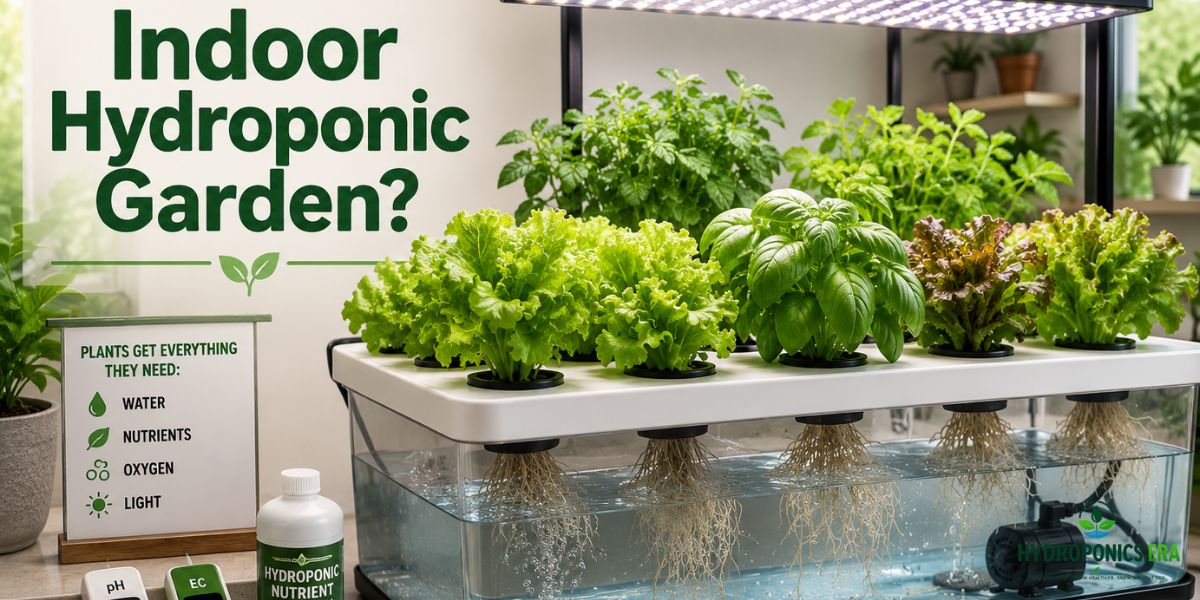
An indoor hydroponic garden is a growing system that allows plants to grow indoors without traditional garden soil. Instead of searching through soil for nutrients and water, plant roots receive the resources they need through a nutrient solution.
Hydroponics can use several different approaches. In some systems, roots sit directly in nutrient-rich water. In others, plants grow in a soilless medium while nutrient solution is delivered to their roots.
Penn State Extension defines hydroponics as growing plants in water containing nutrients and also notes that growing plants without soil can include systems using soilless media.
How Indoor Hydroponic Gardening Works
The basic process is straightforward:
- Water is placed in a reservoir.
- Hydroponic nutrients are added to the water.
- The nutrient solution reaches the plant roots.
- The roots receive water, nutrients, and oxygen.
- A grow light provides the light needed for photosynthesis when natural light is insufficient.
- The grower monitors the system and adjusts conditions when necessary.
The exact process depends on the type of system you choose.
How It Differs from Growing Plants in Soil
In conventional gardening, soil acts as both a physical support and a source or storage medium for water and nutrients.
In an indoor hydroponic garden, the grower has much more direct control over the root environment.
That can be useful, but it also means you have more responsibility. A mistake involving nutrient concentration, pH, water quality, or lighting can affect plants relatively quickly.
Hydroponic systems are therefore not completely maintenance-free. They replace some traditional gardening tasks with monitoring and system management.
Why Grow Plants Indoors?
Indoor growing is especially useful when outdoor space is limited or when you want more control over the growing environment.
An indoor setup can provide:
- Protection from outdoor weather
- More control over lighting
- A convenient growing location
- Efficient use of small spaces
- The ability to grow regardless of the outdoor season
- An opportunity to grow fresh herbs and vegetables close to the kitchen
Vertical hydroponic systems can be particularly useful when floor space is limited. Oklahoma State University notes that vertical systems can support high plant density and can be used for year-round indoor production when appropriate lighting is provided.
What Do You Need for an Indoor Hydroponic Garden?

You do not need every piece of hydroponic equipment available on the market. Your requirements depend on the system, crops, and available space.
For a simple indoor hydroponic garden, beginners generally need the following.
Hydroponic Growing System
The growing system holds the plants and delivers nutrient solution to their roots.
Common options include:
- Deep Water Culture (DWC)
- Nutrient Film Technique (NFT)
- Ebb and flow
- Drip systems
- Wick systems
- Aeroponic systems
For a first project, a simple DWC or another small beginner-friendly system can be easier to understand than a complicated multi-level installation.
Water Reservoir
The reservoir holds the nutrient solution.
Use a container appropriate for your system and keep light exposure under control where necessary. Excess light reaching nutrient solution can encourage algae growth.
Hydroponic Nutrients
Plants still require nutrients even though they are not growing in soil.
A complete hydroponic nutrient program can provide essential nutrients, but nutrient requirements vary with the crop and growing conditions. Penn State Extension explains that nutrient solutions can be prepared using fertilizer programs, recipes, or complete soluble fertilizers.
Do not assume that adding more fertilizer will make plants grow faster. Excess nutrients can cause problems too.
Grow Lights
Light is one of the most important parts of an indoor hydroponic garden.
A bright window may provide useful natural light, but the amount and consistency of light can vary considerably. If plants do not receive enough light, they may become stretched and weak.
LED grow lights are widely used for indoor plant production. Oklahoma State University explains that light intensity, duration, quality, coverage area, plant type, and light placement all need to be considered when selecting lighting.
Air Pump and Air Stone
Some hydroponic systems need additional aeration.
An air pump connected to an air stone can introduce oxygen into the nutrient solution. This is particularly relevant to deep-water systems where roots remain in the solution.
Growing Media
Some systems require a material to support the plant.
Common options include:
- Rockwool
- Coco coir
- Perlite
- Clay pebbles
The growing medium is not intended to replace the nutrient solution. Its primary role is to support the plant and help create an appropriate root environment.
pH and EC Meters
A pH meter measures acidity or alkalinity.
An EC meter measures electrical conductivity, which can be used as an indicator of dissolved salts in a nutrient solution.
These tools become especially useful as you move beyond a very basic setup.
How to Set Up an Indoor Hydroponic Garden
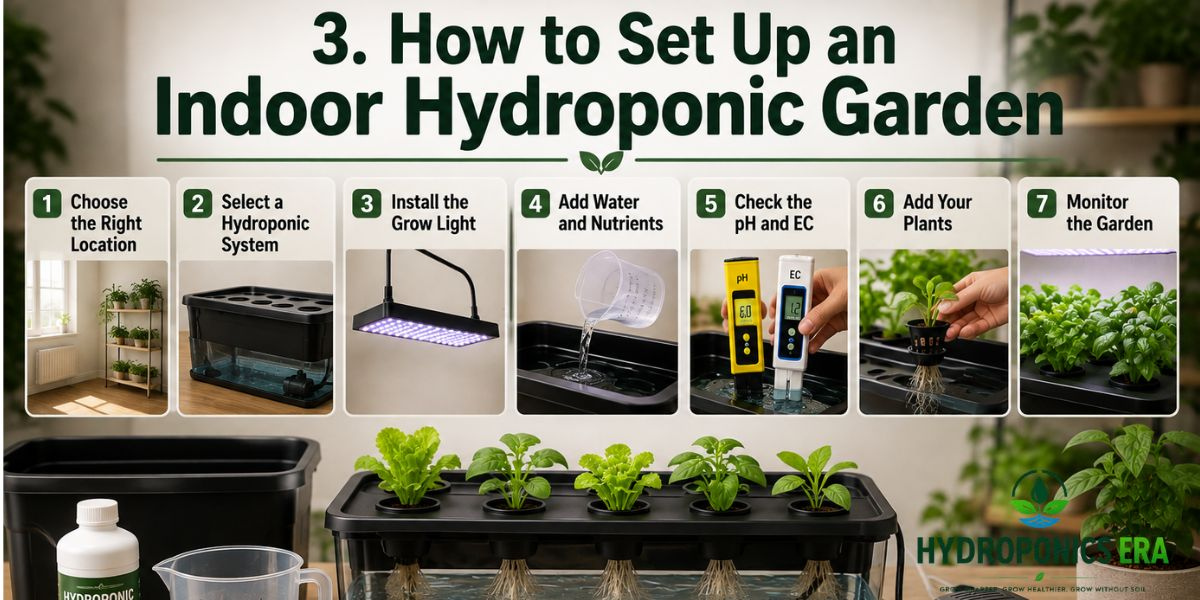
Setting up an indoor hydroponic garden is easier when you build the system around the plants you actually want to grow.
- Choose the Right Location
Start with a clean, stable area that has:
- Access to electricity
- Enough room for the plants
- Good ventilation
- A suitable surface for water equipment
- Enough vertical clearance for the plants and light
Avoid placing the system somewhere where a small water leak could damage electronics, furniture, or flooring.
-
Select a Hydroponic System
Choose a system based on your experience and available space.
For beginners, simplicity is valuable.
A small DWC system can be easier to understand because the basic idea is straightforward: plants are supported above a nutrient solution while their roots access the solution.
If you want to grow many plants in a small area, an NFT or vertical system may make more sense.
-
Install the Grow Light
Position the grow light so that the plant canopy receives reasonably even coverage.
Do not choose the light based only on wattage. Coverage, plant type, light intensity, distance, and the manufacturer’s specifications all matter.
LED grow lights can be useful because they are available in many sizes and designs, and horticultural LED systems can offer high efficiency and relatively low heat emission compared with some traditional lighting technologies.
-
Add Water and Nutrients
Fill the reservoir with appropriate water and add hydroponic nutrients according to the nutrient manufacturer’s instructions.
Avoid guessing the concentration.
Water quality also matters. Penn State Extension notes that the nutrients already present in a water source can affect how much fertilizer needs to be added to a hydroponic solution.
-
Check the pH and EC
Measure the solution after mixing the nutrients.
pH affects nutrient availability. Penn State Extension explains that pH plays an important role in plant nutrient availability and gives a general hydroponic vegetable range of approximately 5.0 to 7.0, while the ideal target depends on the crop and system.
Do not treat one pH number as perfect for every crop.
-
Add Your Plants
You can start plants from seeds or use suitable seedlings.
Make sure the roots are positioned appropriately for the system. Avoid burying plant stems unnecessarily or allowing unsupported plants to wobble.
-
Monitor the Garden
Your job does not end after the system is assembled.
Regularly check:
- Water level
- pH
- EC
- Root appearance
- Leaf color
- Plant growth
- Light position
- Pump operation
- Temperature
- Signs of algae or pests
A simple routine can prevent small problems from becoming major ones.
Best Plants for an Indoor Hydroponic Garden
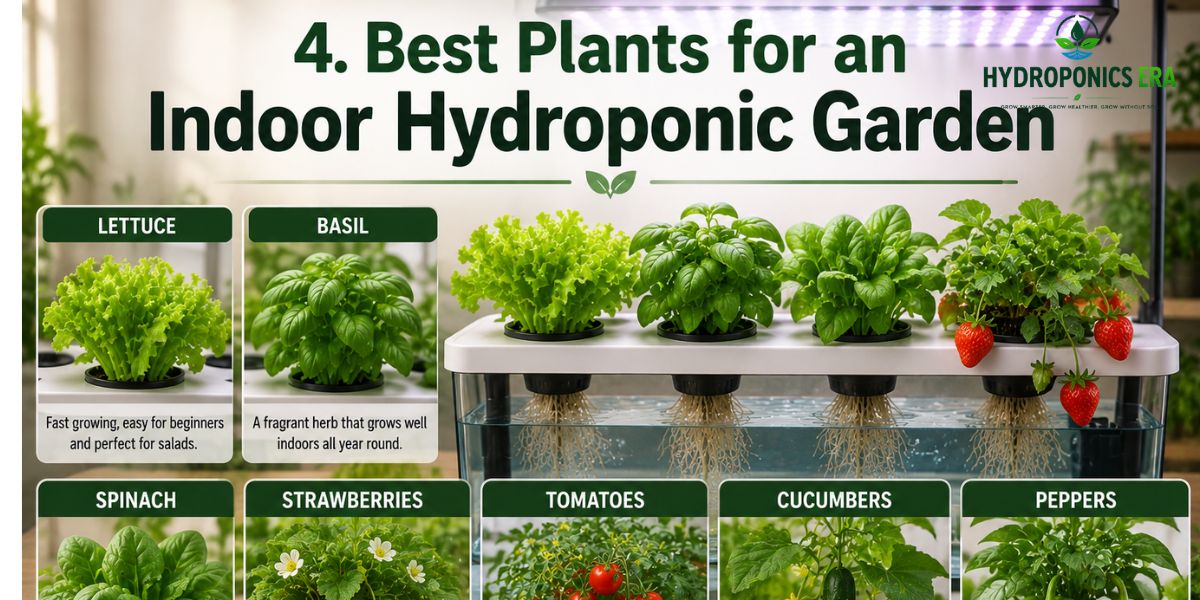
Not every plant is equally convenient for a beginner.
Leafy greens and herbs are often easier starting choices because they generally require less space than large fruiting plants.
Lettuce
Lettuce is one of the most practical crops for a small indoor hydroponic garden.
It does not require the same vertical space as large tomato or cucumber plants, making it suitable for compact systems.
Basil and Other Herbs
Basil is another popular choice.
Herbs can work particularly well when the garden is located near a kitchen. Other herbs can also be considered depending on your system and available space.
Spinach
Spinach can be grown hydroponically, although environmental conditions still need to be appropriate for the variety and growth stage.
Strawberries
Strawberries can be grown hydroponically, but they generally require more planning than simple leafy greens.
Pay attention to lighting, pollination requirements, plant support, and space.
Tomatoes
Tomatoes can grow well in hydroponic systems but are more demanding than lettuce.
They need adequate lighting, root support, nutrients, and enough vertical space for plant growth.
Cucumbers
Cucumbers can become large plants, so they require a system with enough room for vines and appropriate support.
Peppers
Peppers are another option for growers who want to move beyond leafy greens.
However, fruiting plants generally require more attention to lighting and overall plant management.
How Much Light Does an Indoor Hydroponic Garden Need?

Lighting is one of the biggest differences between an indoor and outdoor garden.
If your plants do not receive enough light, they may stretch toward the light source and produce weak, elongated growth.
Choosing the Right Grow Light
Look for a horticultural light designed for plant production rather than simply choosing a household bulb.
Important considerations include:
- Growing area
- Plant type
- Light intensity
- Light spectrum
- Distance from the canopy
- Heat
- Energy consumption
- Manufacturer recommendations
Oklahoma State University recommends considering plant type, coverage area, environmental conditions, light quantity, quality, and duration when selecting LED lighting.
How Far Should Grow Lights Be from Plants?
There is no single distance that works for every grow light.
Two lights with different designs can produce very different light levels at the same distance.
Start with the manufacturer’s recommended hanging distance and watch the plants.
Signs of insufficient light can include:
- Long, weak stems
- Large gaps between leaves
- Plants leaning toward the light
- Slow growth
Signs of excessive light or heat can include leaf stress, bleaching, or excessive heat around the canopy.
Light Duration for Indoor Plants
The correct photoperiod depends on the crop and growth stage.
For example, Oklahoma State University notes that indoor seedlings may require roughly 12–14 hours of supplemental light per day, while other plant categories have different requirements.
For hydroponic vegetables, follow crop-specific guidance and the instructions associated with your lighting system rather than assuming that more hours always mean better growth.
How to Manage Water and Nutrients?

Water management is at the heart of an indoor hydroponic garden.
The roots need access to water and nutrients, but the solution also needs appropriate oxygenation and chemical conditions.
How Often Should You Change the Water?
There is no universal schedule that applies to every hydroponic system.
The appropriate approach depends on:
- Reservoir size
- Crop
- System type
- Plant size
- Nutrient concentration
- Water quality
- Evaporation
- How quickly plants consume nutrients
Instead of changing water simply because a calendar says it is time, monitor the system and follow a consistent maintenance routine.
How to Mix Hydroponic Nutrients
Always follow the fertilizer manufacturer’s mixing instructions.
Do not assume that doubling the recommended concentration will double plant growth.
Hydroponic nutrient calculations can become more complicated when individual fertilizers are used because each fertilizer can supply multiple nutrients. Penn State Extension provides detailed guidance on calculating nutrient concentrations and explains that water chemistry should also be considered.
Understanding pH
pH describes how acidic or alkaline a solution is.
In hydroponics, pH matters because it affects nutrient availability.
If the pH moves outside a suitable range, certain nutrients can become less available to plants even when those nutrients are physically present in the solution.
Understanding EC
EC, or electrical conductivity, provides an indication of the concentration of dissolved salts in the solution.
It is useful for monitoring nutrient strength, but EC should not be treated as a complete picture of plant nutrition.
The correct EC depends on the crop, variety, growth stage, fertilizer program, and water source.
Signs of Nutrient Problems
Possible signs include:
- Yellow leaves
- Slow growth
- Leaf-edge damage
- Unusual coloration
- Weak new growth
- Wilting despite adequate water
However, symptoms can have multiple causes.
For example, yellow leaves do not automatically mean that you need more fertilizer. Lighting, pH, root health, temperature, water quality, and nutrient balance can all influence plant appearance.
Penn State Extension emphasizes that hydroponic nutrient problems can develop quickly and recommends monitoring the nutrient solution and plant status.
How to Maintain an Indoor Hydroponic Garden?
A successful indoor hydroponic garden does not need constant attention, but it does need consistent attention.
Daily Checks
A quick daily inspection can include:
- Looking at plant leaves
- Checking the water level
- Checking whether pumps are operating
- Looking for leaks
- Checking for obvious pest problems
Weekly Maintenance
Depending on the system, weekly tasks may include:
- Checking pH and EC
- Inspecting roots
- Cleaning equipment when necessary
- Checking tubing
- Removing dead leaves
- Checking the grow-light position
- Inspecting the reservoir
Cleaning the System
Cleanliness matters because organic debris and plant material can contribute to water-quality problems.
When cleaning, follow the recommendations appropriate for your equipment and growing system.
Do not allow cleaning products to remain in contact with the nutrient solution unless they are specifically appropriate for that purpose.
Monitoring Roots and Water Quality
Roots are an important window into the health of your system.
Healthy roots should not be ignored simply because the leaves look good.
If roots become brown, slimy, or otherwise abnormal, investigate oxygenation, temperature, water quality, sanitation, and other environmental conditions rather than immediately adding more fertilizer.
Penn State Extension identifies root and nutrient-related symptoms as important indicators of hydroponic problems.
Common Indoor Hydroponic Garden Problems

Even a well-designed indoor hydroponic garden can develop problems.
Yellow Leaves
Yellow leaves can result from several causes, including nutrient deficiency, nutrient imbalance, pH problems, root stress, or environmental conditions.
Start by checking the basics instead of immediately adding more nutrients.
Brown or Slimy Roots
Brown or slimy roots deserve attention.
Possible contributing factors include poor oxygenation, unfavorable water conditions, or root-health problems.
Inspect the system and determine what changed before trying multiple treatments at once.
Algae Growth
Algae becomes more likely when light reaches nutrient-rich water.
Use appropriate opaque materials around reservoirs and exposed nutrient solution areas.
Wilting Plants
Wilting does not always mean that plants need more water.
Check:
- Water level
- Pump operation
- Root condition
- Temperature
- Nutrient concentration
- Airflow
Slow Growth
Slow growth can result from inadequate light, unsuitable temperature, nutrient problems, poor root health, or insufficient space.
Avoid changing several variables simultaneously. Make one reasonable adjustment and observe the response.
Indoor Hydroponic Garden vs Outdoor Hydroponic Garden

Both approaches can work, but the environment is different.
| Feature | Indoor Hydroponic Garden | Outdoor Hydroponic Garden |
| Light | Often requires artificial lighting | Usually relies on sunlight |
| Weather | More controllable | Exposed to weather |
| Space | Useful for small areas | Can use larger areas |
| Temperature | Easier to manage in a controlled room | Changes with weather |
| Growing season | Can be extended or year-round | More dependent on climate |
| Maintenance | Requires equipment monitoring | Requires outdoor environmental monitoring |
Indoor growing gives you more control, but that control comes with equipment and electricity requirements.
Common Mistakes Beginners Should Avoid
The biggest mistake is often trying to make the system more complicated than necessary.
-
Adding Too Much Fertilizer
More fertilizer does not automatically mean faster growth.
Follow the nutrient manufacturer’s instructions and monitor the solution.
-
Ignoring pH
A nutrient solution can contain the correct nutrients while still creating availability problems if pH is unsuitable.
-
Using Insufficient Light
Plants need adequate light for photosynthesis. A room that looks bright to your eyes may not provide the same light environment plants receive outdoors.
-
Overcrowding Plants
Give each plant enough room for its leaves and roots.
Crowding can reduce airflow and make it harder to provide uniform lighting.
-
Neglecting the Roots
Do not only look at leaves.
Root condition can provide important clues about the health of the system.
-
Changing Everything at Once
If plants look unhealthy, avoid randomly changing nutrients, lighting, water, temperature, and the entire system simultaneously.
Start with the most likely causes and make controlled adjustments.
-
Choosing Difficult Crops First
Large fruiting crops can be rewarding, but they may require more support and management.
Starting with lettuce or herbs can give beginners an easier way to learn the fundamentals.
Is an Indoor Hydroponic Garden Worth It?
For many home growers, an indoor hydroponic garden can be worthwhile if they value fresh produce, limited-space gardening, and greater environmental control.
It is especially attractive when outdoor gardening space is limited.
However, hydroponics is not automatically easier than soil gardening. You need to monitor equipment, water, nutrients, light, and plant health.
Oklahoma State University describes home hydroponic gardening as increasingly accessible while also noting that hydroponics can be technically demanding and less forgiving than traditional gardening.
The best approach for a beginner is usually to start small.
Grow a few easy plants, learn how your system behaves, and expand once you understand the basics.
Frequently Asked Questions About Indoor Hydroponic Gardens
Can you grow vegetables in an indoor hydroponic garden?
Yes. Leafy greens, herbs, and many fruiting vegetables can be grown indoors hydroponically when their requirements for light, nutrients, water, temperature, and root support are met.
What is the easiest plant to grow hydroponically indoors?
Leafy greens and herbs are generally good starting choices because many require less space than large fruiting crops. Lettuce and basil are common beginner options.
Does an indoor hydroponic garden need sunlight?
Not necessarily. Plants need adequate light, but that light can come from sunlight, artificial grow lights, or a combination of both. If natural light is insufficient, supplemental lighting may be necessary.
How often should you change hydroponic water?
There is no single schedule for every system. Reservoir size, crop, plant size, nutrient concentration, water quality, and system design all affect maintenance requirements. Monitor the solution and follow a consistent management routine.
How much does it cost to start an indoor hydroponic garden?
The cost varies significantly. A simple DIY system can require relatively little equipment, while automated systems with pumps, lighting, sensors, and larger growing areas can cost considerably more.
The best way to control cost is to start with a small system rather than buying equipment you do not yet need.
Can hydroponic plants grow without soil?
Yes. That is one of the defining features of hydroponic growing. Plants receive water and nutrients through a nutrient solution, while some systems also use a soilless growing medium to support the plants.
Final Thoughts
Starting an indoor hydroponic garden does not have to be complicated.
The basic idea is simple: provide plants with the right combination of water, nutrients, oxygen, light, and a suitable root environment.
For beginners, start with a small system and a few easy crops. Learn how to check pH, understand nutrient strength, position your grow lights, and recognize early signs of plant stress.
Once those fundamentals become familiar, you can experiment with larger systems, vertical growing, fruiting crops, automation, and more advanced hydroponic techniques.
The goal is not to build the most complicated indoor hydroponic garden possible. It is to build a system you understand well enough to keep your plants healthy.
Internal Related Articles For Hydroponicera
- How to Grow Microgreens Hydroponically: 16 Proven Complete Beginner’s Guide
- How to Grow Peppers Hydroponically: Complete Guide to Fruiting, Pollination & High Yields
- How to Grow Strawberries Hydroponically: 10 Easy Steps for Beginners
- How Often to Change Hydroponic Water? Proven Complete Guide
- How to Grow Lettuce Hydroponically: Proven Secrets for a Successful Harvest
Sources and Further Reading
- Penn State Extension — Hydroponics Systems and Principles of Plant Nutrition
- Penn State Extension — Nutrient Solution Programs and Recipes
- Penn State Extension — Calculating Nutrient Solution Concentrations
- Oklahoma State University Extension — LED Grow Lights for Plant Production
- Oklahoma State University Extension — Building a Vertical Hydroponic Tower
- Oklahoma State University Extension — Hydroponics
If an indoor garden starts to feel tight, aeroponics for beginners is another indoor method that uses mist and air instead of a full water column.
Related reading
19 thoughts on “Indoor Hydroponic Garden: Complete Beginner’s Guide to Growing Plants Indoors”