
Tomato leaf mold is a fungal disease of greenhouse, high-tunnel and grow-room tomatoes caused by Passalora fulva. It starts as pale yellow spots on top of older leaves with olive-green, velvety mold underneath. University of Minnesota Extension says it’s driven by relative humidity above 85%. The fix is mostly climate: lower humidity, add airflow, keep leaves dry, remove infected leaves and grow resistant varieties.
| Tomato leaf mold at a glance | Detail |
|---|---|
| Pathogen | Passalora fulva (formerly Fulvia fulva or Cladosporium fulvum) |
| Key trigger | Relative humidity at or above 85% |
| Temperature | Optimum 71–75°F; disease possible from about 50°F to 90°F |
| Upper leaf | Pale greenish-yellow spots, usually under 1/4 inch, fuzzy edges |
| Lower leaf | Olive-green to brown velvety mold |
| Host | Tomato (UMN says it isn’t known to infect other plants) |

How to Identify Tomato Leaf Mold
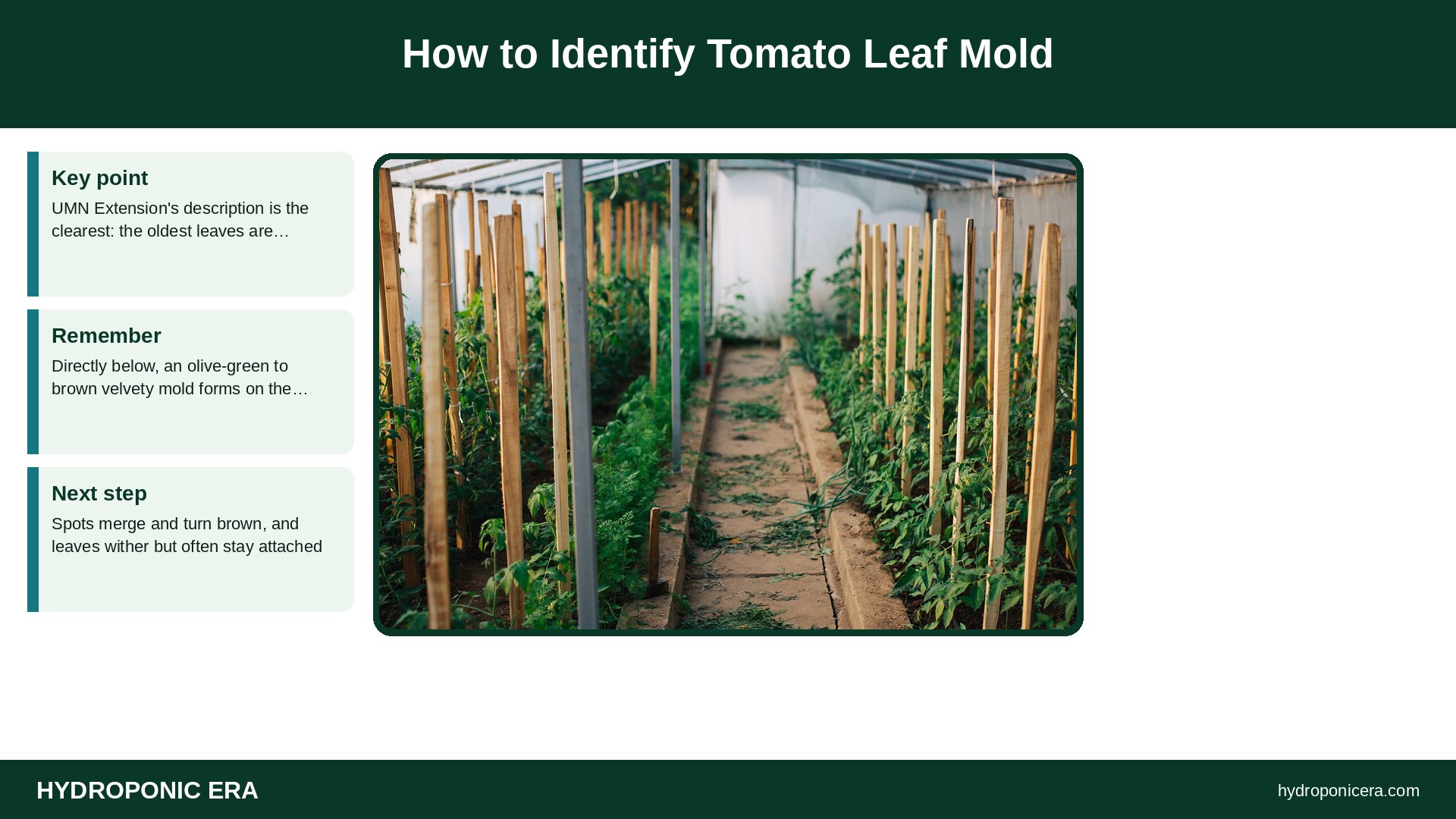
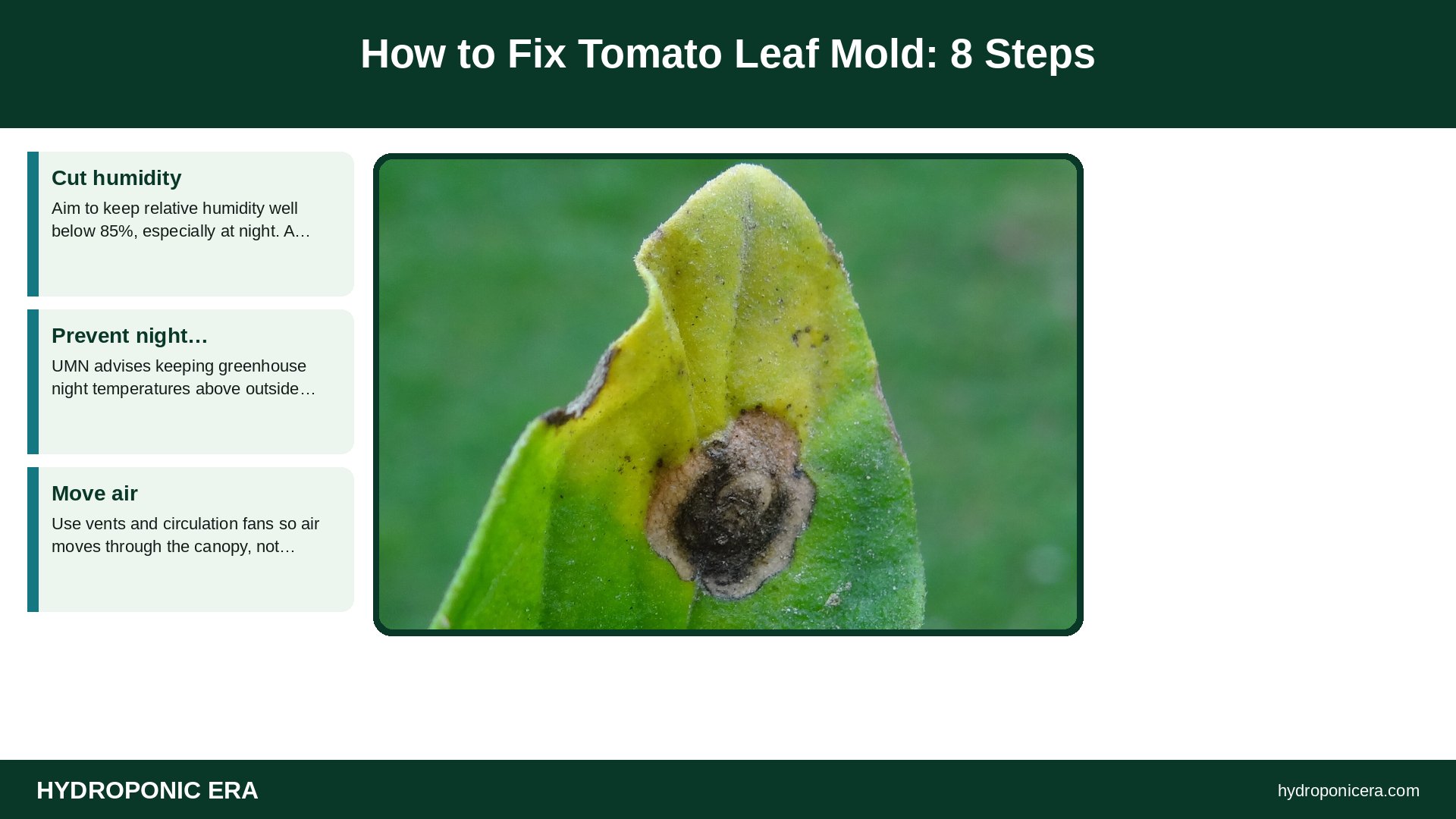
UMN Extension’s description is the clearest: the oldest leaves are infected first, with pale greenish-yellow spots on the upper surface that have no definite margins. Directly below, an olive-green to brown velvety mold forms on the underside. Spots merge and turn brown, and leaves wither but often stay attached. In severe cases infected blossoms turn black and drop, and fruit can develop a black, leathery area at the stem end.
Cornell’s fact sheet notes symptoms can appear about seven days after infection. Ohio State’s high tunnel disease guide puts it at about 10 days. Cornell also warns that nutrient deficiencies can look similar, but leaf mold spots are more discrete and come with that fuzzy underside.
Tomato Leaf Mold vs Look-Alikes
| Problem | Upper leaf | Underside | Typical setting |
|---|---|---|---|
| Tomato leaf mold | Diffuse yellow spots | Olive velvety mold | Humid greenhouse, tent or tunnel |
| Botrytis gray mold | Tan, water-soaked lesions | Gray fuzzy spores | Cool, humid, wounded tissue |
| Powdery mildew | White powder on top | Little underneath | Moderate humidity, still air |
| Magnesium deficiency | Yellowing between veins | No mold | Older leaves, any humidity |
If you’re unsure, see our Botrytis guide and white residue vs powdery mildew guide, or send a sample to your state’s plant diagnostic lab.
What Causes Tomato Leaf Mold Indoors
Tomato leaf mold is a humidity disease. UMN says relative humidity at or above 85% favors severe epidemics, though some disease can occur below that. Cornell explains spores enter leaves through stomata, and the fungus survives on crop debris and on and in seed. Spores spread by air movement, splashing water, tools and workers.
Ohio State notes the fungus can survive at least a year and that night heating helps avoid condensation. This is why grow tents and tightly closed greenhouses are risky: when lights go off, temperature drops, humidity spikes, and leaves can get wet with dew. That’s exactly when tomato leaf mold gets started. UMN also notes it’s unlikely in most outdoor home gardens because outdoor humidity rarely stays high enough for long.
How to Fix Tomato Leaf Mold: 8 Steps
- Cut humidity. Aim to keep relative humidity well below 85%, especially at night. A dehumidifier helps in tents; see our dehumidifier guide.
- Prevent night condensation. UMN advises keeping greenhouse night temperatures above outside temperatures so dew doesn’t form on leaves. Our condensation control guide covers tents.
- Move air. Use vents and circulation fans so air moves through the canopy, not just above it. See our airflow guide.
- Prune and space. Remove lower leaves and suckers, and stake or string plants to open the canopy. Our trellising and pruning guide explains how.
- Keep leaves dry. Use drip or root-zone feeding and never mist tomato foliage.
- Remove infected leaves. Bag them gently to avoid shaking spores loose. Cornell advises removing diseased plants and the plants around them when symptoms appear in a greenhouse.
- Sanitize. UMN suggests sterilizing stakes, ties and trellises with a 10% household bleach solution or a commercial sanitizer, and cleaning walls and benches at season end.
- Remove residue. Clear all crop debris after harvest, away from tomato areas.
Managing Humidity in Grow Tents and Hydroponic Rooms
Indoor hydroponic tomatoes transpire heavily, so a small tent can climb past 85% humidity within an hour of lights-off. A few habits keep tomato leaf mold out:
- Measure at canopy height. Put a hygrometer among the leaves, not near the exhaust fan, and check the overnight high.
- Run exhaust at night. Many growers turn fans down when lights go off, which is exactly when humidity peaks.
- Cover reservoirs. Open nutrient solution adds moisture to the air.
- Don’t overcrowd. Dense, unpruned plants trap humid air in the lower canopy where infections begin.
NC State Extension lists an optimal range of about 72–75°F for the disease, which is also a comfortable range for tomatoes. You can’t make the room too cold for the fungus without hurting the crop, so humidity and airflow are your main controls.
Resistant Varieties for Tomato Leaf Mold
Resistance helps but isn’t a guarantee. UMN says there are 12 races of P. fulva and each resistant cultivar protects against only one to a few. In a Cornell AgriTech high tunnel trial, the determinate varieties Red Mountain and Primo Red were most resistant, with some resistance in Mountain Spring and Florida 97. Cornell also lists Geronimo, Trust and Boa among indeterminates. UMN encourages growers with a history of the disease to trial resistant varieties on a small scale first, since local races differ.
Fungicides for Tomato Leaf Mold: Label Rules

Fungicides are a supplement to climate control, not a replacement. UMN says applications work best before infection when conditions favor disease, should be repeated according to label instructions, and should rotate chemical families to slow resistance. Cornell reports a copper product gave some control in New York trials for organic growers.
- Use only products labeled for tomatoes and for leaf mold, and for greenhouse use if you grow indoors.
- Follow the preharvest interval and reentry rules on the label. Under federal law, the label is the law.
- Don’t put fungicides in a hydroponic reservoir unless the label specifically allows it.
FAQs: Tomato Leaf Mold
Can you eat tomatoes from plants with tomato leaf mold?
The disease mainly attacks leaves. Discard any fruit with black, sunken or leathery areas, and wash all fruit before eating.
Will tomato leaf mold go away by itself?
Not while humidity stays high. Lower humidity and remove infected leaves to stop new spore production.
Does tomato leaf mold live in hydroponic water?
It’s an airborne leaf disease, not a root disease. The bigger risk in hydroponics is humid air around the canopy.
What humidity prevents tomato leaf mold?
Extension sources flag 85% and above as the danger zone. Keep humidity lower than that, with good airflow.
Related HydroponicEra Guides
- How to grow hydroponic tomatoes
- Humidity and VPD for indoor hydroponics
- Tomato brown rugose fruit virus
- Tomatoes not turning red
Sources
- University of Minnesota Extension — Tomato leaf mold
- Cornell Vegetables Program — Tomato Leaf Mold fact sheet
- Ohio State University — High Tunnel Disease Facts: Leaf Mold
- NC State Extension — Foliar Fungal Diseases on High Tunnel and Greenhouse Tomatoes
- U.S. EPA — Introduction to Pesticide Labels
- Photo credits (Wikimedia Commons, edited with titles): Passalora fulva a1 (4) by Jerzy Opioła (CC BY-SA 4.0); Greenhouse filled with tomato plants and a bucket on the path by Shixart1985 (CC BY 2.0); Pepper and tomato seedling trays at Boğaziçi University 2026 by Furkan Akkurt (CC BY-SA 4.0)