
Impatiens necrotic spot virus (INSV) is a thrips-spread virus that causes brown to dark brown spots and dead patches on lettuce leaves, often mistaken for fertilizer burn. There’s no cure. Infected lettuce is usually unmarketable, and young plants can stunt and die. Control depends on stopping western flower thrips, removing infected plants and managing weeds that harbor both the virus and the insect, a lesson from California’s Salinas Valley.
| INSV fact | Detail | Source |
|---|---|---|
| Virus group | Tospovirus (close relative of tomato spotted wilt virus) | UC IPM |
| Vector | Western flower thrips only | UC IPM |
| Lettuce symptoms | Brown spots, necrotic areas, yellowing, wilting margins, stunting | UC IPM |
| Susceptible types | All lettuce types: iceberg, romaine, leaf, butterhead | UC IPM |
| Cure | None; discard infected plants | UMass Extension |
| Weed hosts | Sowthistle, little mallow, purslane, lambsquarters and others | UC ANR |

What Impatiens Necrotic Spot Virus Looks Like in Lettuce
UC IPM’s lettuce guidelines describe brown to dark brown spots and dead (necrotic) areas on leaves. The necrosis can resemble burn from fertilizer or pesticide. As it spreads, much of the leaf browns, dries and dies. Leaf yellowing, brown spots and deformity can appear on both older and newer leaves, and margins may wilt and yellow. Plants infected early may stunt and die, and survivors are usually unmarketable.
INSV and tomato spotted wilt virus (TSWV) cause indistinguishable symptoms in lettuce, so a lab or test kit is needed to tell them apart. UC IPM notes a different disease, lettuce dieback, mainly hits older lower leaves while the center stays green, which helps separate it from tospoviruses.
Impatiens Necrotic Spot Virus vs Common Look-Alikes
| Problem | Pattern | Clue |
|---|---|---|
| INSV | Brown spots and dead patches on old and new leaves, scattered plants | Thrips present; confirm with a test |
| Tip burn | Brown edges on young inner leaves | Calcium transport issue; whole crop |
| Fertilizer or nutrient burn | Crisp edges, often uniform | High EC; affects most plants |
| Lettuce dieback | Older lower leaves die; center green | Romaine and leaf types; iceberg resistant |
For the non-virus causes, see our tip burn guide and nutrient burn guide.
How Thrips Spread Impatiens Necrotic Spot Virus
UC IPM says western flower thrips (Frankliniella occidentalis) is the only thrips species known to vector INSV. The timing is unusual: thrips can only pick up the virus as larvae. A larva feeds on an infected plant, pupates, and emerges as a winged adult that can transmit the virus for life. UMass Extension adds that transmission can happen in as little as 15 to 30 minutes of feeding, and that adults feeding on infected plants don’t acquire the virus.
That biology explains outbreaks. Weeds or ornamentals infected with INSV become nurseries for virus-carrying thrips, which then fly into lettuce. Our thrips in hydroponics guide covers identification and control.
Impatiens Necrotic Spot Virus Host Range
Despite its name, impatiens necrotic spot virus isn’t limited to impatiens. UC IPM says it has a smaller host range than TSWV, which infects over 800 plant species, but INSV still infects a large number of ornamentals and some vegetable crops. On the California coast, INSV can be prevalent on lettuce, while in the San Joaquin Valley only TSWV has been observed in lettuce.
UMass Extension lists common western flower thrips hosts in greenhouses: impatiens, fuchsia, chrysanthemum, ivy geranium, marigold, hibiscus, verbena and petunia. Females lay 150 to 300 eggs in their lifetime, inserted into leaves and petals. Some hosts hide infection for a long time; UMass notes cyclamen can show no symptoms for up to two months. A mixed greenhouse of bedding plants and lettuce is the classic setup for impatiens necrotic spot virus to jump crops.
What Happened in the Salinas Valley
INSV has become a major issue in California’s coastal lettuce region. In a February 2026 UC ANR report, Dylan Beal, Daniel Hasegawa and Yu-Chen Wang described the 2025 season: small, isolated outbreaks in spring next to unmanaged weedy sites, then wider fieldwide outbreaks in late summer and fall that looked more like lettuce-to-lettuce spread.
Annual sampling of weed hosts during the December lettuce-free period found 17.23% of 1,085 weed samples positive for INSV in 2025, up from 3.45% in 2023 and 8.99% in 2024, but lower than 29.67% in 2019 and 33.88% in 2020. The authors list ten key weed hosts: annual sowthistle, little mallow, nettleleaf goosefoot, mare’s tail, field bindweed, shepherd’s purse, common purslane, hairy fleabane, burning nettle and common lambsquarters. Grass cover crops and resident grasses aren’t a concern for INSV.
How to Manage Impatiens Necrotic Spot Virus: 7 Steps
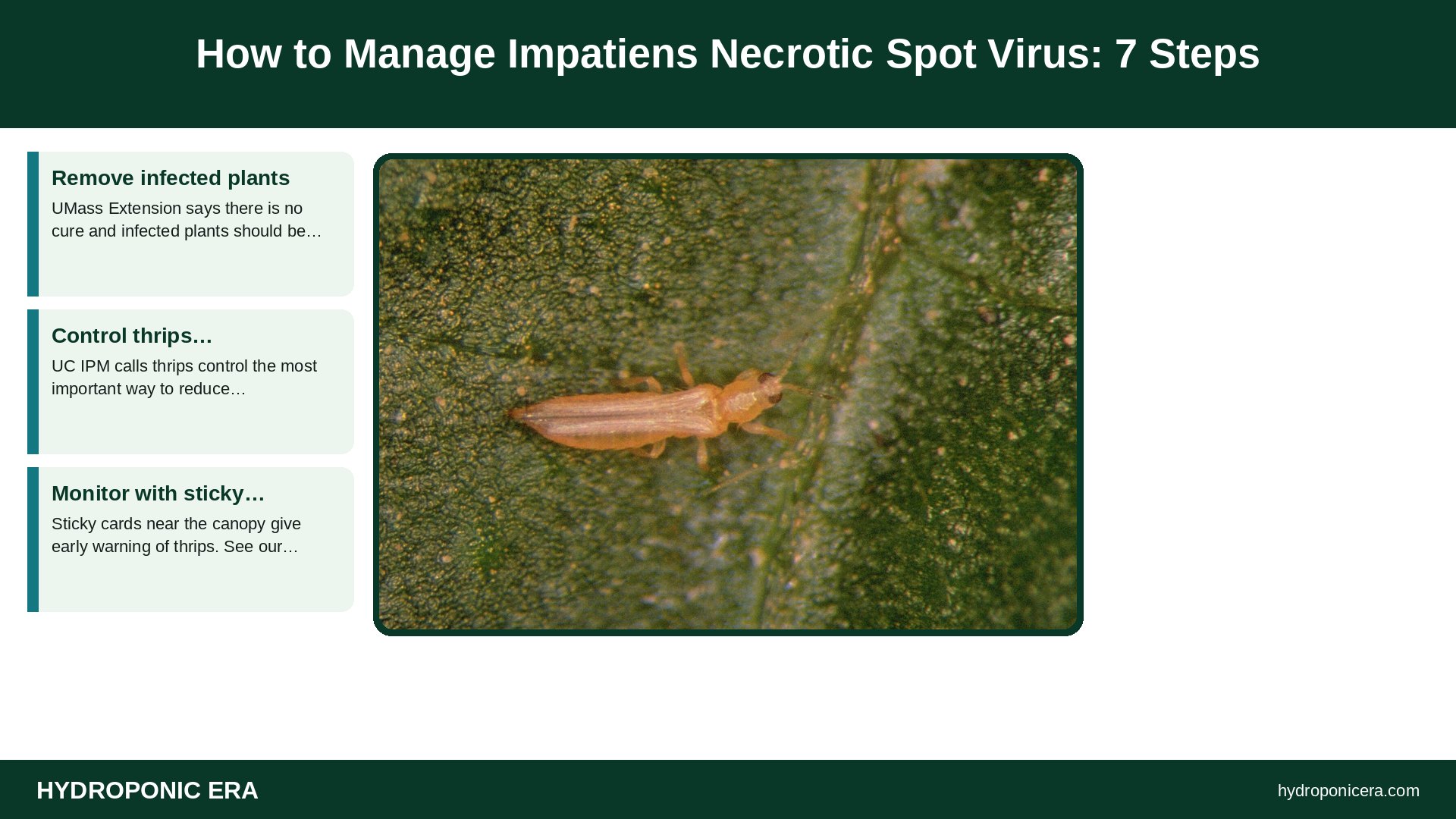
- Remove infected plants. UMass Extension says there is no cure and infected plants should be discarded promptly.
- Control thrips aggressively. UC IPM calls thrips control the most important way to reduce transmission.
- Monitor with sticky cards. Sticky cards near the canopy give early warning of thrips. See our sticky trap guide.
- Use indicator plants in greenhouses. UMass recommends petunias, which show local feeding and virus spots without becoming systemically infected.
- Manage weeds. Remove broadleaf weeds near growing areas. UC IPM advises cultivating weedy areas before lettuce emerges, since disturbing drying weeds later can push thrips into the crop.
- Don’t mix ornamentals and lettuce. INSV infects many ornamentals, including impatiens. Keep bedding plants away from your lettuce.
- Test suspect plants. UMass lists on-site test kits such as Agdia ImmunoStrips, or send samples to a plant diagnostic lab.
Impatiens Necrotic Spot Virus in Hydroponic and Indoor Lettuce
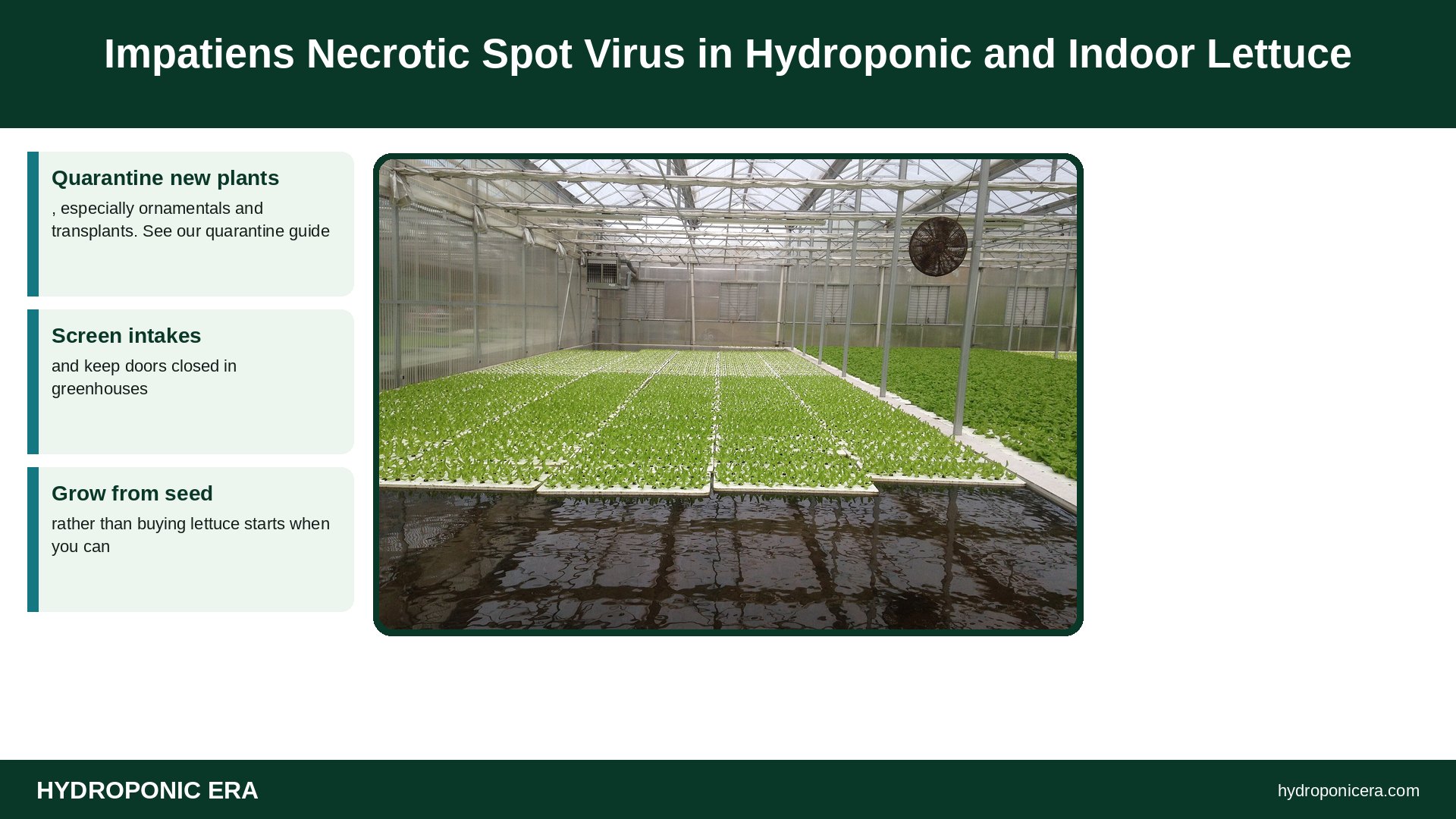
Indoor and hydroponic lettuce is mostly protected from field weeds, but thrips still arrive on new plants, cut flowers, clothing and through vents. The virus doesn’t move through nutrient solution; thrips carry it. Key steps for indoor growers:
- Quarantine new plants, especially ornamentals and transplants. See our quarantine guide.
- Screen intakes and keep doors closed in greenhouses.
- Grow from seed rather than buying lettuce starts when you can.
- Act on the first spotted plant. Remove it, check neighbors for thrips, and start a thrips program right away.
Thrips also spread TSWV in tomatoes and peppers. For a whitefly-spread tomato virus, see our tomato yellow leaf curl virus guide.
FAQs: Impatiens Necrotic Spot Virus
Can lettuce recover from impatiens necrotic spot virus?
No. There’s no cure for impatiens necrotic spot virus. Remove infected plants to protect the rest.
Is lettuce with INSV safe to eat?
Plant viruses don’t infect people, but spotted, necrotic leaves are low quality and usually unmarketable. Discard damaged leaves.
Does impatiens necrotic spot virus spread through water?
No. Western flower thrips spread it, picking up the virus as larvae.
Are some lettuce types resistant?
UC IPM says all lettuce types (iceberg, romaine, leaf and butterhead) are susceptible.
Related HydroponicEra Guides
- Thrips in hydroponics
- How to grow lettuce hydroponically
- Quarantine new plants
- Tip burn in hydroponics
Sources
- UC ANR Salinas Valley Agriculture (Beal, Hasegawa & Wang, Feb. 23, 2026) — Reflections on thrips and INSV during the 2025 Lettuce Season
- University of California IPM — Lettuce: Tospoviruses (INSV, TSWV)
- UMass Extension — Western Flower Thrips Management and Tospoviruses
- Photo credits (Wikimedia Commons, edited with titles): Frankliniella occidentalis 5364132-LGPT by Frank Peairs, Colorado State University, Bugwood.org (CC BY 3.0); Salinas Lettuce Field by ChrisPChapman (CC BY 4.0); Temple Sowerby, Acorn Bank, Mizuna and lettuce seedlings – geograph.org.uk – 7625183 by Michael Garlick (CC BY-SA 2.0); Deep water culture by ArcadiYay (CC BY-SA 4.0)