
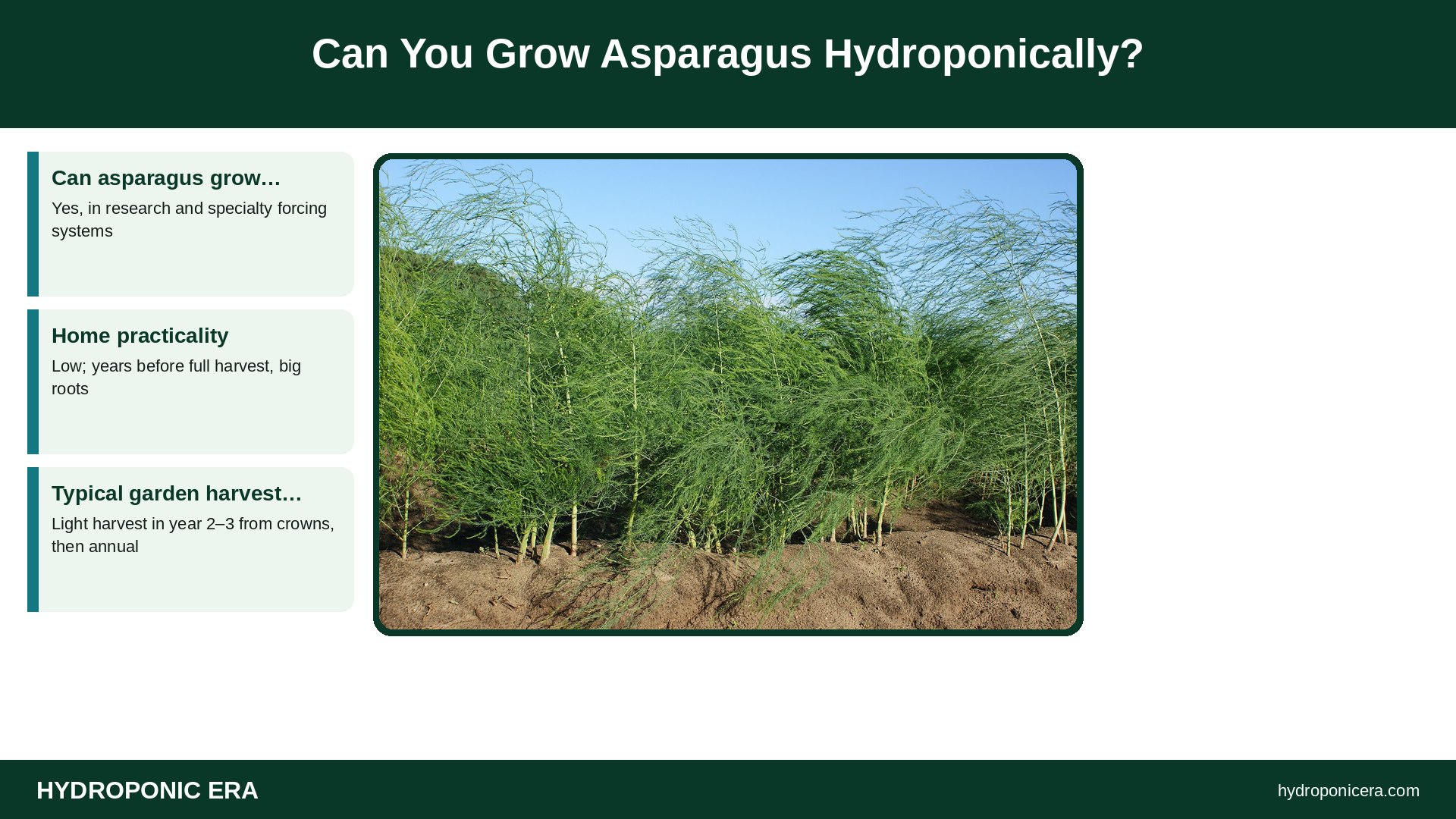
You can grow asparagus hydroponically, but it is one of the least practical crops for a home system. Asparagus is a long-lived perennial that builds a large crown and storage roots for two to three years before a good spear harvest, and each crown wants a lot of root space. Researchers have grown asparagus in hydroponics and soilless containers, including forcing white spears in dark climate rooms in Belgium, but for most US home growers, a garden bed or large container outdoors makes far more sense.
Key takeaway: Asparagus is possible in hydroponics, mainly as research or forcing. For a home kitchen harvest, it ties up space for years.
| Question | Short answer |
|---|---|
| Can asparagus grow hydroponically? | Yes, in research and specialty forcing systems |
| Home practicality | Low; years before full harvest, big roots |
| Typical garden harvest timeline | Light harvest in year 2–3 from crowns, then annual |
| Research EC range | One hydroponic study found 4–8 mS/cm best for crown growth |
| Outdoor hardiness | Grows across most of the US; needs winter dormancy |
Why Asparagus Is Hard in Home Hydroponics

Most hydroponic crops are fast annuals. This perennial is the opposite. The spears you eat are shoots pushed up each spring from energy stored in fleshy roots attached to an underground crown. The University of Minnesota Extension describes it as a perennial that can produce for many years once established, but it needs establishment time before heavy harvests.
- Time: years, not weeks, before steady harvests.
- Space: a mature crown spreads widely, with storage roots that fill containers.
- Dormancy: crowns typically need a rest period, which most indoor systems don’t provide.
- Yield per square foot: low compared with leafy greens.
That’s why asparagus appears in our list of plants that struggle in home hydroponics.
What the Research Shows
This crop has been grown in hydroponics as an experimental tool and for forcing:
- A study in Acta Horticulturae grew ‘Jersey Giant’ and ‘UC157’ asparagus at EC levels from 1.4 to 14 mS/cm and found 4–8 mS/cm best for roots, buds, and ferns.
- Belgian researchers described soilless container production of white spears in a climatized room, using an EC of about 2 mS/cm during vegetative growth, no fertilization during forcing, and a cold treatment of crowns before forcing.
These systems are designed by specialists, not countertop kits. They do show that its roots tolerate soilless culture.
If You Still Want to Try Asparagus Without Soil

- Use a large container, such as a deep tote or barrel, with a coarse medium like perlite or clay pebbles. Our guide to food-grade barrels and stock tanks helps.
- Start from crowns, not seed, to save a year.
- Use drip or ebb and flow rather than DWC, so roots get air. See our ebb and flow guide.
- Let ferns grow the first year to feed the crown; don’t harvest.
- Provide a cool rest period in winter, such as an unheated garage, before forcing spears.
Better Options for Most US Growers
Asparagus is hardy across much of the US and is a classic perennial bed crop. A permanent raised bed in full sun usually gives far more spears for less effort. If you want a quick, hydroponic-friendly vegetable instead, consider kale, bok choy, or beans.
Asparagus Problems in Containers

| Symptom | Likely cause | Fix |
|---|---|---|
| Thin, spindly spears | Young or exhausted crown | Stop harvesting; let ferns grow |
| Yellowing ferns mid-season | Nutrient shortage or root crowding | Check EC; bigger container |
| Rotting crowns | Waterlogged medium | Coarser media, better drainage |
| No spring spears indoors | No dormancy period | Provide a cool rest before forcing |
Common Mistakes
- Expecting harvests in weeks.
- Using small net pots or towers.
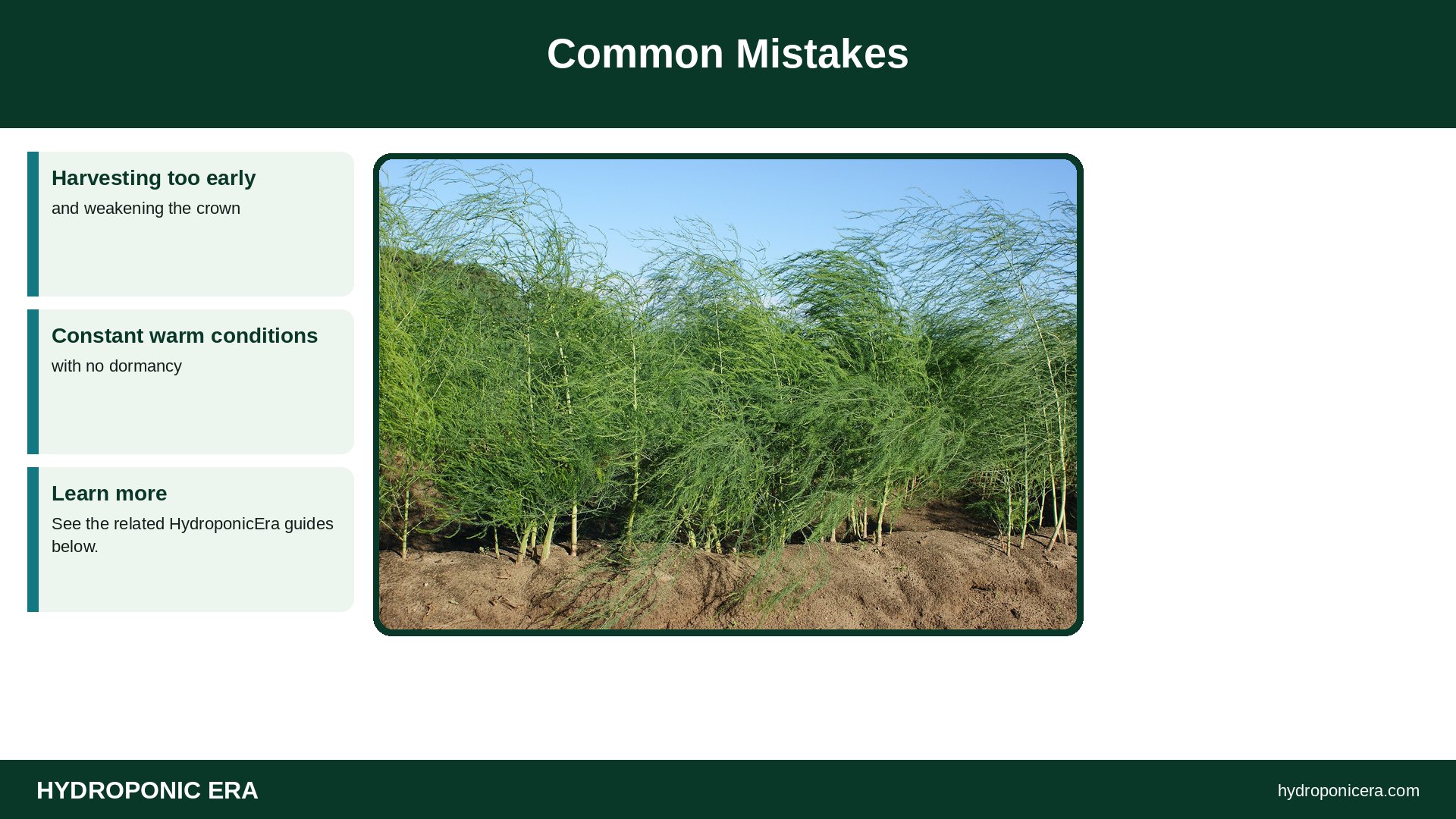
- Harvesting too early and weakening the crown.
- Constant warm conditions with no dormancy.
Variables That Change Results
| Variable | Effect | Adjustment |
|---|---|---|
| Crown age | Older crowns push thicker spears | Buy 1-year crowns; don’t harvest early |
| Container volume | Small pots restrict storage roots | Use the largest practical container |
| Dormancy | No rest = weak spring flush | Cool winter rest in a garage |
| Light | Ferns need sun to recharge the crown | Full sun outdoors in summer |
Keep realistic expectations: a container crop will yield a handful of spears, not a market harvest.
White Spears Without Light
White spears form when shoots grow in darkness, which is why soilless forcing rooms keep crowns in climate-controlled dark spaces. Home growers can mimic this by covering emerging spears with an opaque tube. The result tastes milder, but it’s the same plant and the same crown energy budget.
Quick Decision Guide
- Want spears for years with little effort? Plant crowns in a sunny outdoor bed.
- Want an experiment? Try one crown in a large drip-fed container.
- Want fast hydroponic vegetables? Grow leafy greens, herbs, or beans instead.
What a Realistic Container Trial Looks Like
If you want to experiment anyway, treat it as a multi-year project rather than a quick harvest. Buy healthy one-year crowns from a reputable nursery, plant one or two in a large container of coco and perlite, and feed with a mild, complete nutrient during the growing season. Let ferns grow freely in the first year so the crown stores energy. In most of the US, the plant also needs a cool dormant period in winter, which is hard to provide indoors; an unheated garage or a sheltered patio in milder zones can work. Keep notes on spear count and thickness each spring to judge whether the effort is paying off.
Cost and Space Reality Check
A single crown in a container may yield only a modest handful of spears per season once established. Compare that with the same space producing several rounds of lettuce or herbs each year. For most home growers, the math favors fast crops indoors and asparagus in an outdoor bed. See crop selection for how growers weigh space against value.
FAQs: Asparagus Hydroponics
Can asparagus be grown hydroponically at home?
It can, but this crop is a slow, space-hungry perennial. Most home growers get better results in an outdoor bed.
How long does asparagus take to produce?
In gardens, a light harvest usually starts a couple of years after planting crowns, with full harvests later.
What EC does asparagus like?
One hydroponic study found 4–8 mS/cm best for crown growth, but that was a research setting.
Is white asparagus a different plant?
No. White spears come from the same plant grown without light so the spears don’t turn green.
Related HydroponicEra Guides
- Plants that struggle in home hydroponics
- Dutch bucket hydroponics
- How to grow potatoes hydroponically
- How to grow blueberries hydroponically
Sources
- University of Minnesota Extension — Growing asparagus in home gardens
- Danningsih, Woolley & Nichols, Acta Horticulturae 644 — Changes in morpho-physiology of Asparagus officinalis at different electrical conductivities
- Schrevens, Lamberts & Lettani, ISHS — Soilless production of asparagus in Belgium
- NC State Extension Plant Toolbox — Asparagus officinalis
- Photo credits (Wikimedia Commons, edited with titles): Asparagus field Drzymalowo kz04 by Krzysztof Ziarnek, Kenraiz (CC BY-SA 4.0)