
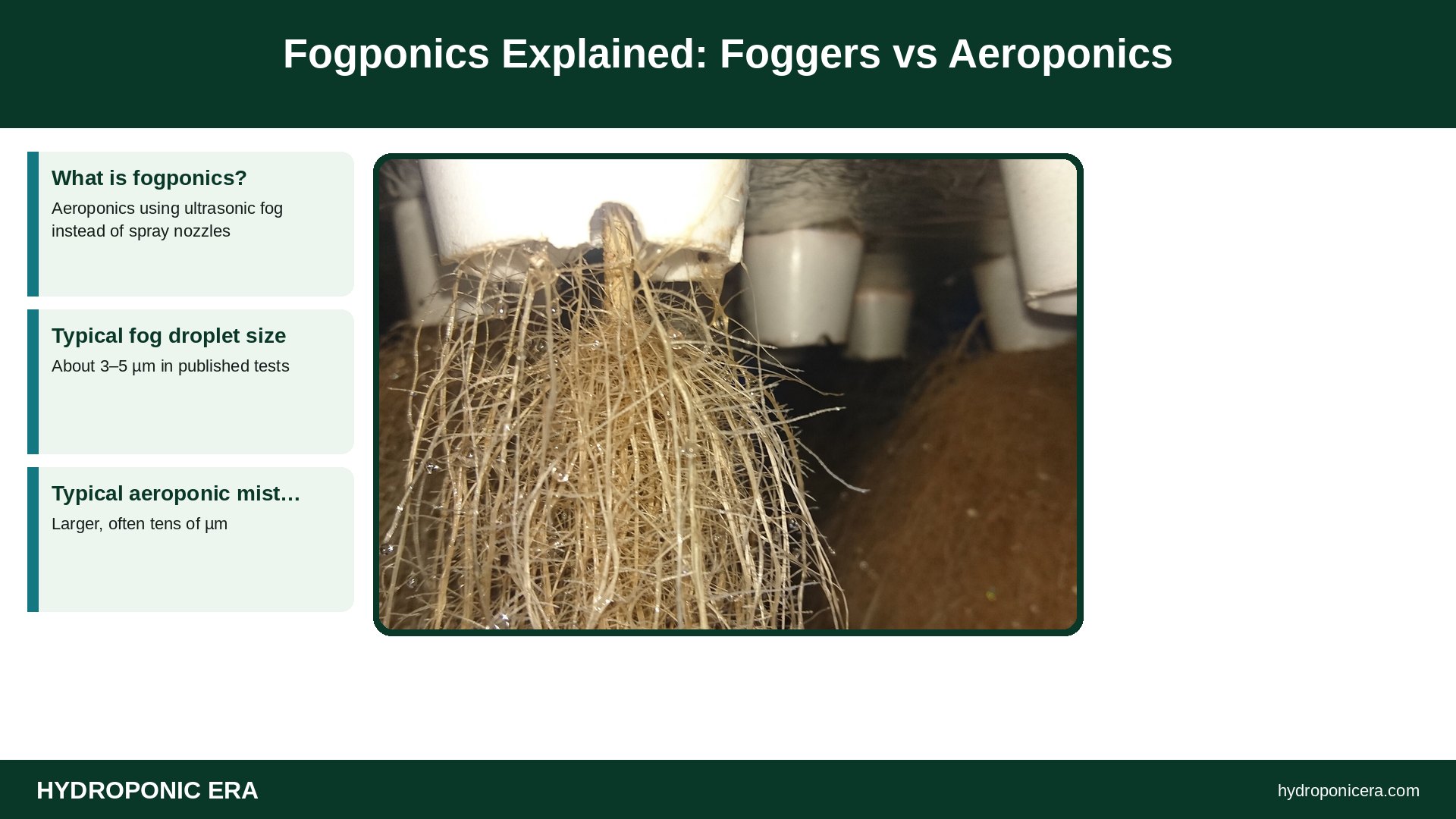
Fogponics is a form of aeroponics that uses ultrasonic foggers to turn nutrient solution into a very fine fog around plant roots, instead of spraying larger droplets from nozzles. It sounds like the ultimate root-zone upgrade, and it gets linked to NASA in marketing, but research on lettuce has not been kind to it. In a 2021 study, ultrasonic foggers produced droplets around 4.89 µm, and lettuce misted that way grew far less than lettuce misted by an air-assisted nozzle with roughly 11 µm droplets. For home growers, fogponics is best treated as an experiment, not an upgrade.
Key takeaway: Smaller droplets are not automatically better. Root growth depends on droplet size, oxygen, and stable nutrient chemistry, and foggers struggle on all three.
| Question | Short answer |
|---|---|
| What is fogponics? | Aeroponics using ultrasonic fog instead of spray nozzles |
| Typical fog droplet size | About 3–5 µm in published tests |
| Typical aeroponic mist (high-pressure) | Larger, often tens of µm |
| Research verdict (lettuce) | Ultrasonic fog underperformed air-assisted nozzles |
| Main home problems | Heat from foggers, mineral buildup on discs, unstable pH/EC |
| Better beginner alternative | Low- or high-pressure aeroponics, or DWC |
How Fogponics Works
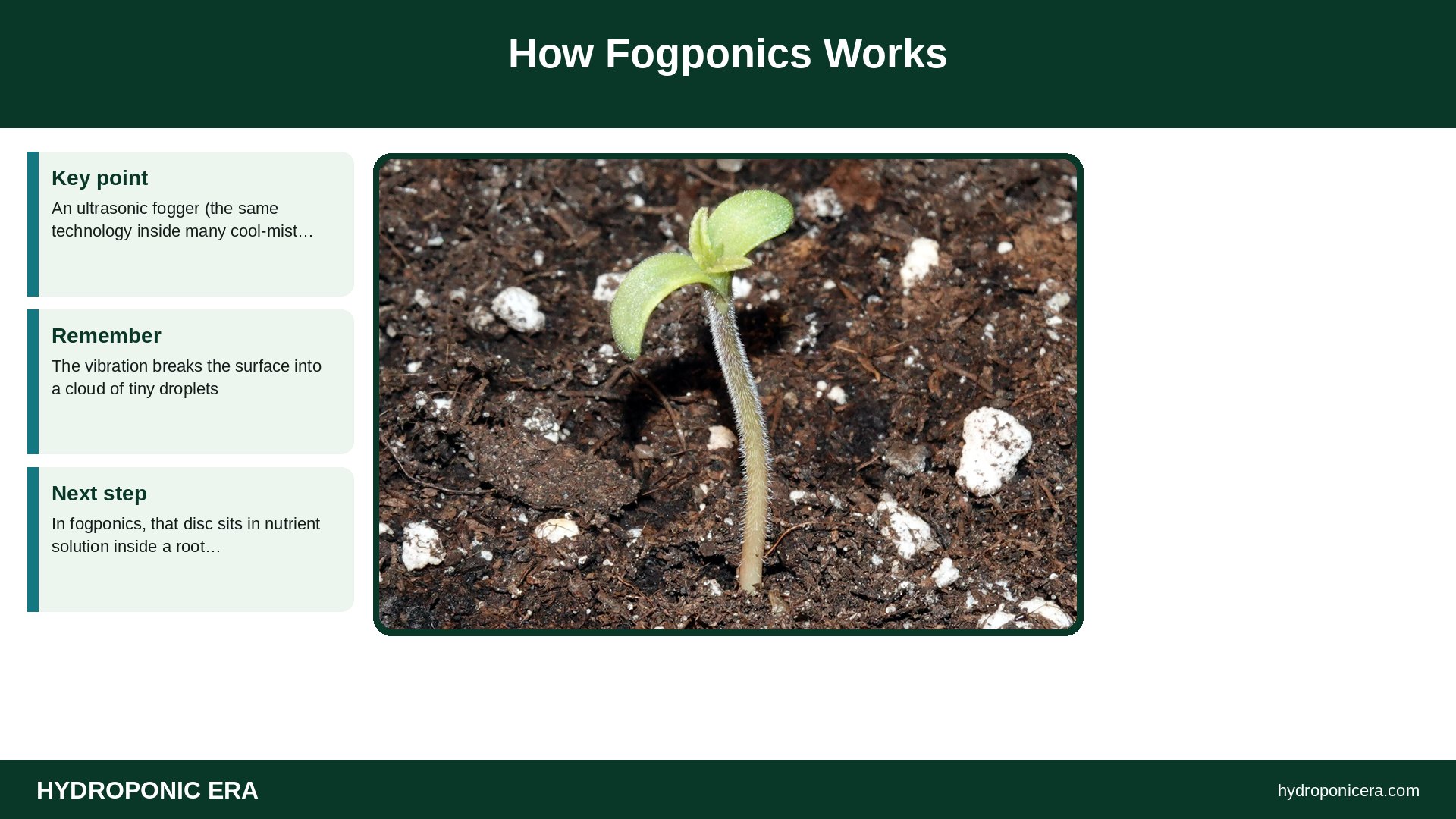
An ultrasonic fogger (the same technology inside many cool-mist humidifiers) uses a piezoelectric disc vibrating at high frequency under a thin layer of water. The vibration breaks the surface into a cloud of tiny droplets. In fogponics, that disc sits in nutrient solution inside a root chamber, and roots hang in the resulting fog.
Traditional aeroponics, explained in our aeroponics for beginners guide, uses pumps and nozzles instead. Low-pressure systems spray coarse droplets; high-pressure systems produce a finer mist.
Fogponics vs Aeroponics: What Research Shows
A 2021 study in the journal Agronomy (Tunio et al.) compared four atomizers on butterhead lettuce in aeroponics:
- An air-assisted nozzle averaged 11.24 µm droplets.
- Two airless nozzles averaged 26.35 and 17.38 µm.
- An ultrasonic fogger averaged 4.89 µm.
The air-assisted nozzle misting every 30 minutes gave the best biomass and roots. The authors reported “very poor plant yield” with the ultrasonic nozzle and linked it to larger changes in pH and EC of the nutrient solution. An earlier study by the same research group (Lakhiar et al., Transactions of the ASABE, 2019) also found air-assisted atomizers outperformed airless ones for lettuce.
These are controlled experiments on one crop, so they don’t prove fogponics can never work. They do show that “finer fog” doesn’t automatically mean faster growth.
Practical Problems With Home Fogponics
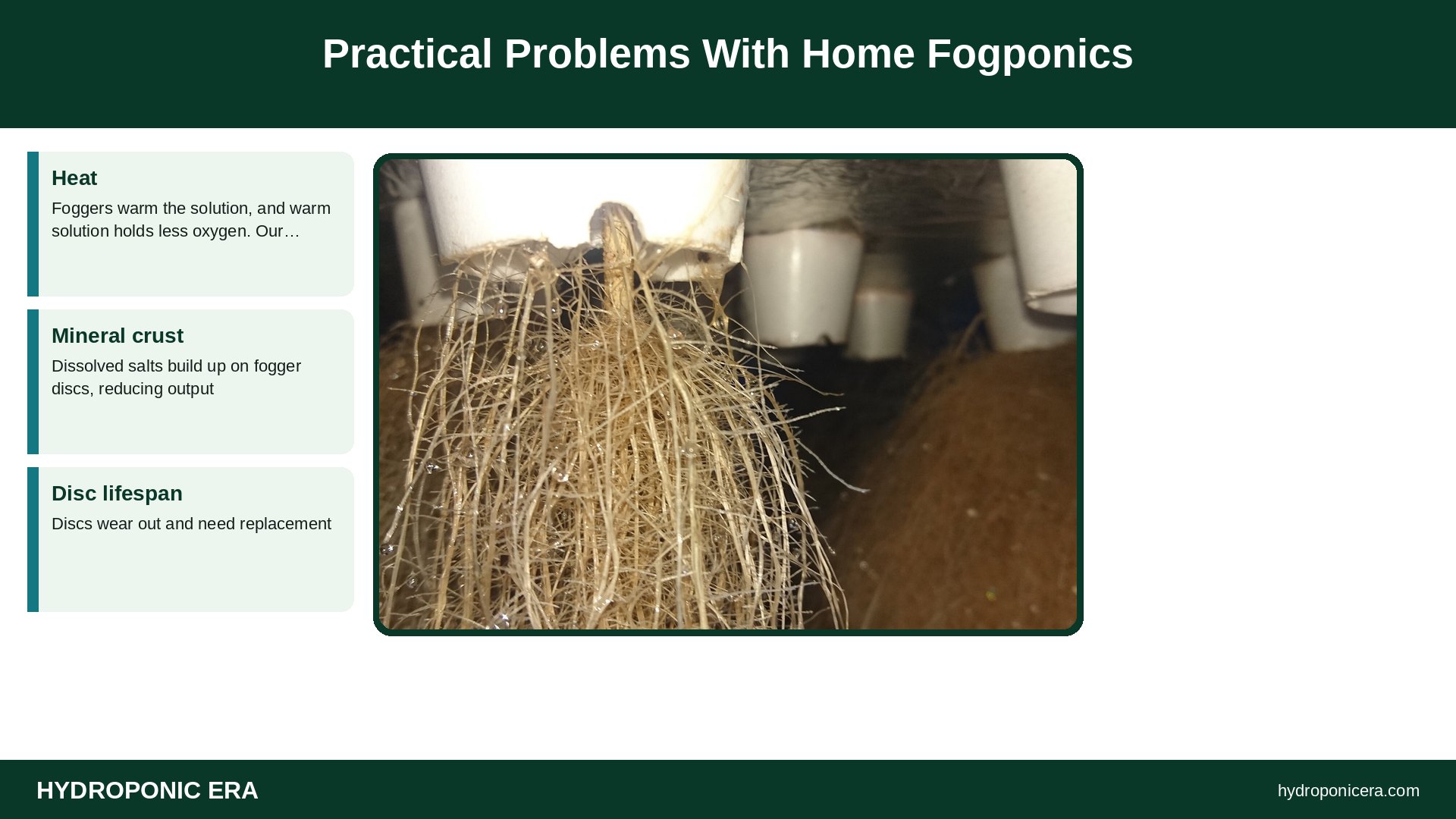
- Heat. Foggers warm the solution, and warm solution holds less oxygen. Our reservoir temperature guide explains why that matters.
- Mineral crust. Dissolved salts build up on fogger discs, reducing output.
- Disc lifespan. Discs wear out and need replacement.
- Nutrient delivery. Very fine fog carries little water per minute; roots can dry if output drops.
- Single point of failure. If the fogger stops, bare roots dry quickly.
If You Want to Experiment With Fogponics
- Start small, with a few lettuce or herb plants.
- Use a fogger rated for continuous use and a float that keeps the disc at the correct depth.
- Run on a timer with on/off cycles, and add a backup.
- Monitor pH and EC daily; refresh solution often.
- Clean discs regularly with a mild acid such as vinegar, per the maker’s instructions.
- Keep the root chamber dark and cool.
Pair any experiment with redundancy. Our timer fail-safes guide and backup power guide help.
Fogponics Problems and Fixes
| Symptom | Likely cause | Fix |
|---|---|---|
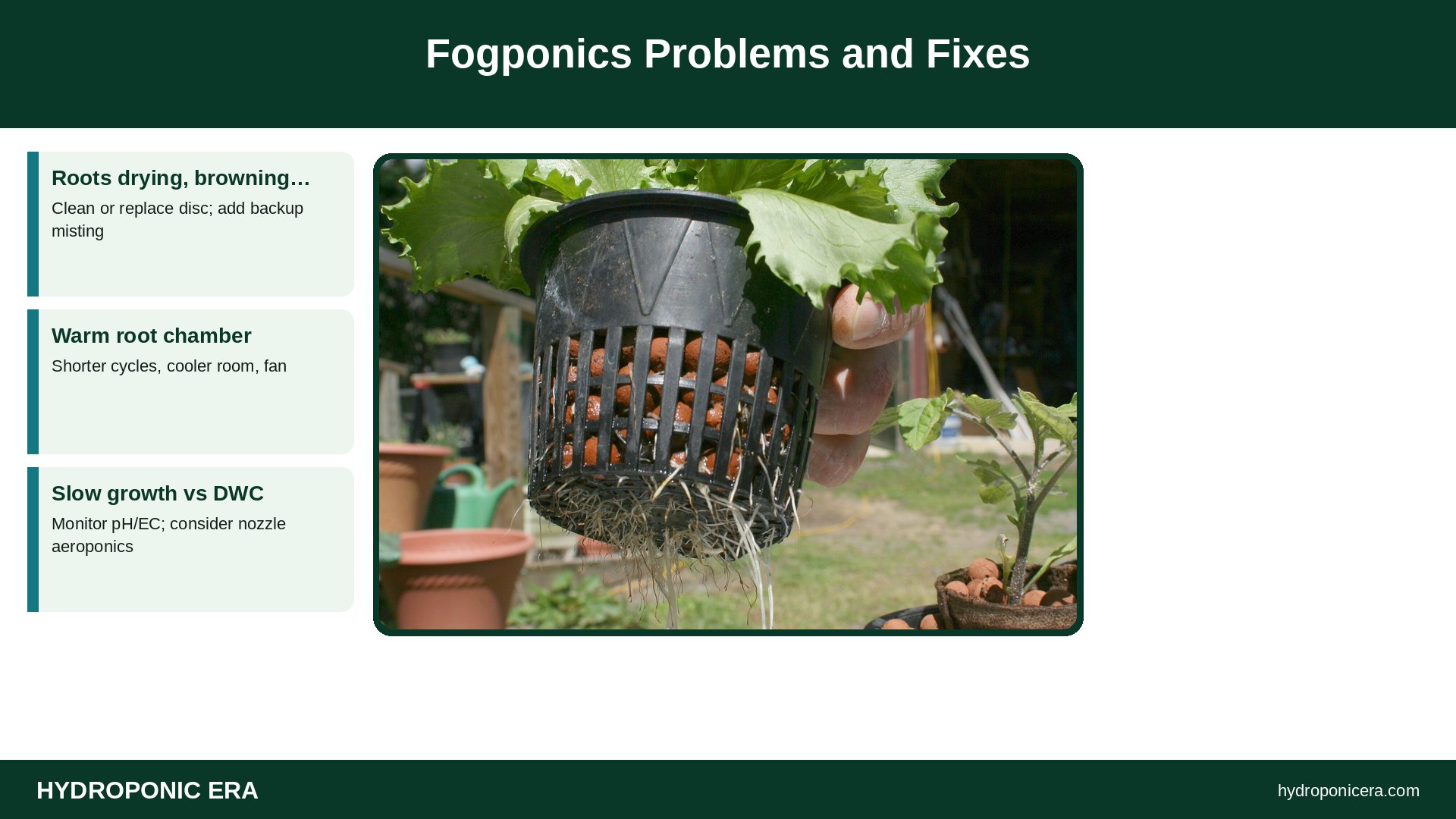
| Roots drying, browning tips | Fogger output dropped or failed | Clean or replace disc; add backup misting |
| Warm root chamber | Fogger heat | Shorter cycles, cooler room, fan |
| Slow growth vs DWC | Low nutrient delivery, unstable chemistry | Monitor pH/EC; consider nozzle aeroponics |
| White crust on disc | Mineral buildup | Regular cleaning; lower EC |
| Slimy roots | Warm, stagnant chamber | Cool, sanitize, improve airflow |
Common Mistakes
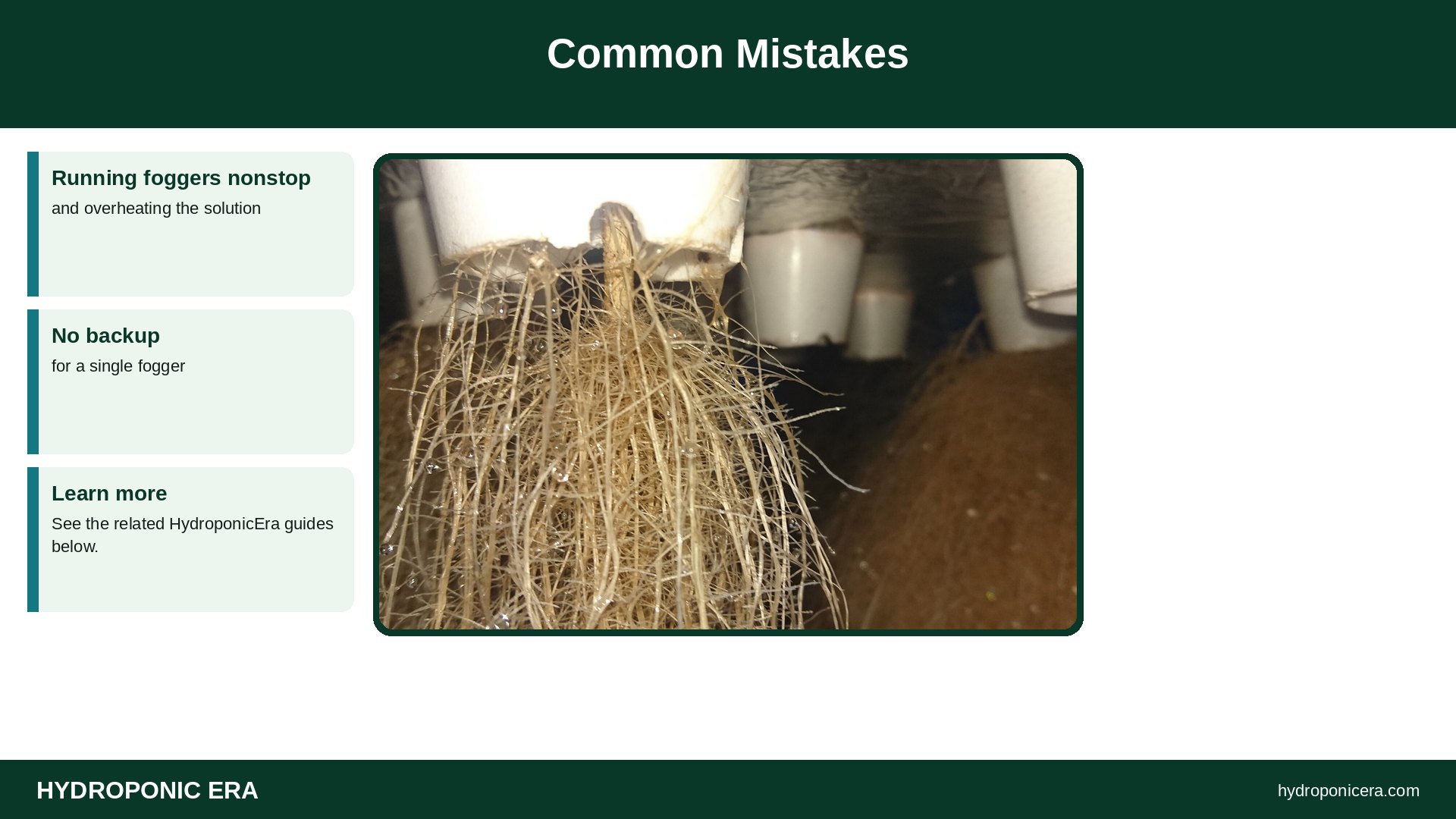
- Believing smaller droplets always grow better plants.
- Running foggers nonstop and overheating the solution.
- No backup for a single fogger.
- Skipping disc cleaning.
Variables That Change Results
| Variable | Effect | Adjustment |
|---|---|---|
| Fogger frequency | Changes droplet size | Follow maker specs |
| Duty cycle | Longer runs add heat | Shorter on/off cycles |
| Solution EC | Higher EC crusts discs faster | Lower EC, frequent cleaning |
| Chamber size | Big chambers need more output | Multiple foggers or nozzles |
Quick Decision Guide
- New to hydroponics? Start with DWC or Kratky.
- Want aeroponics? Try a low-pressure spray system first.
- Curious about fog? Run a small side experiment with backups.
Record root color, growth, and solution readings weekly so you can judge results honestly.
What to Measure if You Experiment
If you build a fog chamber anyway, measure what matters rather than relying on how it looks. Track root zone temperature, since ultrasonic discs add heat; compare plant fresh weight with a control grown in a simple deep water culture tub; and check EC and pH of the reservoir daily, because foggers can concentrate salts in the remaining water. Inspect the fogger discs every few days for mineral scale, which reduces output. Keep the chamber dark and clean, and log any root browning. A controlled side-by-side test like this tells you more than any product claim.
Where Fog Can Be Useful
Fog and fine mist can help in propagation, where cuttings need high humidity around leaves rather than heavy nutrient delivery to roots. Commercial greenhouses use fog systems for cooling and humidity control. For roots of food crops, though, standard methods remain more dependable. See humidity domes for cuttings.
FAQs: Fogponics
Is fogponics better than aeroponics?
Published lettuce research found ultrasonic fog underperformed air-assisted aeroponic nozzles. Fogponics is not a proven upgrade for home growers.
Did NASA invent fogponics?
NASA has supported aeroponics and mist-based plant research, but “fogponics” as sold for home use is a marketing term. See our hydroponics in space guide.
Can I use a humidifier fogger for plants?
You can experiment, but expect heat, mineral buildup, and frequent cleaning.
What should beginners use instead?
Deep water culture or a simple low-pressure aeroponic system is easier and more forgiving.
Related HydroponicEra Guides
- Aeroponics for beginners
- Deep water culture for beginners
- Dissolved oxygen
- Hydroponics in space (NASA)
Sources
- Tunio et al. (2021), Agronomy — Influence of Atomization Nozzles and Spraying Intervals on Butter-Head Lettuce under Aeroponics
- Lakhiar et al. (2019), Transactions of the ASABE — Effects of Various Aeroponic Atomizers (Droplet Sizes) on Leafy Lettuce
- Photo credits (Wikimedia Commons, edited with titles): Aeroponic roots nepal by Makampanda (CC BY-SA 4.0); Hanfsämling mit Wurzelhaaren am Stamm – Hemp seedling with root hairs on the stem by Vschlothauer (CC0); 2009-03-30 Lettuce roots by Ildar Sagdejev (Specious) (CC BY-SA 4.0)