
Quick Answer
Timer fail safes pump redundancy hydroponics planning keeps a home system alive when a $12 timer sticks ON, a pump impeller locks, or a GFCI trips while you are at work. Automation helps (timers, smart plugs) but single points of failure still kill NFT films and flood trays.
Combine electrical safety (electrical safety), backup thinking (backup power/pumps), and simple mechanical redundancy—not a data-center diagram.
Key takeaways for timer fail safes
- Prefer timers that fail OFF for flood pumps when possible; know your device’s stuck-relay behavior.
- Put critical pumps on GFCI-protected circuits with drip loops ({a(‘electrical_b’,’electrical safety’)}).
- Keep a labeled spare pump that fits your fittings—tested wet once per quarter.
- For NFT/drip, a second pump on a separate timer outlet beats a single hero pump.
- Phone alerts help only if the sensor/plug is trustworthy; still walk the room ({a(‘vacation_b’,’vacation checklist’)}).
- Air pumps for DWC deserve the same spare-stone and spare-pump habit ({a(‘air’,’air pumps’)}).
- Document ON/OFF minutes on a card taped near the reservoir.
- Test fail-overs after any outlet or Wi-Fi change.
Related HydroponicEra guides
- Timers and automation
- Backup power and pumps
- Water pump sizing
- Electrical safety
- WiFi controllers and smart plugs
- Vacation checklist
- Auto top-off / float valves
- Leak fixes
- NFT beginners

Failure Modes Worth Designing Against
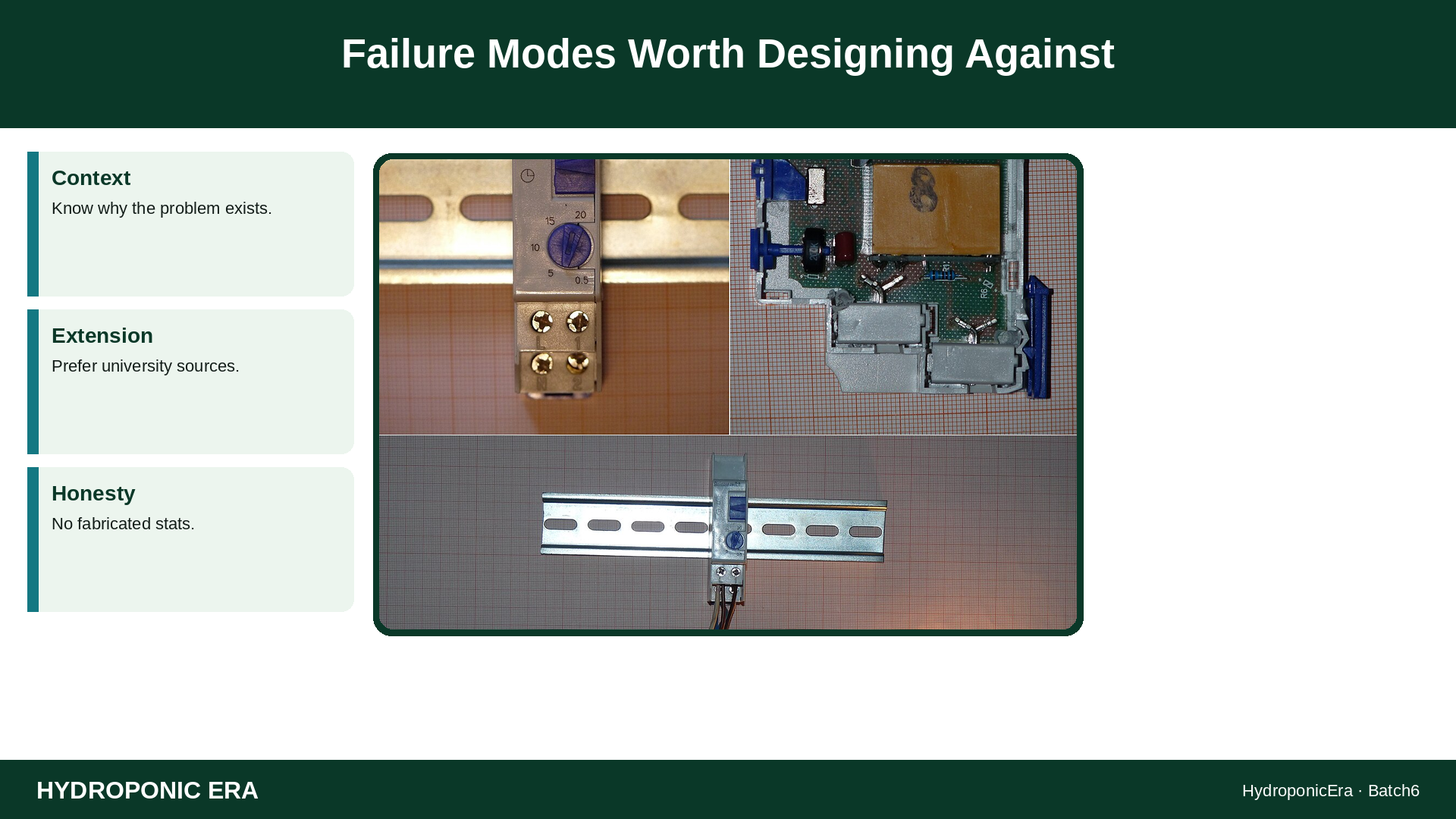
Home hydro failures are boring and lethal: timer stuck ON floods a tray all night; timer stuck OFF dry-outs NFT channels; impeller clogged by roots; outlet tripped; Wi-Fi plug offline after router update. Extension greenhouse production notes repeatedly stress reliable irrigation intervals—home systems are smaller but not exempt.
Redundancy is cheaper than a full crop loss. Pair this page with pump sizing so the spare is not an undersized toy.
Practical Fail-Safe Stack (Home Scale)
| Layer | What to add | Why |
|---|---|---|
| Power | GFCI, drip loops, labeled cords | Shock and nuisance-trip awareness |
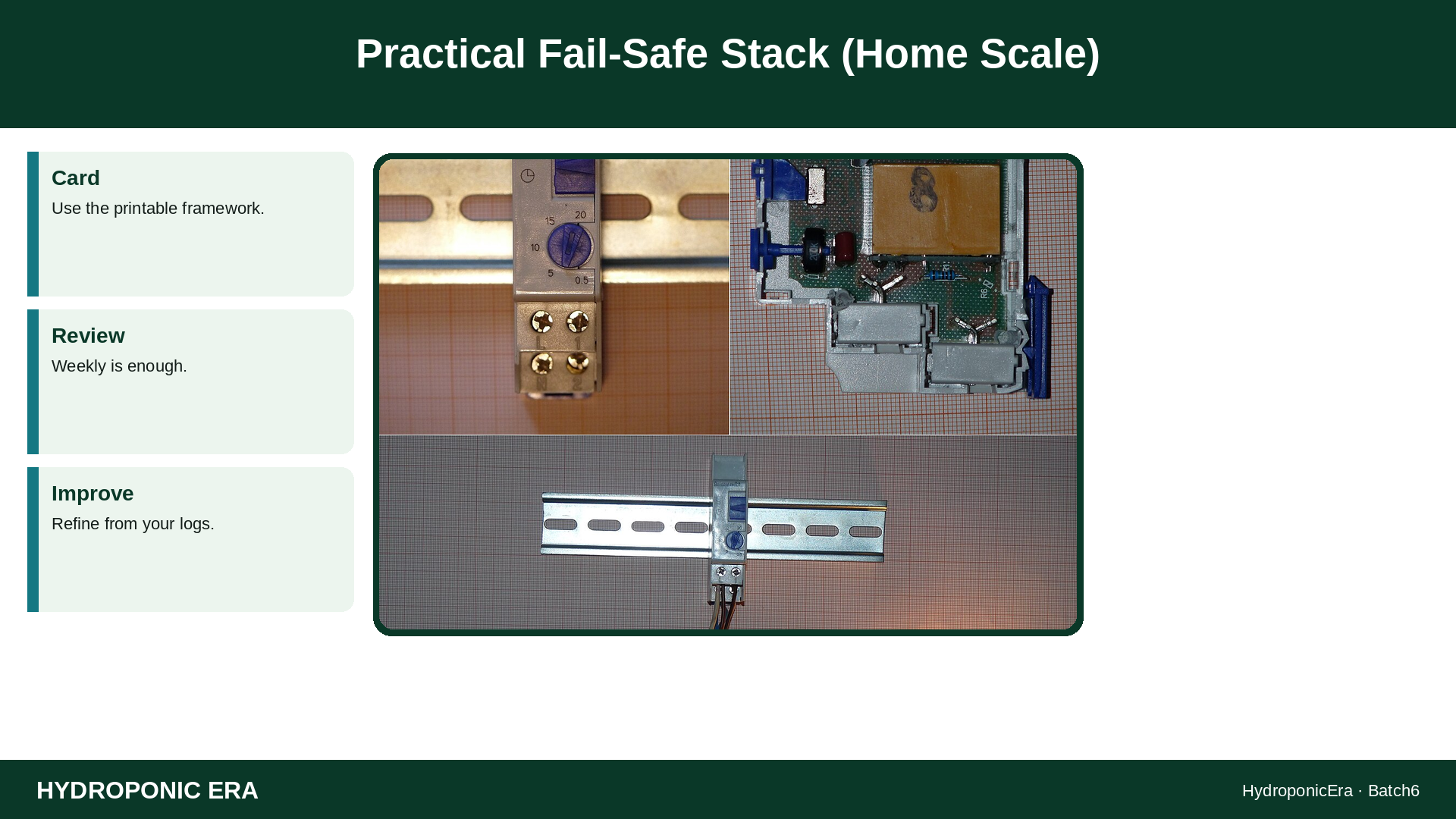
| Timer | Quality mechanical or dual smart plugs | Avoid single cheap relay |
| Pump | Installed primary + boxed spare | Minutes matter in NFT |
| Alarm | Leak puck / plug energy alert | Early notice, not autopilot |
| Process | Weekly manual flood/drain test | Catch silent failures |
Float valves and ATO need their own overflow fail-safes (ATO guide).
Step-by-Step Redundancy Setup

- Map every pump (flood, recirculation, air) and its outlet.
- Verify GFCI and drip loops (electrical).
- Label timer programs with minutes ON/OFF and crop stage.
- Install or stage a spare pump with matching fittings/hose barb.
- Optional: Y-valve or quick-disconnect for faster swap.
- Add a leak sensor near the reservoir rim and tray.
- Decide Wi-Fi vs mechanical for the critical flood timer (smart plugs).
- Run a drill: unplug primary, swap spare, confirm prime within your crop’s dry-out window.
- Retest after storms or breaker work.
Common mistakes with timer fail safes
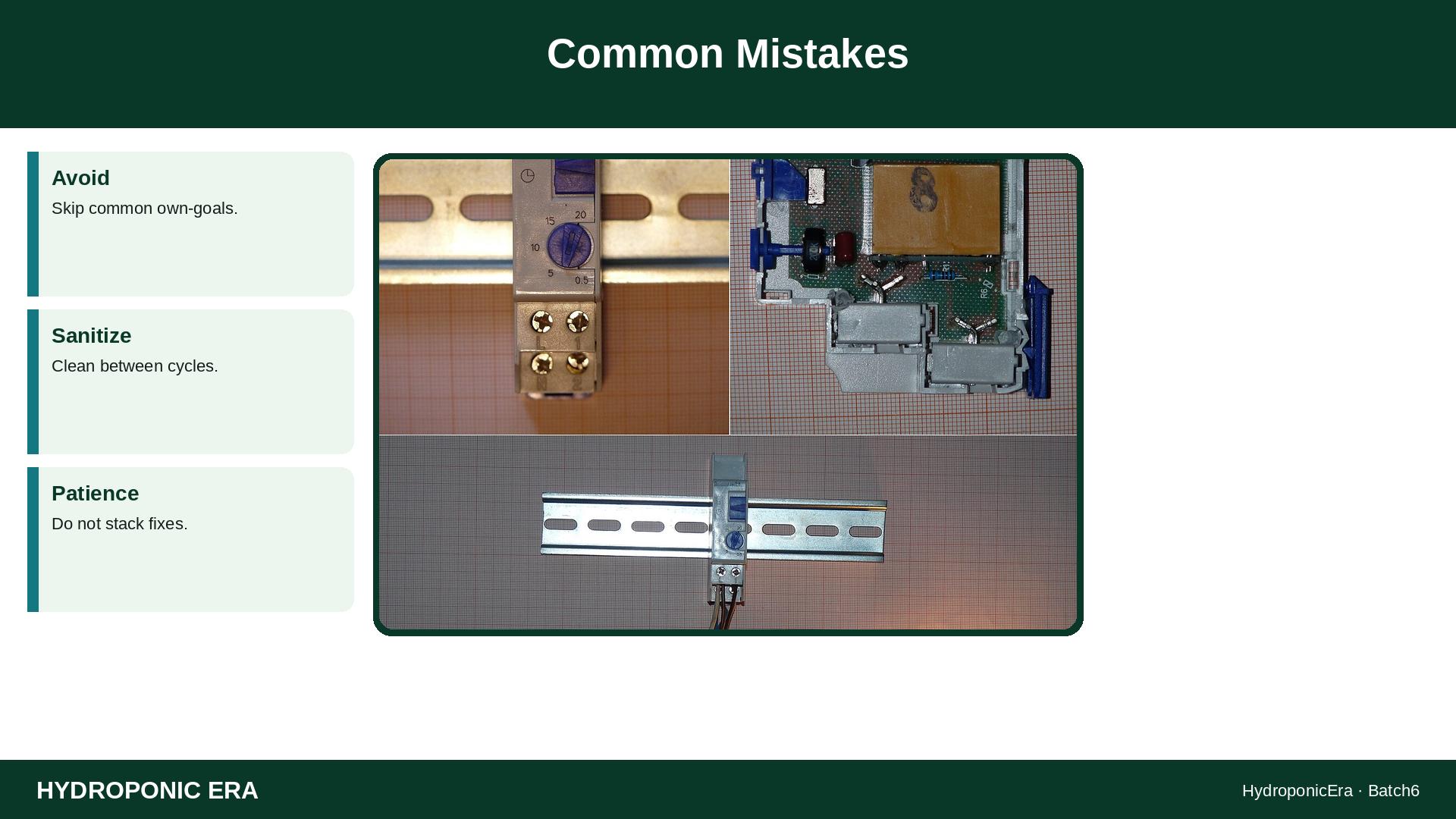
- One timer daisy-chained to lights and pumps
- Spare pump never wet-tested (seals dry-rot)
- Assuming smart plugs reboot into the correct schedule
- No drip loop—water walks into the outlet
- Oversizing a flood pump without overflow path ({a(‘leaks’,’leaks’)})
- Forgetting air-pump stones clog silently in DWC
Troubleshooting Outages

| Symptom | Check | Action |
|---|---|---|
| Tray flooded overnight | Timer stuck ON / float fail | Replace timer; verify drain |
| NFT wilt at noon | Pump/timer OFF | Spare pump; shorten dry window |
| GFCI trips | Wet cord / failing pump | Dry, replace, re-route |
| Smart plug offline | Router/app | Fall back to mechanical timer |
What to Check This Week on Timers and Pumps
- Written ON/OFF schedule matches the timer display?
- Spare pump boxed with fittings?
- GFCI test button clicked this month?
- Leak sensor battery OK?
- Air stone still bubbling evenly?
- Vacation plan lists who can swap the spare?
- Overflow path clear on flood trays?
Home Drill: Practice the Fail-Over
Write a 10-minute drill for timer fail safes pump redundancy hydroponics. Once a month, simulate a dead primary pump: shut it off, install the spare, confirm prime, and restore the schedule. Time yourself. If the drill takes longer than your crop’s dry-out window—especially NFT—simplify fittings with quick-disconnects.
Create a laminated card: primary outlet, backup outlet, timer model, ON/OFF minutes, spare pump location. Tape it above the reservoir. After storms or breaker work, re-run the card. Combine timer fail safes pump redundancy hydroponics habits with GFCI/drip-loop safety so the spare is not plugged into a wet hazard.
Smart plugs can text you, but SMS without a spare pump only documents the death of plants. Keep mechanical fallback timers in a drawer. For air pumps, label stones left/right and replace on a calendar, not after silence. Review vacation coverage so a neighbor can execute the same pump swap without a phone call essay. Timer fail safes pump redundancy hydroponics is boring on purpose—boring keeps basil alive.
If you run flood tables, include overflow verification in the drill. A stuck-ON timer plus a blocked return is a floor event. Your timer fail safes pump redundancy hydroponics plan should name who dries the floor and where towels live. Log each drill date beside EC readings so maintenance is visible.
Power, Plugs, and People
Map circuits so lights and pumps do not share a browning-out strip. Use electrical safety habits: drip loops, GFCI, no daisy-chained cubes of death. Put the spare pump in a labeled dry box with hose clamps and a headlamp—night failures happen.
Agree who is on-call during heat waves. A redundancy plan without a human who can drive across town is incomplete. Test smart-plug schedules after router firmware updates. Keep one mechanical timer as the source of truth for critical flood events. Document amp draws roughly so you do not trip breakers when both pumps momentarily run during a swap.
For community labs, post the fail-over photo SOP on the wall. New members should not invent plumbing under stress.
Practice Notes for This Guide
Re-read the Quick Answer before each cycle and apply only the checks that match your system type. Keep meters calibrated, write what you changed, and give new growth time to judge results. Link outward to related HydroponicEra cluster guides rather than stacking five new additives in one night. University and extension sources listed below frame principles—your room’s sensors decide the final setpoints.
If something conflicts with a product label, the label wins. If a plant shows severe disease, isolate and sanitize before optimizing fine points. Share honest notes with anyone who co-owns the system so habits survive busy weeks. Return to this page when symptoms rhyme with the troubleshooting table, not only when buying new gear.
Small consistent improvements beat rare heroic overhauls. Schedule a 20-minute weekly review: environment, roots, pests, and notes. That rhythm turns articles into operations.
FAQs about timer fail safes pump redundancy hydroponics
Do I need two pumps running at once?
Not always—hot-spare ready to install is enough for many home DWC tanks. NFT growers may prefer dual lines.
Are battery backups required?
Helpful for short blips; size realistically ({a(‘backup_b’,’backup guide’)}).
Mechanical or digital timer?
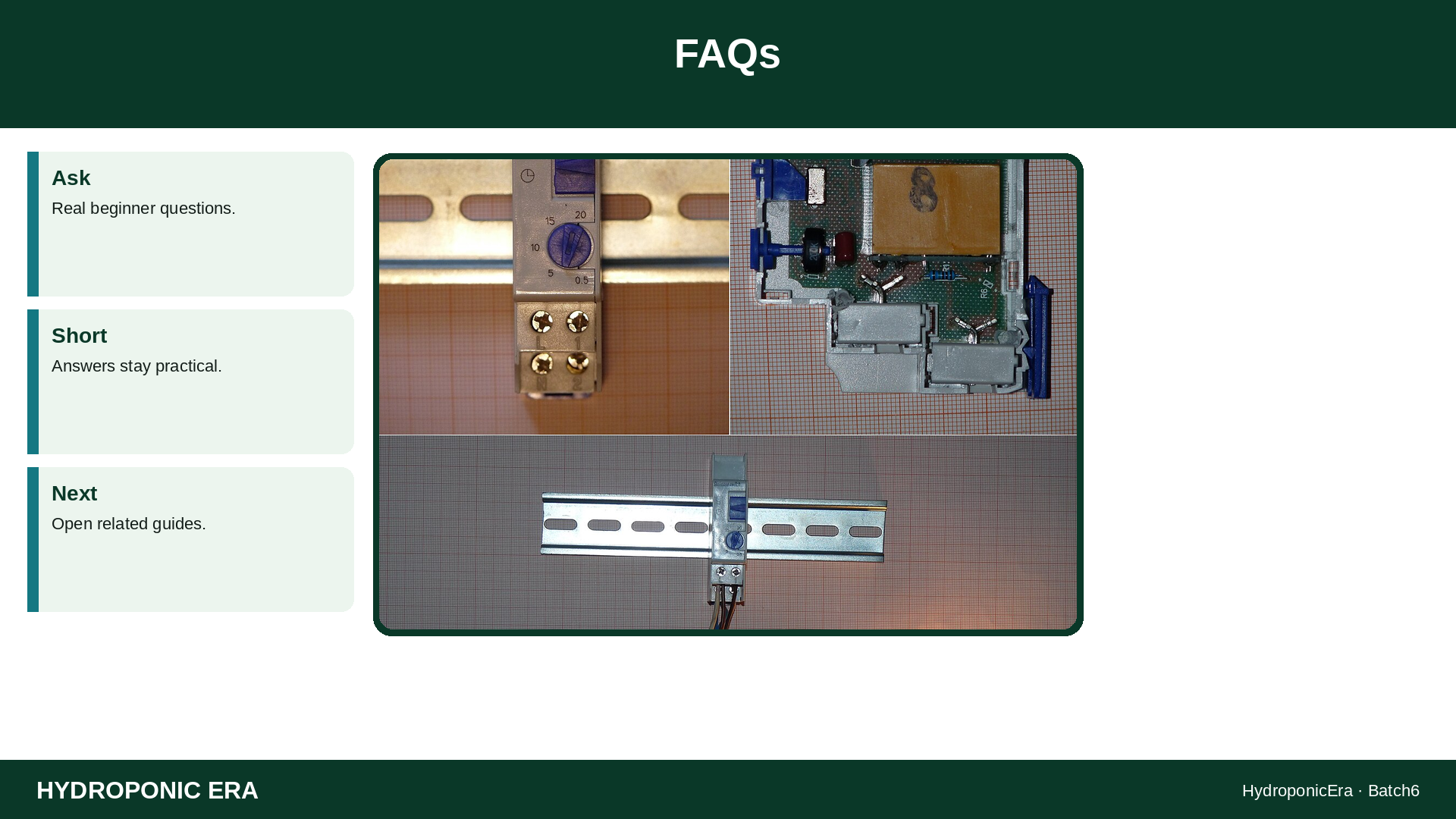
Either can work; know failure mode and keep a spare either way.
Can one air pump feed two stones?
Yes with a splitter—still keep a spare pump.
What about vacation?
Combine redundancy with the vacation checklist.
Will a bigger pump fix clogging?
No—filter intakes and manage roots.
Keep timer fail safes pump redundancy hydroponics on your weekly ops card so the next cycle inherits the habit, not just the gear list.
When training a helper, explain timer fail safes pump redundancy hydroponics in plain language before handing them scissors, timers, or meters.
Keep timer fail safes pump redundancy hydroponics on your weekly ops card so the next cycle inherits the habit, not just the gear list.
When training a helper, explain timer fail safes pump redundancy hydroponics in plain language before handing them scissors, timers, or meters.
Keep timer fail safes pump redundancy hydroponics on your weekly ops card so the next cycle inherits the habit, not just the gear list.
When training a helper, explain timer fail safes pump redundancy hydroponics in plain language before handing them scissors, timers, or meters.
Keep timer fail safes pump redundancy hydroponics on your weekly ops card so the next cycle inherits the habit, not just the gear list.
When training a helper, explain timer fail safes pump redundancy hydroponics in plain language before handing them scissors, timers, or meters.
Extended Home-Grower Walkthrough
Use this extended walkthrough as a second pass after the Quick Answer. Walk the system with a notebook: write the date, crop, EC, pH, reservoir temperature, and one observation about roots or leaves. Change only one control at a time when a problem appears. If last week’s fix did not show in new growth, revert and try the next smallest lever. Keep university and extension principles in mind—oxygen, sanitation, and measured nutrition beat product stacking.
Photograph the canopy and the reservoir surface weekly. Dated photos settle arguments about algae, tip burn, or stretch faster than memory. When a helper waters for you, leave a one-page card with do-not-touch items and the exact top-off rule. Store calibration sachets next to the meters so “I will calibrate later” stops being the default. Review timers after any power event. Confirm air stones still roar. Confirm drains still drain.
At the end of the week, score the cycle 1–5 for ease and plant quality. Low scores should trigger a sanitation or climate review before you buy new hardware. Link neighboring HydroponicEra guides when the symptom matches a cluster page. Prefer labeled procedures over improvisation under stress. Healthy boring routines are the real upgrade path for home hydroponics.
If you sell or share produce, keep food-safe handling in the same notebook as EC readings. Clean harvest tools, avoid stagnant splash, and quarantine sick plants away from harvest bins. A tidy teardown between cycles protects the next seeding more than any single additive. Return to the checklists above whenever the room’s weather or crop mix changes.
Keep timer fail safes on your weekly card so the habit stays consistent without guessing.
Keep timer fail safes on your weekly card so the habit stays consistent without guessing.
Sources
- Oklahoma State University Extension — Hydroponics
- Michigan State University Extension — Hydroponics as an agricultural production system
- University of Florida IFAS — HS184: Building a Floating Hydroponic Garden
- Penn State Extension — Hydroponics Systems and Principles of Plant Nutrition
- Ohio State University Extension — HYG-1132 Food safety / produce handling