
Quick Answer
Auto Top-off Float Valves Hydroponics (auto top-off float valves hydroponics) is the practical focus of this guide for home growers.
Auto top-off (ATO) and float valves for hydroponic reservoirs automatically replace water volume as plants drink and evaporate. Done well, they stabilize levels; done poorly, they overflow floors or silently dilute EC. Home growers should add fail-safes (overflow paths, dual floats, shutoffs) rather than trusting a single cheap valve forever.
Related: reservoir setup, timers/automation, water change guide, leaks.
Key Takeaways
- ATO replaces lost water; it does not replace a full nutrient change schedule.
- Float valves and electronic ATO both fail—plan overflow to a safe place.
- Topping with plain RO/tap dilutes EC over days—measure and adjust nutrients.
- Mechanical float valves need correct height, orientation, and debris-free seats.
- Never plumb city water into a reservoir without backflow awareness and local code sense.
- Pair ATO with leak detection habits from the leaks guide.
- Vacation usefulness is real—if fail-safes are real too ({a(‘timers’,’automation’)}).
- Manual top-off is still valid for small systems—ATO is optional convenience.
Related HydroponicEra guides
- Reservoir setup
- Timers/automation
- How often to change water
- Leaks
- EC/TDS
- Backup power
- Mixing nutrients

Auto Top-off Float Valves Hydroponics: When ATO Helps vs Hurts
ATO helps when daily volume loss would otherwise expose NFT channels, float pumps, or DWC net pots. It hurts when a stuck-open valve floods the room, or when plain-water top-offs crash EC unnoticed. Extension hydroponic overviews emphasize monitoring EC/pH as plants take up water and nutrients unevenly—automation does not remove that homework (EC/TDS, water changes).
Auto Top-off Float Valves Hydroponics: Design Options Table
| Approach | Pros | Watch-outs |
|---|---|---|
| Mechanical float valve | Simple, no electronics | Stick-open risk; height critical |
| Electronic ATO + sensor | Tunable; alarms possible | Needs power; sensor fouling |
| Manual graduated top-off | Forces observation | Labor; vacation gaps |
| Secondary RO day tank | Buffers pressure/quality | Extra plumbing complexity |
Auto Top-off Float Valves Hydroponics: Step-by-Step Safe Install Habits

- Decide max safe water line and mark it on the reservoir
- Install float/sensor with room for wave action from air stones
- Add an overflow bulkhead to a safe drain or catchment tub
- Use a shutoff on the supply line you can reach quickly
- Start with a supervised 24-hour test using a catchment tray
- Measure EC before/after multi-day ATO—compensate nutrients
- Clean float seats/sensors on a schedule
- Label valves so household members don’t “adjust” blindly
- Pair with leak checks on fittings
- Document vacation settings that fail closed, not open
Auto Top-off Float Valves Hydroponics: Common Mistakes

- Single point of failure with no overflow path
- Topping only with plain water for weeks without EC checks
- Mounting floats where turbulence chatters them
- Forgetting backflow/cross-connection caution on potable lines
- Assuming ATO equals “never change the reservoir”
Auto Top-off Float Valves Hydroponics: Troubleshooting Table
| Symptom | Likely | Next |
|---|---|---|
| Floor wet, tank full | Stuck open | Shut supply; add overflow |
| EC crashing daily | Plain-water dilution | Dose nutrients; see mixing |
| Valve chatters | Turbulence/height | Baffle; relocate |
| Tank still empties | Supply off / clogged | Check feed; filters |
Practical Framework
Framework: overflow first → supervised test → EC monitoring → cleaning cadence. ATO is plumbing + process, not a gadget trophy. Link leaks, reservoirs, and automation.
What to Check Before You Buy or Rebuild
- Overflow path exists?
- Supervised test done?
- EC tracked under ATO?
- Supply shutoff reachable?
- Float clear of air-stone waves?
- Water change schedule still defined?
Fail-Safe Plumbing and EC Under Automation
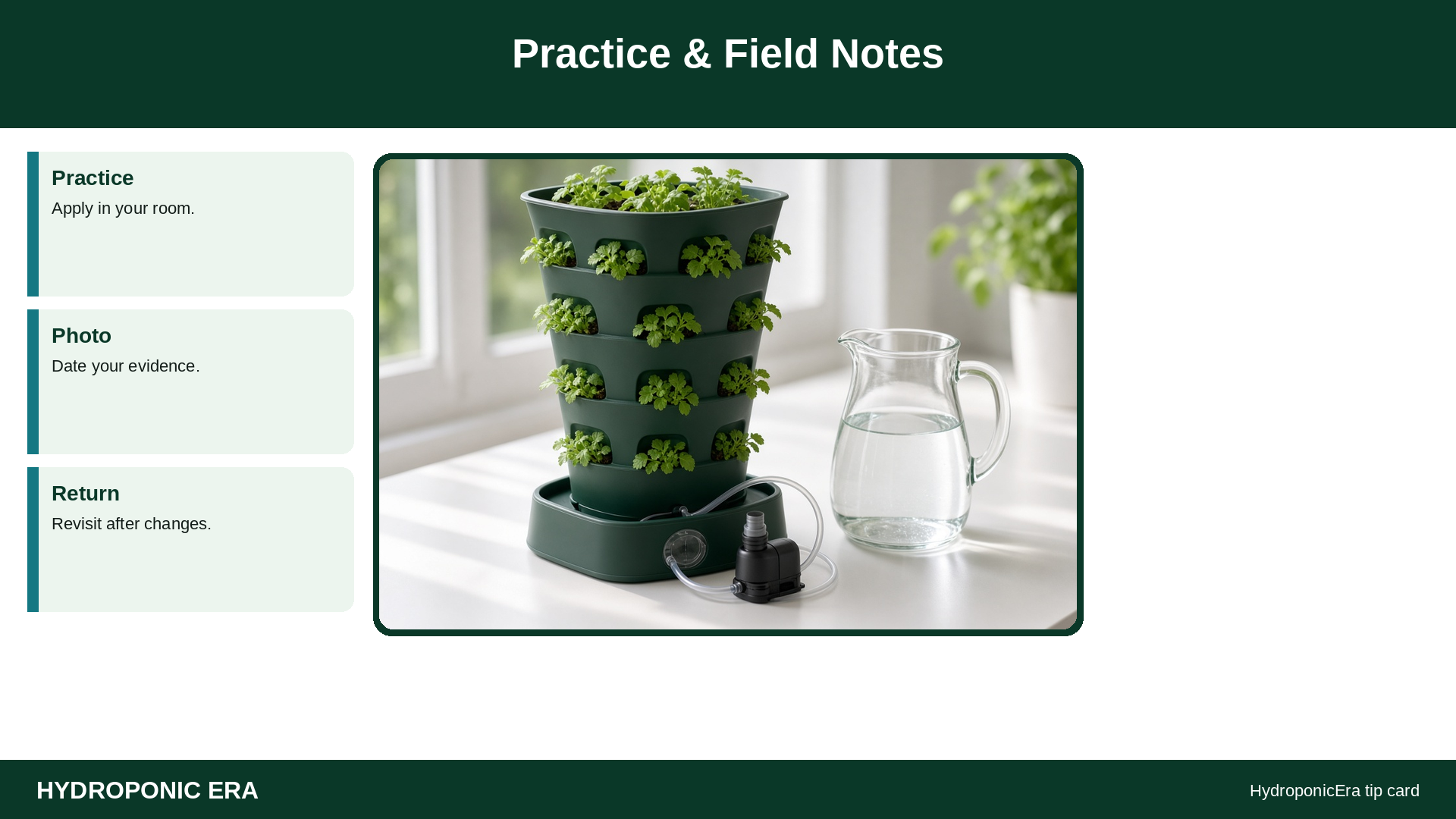
Draw your ATO on paper: supply → shutoff → float/sensor → reservoir → overflow path → catchment. If overflow is “hope,” redesign before vacation. Extension hydroponic management assumes monitoring; automation without catch basins floods apartments (leaks, apartments).
Original dilution log: each morning record reservoir volume mark + EC. Under plain-water ATO, EC trends down as plants drink. Compensate with nutrients on a schedule you actually follow (EC, mixing, water changes). ATO is not a full nutrient brain.
Mechanical floats hate debris and turbulence. Baffle air stones or relocate floats. Electronic sensors foul with biofilm—clean them during reservoir service (reservoir setup).
Potable plumbing caution: understand backflow risk and local rules before teeing into household water. When unsure, use a manual fill of a day tank instead of a live pressure connection.
Test stuck-open and stuck-closed failures on purpose during a supervised afternoon. Know which failure mode your design prefers (usually fail closed + overflow).
Practice closer: label the supply shutoff with red tape and show household members. Pair ATO with timers/automation only after the plumbing pass/fail test. Revisit this page anytime you add a larger reservoir or RO day tank.
Field Notes: Vacation Mode Without Floor Mode
Before travel, run ATO for 72 supervised hours with a catchment tray and daily EC checks. If EC crashes, your vacation water is starving the recipe—adjust dosing plan (EC, mixing). If the tray collects water, you have a leak or overfill to fix (leaks).
Prefer fail-closed supply with a marked shutoff. Teach one household member the shutoff location. Pair volume automation with timers for lights/pumps so the whole stack is coherent.
Gravity day-tanks reduce live pressure risk. Keep lids opaque and clean to limit film on floats (reservoir).
Original preflight: overflow tested | shutoff labeled | EC plan written | sitter SOP one page. That card belongs with your vacation checklist mindset even if that Basics article is another worker’s draft.
FAQs
Does ATO replace reservoir changes?
No—it only maintains volume between proper changeouts.
RO or tap for ATO?
Match your nutrient strategy; know hardness/chlorine issues.
Float valve vs electronic?
Both work; both need fail-safes.
Can I tee into a sink line?
Mind backflow, pressure, and local plumbing rules.
Vacation ready?
Only with overflow, shutoffs, and tested behavior.
Sources?
OSU hydroponics, PSU water toolkit, MSU water quality, site reservoir guides.
Can ATO run from a gravity barrel?
Yes—often safer than live pressure lines if the barrel sits above and is managed cleanly.
What if air stones fool the float?
Add a stilling baffle or relocate the float away from bubbles.
Measurement and Logging Habits That Keep Advice Honest
Every troubleshooting or equipment claim on HydroponicEra should collapse to something you can measure or photograph. Write the date, the meter reading, and one photo when you change a variable. That habit prevents stacking five fixes overnight and then inventing a success story. Use calibrated pH/EC meters where nutrients are involved, and canopy-level climate sensors where humidity and heat are involved (humidity/VPD).
When you link outward to university extension pages in the Sources section, treat them as anchors—not as promises that your exact tent will match a greenhouse trial. Translate ranges into your room with logs. If a fix works, keep it; if not, revert one step and retest. That methodology is the expertise signal search and AI systems can trust without fabricated statistics.
Internal next reads stay in-cluster: problems pages cross-link to cleaning, airflow, and crop guides like tomatoes or lettuce when symptoms live on those plants. Equipment pages cross-link to reservoir setup, pumps, and grow tents so purchases match the system you already run.
Auto Top-off Float Valves Hydroponics: Practical Checklist
Auto Top-off Float Valves Hydroponics matters every week in a home system. Recheck auto top-off float valves hydroponics after transplants, heat spikes, and canopy fill-in. Strong auto top-off float valves hydroponics habits beat one-time guesses. When auto top-off float valves hydroponics drifts, leaves crowd, roots stress, or harvest quality drops. Write auto top-off float valves hydroponics targets into your log so you do not rely on memory. Teach helpers your auto top-off float valves hydroponics checklist before you leave town. Improve auto top-off float valves hydroponics in small steps—measure, adjust, then wait a day.
Sources
- Oklahoma State University Extension — Hydroponics
- Penn State Extension — A Water Quality Toolkit for Greenhouse and Nursery Production
- Michigan State University Extension — Water quality considerations for greenhouse and nursery crops
- University of Florida IFAS — AE094: Water Quality for Crop Production Systems
- Oklahoma State University Extension — Electrical Conductivity and pH Guide for Hydroponics
- Michigan State University Extension — Hydroponics as an agricultural production system