
For most hydroponic growers, LED grow lights now beat T5 fluorescents: LEDs produce more usable light per watt, last longer, run cooler at the canopy, and come in full-spectrum fixtures that cover seedlings through fruiting. In the T5 vs LED question, T5 tubes still make sense for cheap seedling shelves, clones, and microgreens, especially if you already own fixtures. For anything bigger or longer-running, a quality LED usually saves money over time.
Key takeaway: Compare lights by efficacy (µmol/J) and coverage, not by watts or “equivalent” claims. Good LEDs simply turn more electricity into plant light.
| Factor | T5 fluorescent (HO) | LED |
|---|---|---|
| Upfront cost | Low | Moderate to high |
| Efficiency | Lower | Higher in quality fixtures |
| Tube/diode life | Tubes dim and need replacing | Long life; slow decline |
| Heat at canopy | Warm, but can sit close | Cooler beam; heat at the driver/heatsink |
| Best uses | Seedlings, clones, microgreens | Everything from seedlings to fruiting |
| Mercury | Contains a small amount | None |
T5 vs LED: How Each Light Works
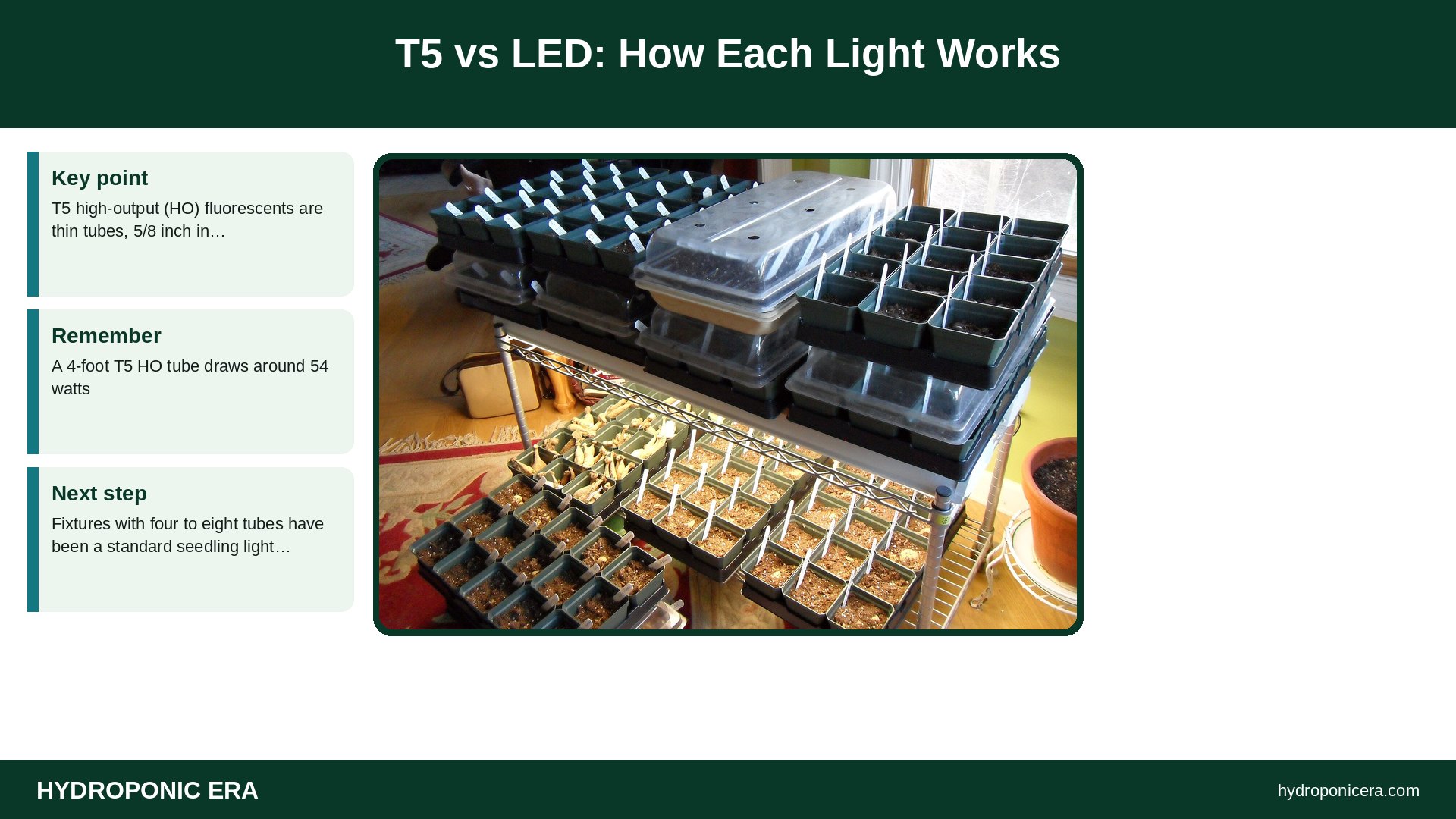
T5 high-output (HO) fluorescents are thin tubes, 5/8 inch in diameter, usually in 2-foot or 4-foot lengths. A 4-foot T5 HO tube draws around 54 watts. Fixtures with four to eight tubes have been a standard seedling light for decades. The light is soft and even, and the tubes can sit just a few inches above young plants.
LED grow lights use many small diodes, usually white plus some red, mounted on boards or bars. Because diodes are directional and efficient, an LED can deliver more photosynthetic light (PPF) per watt than fluorescent tubes. Research summaries, such as those from Utah State University’s crop physiology lab, have documented that efficiency gap.
Efficiency and Running Cost of LED Grow Lights
Efficacy is measured in micromoles of light per joule of electricity (µmol/J). Higher numbers mean more light per dollar of power. Quality LED fixtures generally beat T5 tubes on this measure, so over months of 16-hour days, the electricity savings can pay back the higher price. Estimate your own costs with our electricity cost framework.
T5 tubes also lose output as they age, so many growers replace them yearly or so to keep intensity up. LED output declines too, but much more slowly.
Light Intensity and Coverage
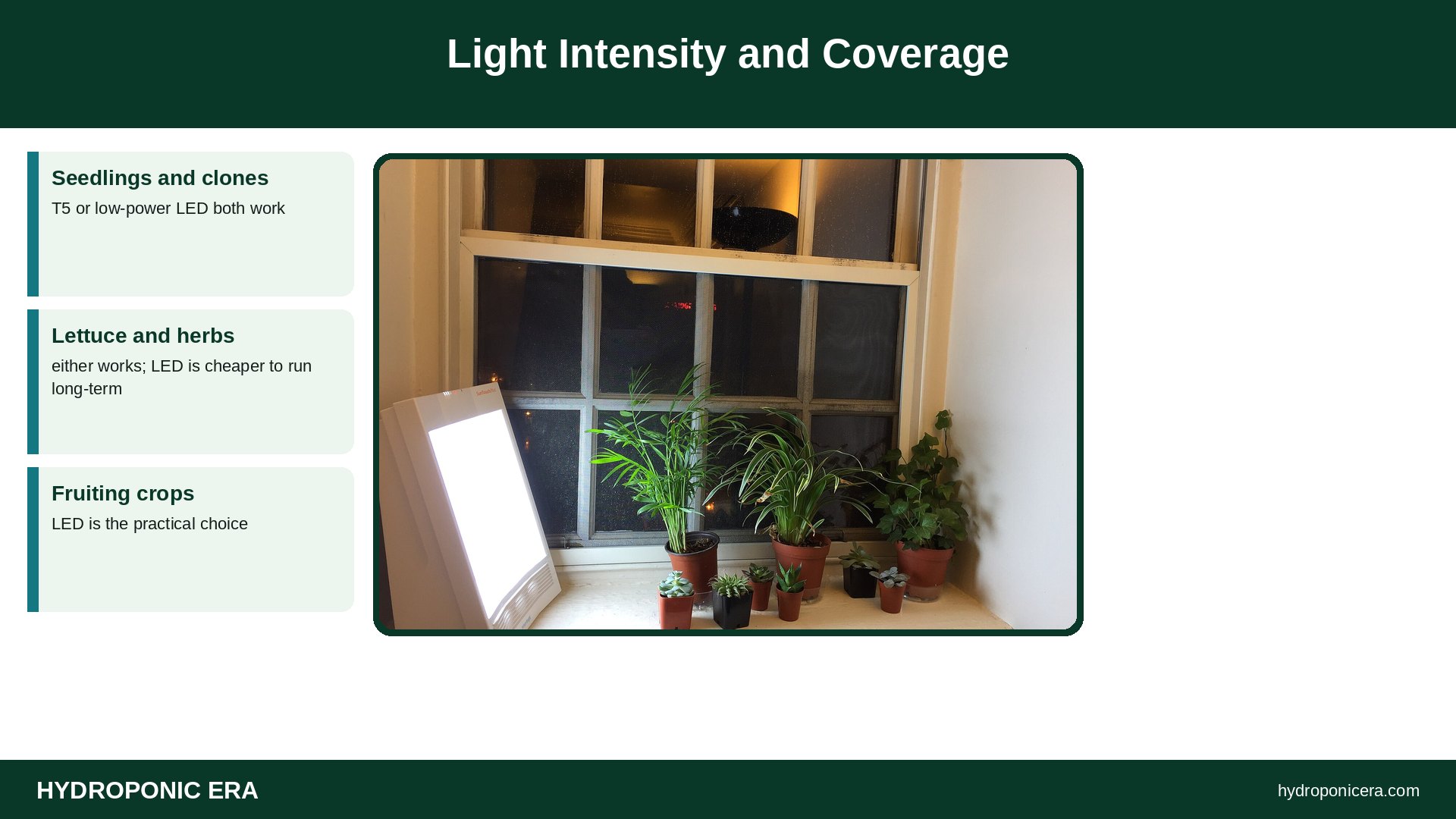
What plants actually respond to is PPFD at the canopy and the daily light integral (DLI). A four-tube T5 fixture can give seedlings and greens plenty of light when hung close. Fruiting crops like tomatoes and peppers need much more, which is where LEDs pull ahead. Learn the targets in our PPFD and DLI guide.
- Seedlings and clones: T5 or low-power LED both work.
- Lettuce and herbs: either works; LED is cheaper to run long-term.
- Fruiting crops: LED is the practical choice.
Heat and Hanging Height
T5 tubes run warm to the touch but spread heat along their length, so you can hang them 2–6 inches above seedlings. LEDs move most heat to a heatsink behind the diodes. Higher-power LEDs must hang farther away to avoid light burn, even though the canopy feels cool. Use our hanging height guide and the manufacturer’s PPFD chart.
Spectrum: Does It Matter?
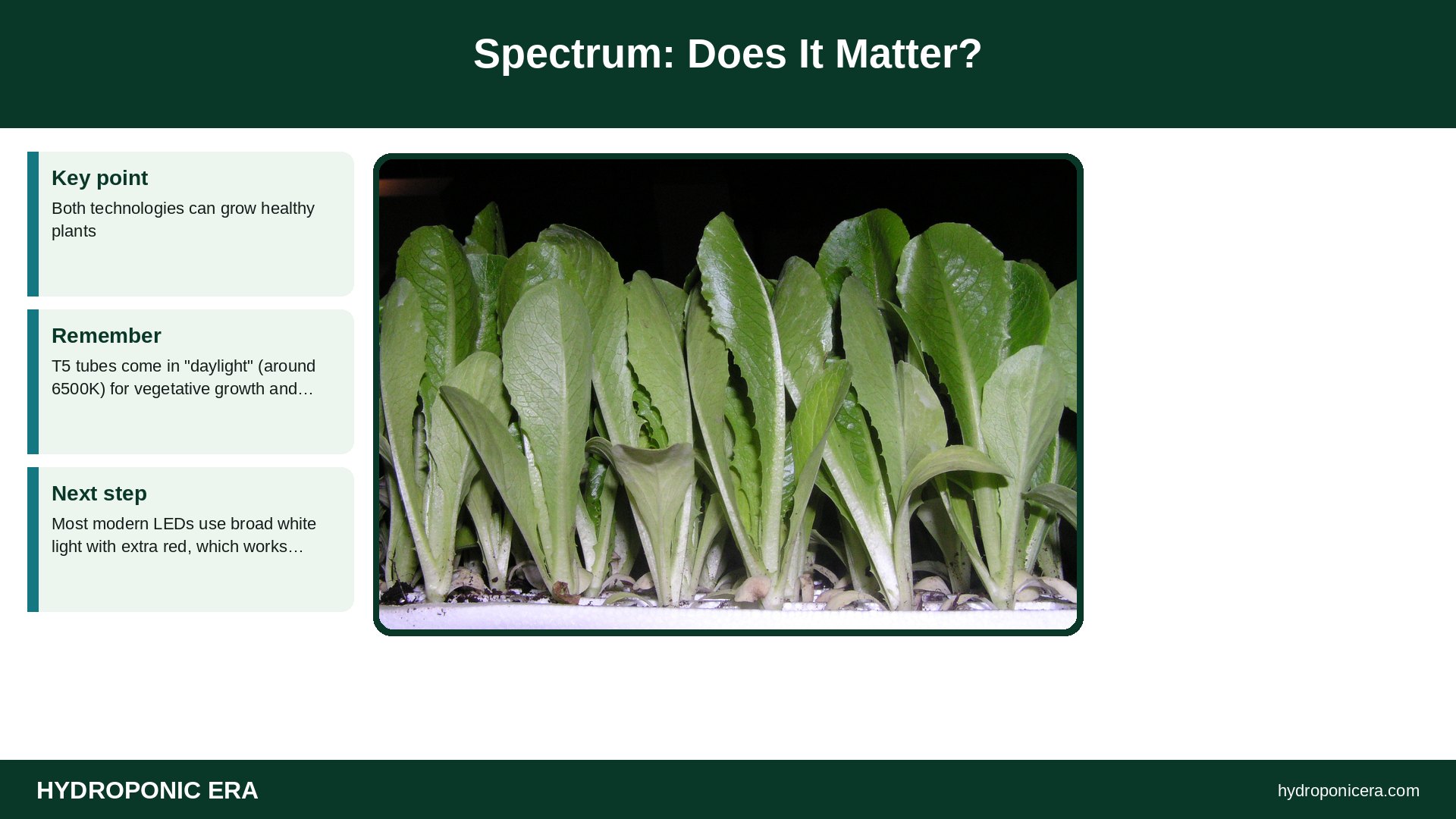
Both technologies can grow healthy plants. T5 tubes come in “daylight” (around 6500K) for vegetative growth and warmer tubes for flowering. Most modern LEDs use broad white light with extra red, which works across all stages. Spectrum tweaks can shape plant height and color, but total light intensity has a bigger effect on growth than small spectrum differences.
Where T5 Still Beats LED Grow Lights
- Cheap seedling racks where fixtures are already owned.
- Clones and cuttings that like soft, even light. See hydroponic cuttings and cloning.
- Microgreens on short cycles. See microgreens guide.
- Classrooms on tight budgets.
Where LED Grow Lights Clearly Win
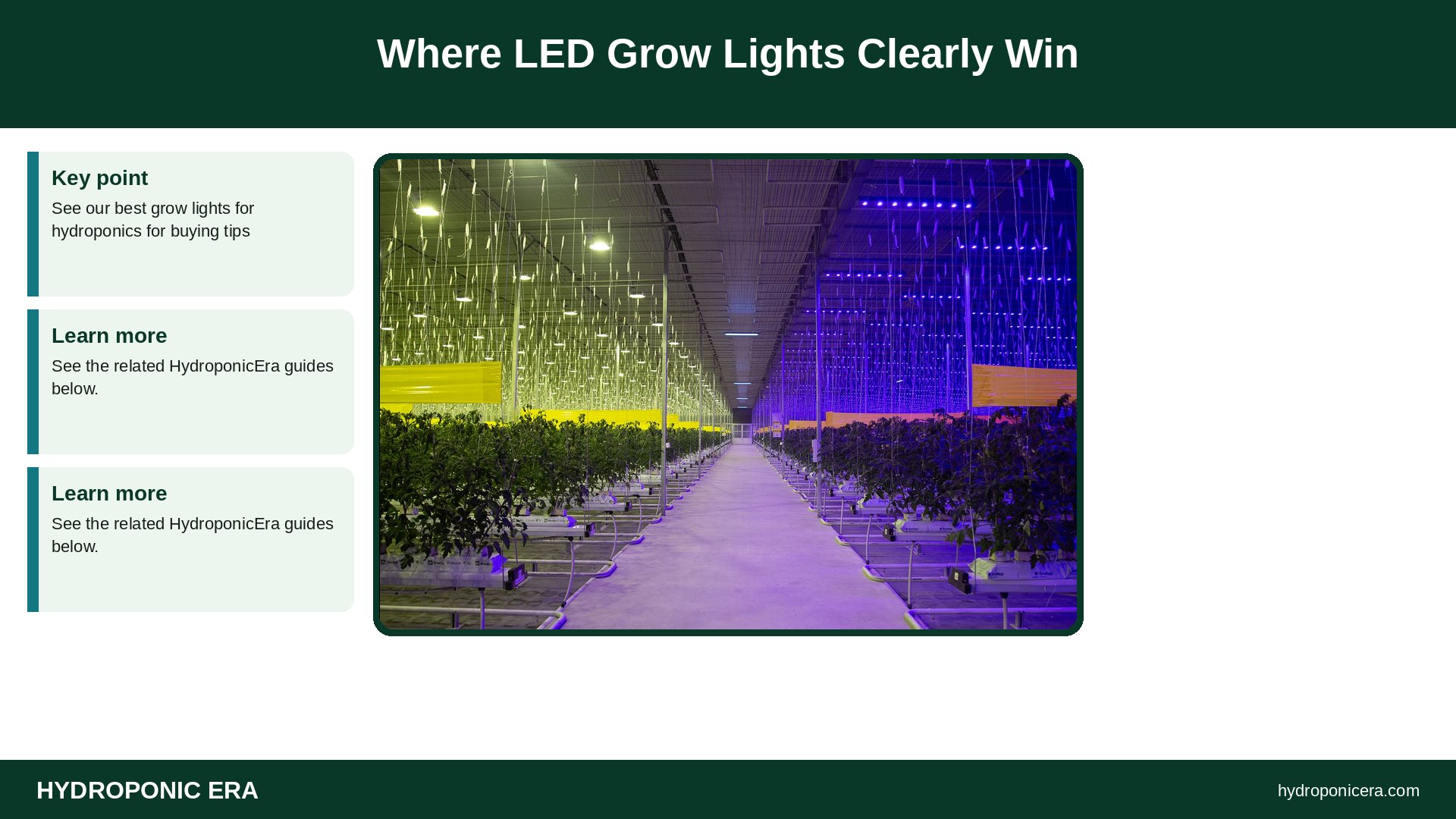
- Grow tents and cabinets, where heat and power limits matter.
- Fruiting crops and high-light herbs.
- Long-running systems where electricity adds up.
- Homes that want to avoid mercury-containing tubes.
See our best grow lights for hydroponics for buying tips.
How to Compare LED Grow Lights and T5 Fixtures
- Find the true wall wattage, not “equivalent” wattage.
- Look for a PPF value (µmol/s) and efficacy (µmol/J).
- Check the PPFD map at a stated height and coverage area.
- Confirm safety certifications such as UL or ETL listing.
- Consider dimming, warranty, and replacement parts.
If a T5 fixture or LED doesn’t publish these numbers, treat marketing claims with caution. You can also take rough readings yourself; see measuring canopy PPFD.
Disposal and Safety
Fluorescent tubes contain a small amount of mercury. The US EPA recommends recycling them rather than throwing them in household trash, and many hardware stores and local programs accept them. Handle tubes carefully to avoid breakage. LEDs don’t contain mercury but still belong in electronics recycling when they fail.
Switching From T5 to LED Grow Lights
If you already run T5 tubes and they’re working, there’s no need to throw them out. Use them on seedling shelves and buy an LED when you expand or when tubes need replacing. When switching, start the LED at a lower dimmer setting or higher hanging height and increase gradually; plants used to soft fluorescent light can bleach if hit with full LED intensity overnight.
Cost Over Three Years: A Worked Example
Here is a way to compare the two for a 2×4 ft seedling and greens shelf, using your own numbers. Write down the fixture price, true wattage, and expected tube replacements for the T5 option, then do the same for the LED. Multiply each fixture’s watts by your daily hours and 365 days, divide by 1,000 for kWh per year, and multiply by your electricity rate. Add replacement tubes for the T5. Over three years, the cheaper fixture on day one is often not the cheaper fixture overall, especially at 16 hours a day. Our cost tracking framework gives a simple sheet for this.
Choosing LED Grow Lights for Seedling Shelves
If you’re replacing T5 fixtures on a seedling rack, look for LED grow lights in a bar or strip format that spreads light evenly, similar to tubes. Wide, flat coverage matters more than peak intensity for trays of small plants. Many LED grow lights made for shelves can be daisy-chained, which keeps cords tidy. Start with the fixture higher than you would hang T5 tubes and lower it gradually while watching for stretching or bleaching.
Maintaining LED Grow Lights
LED grow lights need little care, but a few habits keep output steady. Dust the diodes and heat sink every month or two with a dry cloth or soft brush, since dust traps heat and blocks light. Keep fixtures away from spray and splashing nutrient solution, and check that cords and drivers aren’t sitting in water. Many LED grow lights slowly lose output over years rather than burning out suddenly, so if growth gets leggier over time at the same height, lower the fixture slightly or measure with a light meter. See PPFD and DLI.
Warranty and Buying Tips
Read the warranty before buying LED grow lights. Reputable brands commonly offer multi-year coverage and publish PPFD maps for a stated coverage area and height. Be wary of fixtures that list only an “equivalent” wattage or no actual power draw. Measured watts from the wall tell you running cost, and a PPFD map tells you whether the light suits your shelf size.
Keep the box and receipt until a new fixture has run for a couple of weeks, since early driver failures usually show up quickly. If you are replacing T5 tubes on a seedling shelf, measure the shelf first so the new bar or panel fits the frame and leaves room to raise it as plants grow.
FAQs: T5 vs LED Grow Lights
Are LED grow lights better than T5?
For most uses, yes: more light per watt, longer life, and better coverage for fruiting crops. T5 remains a fine, cheap option for seedlings.
Can I grow lettuce under T5 lights?
Yes. Lettuce and herbs grow well under T5 HO fixtures hung close above the canopy.
How close should T5 lights be to plants?
Typically 2–6 inches for seedlings and greens. Watch for bleaching and raise the fixture if leaves pale.
Do LED grow lights use less electricity than T5?
Quality LEDs produce the same plant light using fewer watts, so running costs are lower for the same intensity.
Can I mix T5 and LED in one setup?
Yes. Some growers use T5 for seedlings on one shelf and LED for mature plants. Just measure intensity at each canopy.
Sources
- University of Missouri Extension — Controlled Environment Agriculture: Understanding Grow Lights
- Kusuma, Pattison and Bugbee (2020), Horticulture Research — From physics to fixtures to food: current and potential LED efficacy
- US EPA — Recycling and Disposal of CFLs and Other Bulbs that Contain Mercury
- Photo credits (Wikimedia Commons, edited with titles): Led digital visuals-leds in grow box PNr°0082 by D-Kuru (CC BY-SA 3.0 at); Dahlias started indoors by F. D. Richards from Clinton, MI (CC BY-SA 2.0); Potted plants succulents under grow light Nov 2016 by Asdfjrjjj (CC BY-SA 4.0); Lettuce Plugs by Apapac at English Wikipedia (Public domain); Greenhouse in Kazakhstan by Gakon Netafim (CC BY-SA 4.0)