
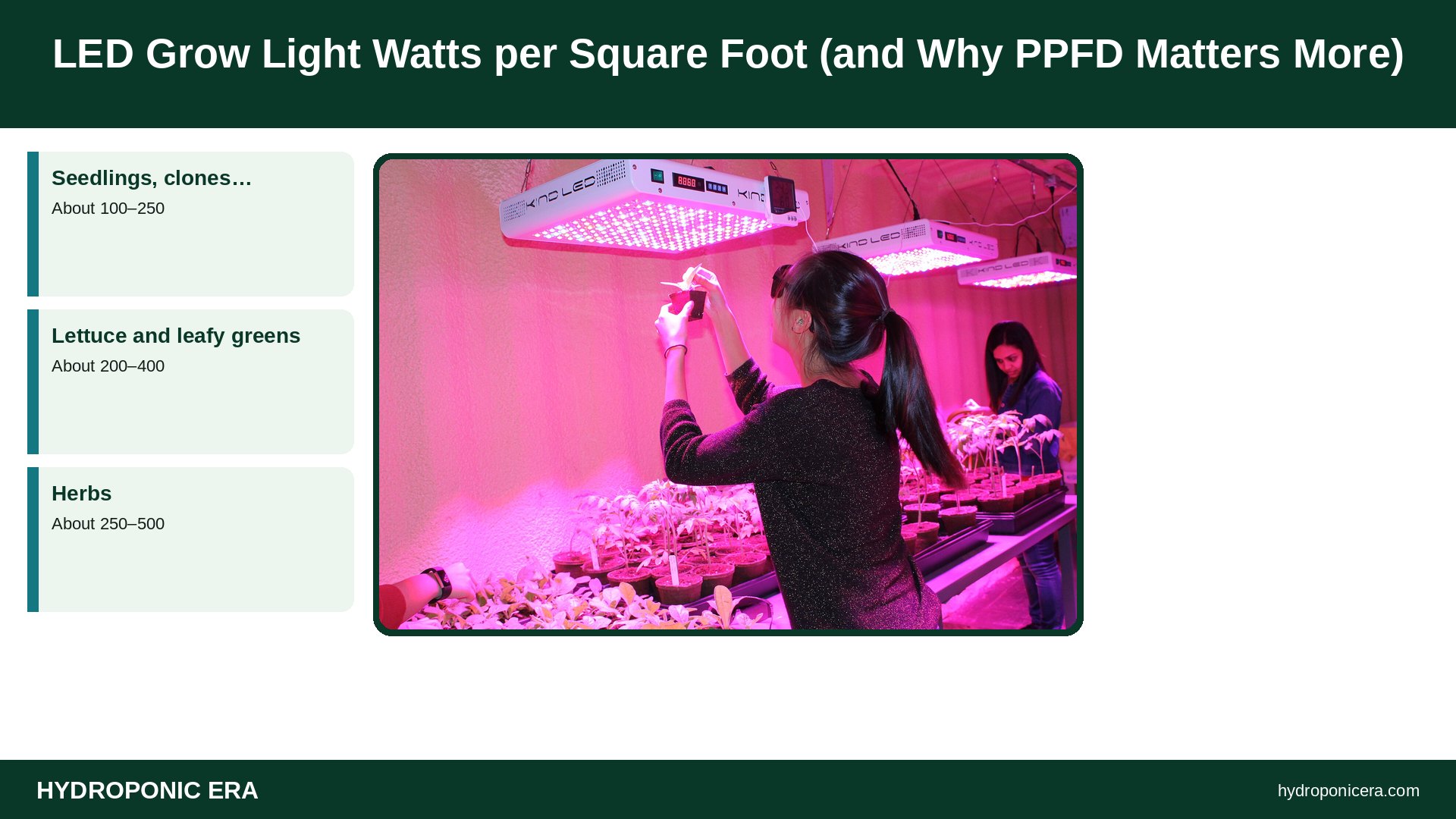
A common rule of thumb for LED grow lights is roughly 20–40 actual watts per square foot for leafy greens and seedlings, and about 30–50 or more watts per square foot for fruiting crops. But watts measure electricity, not light. Two fixtures with the same wattage can deliver very different light levels, so PPFD (photosynthetic photon flux density, in µmol/m²/s) and DLI (daily light integral) are the numbers that actually predict growth. Use watts per square foot as a rough first filter, then confirm with PPFD.
Key takeaway: Watts per square foot only works as a guideline when you compare LEDs of similar efficiency. PPFD and DLI tell you what the plants really receive.
| Crop group | Rough LED watts per square foot | Typical PPFD target (µmol/m²/s) |
|---|---|---|
| Seedlings, clones, microgreens | About 15–25 W | About 100–250 |
| Lettuce and leafy greens | About 20–35 W | About 200–400 |
| Herbs | About 25–40 W | About 250–500 |
| Tomatoes, peppers, cucumbers | About 35–50+ W | About 400–800+ |
These ranges assume reasonably efficient, modern LED fixtures and a few hours of light per day typical of indoor growing. They are starting points, not guarantees.
Why Watts Per Square Foot Is Misleading
Watts are the power a fixture pulls from the wall. Plants care about photons in the 400–700 nm range. The conversion between the two is efficacy, measured in µmol/J. An older or cheaper fixture might deliver noticeably less light per watt than a newer high-efficiency one. That means the same watts per square foot can give very different PPFD at the canopy.
Marketing makes this worse. Many budget lights advertise an “equivalent” wattage far above their real draw. Always use the true wall wattage, often printed on the driver label or in the specs as “actual power.”
How to Calculate Watts Per Square Foot
- Measure the growing area: length × width in feet. A 2×4 ft tent is 8 sq ft.
- Find the fixture’s actual wattage, for example 240 W.
- Divide: 240 ÷ 8 = 30 watts per square foot.
Then compare with the table above. For a 2×4 of lettuce, 30 W per square foot from a decent LED is in a comfortable range. For tomatoes, you’d likely want more.
Better Metric: PPFD and DLI
PPFD is the instant light intensity hitting a spot on the canopy. DLI is the total light received over a day, in mol/m²/day. You can convert between them:
DLI = PPFD × hours of light × 0.0036
For example, 250 µmol/m²/s for 16 hours gives about 14.4 mol/m²/day, a reasonable target for lettuce. Our guide to PPFD and DLI explains the math and targets for many crops, and our light schedule guide covers photoperiod choices.
Because DLI combines intensity and time, you can sometimes run a lower-wattage light for more hours to reach the same daily total, as long as the crop tolerates long days.
Reading a PPFD Map
Reputable manufacturers publish a grid of PPFD readings across a footprint at a stated hanging height. Look at both the average and the edges. Many fixtures read high in the center and much lower at the corners. If the corners fall below your crop’s needs, either the light is too small for that space or you’ll need to arrange plants accordingly. Our guide to canopy mapping and hot spots shows how to use those differences.
Measuring Your Own Light
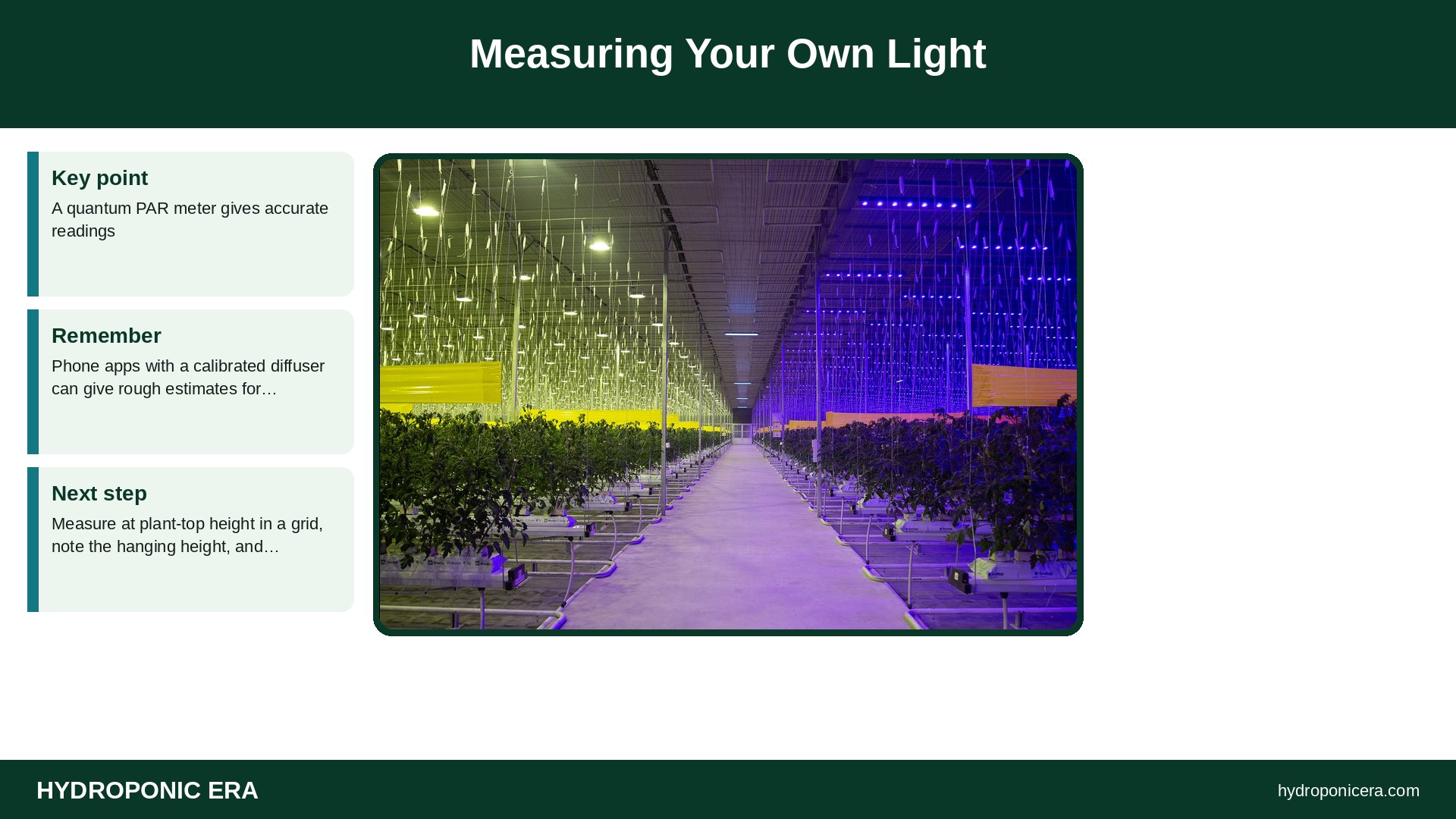
A quantum PAR meter gives accurate readings. Phone apps with a calibrated diffuser can give rough estimates for home use; see measuring canopy PPFD with a phone. Measure at plant-top height in a grid, note the hanging height, and repeat whenever you move the light.
Adjusting for Your Setup
- Reflective walls in a tent raise edge readings; open shelves lose more light. See reflective materials.
- Hanging height changes intensity and spread. Lower means brighter but smaller footprint. See hanging height by stage.
- Dimming lets you start seedlings gently and ramp up.
- CO2 and temperature affect how much light plants can use. Without extra CO2, very high PPFD gives diminishing returns. See CO2 enrichment.
Signs Your Light Is Too Weak or Too Strong
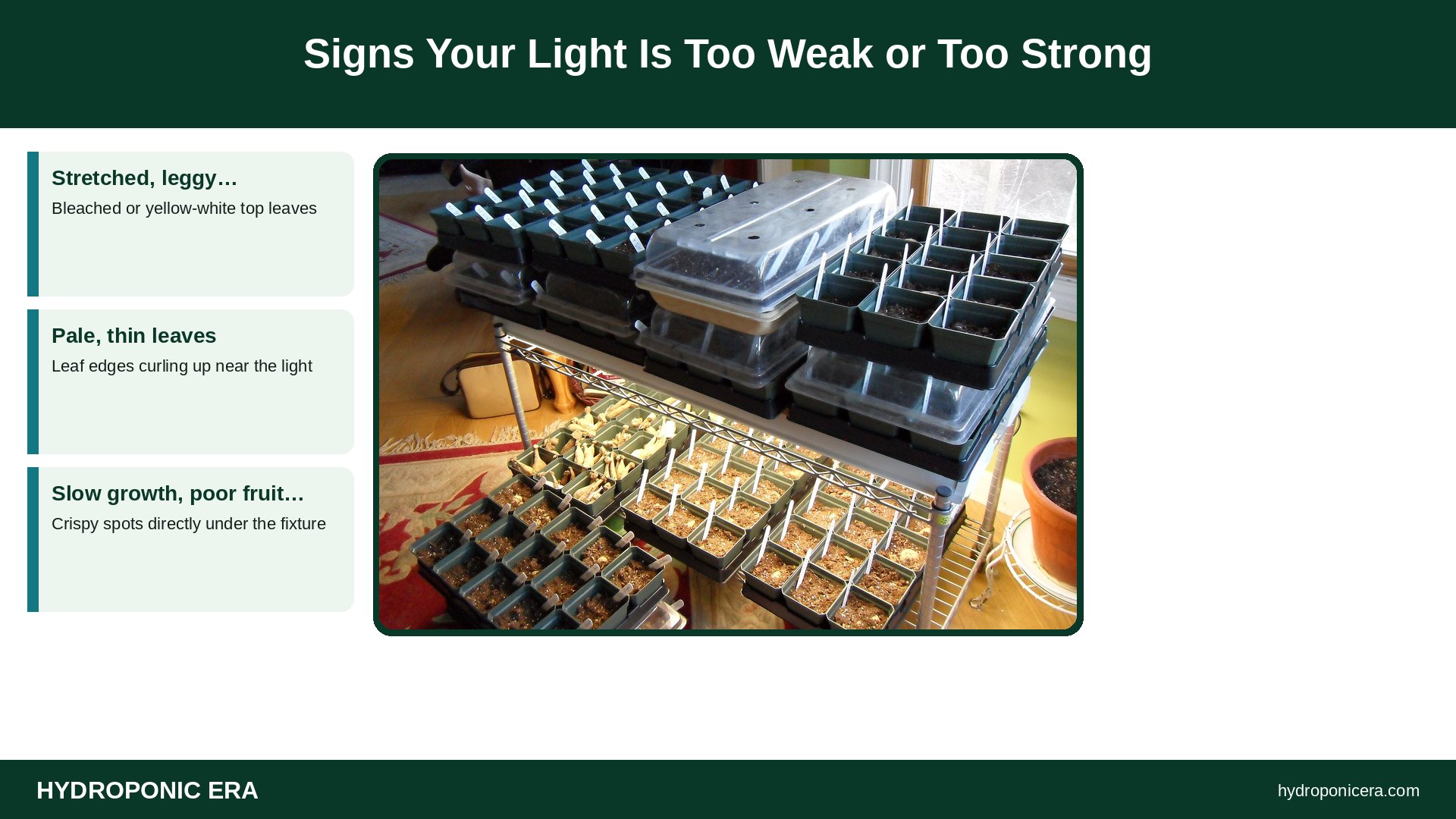
| Too little light | Too much light |
|---|---|
| Stretched, leggy seedlings | Bleached or yellow-white top leaves |
| Pale, thin leaves | Leaf edges curling up near the light |
| Slow growth, poor fruit set | Crispy spots directly under the fixture |
| Loose lettuce heads | Tip burn worsened by fast growth |
For too-strong symptoms, see our guide to light burn and photobleaching.
Example Setups
- 2×2 ft lettuce shelf (4 sq ft): a 100 W efficient LED gives 25 W per square foot, typically adequate for greens when hung appropriately.
- 2×4 ft herb tent (8 sq ft): 200–300 W gives 25–37 W per square foot.
- 4×4 ft tomato tent (16 sq ft): 500–700 W gives roughly 31–44 W per square foot; fruiting crops benefit from the upper end.
Treat these as sanity checks, then verify PPFD at the canopy with the manufacturer’s map or your own meter.
Electricity Cost
Higher watts per square foot mean higher power bills. Multiply fixture watts by hours per day and days per month, divide by 1,000 for kWh, and multiply by your utility rate. Our electricity cost framework walks through it. Efficient LEDs reach the same PPFD with fewer watts, which is the strongest argument for paying more upfront.
Choosing a Fixture With Confidence
Start by deciding what you will grow and the footprint. Pick a target PPFD from the table, then shortlist fixtures whose published maps hit that range across your footprint at a sensible hanging height. Only then check watts per square foot and efficacy to compare running costs. This order of decisions keeps you focused on plant needs rather than marketing numbers. See best grow lights for hydroponics for more.
FAQs: LED Watts Per Square Foot
How many watts per square foot do I need for lettuce?
Roughly 20–35 actual watts per square foot from an efficient LED is a common range. Confirm with a PPFD of about 200–400 µmol/m²/s.
Is 50 watts per square foot too much?
For greens, often yes, unless dimmed or raised. For fruiting crops, it can be appropriate if heat and airflow are managed.
Should I use “equivalent watts”?
No. Use actual wall wattage. Equivalent figures compare to old bulbs and inflate the number.
What’s more important, watts or PPFD?
PPFD. It measures the light plants receive. Watts only measure electricity used.
How do I convert PPFD to DLI?
Multiply PPFD by hours of light and by 0.0036.
Sources
- University of Missouri Extension — Controlled Environment Agriculture: Understanding Grow Lights
- Kusuma, Pattison and Bugbee (2020), Horticulture Research — From physics to fixtures to food: current and potential LED efficacy
- Virginia Cooperative Extension — Calculating and Using Daily Light Integral (SPES-720)
- Photo credits (Wikimedia Commons, edited with titles): Terramera scientists working in a climate-controlled growth chamber located in Vancouver, BC. The space uses LED lighting, which supports plant growth. (50188965171) by Simon Fraser University – Communications & Marketing (CC BY 2.0); Potted plants succulents under grow light Nov 2016 by Asdfjrjjj (CC BY-SA 4.0); Led digital visuals-leds in grow box PNr°0082 by D-Kuru (CC BY-SA 3.0 at); Greenhouse in Kazakhstan by Gakon Netafim (CC BY-SA 4.0); Dahlias started indoors by F. D. Richards from Clinton, MI (CC BY-SA 2.0)