
Quick Answer
For most indoor hydroponic growers, a quality full-spectrum LED is the most practical starting choice: better efficiency and lower radiant heat than many older options, with enough flexibility for leafy greens through fruiting crops. Match the fixture to your canopy size using coverage and usable intensity (PPFD/DLI), not marketing watts alone.
Plan a consistent photoperiod (many leafy greens do well around 14–16 hours of light with a dark period), hang/dim to avoid bleaching, and remember light cannot fix poor water management—keep pH, nutrients, and water changes in range.
Key Takeaways
- Prefer fixtures that publish useful light data (PPF/PPFD maps, efficacy) over vague “wattage” claims.
- Full-spectrum LEDs suit most beginners; fluorescents can still work for seedlings/low-light greens; HID/HPS need more heat management.
- Target crop needs with PPFD + hours → DLI (DLI ≈ PPFD × hours × 0.0036).
- Leafy greens often need less intensity than fruiting tomatoes/peppers.
- Keep a consistent on/off schedule; do not assume 24/7 lighting is better.
- Raise/lower or dim lights as plants grow to prevent stretch or leaf burn.
- Pair lighting with healthy roots and solution management—yellow leaves or brown roots usually need a whole-system check.
Related HydroponicEra guides
- Indoor hydroponic garden guide
- Hydroponic garden basics
- How to grow lettuce hydroponically
- How to control hydroponic pH
- Hydroponic nutrients for beginners
- How often to change hydroponic water
- Why hydroponic leaves turn yellow
- Hydroponic tower garden
Best Grow Lights for Hydroponics: Complete Beginner’s Guide

Introduction
If you are growing plants indoors with hydroponics, light is one of the most important parts of your setup. Your plants do not have access to natural sunlight, so the right artificial lighting has to provide the energy they need for healthy growth.
Choosing grow lights for hydroponics can feel confusing because there are many different types, sizes, spectrums, and wattages available. You may see LED panels, fluorescent fixtures, full-spectrum lights, red and blue lights, and products with very different power ratings.
The good news is that choosing the right light does not have to be complicated.
The best grow lights for your hydroponic setup are the ones that provide enough usable light for your particular plants, cover your growing area evenly, and allow you to control the lighting environment as your plants grow.
In this guide, we will look at the different types of hydroponic grow lights, light spectrum, wattage, PPFD, light distance, daily lighting hours, and the mistakes beginners should avoid. Lighting works best alongside solid water management—pH, nutrients, and reservoir changes.
What Makes a Good Grow Light for Hydroponics?

For most indoor hydroponic growers, modern LED grow lights are one of the best choices. They are available in many sizes and can be used for everything from a small shelf of lettuce (see growing lettuce hydroponically) to a larger indoor garden.
However, there is no single light that can be called the hydroponic grow lights for every situation.
A light that works well for lettuce may not provide enough intensity for tomatoes or peppers. Similarly, a powerful fixture designed for fruiting plants may be unnecessary for a small herb garden.
When choosing the hydroponic grow lights, start by considering your plants and growing space.
A good grow light should provide:
- Enough usable light for your crop
- Good coverage across the growing area
- An appropriate spectrum
- Reasonable energy consumption
- Manageable heat
- Suitable mounting height
- Reliable construction
- Adjustable intensity when possible
For beginners, a quality full-spectrum LED is usually a practical option because you can use the same fixture through several stages of plant growth.
The most important thing to remember is that the brightest-looking light is not necessarily the best light for your plants.
What Should You Look for in Hydroponic Grow Lights?
Before buying the hydroponic grow lights, look beyond the product’s wattage and appearance.
Several factors determine whether a grow light will actually work well in your hydroponic garden.
Light intensity
Plants need enough light to carry out photosynthesis effectively. A grow light that looks bright to your eyes may still provide insufficient light for demanding crops.
This is why serious growers pay attention to measurements such as PPFD rather than judging a fixture simply by how bright it looks.
PPFD
PPFD stands for Photosynthetic Photon Flux Density.
In simple terms, PPFD describes how much photosynthetically useful light reaches a particular area of the plant canopy.
When comparing the hydroponic grow lights, a manufacturer’s PPFD map can be extremely useful.
A PPFD map can show how much light reaches the plants at different positions underneath the fixture and at different hanging heights.
Coverage
Coverage is just as important as power.
Imagine buying a powerful light that produces plenty of light directly below it but leaves the plants around the edges in relative darkness. You could end up with uneven growth.
The hydroponic grow lights should provide reasonably even coverage across the actual growing area.
Efficiency
Your grow light may run for many hours every day, so electricity consumption matters.
Two fixtures can provide similar plant lighting while consuming different amounts of electricity. Looking at efficiency can help you make a better long-term decision.
Dimming
Dimming is another useful feature.
Seedlings may not need the same intensity as mature plants. A dimmable fixture allows you to adjust the light instead of replacing it as your plants develop.
Heat
Although LEDs generally produce less heat than many older grow-light technologies, they still produce heat.
If your grow area is enclosed, consider how the light will affect the temperature around your plants.
LED vs. Other Types of Hydroponic Grow Lights: Which Is Best?

LEDs have become a popular choice for indoor hydroponic gardening, but they are not the only type of grow light available.
Understanding the differences will help you decide which option is right for your setup.
| Light Type | Advantages | Disadvantages | Suitable For |
| LED | Efficient, versatile, long-lasting | Initial cost can be higher | Most hydroponic gardens |
| Fluorescent | Affordable and gentle | Less suitable for high-light crops | Seedlings and leafy greens |
| HPS | Strong light output | Produces considerable heat | High-light flowering crops |
| CMH | Broad spectrum | More heat and energy considerations | Specialized growing |
LED grow lights
For many growers, LEDs are the easiest place to start.
Modern LED fixtures can provide broad-spectrum light and are available in compact designs for small hydroponic systems as well as larger fixtures for bigger growing areas.
The hydroponic grow lights for a beginner will often be an LED fixture that has suitable coverage and adjustable output.
Fluorescent lights
Fluorescent lights can work for seedlings and some leafy greens.
They can be useful when the growing area is small and the plants do not require very high light intensity.
However, they are generally less attractive for larger hydroponic gardens or demanding fruiting crops.
HPS and other HID lights
High-intensity discharge systems have been used for indoor growing for many years.
They can produce strong light, but they also produce considerable heat and can require more attention to ventilation.
For someone starting a modern indoor hydroponic garden, an efficient LED system is often simpler to manage.
What Is the Best Light Spectrum for Hydroponic Plants?
Light spectrum is another important part of choosing the hydroponic grow lights.
The spectrum describes the different wavelengths of light produced by a fixture.
Plants respond differently to different parts of the light spectrum. Blue and red wavelengths are particularly important for photosynthesis and plant development, while other wavelengths can also influence how plants grow.
Blue light
Blue light is strongly associated with vegetative growth and plant structure.
An appropriate amount of blue light can help plants develop compact, healthy growth instead of becoming excessively stretched.
This makes blue wavelengths particularly relevant during the vegetative stage.
Red light
Red wavelengths are important for photosynthesis and can influence flowering and fruiting.
This is one reason red light is especially interesting when growing tomatoes, peppers, and other fruit-producing crops indoors.
Full-spectrum lighting
Full-spectrum grow lights are designed to provide a broader range of wavelengths.
For a beginner, full-spectrum lighting can be convenient because you do not necessarily need to change fixtures between different growth stages.
If you are looking for the hydroponic grow lights for a mixed garden containing herbs, leafy greens, and fruiting plants, a good full-spectrum LED is worth considering.
How to Choose the Best Grow Light for Different Hydroponic Plants
The best lighting setup depends heavily on what you are growing.
This is an important point because the hydroponic grow lights for lettuce may not be the best option for tomatoes.
Lettuce and leafy greens
Leafy greens such as lettuce, kale, and spinach generally do not require the same lighting intensity as fruiting plants.
A moderate-output LED with good coverage can work well.
In vertical hydroponic systems, pay particular attention to uniformity because plants positioned at different heights can receive different amounts of light.
Herbs
Herbs such as basil, mint, parsley, and cilantro can also be grown indoors with artificial lighting.
Basil, in particular, can become thin and stretched when it does not receive enough light.
For herbs, choose a fixture that provides adequate coverage without producing excessive heat.
Tomatoes
Tomatoes are considerably more demanding than many leafy greens.
If you want to grow tomatoes indoors and produce fruit, you will generally need a stronger lighting setup than you would for a small lettuce garden.
When choosing the hydroponic grow lights for tomatoes, pay close attention to light intensity, coverage, and the total amount of light plants receive throughout the day.
Peppers
Peppers are another fruiting crop that benefits from strong, consistent lighting.
A fixture suitable for tomatoes can often be considered when designing a lighting system for peppers, but the exact requirements depend on the variety and growing conditions.
Seedlings
Young seedlings require a different approach from mature plants.
Too little light can cause stretching, while excessive intensity can stress young plants.
If possible, use a dimmable fixture so you can gradually increase the intensity as the plants develop.
How Many Watts Do Hydroponic Grow Lights Need?

One of the biggest mistakes beginners make is choosing the hydroponic grow lights based only on watts.
Watts measure electrical power consumption. They do not directly tell you how much usable light reaches your plants.
For example, two fixtures can consume the same amount of electricity but distribute their light very differently.
One might provide excellent coverage, while the other concentrates most of its light in a small area.
This is why PPFD is a more useful measurement when evaluating plant lighting.
Understanding DLI
DLI stands for Daily Light Integral.
It describes the total amount of photosynthetically useful light a plant receives during a 24-hour period.
DLI combines light intensity with the amount of time the light is operating.
The basic relationship is:
DLI = PPFD × hours of light × 0.0036
For example, if your plants receive an average PPFD of 300 µmol/m²/s for 14 hours:
300 × 14 × 0.0036 = 15.12 mol/m²/day
This shows why both intensity and duration matter.
Instead of asking only how many watts the hydroponic grow lights use, consider how much useful light they actually deliver to the canopy.
A better way to choose wattage
Start with the growing area and crop.
Then:
- Identify the approximate lighting needs of your crop.
- Check the fixture’s PPFD information.
- Look at the manufacturer’s coverage area.
- Consider the fixture’s efficiency.
- Make sure you can position it at an appropriate height.
- Adjust the intensity as your plants grow.
This gives you a much better basis for choosing a light than wattage alone.
How Far Should Grow Lights Be From Hydroponic Plants?
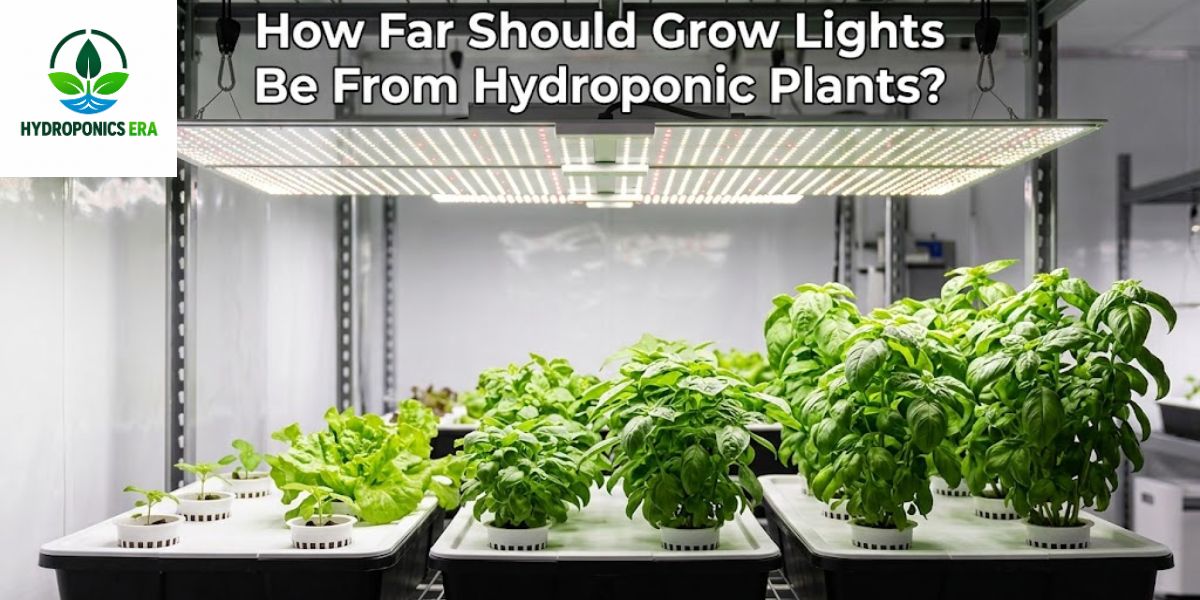
The correct distance between your plants and the hydroponic grow lights depends on the fixture.
There is no single distance that works for every LED grow light.
A small LED bulb and a powerful LED panel can produce very different levels of light even when they are positioned at the same distance from plants.
When the light is too close
If the light is too close, the plants may receive excessive intensity.
You may notice:
- Leaf bleaching
- Leaf damage
- Excessive heat
- Stress concentrated near the top of the canopy
If you notice these symptoms, consider raising the light or reducing its intensity if the fixture can be dimmed.
When the light is too far away
If the light is too far away, plants may stretch toward the fixture.
You may see:
- Long stems
- Large gaps between leaves
- Weak growth
- Plants leaning toward the light
The goal is not simply to place the light as close as possible.
The goal is to provide the appropriate intensity across the entire canopy.
Adjusting the light as plants grow
Your plants change over time, so your lighting setup should change with them.
Seedlings are short. Mature plants may grow much closer to the fixture.
Check the distance regularly and adjust the height or dimming level when necessary.
How Many Hours Should Hydroponic Grow Lights Run?
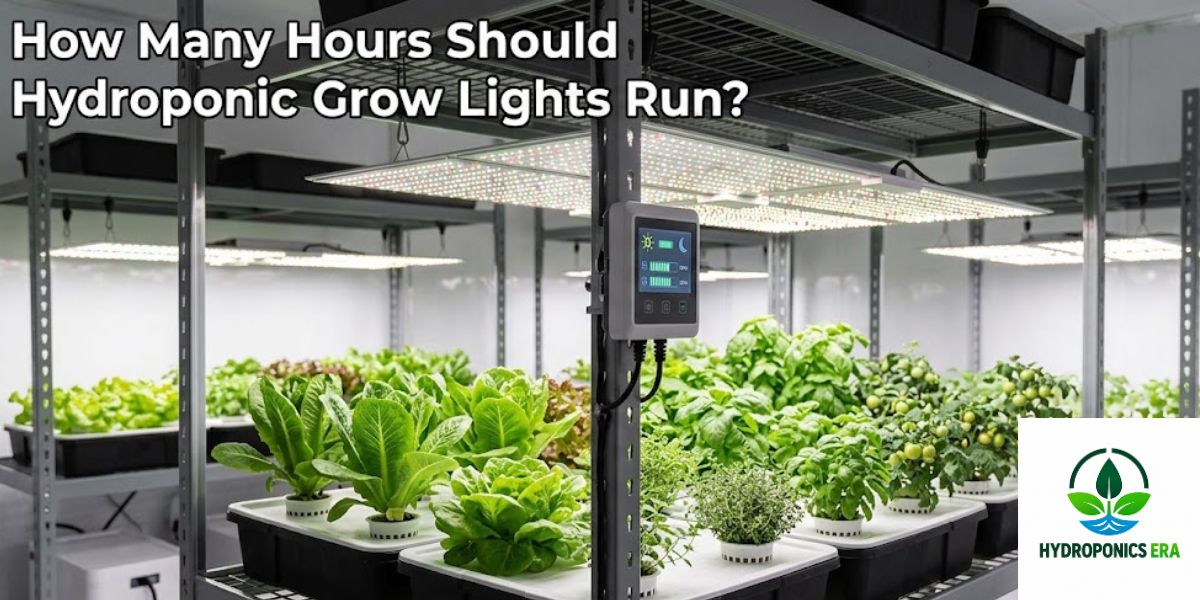
The number of hours your lights should operate depends on the crop, light intensity, growth stage, and target DLI.
Typical indoor lighting targets (guidance)
Use these as starting ranges, not guarantees. Measure canopy PPFD when you can, and adjust height/dimming to plant response.
| Crop type (typical) | Rough photoperiod | What to prioritize |
|---|---|---|
| Lettuce & leafy greens | About 14–16 hours light / day | Even coverage, moderate intensity, cooler canopy temps |
| Herbs | Often similar to leafy greens | Uniform PPFD; avoid excessive heat on soft herbs |
| Fruiting crops (tomato/pepper) | Often ~14–18 hours depending on stage/strategy | Higher intensity, good coverage, manage heat and DLI |
| Seedlings | Commonly long days at gentler intensity | Keep lights farther/dimmer at first; raise intensity gradually |
There is no universal schedule that makes the hydroponic grow lights work perfectly for every plant.
A common beginner mistake is assuming that longer lighting automatically produces faster growth.
It does not work that way.
For example, if your average PPFD is 200 µmol/m²/s:
- 12 hours produces about 8.64 DLI
- 16 hours produces about 11.52 DLI
- 18 hours produces about 12.96 DLI
The same light therefore provides a different daily light total depending on how long it runs.
Give plants a consistent schedule
Plants benefit from a predictable light and dark cycle.
A simple timer can automate the schedule so you do not have to switch your grow lights on and off manually every day.
For many indoor hydroponic systems, using a timer is one of the easiest ways to improve consistency.
Do not automatically run lights 24 hours
Keeping grow lights on continuously is not a shortcut to better growth.
Plants have biological processes that respond to daily light and dark cycles.
Instead of maximizing the number of hours, aim for an appropriate combination of intensity and photoperiod for the crop.
Full-Spectrum vs. Red and Blue Grow Lights for Hydroponics

You may have noticed that some older LED grow lights produce a strong purple or pink appearance.
These fixtures often emphasize red and blue wavelengths.
Today, many growers prefer broad-spectrum or full-spectrum fixtures because they provide a more natural-looking light and can be used throughout the growing cycle.
Full-spectrum lights
The main advantage of full-spectrum lighting is versatility.
You can use one fixture for seedlings, vegetative growth, and many fruiting plants without constantly changing the lighting system.
For beginners searching for the hydroponic grow lights, this simplicity can be valuable.
Red and blue lights
Red and blue wavelengths are important to plants, but that does not mean every red-and-blue fixture is automatically superior.
A fixture should be evaluated based on its actual light output, coverage, spectrum, and efficiency.
Which should you choose?
For most home hydroponic growers, a good full-spectrum LED is an easy and practical choice.
If you are an experienced grower with a specific crop and a carefully designed lighting strategy, a more specialized spectrum may make sense.
For a beginner, however, simplicity is often an advantage.
Common Hydroponic Grow Light Mistakes to Avoid
Even the hydroponic grow lights will not perform properly if they are installed or operated incorrectly.
Here are some common mistakes to avoid.
Choosing a light only because it has high wattage
More watts do not automatically mean better plant growth.
Look at PPFD, coverage, efficiency, and spectrum instead.
Placing the light too close
A stronger light is not always better.
If your fixture is too close, the top of the canopy may receive excessive intensity.
Placing the light too far away
Weak lighting can cause plants to stretch and develop poor structure.
Check plant growth and adjust the fixture when necessary.
Ignoring coverage
Don’t assume that a light covers your entire growing area just because the manufacturer lists a large coverage number.
A PPFD map can give you a better idea of how evenly the light is distributed.
Running lights without a schedule
Manually turning lights on and off every day can lead to inconsistent lighting.
Use a timer whenever possible.
Forgetting about heat (heat stress can show up as leaf damage—see also yellow leaves)
Even efficient LEDs produce heat.
Monitor the temperature in your growing area, especially if the space is enclosed.
Never adjusting the light
Plants grow.
If you leave your fixture in exactly the same position throughout the entire crop cycle, the distance between the canopy and light will change.
Regularly inspect your plants and adjust the fixture as needed.
Frequently Asked Questions About Hydroponic Grow Lights
What is the best type of grow light for hydroponics?
For most indoor growers, a quality full-spectrum LED is a practical choice. It can provide broad-spectrum lighting, good efficiency, and flexibility across different growth stages.
Are LED grow lights good for hydroponics?
Yes. LEDs are widely used for indoor hydroponic growing because they are available in many sizes, can provide different spectra, and generally offer good energy efficiency.
How many watts do I need for hydroponic plants?
There is no single wattage that works for every hydroponic plant. Consider the crop, growing area, PPFD, coverage, and DLI rather than relying on watts alone.
How far should an LED grow light be from plants?
The correct distance depends on the fixture and its output. Use the manufacturer’s recommendations and PPFD information when available, and watch how your plants respond.
Is full-spectrum light better for hydroponics?
Full-spectrum lighting is a convenient option for many hydroponic growers because it can be used across different growth stages. However, spectrum should not be considered separately from light intensity and duration.
How many hours should hydroponic plants receive light?
The appropriate photoperiod depends on the crop, light intensity, and target DLI. Rather than choosing a number of hours blindly, consider the total amount of light your plants receive each day.
Can regular LED bulbs grow hydroponic plants?
Some ordinary LED bulbs may provide enough light for certain low-light plants or seedlings, but purpose-built grow lights are generally easier to evaluate because they are designed specifically for plant lighting.
Do hydroponic plants need darkness?
Yes. Indoor plants still benefit from an appropriate light and dark cycle. Keeping lights on continuously is not automatically better.
Final Thoughts: Choosing the Right Hydroponic Grow Light
Finding the hydroponic grow lights becomes much easier once you stop looking at the product label alone.
Instead of asking which light is the brightest or has the highest wattage, ask whether it provides the right amount of usable light for your plants and growing area.
For most beginners, a quality full-spectrum LED is a sensible starting point. Look for good coverage, suitable intensity, reasonable efficiency, manageable heat, and adjustable output when possible.
If you are growing lettuce or herbs, you may not need the same lighting system required for tomatoes and peppers. Likewise, a small countertop hydroponic garden has very different requirements from a large indoor growing area.
The most important factors to remember are:
- Plant type
- Growing area
- PPFD
- DLI
- Light spectrum
- Fixture coverage
- Light distance
- Daily photoperiod
- Heat management
- Energy efficiency
The best grow lights for your setup are the ones that match your particular growing conditions.
Once you understand the relationship between intensity, spectrum, distance, and lighting duration, choosing the hydroponic grow lights becomes much less complicated.
Start with your crop, measure your growing area, choose a suitable fixture, and then adjust the lighting as your plants develop. That approach will give you a much better result than simply buying the most powerful light you can find.
Related reading
- Hydroponic garden basics for beginners
- How to control hydroponic pH
- Hydroponic nutrients for beginners
- How often to change hydroponic water
- Grow lights for hydroponics
- Why hydroponic leaves turn yellow
- Why hydroponic roots turn brown
- Deep water culture (DWC) for beginners
- Indoor hydroponic garden guide
Sources
These university and extension resources explain grow-light metrics (PAR/PPFD/DLI), supplemental lighting, and LED considerations. Targets in this article are typical guidance and vary by crop and setup.
- University of Missouri Extension — Controlled Environment Agriculture: Understanding Grow Lights (G6987)
- Iowa State University Extension — Important considerations for providing supplemental light to indoor plants
- University of New Hampshire Extension — Supplemental Lighting Run Time Worksheet
- Michigan State University — Getting Started With Supplemental Lighting (LEDs)
- University of Kentucky CCD — Hydroponic Lettuce Production in Controlled Environments (includes DLI guidance)
14 thoughts on “Best Grow Lights for Hydroponics: Complete Beginner’s Guide”