
Water culture orchids grow with their roots in or just above water instead of in a free-draining pot. The safer version is semi-water culture: a non-draining pot with chunky media and ¼–½ inch of water in the bottom. Full water culture (roots always submerged) has little expert backing, so test one plant first.
| Question | Quick answer |
|---|---|
| Best starter orchid | Phalaenopsis (moth orchid) for the home (AOS) |
| Semi-water culture | Non-draining pot, chunky media, about ¼–½ inch of water |
| Full water culture | Roots kept in water; limited expert guidance |
| Main risk | Root rot in soggy conditions; crown rot if water sits in the crown |
| Water quality | Low-salt water; EC of 0.5 dS/m or less before fertilizer |
| Orchids that adapt well | Paphiopedilums, phragmipediums, most cattleya hybrids (AOS article) |

What Are Water Culture Orchids?

“Water culture” covers two quite different methods:
- Semi-water culture (semi-hydro): The orchid sits in a non-draining container with coarse media and a shallow layer of water at the bottom. Roots near the top stay airy while the base stays moist.
- Full water culture: The roots sit in water most or all of the time, usually in a clear vase.
Standard American Orchid Society (AOS) culture advice for phalaenopsis calls for a porous mix and warns that root rot occurs if plants are left in soggy medium. A September 2025 AOS article by experienced grower Katherine Weitz, though, describes growing many orchids for 28 years in non-draining pots with about ¼–½ inch of water in the bottom. So water culture orchids are possible, but they’re a departure from the textbook.
Full vs. Semi Water Culture: Which Is Better?
| Factor | Semi-water culture | Full water culture |
|---|---|---|
| Expert support | Described in an AOS article by an award-winning grower | We found no AOS or university guidance |
| Root aeration | Upper roots in airy media | Depends entirely on your routine |
| Rot risk | Moderate; needs monitoring | Higher; soggy roots rot (AOS) |
| Watering effort | Low; water in place | Low, but needs frequent checks |
| Best for | Most beginners trying the method | Experimenters willing to lose a plant |
For most people, semi-water culture is the better route to healthy water culture orchids.
How Do You Start Water Culture Orchids Step by Step?
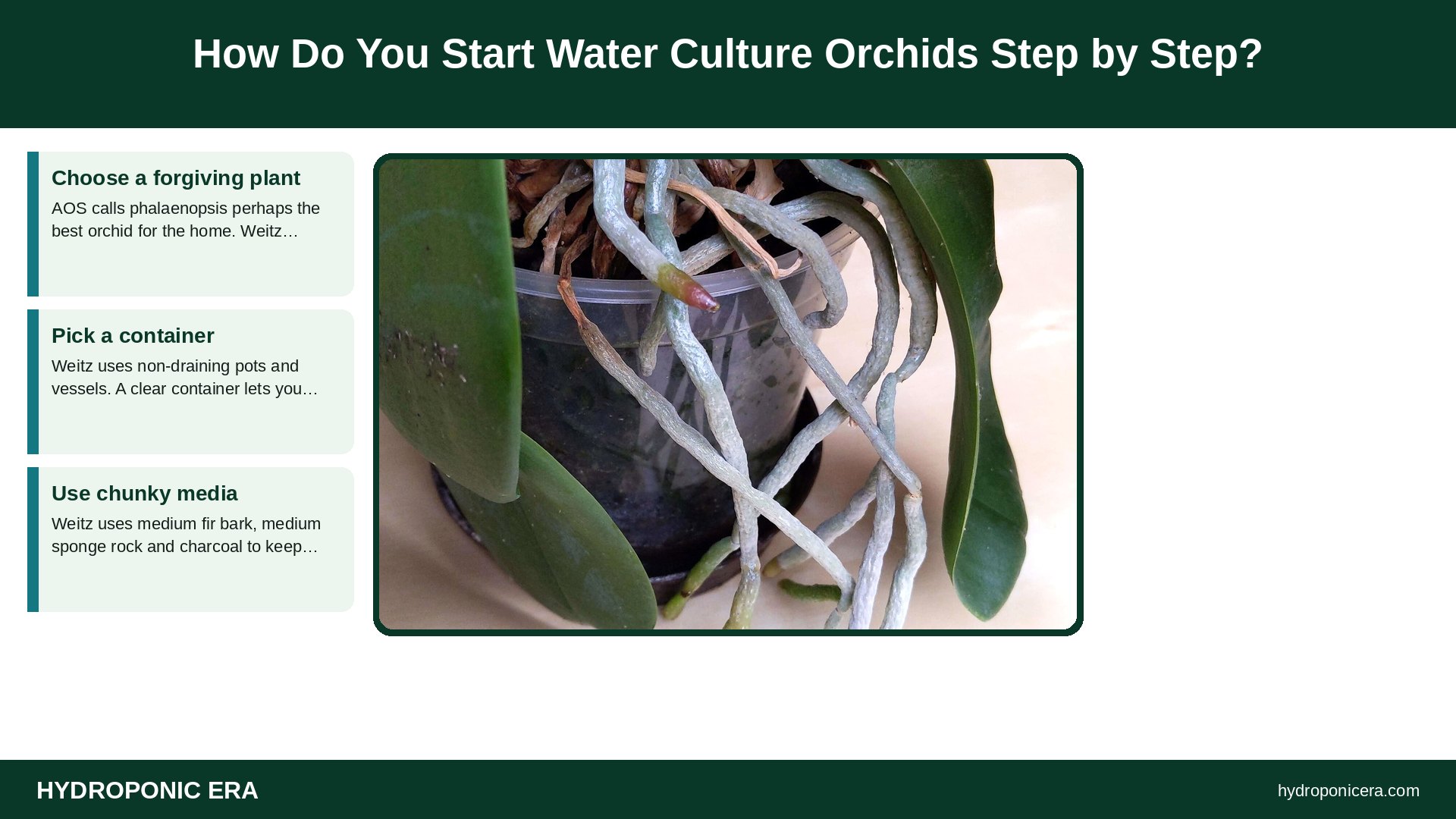
- Choose a forgiving plant. AOS calls phalaenopsis perhaps the best orchid for the home. Weitz reports paphiopedilums, phragmipediums and most cattleya hybrids adapt well, while tolumnias failed.
- Pick a container. Weitz uses non-draining pots and vessels. A clear container lets you see roots and the water level.
- Use chunky media. Weitz uses medium fir bark, medium sponge rock and charcoal to keep air at the roots.
- Trim bad roots. AOS says to trim soft, rotted roots when repotting.
- Add a little water. Keep about ¼–½ inch in the bottom. Weitz lifts the pot or listens for “sloshing”; if water is still present, she waits.
- Keep the crown dry. AOS says to water in the morning and keep water out of the crown to prevent crown rot.
- Keep air moving. AOS says air should always move around plants to prevent fungal and bacterial disease. Weitz runs a ceiling fan constantly.
Those steps are the core of growing water culture orchids. Repot often so you can inspect roots, as Weitz does.
What Light and Temperature Do Water Culture Orchids Need?

| Factor | Phalaenopsis target (AOS) |
|---|---|
| Light | Bright window with little or no direct sun; east is ideal |
| Grow lights | 6–12 inches above leaves, 12–16 hours a day |
| Night temperature | Above 60°F |
| Day temperature | 75–85°F; maximum about 90–95°F |
| Reblooming cue | About 55°F nights for several weeks in autumn |
| Humidity | Pebble trays, with plants not sitting in the water |
An AOS Orchids magazine article by Texas A&M and Michigan State researchers notes that phalaenopsis roots exposed to light have chloroplasts and photosynthesize, and that many growers use clear pots. That’s one reason clear vases are popular for water culture orchids. See grow lights.
What Water and Fertilizer Should You Use?
Water quality matters more when roots sit in water. The same AOS research article recommends water with an electrical conductivity (EC) of 0.5 dS/m or less before adding fertilizer, and warns that salts can build up and injure roots without periodic leaching. Weitz uses reverse osmosis (RO) water in winter and notes that heavy rain helps flush fertilizer salts. See EC and TDS and tap water.
For fertilizer, AOS notes some growers apply quarter-strength fertilizer with every watering, which suits warm, humid conditions. Flush pots with plain water from time to time to keep water culture orchids free of salt buildup.
When Should You Repot?
AOS says potting is best done in spring, right after flowering, and usually every one to three years; mature plants can stay in the same container until the medium starts to break down, usually around two years. Seedlings grow fast enough to need repotting yearly. When you repot, AOS recommends trimming soft, rotted roots and setting the plant so the junction of roots and stem sits at the top of the medium. Weitz repots more often than usual so she can keep a close eye on root health.
Can Orchids Go Outside for Summer?
Weitz moves her collection outdoors in Minnesota once nights stay above about 52°F, usually mid-May through mid-September, for dappled sun, rain and a bigger day-night temperature swing. After heavy rain, she simply tips out the extra water. Bring plants in before nights turn cold.
What Mistakes Happen With Water Culture Orchids?
| Mistake | Result | Fix |
|---|---|---|
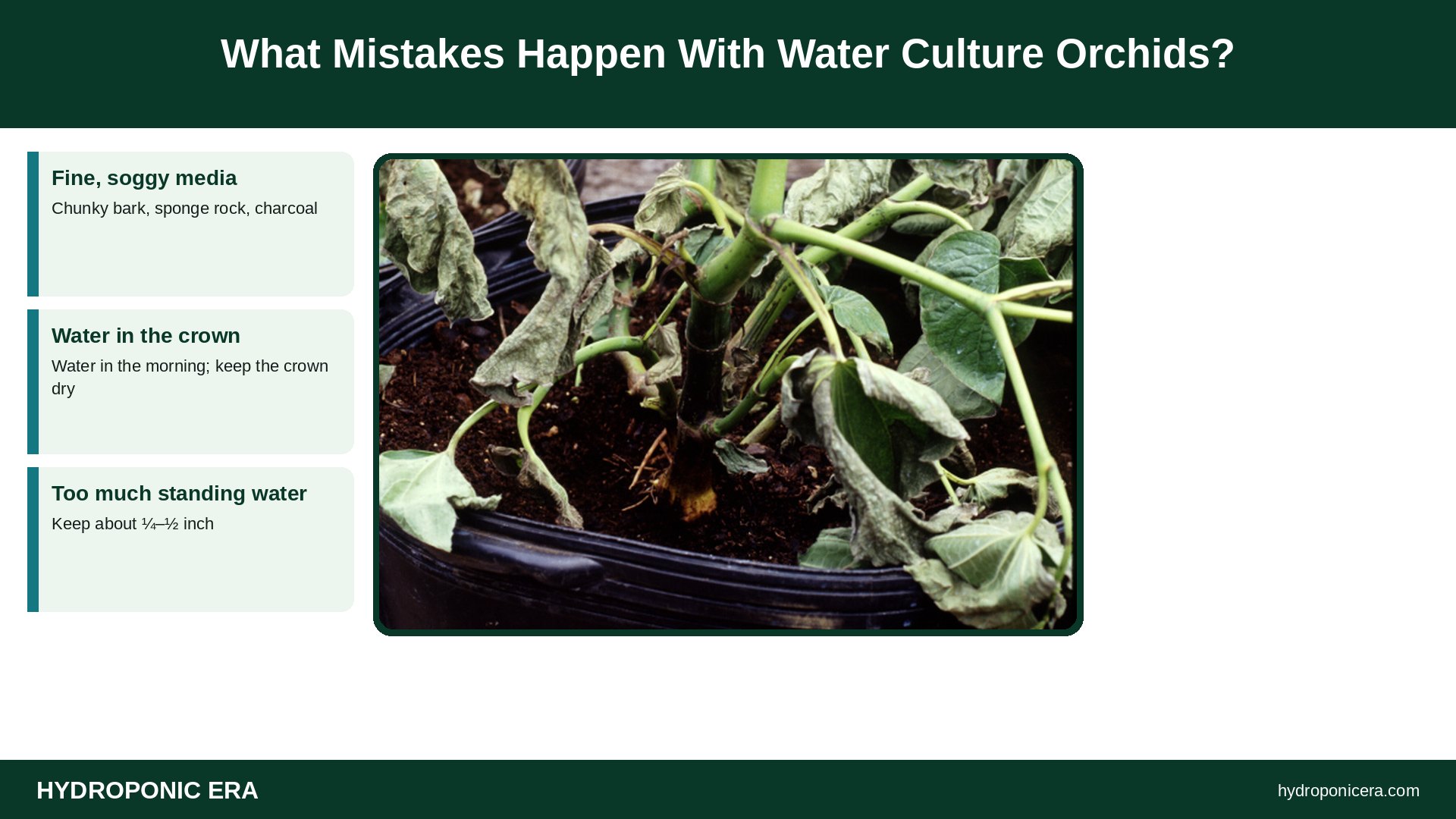
| Fine, soggy media | Root rot (AOS) | Chunky bark, sponge rock, charcoal |
| Water in the crown | Crown rot (AOS) | Water in the morning; keep the crown dry |
| Too much standing water | Drowned roots | Keep about ¼–½ inch |
| Salty tap water, no flushing | Root tip injury | Low-EC or RO water; flush regularly |
| Still air | Fungal and bacterial disease | Gentle, constant airflow |
| Wrong orchid | Decline (e.g., tolumnias) | Start with phals, paphs or cattleyas |
If roots turn brown and mushy, see root rot. Mistakes with water culture orchids usually show in the roots before the leaves.
FAQs: Water Culture Orchids
Do water culture orchids live long?
They can. Weitz reports 28 years with semi-water culture and several AOS awards. Long-term results with full water culture aren’t well documented.
Can a grocery-store phalaenopsis become one of your water culture orchids?
Yes. Phalaenopsis is the most forgiving choice. Repot after flowering, trim rotted roots and start with semi-water culture.
Should water culture orchids sit in water all the time?
In semi-water culture, only a shallow layer sits at the bottom. AOS warns that soggy roots rot, so avoid fully submerging roots long term.
What water is best for water culture orchids?
Low-salt water. Aim for an EC of 0.5 dS/m or less before fertilizer; RO water or rainwater works well.
Which orchids don’t like water culture?
Weitz found tolumnias failed. Species described as doing best mounted are a clue they need fast drainage.
Related HydroponicEra Guides
- Pothos in water
- Humidity and VPD indoors
- Plants that grow in water
Sources
- American Orchid Society — Phalaenopsis Culture Sheet
- American Orchid Society — A New Way to Grow Orchids (Katherine Weitz, September 2025)
- Michigan State University / Orchids magazine — Growing the Best Phalaenopsis, Part 2: Media, Transplanting, Water and Nutrient Requirements (PDF)
- Photo credits (Wikimedia Commons, edited with titles): Phalaenopsis (aka) by André Karwath aka Aka (CC BY-SA 2.5); Aerial roots by Nefronus (CC BY-SA 4.0)