
Quick Answer
Chlorine Chloramine Tap Water Hydroponics (chlorine chloramine tap water hydroponics) — Chlorine Chloramine Hydroponics (chlorine chloramine hydroponics) is the practical focus of this guide for home growers.
Chlorine and chloramine in tap water are municipal disinfectants that can stress sensitive roots and beneficial microbes; home growers should know which disinfectant their utility uses and choose practical dechlorination—standing, aeration, or carbon—before blaming nutrients for poor starts.
See hard water / RO, water changes, dissolved oxygen, and reservoir setup.
Key takeaways for chlorine chloramine tap water hydroponics
- Ask your utility or consumer confidence report: chlorine vs chloramine.
- Free chlorine often dissipates with time/air; chloramine is more persistent.
- Carbon filtration is a common practical approach for chloramine-treated water.
- Penn State water-quality toolkit thinking applies to greenhouse/nursery water decisions.
- RO removes many ions—but plan remineralization via fertilizers ({a(‘hard’,’RO guide’)}).
- Do not overdose random chemicals as “dechlorinator cocktails.”
- Seedlings and beneficials are more sensitive than established plants sometimes appear.
- Original water card: disinfectant type | treatment method | test habit.
Related HydroponicEra guides
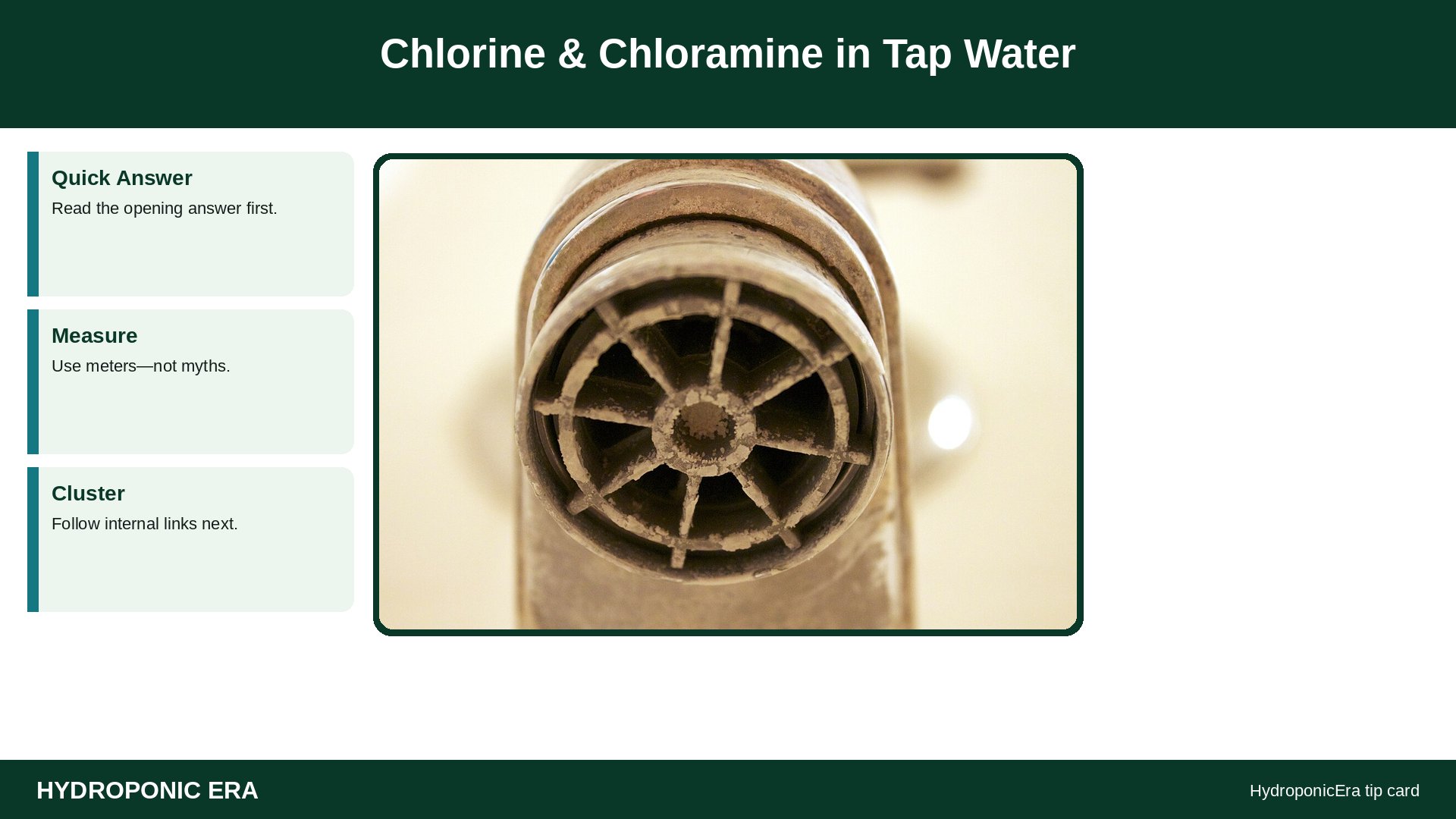
Chlorine Chloramine Hydroponics: What Utilities Add—and Why It Matters

Cities disinfect drinking water for human safety. Hydroponic roots live immersed in that same water. Chlorine and chloramine differ in persistence. Extension and greenhouse water-quality resources (Penn State toolkit framing) urge growers to understand source water before troubleshooting crops.
This is not a claim that tap water is “poison”—only that soilless systems expose roots differently than garden soil buffered by organic matter.
Chlorine Chloramine Hydroponics: Practical Treatment Options

| Method | Often helps | Limits |
|---|---|---|
| Stand / aerate | Free chlorine | Weak on chloramine |
| Activated carbon filter | Chlorine & chloramine (sized properly) | Cartridge life; flow rate |
| RO | Many dissolved ions + some disinfectant reduction depending on system | Waste water; remineralize via nutrients |
| Commercial dechlorinators | Aquarium/hort products as labeled | Follow label; no inventing doses |
Chlorine Chloramine Hydroponics: Step-by-Step Tap Water Workflow
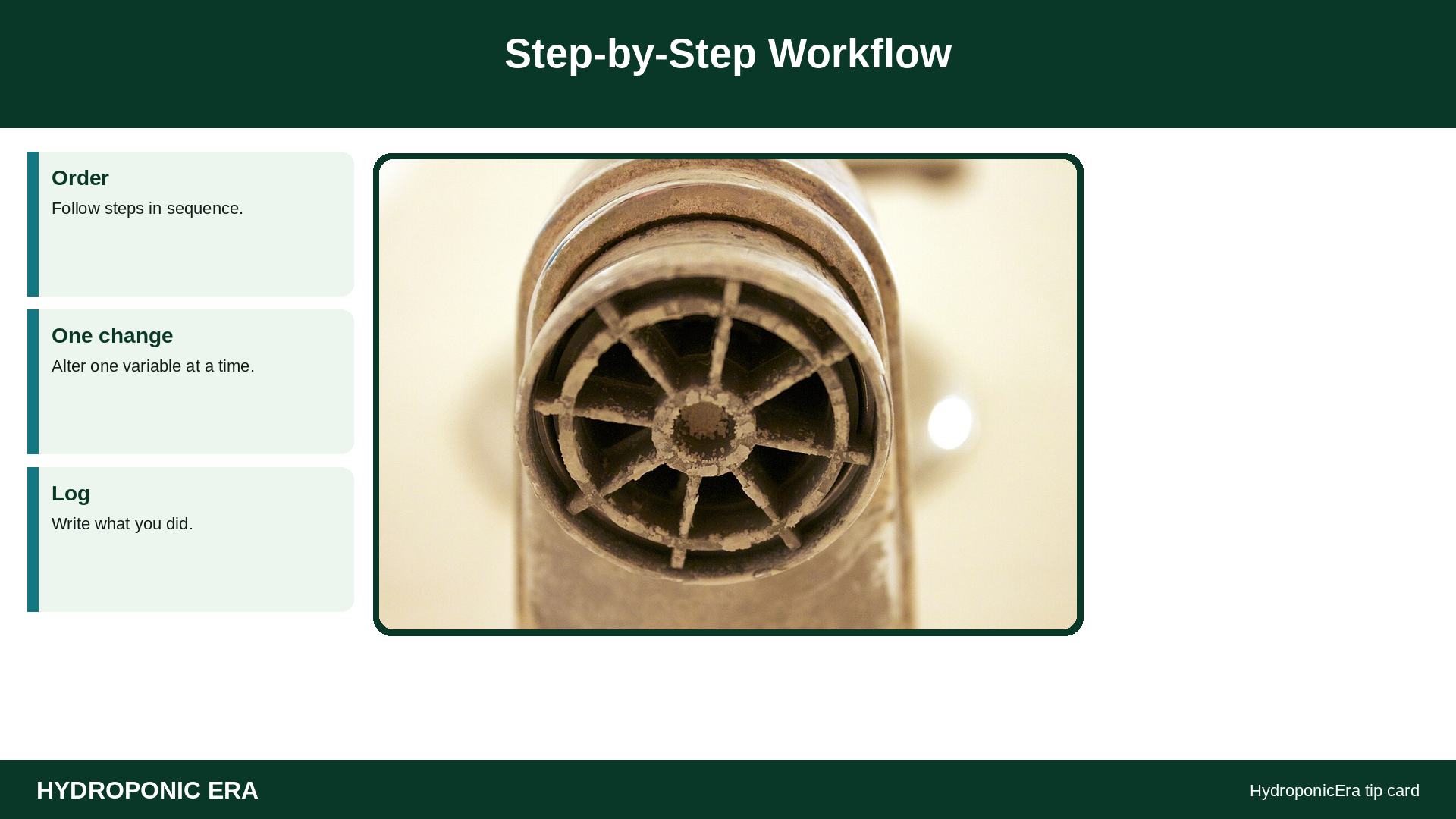
- Identify disinfectant via utility report or inquiry.
- Measure starting EC/TDS of tap ({a(‘ectds’,’EC’)}).
- Choose treatment matching disinfectant (carbon for chloramine persistence).
- Fill reservoir; aerate if using standing methods for chlorine.
- Mix nutrients only after base water is prepared ({a(‘mixing’,’mixing’)}).
- Set pH after strength ({a(‘ph’,’pH’)}).
- Watch seedlings especially ({a(‘seedlings’,’seedlings’)}).
- Replace carbon cartridges on schedule—exhausted carbon lies.
- Log water source changes (seasonal utility switches happen).
- If problems persist, broaden diagnosis beyond disinfectant alone.
Chlorine Chloramine Hydroponics: Variables

| Variable | Why | Link |
|---|---|---|
| Chloramine | More persistent | Carbon / labeled products |
| Hardness / Na | Separate from disinfectant | hard water |
| Temperature | Gas off rates / root stress | temp |
| Biofilm goals | Some growers cultivate beneficials | Sanitation balance (clean) |
Chlorine Chloramine Hydroponics: Mistakes

- Assuming overnight standing fixes chloramine
- Never reading the utility report
- Overdosing mystery “conditioner” powders
- Blaming chlorine for every tip burn
- Skipping carbon changes for a year
Troubleshooting

| Symptom | Water angle | Also check |
|---|---|---|
| Seedling burn after tap fill | Disinfectant / EC | burn, EC |
| Beneficials dying after refill | Chloramine shock | Treat water first |
| High TDS always | Hardness, not Cl2 | hard water |
Original Water Identity Card
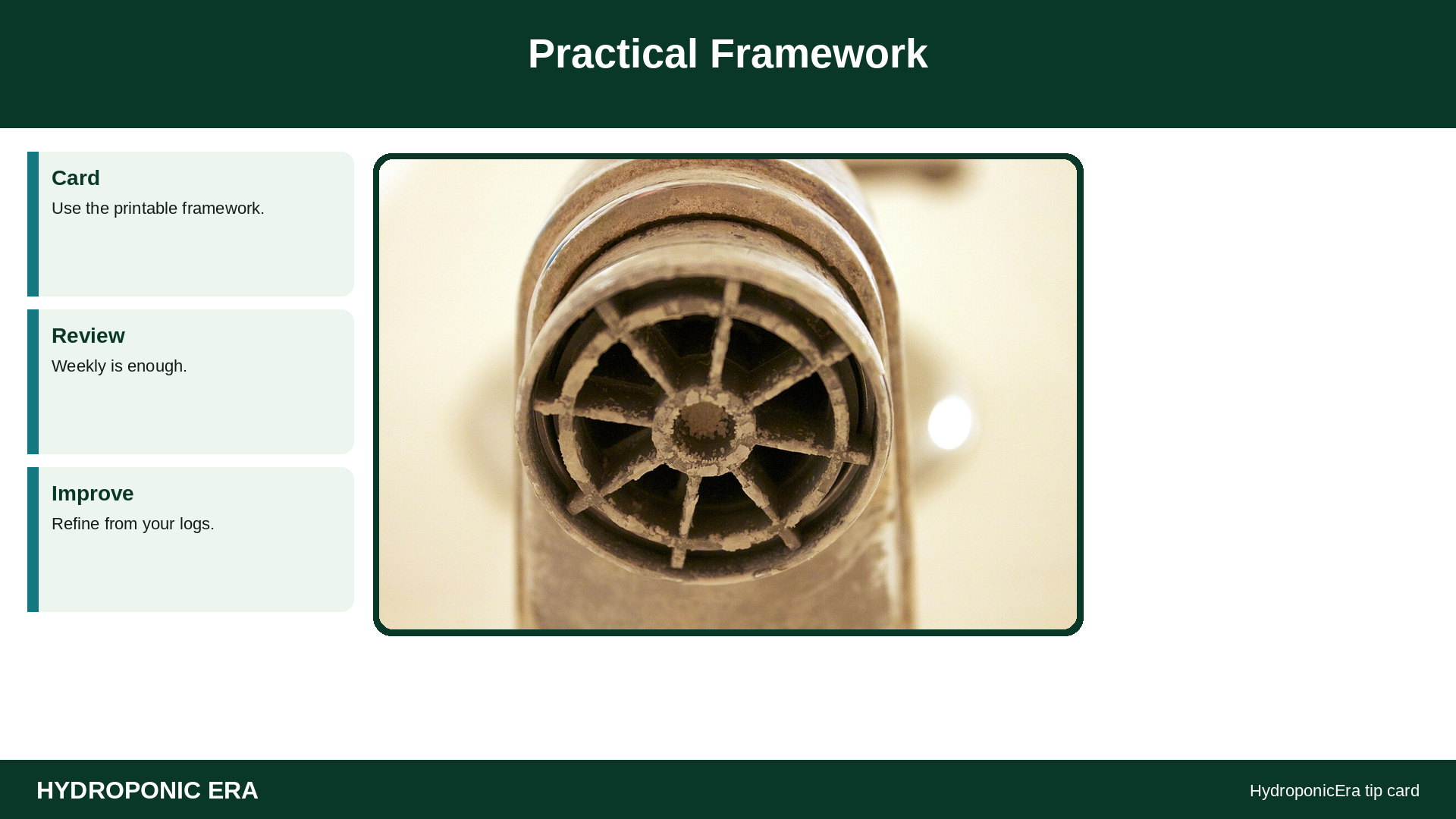
Card: utility name | Cl2 vs chloramine | treatment used | carbon date | tap EC | notes. Update when the city switches seasonal methods. Cluster with hard water/RO and water changes.
What to Check Before You Blame the Nutrient Brand
- Utility disinfectant known?
- Treatment matches type?
- Carbon in-date if used?
- Tap EC logged?
- Nutrients mixed after treatment?
- Seasonal changes watched?
FAQs about chlorine chloramine tap water hydroponics
Is boiling the answer?
Not a practical hydroponic SOP; use proper treatment.
Does RO always remove chloramine?
Systems vary—often paired with carbon stages; know your unit.
Safe for drinking = safe for roots?
Drinking standards ≠ soilless root comfort automatically.
Aquarium drops OK?
Only as labeled for your use case; no homemade chemistry.
Rainwater?
Different risks (contamination)—not automatically better.
Next read?
Hard water/RO and reservoir setup.
Utility Reports, Carbon Care, and Diagnosis Discipline

Download your utility’s consumer confidence report or water quality page and highlight disinfectant type. Write it on the reservoir card. Cities sometimes switch seasonally—recheck twice a year. Penn State’s water-quality toolkit mindset is exactly this: know the source before spending on additives.
If you use carbon, note the install date on the cartridge. Exhausted carbon silently fails. Match flow rates to manufacturer guidance; rushing water through undersized carbon reduces contact time.
Diagnosis discipline: seedlings failing after a raw tap fill may implicate disinfectant—or high EC, bad plugs, or heat (seedlings, EC, burn). Treat water, then isolate variables.
Original decision tree: Identify disinfectant → choose stand/aerate vs carbon vs RO path → mix nutrients → measure → log. Do not skip to random conditioners.
RO users still need complete fertilizers and pH care (hard water/RO, mixing). Chloramine management and hardness management are related water topics, not identical.
Beneficial microbe products—if you use them—are especially sensitive to residual disinfectant; treat first. Sanitation and biology goals can conflict; pick a coherent strategy (cleaning).
Practice: label a dedicated “hydro fill” jug that only receives treated water so family members do not refill from the softener line by mistake.
Putting This Guide Into Practice
Identify your disinfectant today from the utility report. Choose standing/aeration vs carbon vs RO accordingly. Date carbon cartridges. Mix nutrients only after base water is ready (mixing, hard water/RO).
Do not blame chlorine for every tip burn—confirm EC, plugs, and heat (EC, seedlings). Penn State water-quality toolkit thinking: know the source.
Bottom line: match treatment to disinfectant, then measure. Continue with water changes and reservoir setup.
Advanced tip: if your city uses chloramine and you only stand water overnight, you may still stress soft seedlings—upgrade to carbon sized for your fill volume. Keep a dedicated treated-water jug so household members do not refill from a softener line (hard water/RO, seedlings).
Second-pass note: disinfectant identity first, treatment second, nutrients third. Anchor to Penn State water-quality literacy and water changes.
Operational Checklist Card
Print: utility disinfectant type | treatment method | carbon date | tap EC | treated jug labeled | mix nutrients after treatment. Re-read utility notes seasonally. Diagnose seedlings with multiple causes in mind (hard water/RO, seedlings, EC).
Final reminder: match treatment to disinfectant—standing water alone often fails chloramine. Related: water changes, mixing, reservoir.
Chlorine Chloramine Hydroponics: Practical Checklist
Chlorine Chloramine Hydroponics matters every week in a home system. Recheck chlorine chloramine hydroponics after transplants, heat spikes, and canopy fill-in. Strong chlorine chloramine hydroponics habits beat one-time guesses. When chlorine chloramine hydroponics drifts, leaves crowd, roots stress, or harvest quality drops. Write chlorine chloramine hydroponics targets into your log so you do not rely on memory. Teach helpers your chlorine chloramine hydroponics checklist before you leave town.
Treat chlorine chloramine tap water hydroponics as a weekly habit: scan, note, then adjust only when data says so.
Share chlorine chloramine tap water hydroponics basics with anyone covering your system while you are away.
Print a short chlorine chloramine tap water hydroponics note and leave it near the reservoir.
Update chlorine chloramine tap water hydroponics after storms, heat waves, or DIY plumbing changes.
Good chlorine chloramine tap water hydroponics beats last-minute guessing when something drifts overnight.
Archive last month’s chlorine chloramine tap water hydroponics notes; patterns beat memory.
Teach one other person your chlorine chloramine tap water hydroponics so coverage is not a single point of failure.
When chlorine chloramine tap water hydroponics is clear, you waste less time chasing the wrong variable.
Revisit chlorine chloramine tap water hydroponics whenever you change lighting, EC, or who waters the system.
Write one line on chlorine chloramine tap water hydroponics after each reservoir check so patterns show up early.
Keep chlorine chloramine tap water hydroponics tied to a short list of numbers you already measure.
Sources
- Penn State Extension — A Water Quality Toolkit for Greenhouse and Nursery Production
- Oklahoma State University Extension — Hydroponics
- Oklahoma State University Extension — Electrical Conductivity and pH Guide for Hydroponics
- Michigan State University Extension — Hydroponics as an agricultural production system
- University of Florida IFAS — HS184: Building a Floating Hydroponic Garden
- Penn State Extension — Hydroponics Systems and Principles of Plant Nutrition
- Ohio State University Extension — HYG-1263
- University of Georgia Extension — B1314: Soilless Growing Media
2 thoughts on “Chlorine and Chloramine in Tap Water for Hydroponics”