
Quick Answer
A good hydroponic reservoir holds enough nutrient solution for your plant count, blocks light to limit algae, allows aeration and access for meters, and stays cool enough for root health. Size is a capacity decision based on crop water use, refill habits, and system type—not a magic universal number. Hygiene and opaque lids matter as much as liters.
See algae, dissolved oxygen, air pumps, reservoir temperature, water changes, and cleaning.
Key Takeaways
- Oklahoma State hydroponics guidance frames reservoirs as managed soilless environments.
- UF/IFAS floating garden and leafy hydroponic publications show practical small-system layouts where solution management is central.
- Light leaks grow algae; opaque walls and lids are foundational.
- Warm reservoirs lose oxygen and raise disease risk.
- Leave headspace and access ports for safe mixing and measurement.
- Bigger is not always better if you cannot keep solution fresh and oxygenated.
- Plan drain and clean paths before you fill a tank you cannot move.
Related HydroponicEra guides
Reservoir Design Essentials
Choose food-safe plastics rated for your use, or purpose-built hydroponic tanks. Avoid mystery containers that leach or crack. Opaque or blacked-out walls beat clear totes wrapped poorly with gaps. Lids should block light yet allow cables for air stones and probes.
Place the reservoir where temperature stays moderate—off hot concrete in summer sun rooms, away from heaters. Insulate if needed. The HydroponicEra reservoir temperature article explains why heat is a root-health problem.
Include a way to drain completely. A bulkhead fitting and valve beat siphoning with cups when you do maintenance. University hydroponic beginners materials treat solution access and cleanliness as part of the system, not optional chores.
Sizing Framework (No Fake Formulas)
There is no single universal liters-per-plant law that fits every crop and climate. Use a framework instead:
- Estimate how often you can realistically refill and change solution.
- Observe how fast EC rises and volume falls in your room for a given crop.
- Increase volume if you see wild concentration swings between top-offs.
- Ensure air stones still oxygenate the full depth effectively.
- For NFT, the reservoir must supply continuous flow with reserve against evaporation.
Leafy greens in cool rooms may use less water than fruiting tomatoes under strong light. Track your own use for two weeks and size the next tank accordingly. Michigan State University Extension’s hydroponics overview reminds beginners that hydroponics is a managed production system—measurement beats myths.
Aeration, Filtration, and Access
| Feature | Why it matters | Beginner tip |
|---|---|---|
| Air stone + pump | Dissolved oxygen | Keep spare stones; see air-pump guide |
| Probe ports | Clean measurements | Do not dunk meters through algae mats |
| Fill line mark | Consistent volume | Mark gallons/liters on the wall |
| Coarse prefilter on returns | Less sludge in pump | Clean weekly |
| Overflow plan | Leak prevention | Tray under tank |
Step-by-Step Setup

- Wash new tanks with mild soap; rinse thoroughly; avoid scented residues.
- Install bulkhead/drain if possible; seal carefully and leak-test with plain water.
- Paint or wrap clear tanks opaquely; close light leaks at lid edges.
- Place air stone; confirm bubbles distribute.
- Add calibrated meter access; mix nutrients; set pH.
- Connect to system; verify return flow does not splash light into the tank.
- Log volume, EC, pH, and temperature on day one.
Hygiene Habits
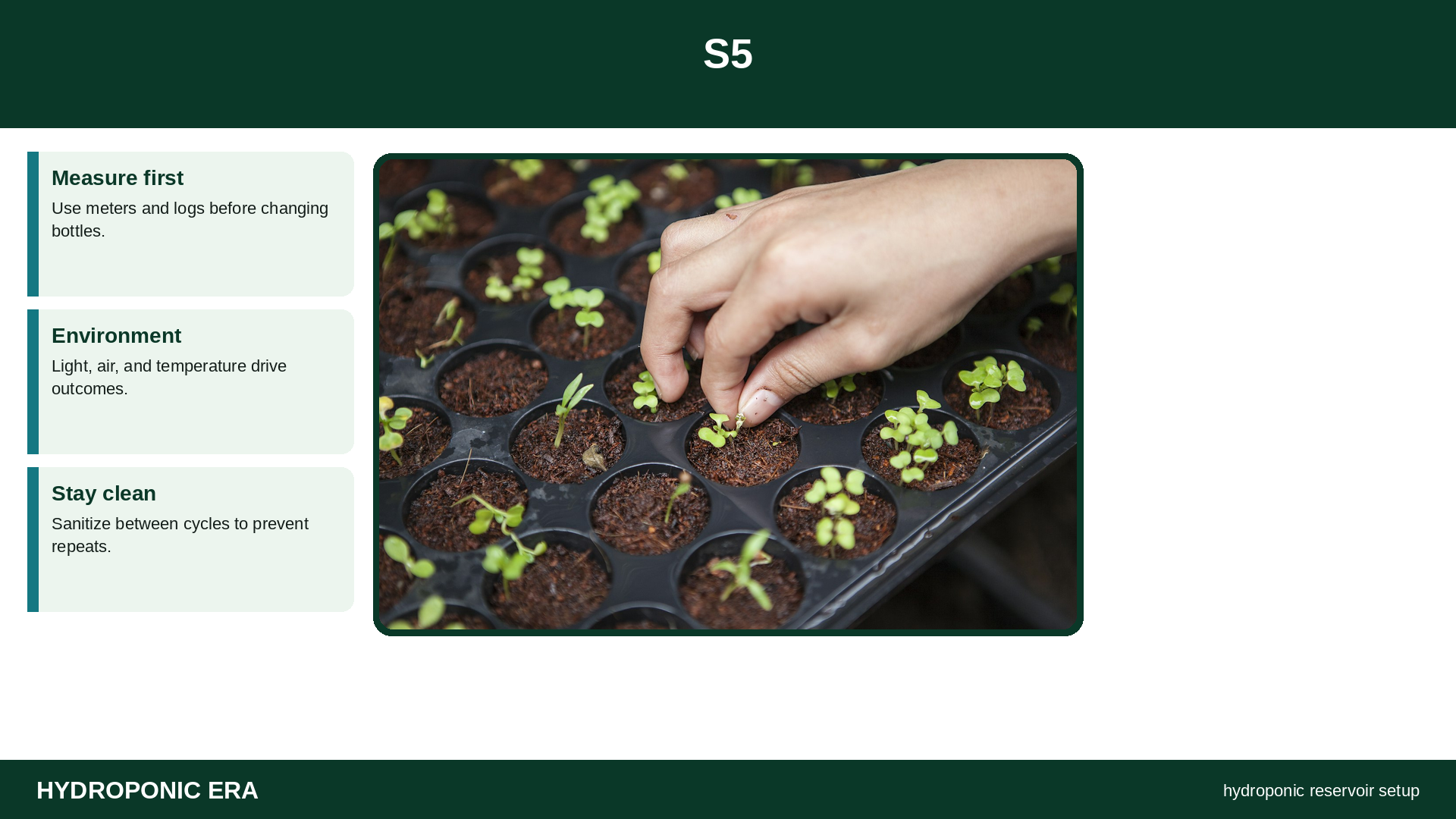
Biofilm builds on walls and tubing. Between crops, clean and sanitize using the HydroponicEra cleaning guide. During crops, remove debris, wipe lid undersides, and do not let dead roots recirculate endlessly.
University of Kentucky’s hydroponic root disease notes emphasize sanitation and environment for pathogen pressure. A filthy warm reservoir invites root problems—including Pythium risk factors discussed in the Pythium article.
Schedule solution changes based on EC drift and crop stage using the water-change guide. Topping off forever without resets concentrates unused ions and organic junk.
Common Mistakes
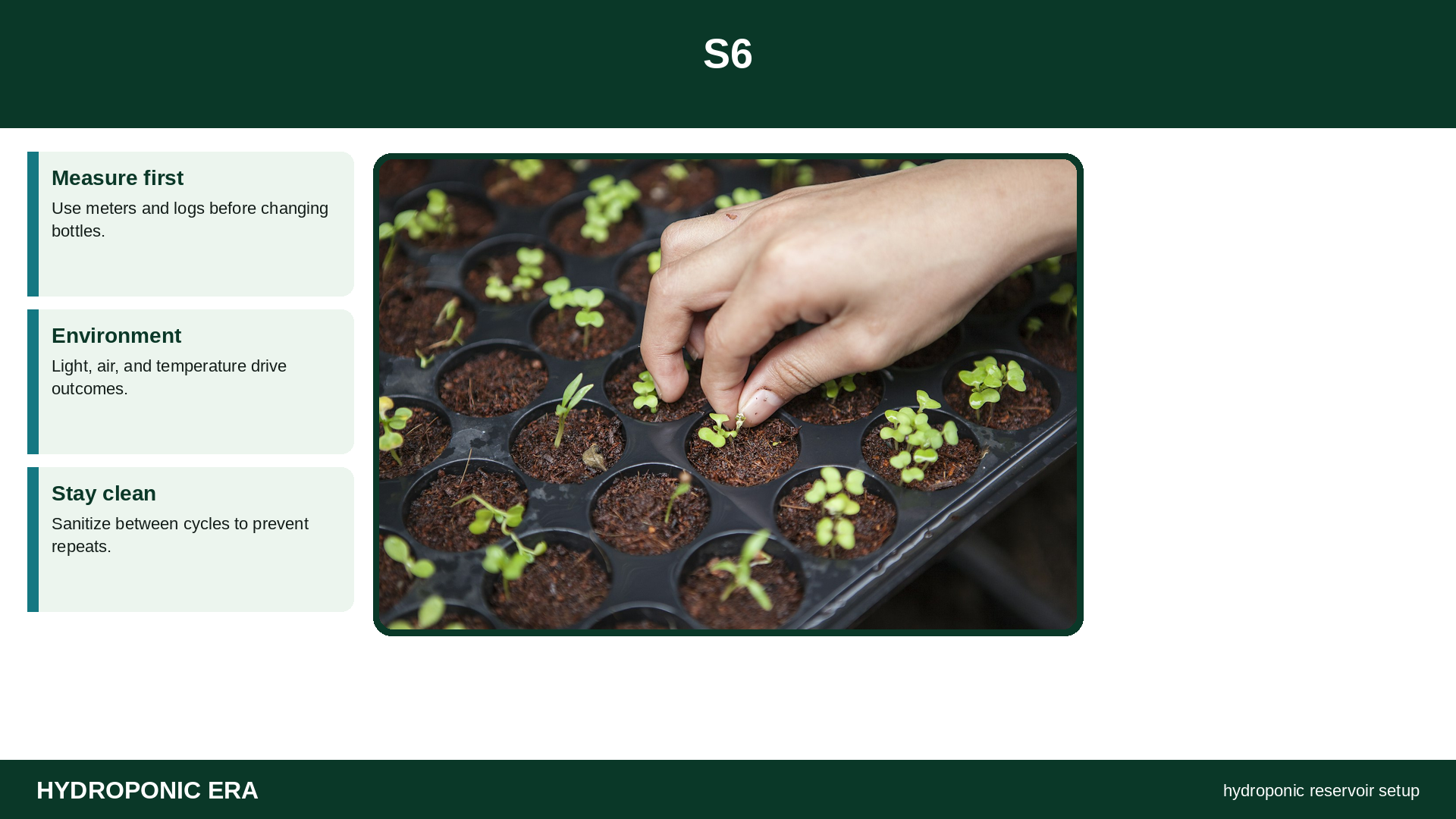
- Clear tote in a sunny window with no lid
- Air pump too weak for deep tanks
- No drain plan on a heavy upstairs vessel
- Ignoring temperature because roots sit in water
- Topping off casually until EC is extreme
- Placing reservoirs on heaters or hot roofs
What to Check Weekly
- Light leaks and algae films
- Air stone output
- Reservoir temperature at peak heat
- EC/pH trend
- Lid seal and cable holes
- Floor moisture (slow leaks)
For water chemistry issues that start at the tap, see the hard water and RO article. For meter skills, see the pH/EC meters guide in this batch.
FAQs
Should reservoirs be airtight?
They should block light and limit debris, but air pumps need tubing access. Complete hermetic seals are unnecessary.
Can I use a trash can?
Only if it is a food-safe design you trust not to leach and you can clean it. Purpose-built tanks are simpler for edible crops.
How often do I change solution?
Depends on crop, volume, and EC drift—see the water-change guide rather than a single universal day count.
Do I need a chiller?
Only if temperatures routinely run too warm for root health. Try location and insulation first.
Is a smaller reservoir easier?
Small reservoirs swing chemistry faster. Match size to your monitoring habits.
Practice log and next steps
Keep a simple logbook for this topic: date, meter readings when relevant, what you changed, and what the plants did over the next three to seven days. Hydroponics rewards slow feedback loops more than frantic daily recipe rewrites.
When in doubt, return to calibrated pH and EC, root inspection, and light adequacy before buying another bottle. Extension hydroponic and plant nutrition resources emphasize fundamentals for a reason.
Link outward to the matching HydroponicEra cluster pages so readers can continue into systems, water, crops, or troubleshooting without dead ends. Internal links are part of topical authority, not decoration.
Sanitation and opaque reservoirs prevent many secondary problems that look like nutrient mysteries. Clean systems make diagnosis clearer.
If you sell produce or teach workshops, document procedures. Consistency protects customers and your future self.
Field notes
Put the reservoir where you can see it daily without moving furniture. Hidden tanks hide leaks and empty floats.
Use a cheap wet floor sensor or tray alarm in upstairs grows. One overflow can cost more than the entire hydroponic kit.
Standardize fittings so spare air stones and tubing match. Odd proprietary connectors become downtime.
Mark maximum fill below lid overflows. Operators rush and overfill during nutrient changes.
Cycle-ready reminder
Readers evaluating this topic should also cross-check related HydroponicEra cluster articles on water chemistry, system choice, and troubleshooting so advice stays connected rather than isolated tips. Measure first, change one major variable at a time, and keep notes through at least one full crop cycle before declaring a method a failure. University extension hydroponic and plant nutrition pages remain the external evidence backbone whenever a claim needs grounding beyond grower habit.
Readers evaluating this topic should also cross-check related HydroponicEra cluster articles on water chemistry, system choice, and troubleshooting so advice stays connected rather than isolated tips. Measure first, change one major variable at a time, and keep notes through at least one full crop cycle before declaring a method a failure. University extension hydroponic and plant nutrition pages remain the external evidence backbone whenever a claim needs grounding beyond grower habit.
Sources
- Oklahoma State University Extension — Hydroponics
- Oklahoma State University Extension — Electrical Conductivity and pH Guide for Hydroponics
- University of Florida IFAS — HS184: Building a Floating Hydroponic Garden
- University of Florida IFAS — HS1279: Leafy Greens in Hydroponics and Protected Culture for Florida
- University of Kentucky Greenhouse Horticulture — Root disease management in hydroponic systems (PDF)
- Michigan State University Extension — Hydroponics as an agricultural production system
7 thoughts on “Hydroponic Reservoir Setup: Size, Design, and Hygiene”