
Quick Answer: DWC vs NFT vs Dutch bucket
DWC vs NFT vs Dutch bucket systems all grow plants without soil, but they move water and support roots differently. DWC (deep water culture) suspends roots in an aerated nutrient reservoir—simple and excellent for leafy herbs and lettuce. NFT (nutrient film technique) runs a thin film of solution through channels—efficient for short-cycle leafy crops in rows. Dutch buckets (Bato-style media buckets with drip irrigation) support larger fruiting plants with more root anchoring. Choose based on crop type, space, failure tolerance, and how much plumbing you want to maintain—not on which name sounds most “advanced.”
Read the dedicated setup guides for DWC, NFT, and Dutch buckets, then return here when you need a side-by-side decision.
Key Takeaways
- UF/IFAS describes NFT as a water-culture method with roots in a plastic channel and a recirculating nutrient film; Dutch/perlite bucket systems are common media drip approaches for greenhouse vegetables.
- Oklahoma State outlines NFT, water culture with aeration, drip, and related soilless methods—each with different oxygen and irrigation patterns.
- Penn State notes NFT and deep-water float systems as examples where roots sit in nutrient solution.
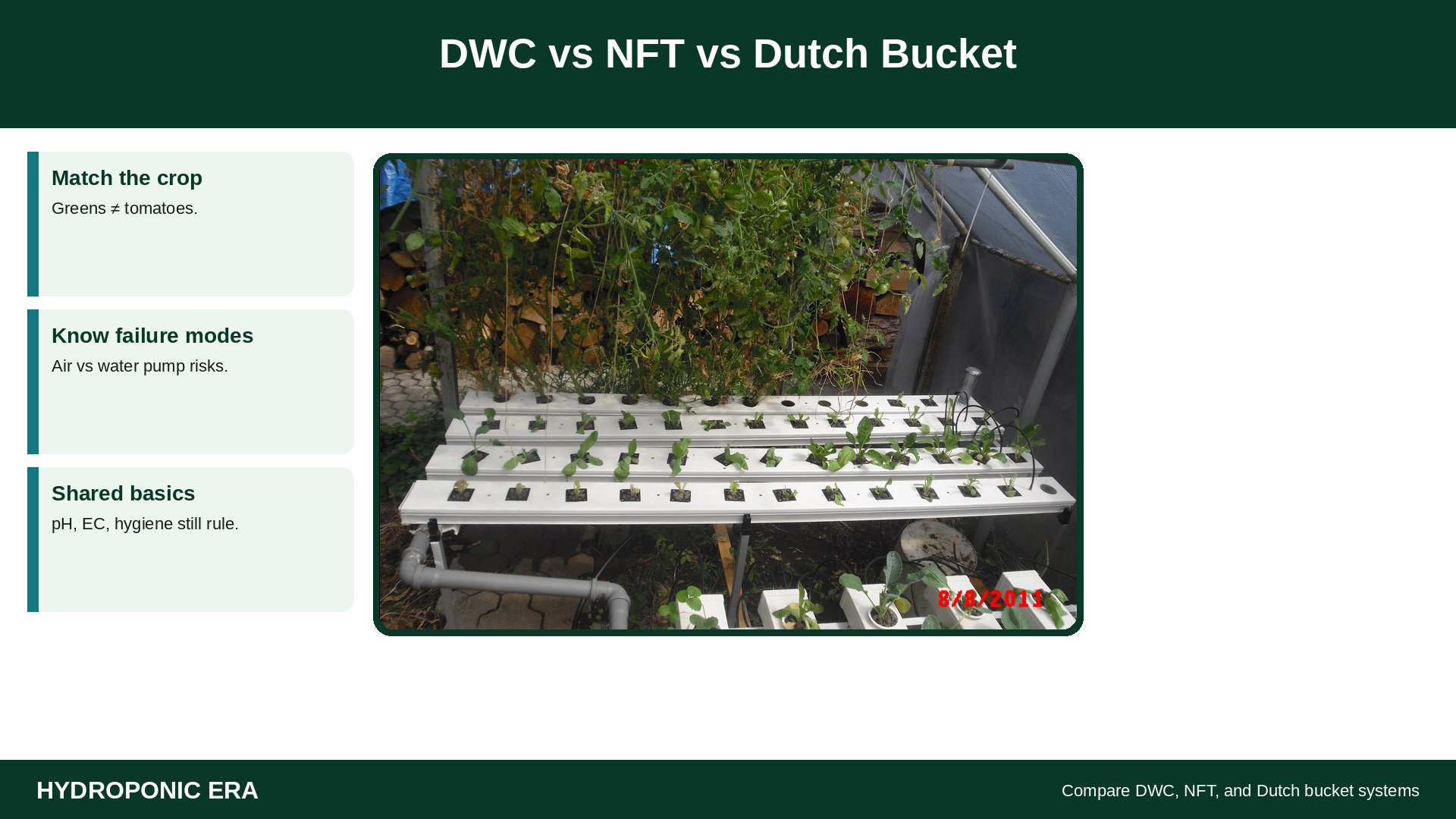
- DWC fails when air pumps stop; NFT fails when water pumps stop; Dutch buckets fail more slowly but can still overwater or dry unevenly.
- Leafy crops → DWC/NFT often; tomatoes/peppers/cucumbers → Dutch buckets or other media drip systems often.
- All three still need pH, nutrient strength, cleanliness, and temperature awareness.
Related HydroponicEra guides
- Hydroponic system for beginners
- Deep water culture for beginners
- NFT hydroponics for beginners
- Dutch bucket hydroponics for beginners
- How to grow tomatoes hydroponically
- How to grow lettuce hydroponically
How DWC vs NFT vs Dutch bucket systems work
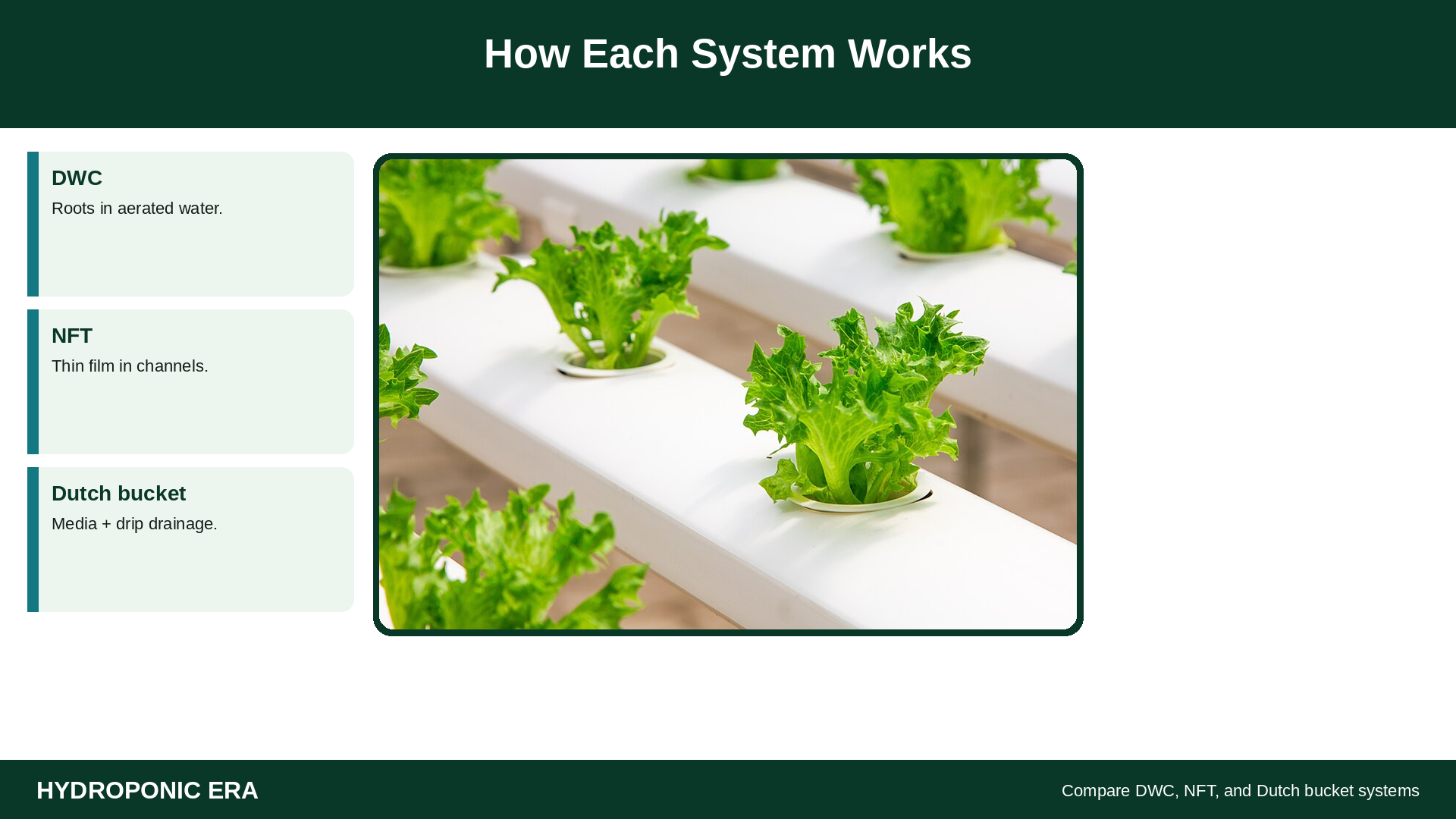
DWC (Deep Water Culture)
Plant roots hang into a shared or individual reservoir of nutrient solution. An air pump and air stone dissolve oxygen into the water. Oklahoma State’s hydroponics overview describes water-culture systems that bubble nutrient solution to supply oxygen to roots.
NFT (Nutrient Film Technique)
UF/IFAS explains NFT as a media-free water-culture technique: plants sit in channels while a thin film of nutrient solution flows past the roots and usually returns to a tank. Continuous film flow means pump reliability matters.
Dutch Bucket (Bato-style)
UF/IFAS describes Dutch-bucket/perlite systems as plastic buckets with media and a small reservoir zone at the bottom, fed by drip irrigation, with excess draining to a collection path. These systems support larger plants that need physical anchoring.
DWC vs NFT vs Dutch bucket comparison table
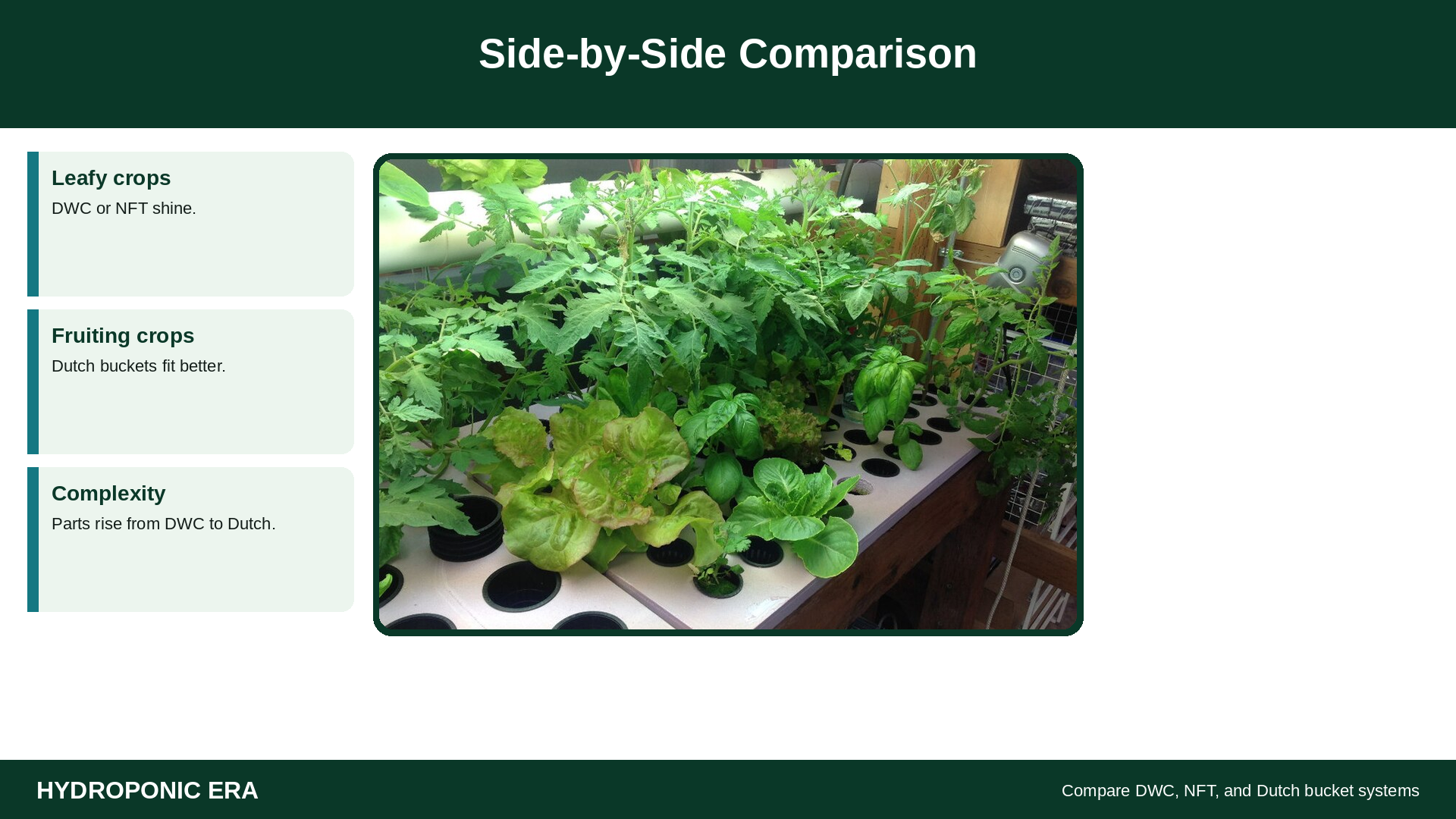
| Factor | DWC | NFT | Dutch bucket |
|---|---|---|---|
| Best beginner crops | Lettuce, basil, herbs | Lettuce, herbs, greens | Tomato, pepper, cucumber, larger plants |
| Root support | Water + net pot | Channel + small plug | Media in bucket |
| Key active device | Air pump | Water pump | Water pump / drip |
| Failure mode | Low oxygen if air stops | Roots dry if flow stops | Dry-out or saturation issues |
| Shared disease risk | Shared reservoir can spread problems | Shared channels/tank can spread problems | Often more localized per bucket (especially non-recirculating designs) |
| Space style | Tubs / totes | Linear channels | Rows of buckets |
| Complexity | Low–medium | Medium | Medium–higher plumbing |
| Algae hotspot | Lit reservoirs | Uncovered channels/returns | Lit drip lines / wet media surfaces |
UF/IFAS notes that in some flow-through media systems, root infections can remain more localized than in fully shared recirculating water cultures—useful context when you grow valuable fruiting plants.
Choosing DWC vs NFT vs Dutch bucket step by step
- Name your first crop. Leafy herbs/lettuce favor DWC or NFT. Fruiting vines favor Dutch buckets or similar media drip.
- Check your risk tolerance. If power outages are common, understand DWC oxygen risk and NFT dry-out risk; media buffers can buy time.
- Measure space. NFT wants length; Dutch buckets want floor rows; DWC wants vertical lid space and reservoir footprint.
- Be honest about maintenance. All need cleaning. NFT channels and Dutch drip emitters add parts to inspect.
- Plan lighting and climate next—system choice does not replace light or temperature management.
- Start one system well before mixing styles on one shared tank.
Important Variables Across All Three
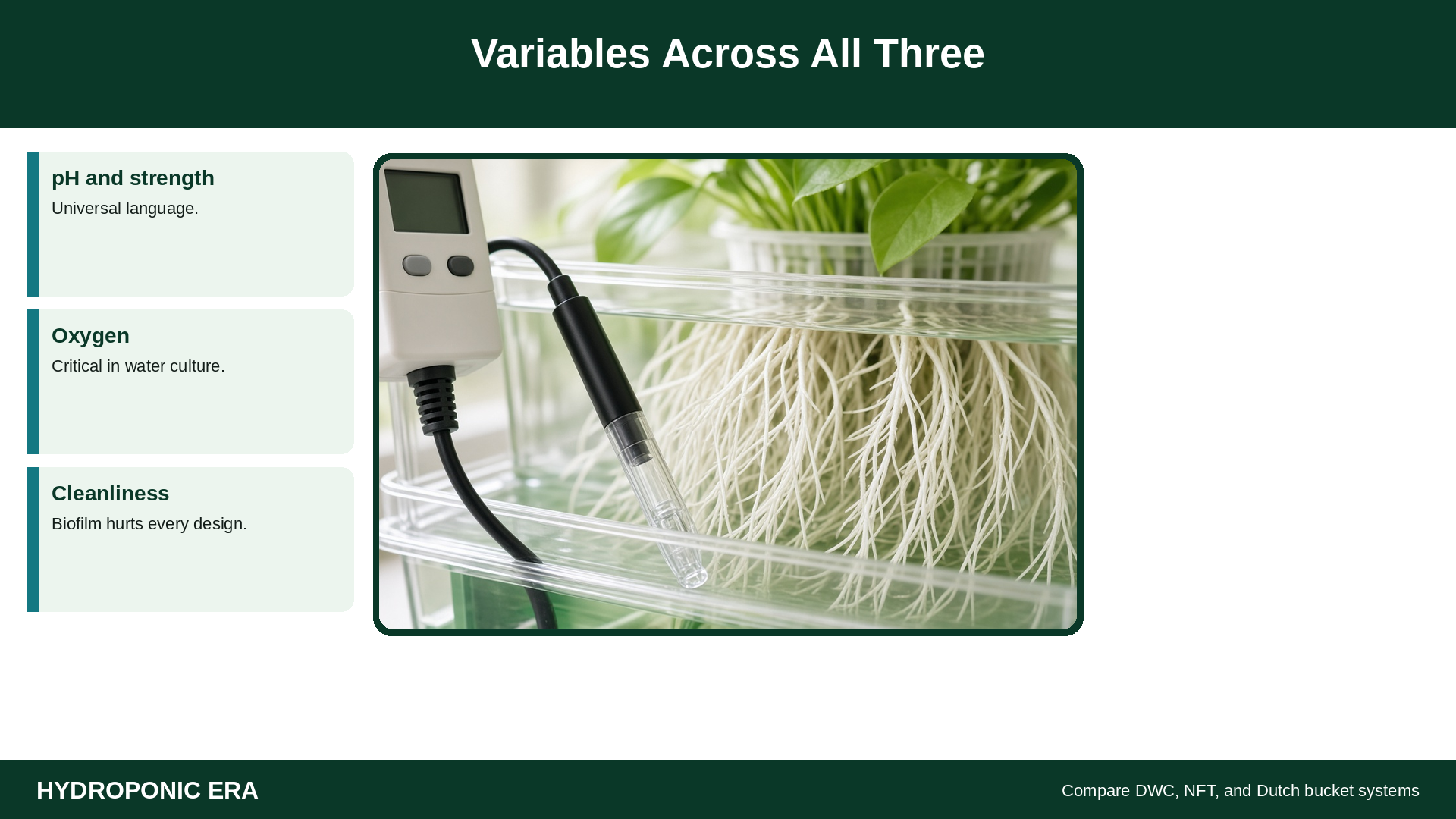
- pH and nutrient strength — still the daily language of hydroponics (Oklahoma State EC/pH guide).
- Dissolved oxygen / aeration — critical in DWC; still relevant in return tanks for NFT/Dutch recirculating designs.
- Solution temperature — warm water holds less oxygen and encourages biology you may not want.
- Hygiene — biofilm, plant debris, and algae reduce reliability.
- Irrigation uniformity — especially Dutch drip lines and NFT channel slope/flow.
Common Mistakes
- Putting indeterminate tomatoes in a tiny DWC tub “because it worked for lettuce”
- Building long NFT runs with no backup plan for pump failure
- Using clear tubing and uncovered channels under bright LEDs
- Ignoring emitter clogging in Dutch buckets
- Comparing systems only by YouTube aesthetics instead of crop fit
- Sharing one unstable reservoir across too many crop types
Troubleshooting by System
| System | Problem | First checks |
|---|---|---|
| DWC | Wilting, brown roots | Air pump, stone, temperature, reservoir hygiene |
| NFT | Dry root tips / sudden wilt | Pump, filter, channel slope, film depth |
| Dutch | Uneven plants in a row | Emitter flow, media moisture, drain height |
| Any | pH/EC chaos | Meter calibration, top-up habits, water changes |
| Any | Green slime | Light leaks on solution and plumbing |
Cost, Time, and Skill Snapshot
| Question | DWC | NFT | Dutch bucket |
|---|---|---|---|
| Parts count | Low | Medium | Higher |
| Daily attention | Check air + solution | Check flow + solution | Check drippers + solution |
| Learning curve | Gentle | Moderate | Moderate |
| Best first win | Herbs/lettuce tote | Greens channel | One tomato / pepper plant |
| Scaling style | More totes | Longer / more channels | More buckets in a row |
Practical decision tree:
- If you want salad greens this month with minimal plumbing → DWC.
- If you want a neat row of cut herbs/lettuce and can monitor a water pump → NFT.
- If your goal is fruiting crops with stakes/trellis → Dutch bucket.
- If you are unsure → grow lettuce or basil in DWC first, then add a second system for fruiting plants.
UF/IFAS materials repeatedly separate leafy water-culture approaches from media bucket approaches used for longer-term fruiting crops. Matching crop biology to hardware prevents most “my hydroponic system failed” stories that are really crop-system mismatches.
Whatever you choose, keep the shared basics strong: opaque reservoirs where possible, calibrated meters, and a water-change habit from the reservoir change guide.
Crop Fit Matrix and Upgrade Paths
| Crop goal | First system | Later upgrade | Why |
|---|---|---|---|
| Weekly salad greens | DWC tote or NFT | More channels / raft space | Fast cycles, shallow roots |
| Kitchen herbs | DWC or NFT | Dedicated herb channel | Frequent harvest, compact plants |
| Cherry tomatoes | Dutch bucket | More buckets + trellis | Support + longer crop time |
| Peppers | Dutch bucket | Row of buckets | Media anchoring helps |
| Mixed beginner learning | DWC basil/lettuce | Add one Dutch bucket tomato | Learn water culture, then fruiting |
UF/IFAS descriptions of NFT for leafy production and Dutch buckets for media-grown greenhouse vegetables are a reliable map for this decision. Penn State’s mention of NFT and deep-water float systems as solution-root methods reinforces that DWC/NFT are cousins—great for greens—while media drip methods fill a different job.
Maintenance calendar idea: weekly meter checks for all systems; monthly emitter/stone inspection; end-of-crop scrub for channels, totes, and buckets. The “best” system is the one you will actually clean.
Shared Chemistry Still Applies
No matter which acronym you pick, you still manage pH, nutrient strength, cleanliness, and temperature. A perfect NFT channel with chaotic pH will underperform a plain DWC tote with calm daily habits. Use the pH guide and nutrient guide as shared operating manuals across systems.
When you publish-ready compare notes later, also connect this article to crop guides (lettuce, tomatoes, basil) so readers land on hardware and horticulture together—that is how topical clusters strengthen.
Scenario picker: DWC vs NFT vs Dutch bucket
Use these scenarios to choose among DWC vs NFT vs Dutch bucket without buying three full systems first.
| Your situation | Lean toward | Why |
|---|---|---|
| First leafy herbs/lettuce, one reservoir, want simple DIY | DWC | Few moving parts; aeration discipline is the main skill |
| Want many small heads in a compact footprint | NFT | Channels pack plants; flow and slope matter |
| Tomatoes/peppers/cucumbers with media support | Dutch bucket | Media + drip suits heavier fruiting crops |
| Unreliable power / fear of pump-out dry roots | DWC (with caution) or media beds | NFT can dry channels if pumps fail |
| Mixed goals: greens now, fruit later | Start DWC/NFT greens; plan Dutch bucket later | Upgrade path beats one “do everything” buy |
- Shared chemistry still applies across DWC vs NFT vs Dutch bucket: pH, nutrient strength, clean reservoirs, and root oxygen.
- Skill to practice first: measuring pH/EC and cleaning between cycles—system brand logos do not replace that.
- If you are undecided, run a single-crop pilot for one full cycle before expanding channels or bucket counts.
Failure modes to respect
- DWC: warm unaerated water and light leaks into the tank.
- NFT: thin film stalls, channel dry-out, or uneven slope.
- Dutch bucket: emitter clogging, uneven media moisture, neglected drain returns.
Write your choice as one sentence: “I am choosing ___ because my crop is ___ and my constraint is ___.” That sentence should mention DWC vs NFT vs Dutch bucket explicitly so your future self remembers the tradeoff.
DWC vs NFT vs Dutch bucket: practical review sheet
Use this review sheet to keep DWC vs NFT vs Dutch bucket actionable after you finish the main guide.
- What did you measure today related to DWC vs NFT vs Dutch bucket?
- What did you change with your hands (not just what you bought)?
- What will you re-check in 24–48 hours about DWC vs NFT vs Dutch bucket?
- Which linked HydroponicEra guide should you reread next?
- What cleaning or logging step did you skip last cycle?
| Item | Today | Next check |
|---|---|---|
| Environment | ||
| Solution (pH/EC) | ||
| Roots / pests / biofilm | ||
| Plant response |
Print or duplicate this table in your notes app. The goal is not paperwork—it is fewer repeated mistakes around DWC vs NFT vs Dutch bucket.
When results are unclear, slow down and restate the problem in one sentence that includes DWC vs NFT vs Dutch bucket, then list the last three changes you made. Most home-system failures come from stacked changes without logs. Keep DWC vs NFT vs Dutch bucket paired with basic hygiene: clean reservoirs, honest meter calibration, and root inspection. If you cannot explain your last adjustment, do not add another product. Re-read the troubleshooting section and apply one change at a time while you watch how DWC vs NFT vs Dutch bucket interacts with pH, temperature, and oxygen.
When results are unclear, slow down and restate the problem in one sentence that includes DWC vs NFT vs Dutch bucket, then list the last three changes you made. Most home-system failures come from stacked changes without logs. Keep DWC vs NFT vs Dutch bucket paired with basic hygiene: clean reservoirs, honest meter calibration, and root inspection. If you cannot explain your last adjustment, do not add another product. Re-read the troubleshooting section and apply one change at a time while you watch how DWC vs NFT vs Dutch bucket interacts with pH, temperature, and oxygen.
When results are unclear, slow down and restate the problem in one sentence that includes DWC vs NFT vs Dutch bucket, then list the last three changes you made. Most home-system failures come from stacked changes without logs. Keep DWC vs NFT vs Dutch bucket paired with basic hygiene: clean reservoirs, honest meter calibration, and root inspection. If you cannot explain your last adjustment, do not add another product. Re-read the troubleshooting section and apply one change at a time while you watch how DWC vs NFT vs Dutch bucket interacts with pH, temperature, and oxygen.
When results are unclear, slow down and restate the problem in one sentence that includes DWC vs NFT vs Dutch bucket, then list the last three changes you made. Most home-system failures come from stacked changes without logs. Keep DWC vs NFT vs Dutch bucket paired with basic hygiene: clean reservoirs, honest meter calibration, and root inspection. If you cannot explain your last adjustment, do not add another product. Re-read the troubleshooting section and apply one change at a time while you watch how DWC vs NFT vs Dutch bucket interacts with pH, temperature, and oxygen.
DWC vs NFT vs Dutch bucket FAQs
Is DWC better than NFT for beginners?
DWC is often simpler to understand for a first tote garden. NFT can be excellent too if you are comfortable with pumps and channel setup.
Can I grow tomatoes in NFT?
Some growers do, but Dutch buckets/media systems are commonly preferred for larger fruiting plants that need support and a buffered root zone.
Which system uses the least water?
All recirculating hydroponic systems can be water-efficient compared with wasteful outdoor irrigation. Exact use depends on leaks, evaporation, and crop size—not the acronym alone.
Should I recirculate Dutch buckets?
Both recirculating and drain-to-waste styles exist. Recirculating saves solution but shares chemistry and disease risk; manage monitoring carefully.
What if I want both lettuce and tomatoes?
Consider separate systems or separate reservoirs. Crop needs and failure modes differ.
Sources
- University of Florida IFAS — HS405: Hydroponic Vegetable Production in Florida
- University of Florida IFAS — HS1422: Growing Lettuce in Small Hydroponic Systems
- Oklahoma State University Extension — Hydroponics
- Penn State Extension — Hydroponics Systems and Principles of Plant Nutrition
4 thoughts on “DWC vs NFT vs Dutch Bucket: Which Hydroponic System Is Best?”