
Hydroponic System for Beginners: How to Choose and Set One Up
A hydroponic system grows plants without garden soil by delivering a nutrient solution to the roots. You choose a layout—deep water culture, Kratky, NFT, ebb and flow, drip, Dutch bucket, wick, or a mention of aeroponics—then manage water, oxygen, light, and a simple care routine. Beginners in the United States, United Kingdom, Australia, and Canada can start with leafy greens in one small unit and expand only after a calm first harvest.
This guide explains what a hydroponic system is, how it works, how the main types compare, how to choose and set one up, which plants to start with, and how to keep pH and EC steady. It is practical home guidance from Hydroponic Era, not a commercial greenhouse plan.
Published by Hydroponic Era, beginner hydroponics guides for home growers.
Key takeaways
- A hydroponic system feeds roots with dissolved nutrients instead of soil.
- Kratky is the no-pump starter option; DWC is the simplest active bucket style.
- Match system type to crop: greens love DWC, Kratky, and NFT; fruiting plants prefer Dutch buckets or drip.
- Opaque reservoirs, meters, and hydroponic nutrients matter more than fancy automation.
- Target roughly pH 5.5–6.5 for most leafy crops and log EC so strength does not drift silently.
- Finish one small hydroponic system before building a second.
- Use university and Extension sources when you want design details beyond a blog post.
Table of contents
- What a Hydroponic System Is
- How a Hydroponic System Works
- Types of Hydroponic Systems
- How to Choose a Hydroponic System
- Hydroponic System Setup Checklist
- Best First Plants
- pH, EC, and Everyday Care
- Common Mistakes
- US / UK / AU / CA Notes
- Frequently Asked Questions
- Final Thoughts
What a Hydroponic System Is

Oregon State University Extension’s Hydro hints series defines hydroponics as growing plants without soil, using a nutrient solution that is typically mildly acidic because of dissolved salts. A home hydroponic system is the set of parts that holds that solution, supports the plants, and keeps roots wet, fed, and oxygenated. You still need light—sun outdoors or a grow light indoors—and you still need a complete fertilizer made for soilless culture, not a bag of garden soil food.
University of Minnesota Extension describes small-scale hydroponics as a way to grow year-round with less water than many soil gardens, using plants, a container, water, a way to anchor roots, nutrients, and light. Their simplest home category is deep water culture: net pots in a lid, roots hanging into a reservoir. That picture is enough to start. You are not required to buy a tall tower on day one.
University of Georgia Extension’s homeowner circular stresses the same basics: light, air, a pH-balanced nutrient solution, and water. Active systems use pumps or aerators; passive systems rely on capillary action or a carefully managed air gap. Either path can feed a salad. The goal is a working hydroponic system you can clean and refill without drama.
Hydroponic Era uses “hydroponic system” the way Extension does: a practical arrangement, not a brand name. If you already follow our hydroponic garden beginner guide or the indoor hydroponic garden guide, this page zooms in on choosing and assembling the system itself.
How a Hydroponic System Works

Roots need water, dissolved minerals, oxygen, and a stable temperature. In soil, pores and microbes help. In a hydroponic system, you replace those roles with design choices. Deep water culture keeps roots in solution while an air stone adds oxygen. Kratky leaves an air gap above a non-circulating reservoir so roots breathe as the water level drops. NFT runs a thin film of solution through a channel so roots stay wet without drowning. Ebb and flow floods a tray, then drains it so fresh air is pulled into the media—OSU Extension EM 9458 walks through that flood-and-drain rhythm in plain language.
Nutrients arrive already dissolved. You mix a hydroponic formula to a target electrical conductivity (EC), adjust pH so nutrients stay available, and refresh the reservoir before it becomes stale. For mixing habits, see how to use hydroponic nutrients for beginners. For pH control, use how to control pH in hydroponics. For change intervals, read how often to change hydroponic water.
Light is still a separate decision. Leafy greens indoors need consistent daily hours from a dedicated fixture more often than a bright window can provide. Pair any hydroponic system with the advice in best grow lights for hydroponics rather than guessing with a desk lamp.
UMN Extension also notes that outdoor summer sun can power a patio unit, while indoor winter growing almost always needs artificial light. Either way, keep the reservoir opaque and cool enough that dissolved oxygen stays useful. Warm, clear water invites algae and soft roots.
Types of Hydroponic Systems

OSU’s “What is hydroponics?” sheet hints that short-lived crops and vertical layouts often suit nutrient film technique, long-lived vines suit bucket methods, large spaces can use deep water culture, and seedlings often sit on ebb and flow. Below is a beginner comparison of the types you will meet most often. Cover Kratky as the no-pump starter inside this list—useful, not the only story.
| Type | How it delivers solution | Pump? | Best beginner use | Watch-outs |
|---|---|---|---|---|
| Deep water culture (DWC) | Roots hang in aerated reservoir | Air pump | Lettuce, basil, demo buckets | Warm water and weak air stones |
| Kratky | Static solution with air gap | None | Jars and totes for greens | Not ideal for long fruiting crops |
| NFT | Thin film in sloped channels | Water pump | Many leafy sites in a row | Pump failure dries roots fast |
| Ebb and flow | Flood tray, then drain | Pump + timer | Seedlings, herbs, flexible media | Timer faults and salt crusts |
| Drip | Emitters wet media on a schedule | Pump + timer | Mixed crops, larger pots | Clogged emitters |
| Dutch bucket | Per-plant buckets on drip/drain | Pump | Tomatoes, peppers, cucumbers | More plumbing to learn |
| Wick | Capillary wicks from reservoir | None | Herbs and very small greens | Limited for thirsty plants |
| Aeroponics (mention) | Mist or spray on hanging roots | Pump / nozzles | Advanced after basics | Nozzle clog risk; see separate guide |
Deep water culture. UMN calls DWC the most common small-scale home approach and the least expensive active style to maintain and expand. An opaque bucket or tote, net pots, inert media, air pump, tubing, and air stone form a classic first hydroponic system.
Kratky. No electricity. Fill a container with nutrient solution, leave an air gap under the lid, and let roots chase the dropping water line. It teaches pH and EC without pump anxiety. Use it for lettuce and herbs, then graduate when you want continuous production or larger fruiting plants.
NFT. A shallow film flows along channels and returns to a reservoir. UMN notes NFT scales well but warns that a malfunction can leave plants without water quickly. Keep spare pumps and check flow daily.
Ebb and flow. OSU EM 9458 describes flood trays, a reservoir, a pump, and a timer. Flood until media is glistening, drain fully, and flood again before the media pulls away from the pot wall. Media options include clay pebbles, rockwool, or fabric pots. Good for seedlings and a wide plant mix.
Drip and Dutch bucket. Emitters feed each plant; runoff can return or drain to waste. Dutch buckets shine for vining crops that need root volume and support. They are still a hydroponic system, just less “raft of lettuce” and more “orchard of buckets.”
Wick. Simple and quiet. Fine for light feeders; weak for cucumbers.
Aeroponics. Roots hang in air and receive mist. Powerful when tuned, fussy when nozzles clog. Read aeroponics for beginners after you are comfortable with reservoirs. Vertical towers that recirculate solution sit between drip and NFT ideas—see the hydroponic tower garden page when you want height instead of floor footprint.
How to Choose a Hydroponic System

Start with the crop, not the gadget shelf. If you want salad and herbs, choose Kratky or a small DWC hydroponic system. If you want many identical lettuce heads, NFT or a raft becomes attractive once you accept pump duty. If you want tomatoes and peppers, plan Dutch buckets or drip with sturdy support from the beginning.
Next, score your risk tolerance. No-pump Kratky fails slowly. DWC fails if aeration stops in warm water, but you usually have hours to notice. NFT fails fast when flow stops. Ebb and flow fails when timers stick on or off. Buy the spare part that matches your weakest link.
Then check space, noise, and budget. An air pump hums; a water pump gurgles. Apartments may prefer a quiet tote under a light tent. Patios may prefer a covered reservoir in summer shade. One finished system that you can clean on a Saturday beats three half-plumbed experiments.
Finally, decide kit versus pieces. Kits speed matching parts. Pieces fill gaps when you already own a light or meter. Either way, do not skip meters. Blind dosing is the expensive “cheap” path.
Hydroponic System Setup Checklist
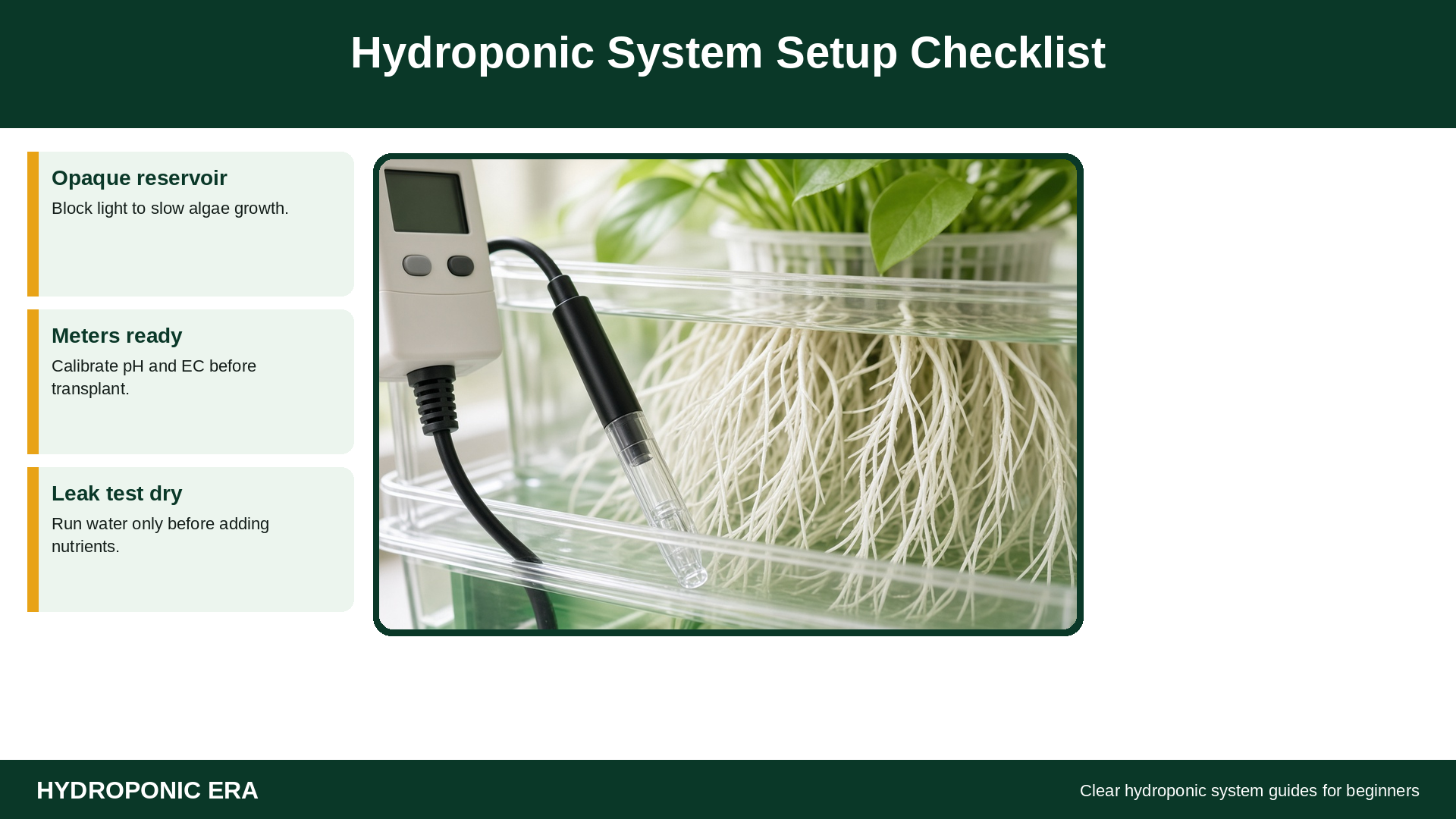
Use this checklist for a first home hydroponic system:
- Opaque reservoir or tote with a lid you can service.
- Net pots sized to your lid holes or channel spacing.
- Inert media (clay pebbles, rockwool, or kit plugs)—never garden soil.
- Hydroponic nutrients labeled for soilless use.
- pH meter or kit plus pH up/down; EC or TDS meter.
- Air pump and stone for DWC; water pump and timer for NFT, drip, or ebb and flow.
- Grow light and timer if you are indoors.
- Food-safe tubing, check valve where needed, and a spare air stone or pump.
Dry-fit everything. Leak-test with plain water. Mix nutrients only after plumbing behaves. Transplant sturdy seedlings, not fragile sprouts, into the wet media. Label the normal water line with tape so evaporation is obvious. Keep a dedicated bucket for system water so you never scoop from a soil area into the reservoir.
Place the unit where you will see it daily. Daily glances catch wilting, cloudy water, or a silent pump before a weekend disaster. Photograph the plumbing once it works for faster repairs later.
Best First Plants

Leafy greens and herbs are the calmest first crops in any beginner hydroponic system. Lettuce, basil, mint, and similar soft herbs forgive small EC mistakes and finish quickly enough that you learn a full cycle. UGA Extension suggests leaf lettuce for first-time growers because it is compact and does not need the staking that tomatoes demand.
For crop-specific habits, use best plants for hydroponics and our lettuce walkthrough: how to grow lettuce hydroponically. Save heavy fruiting plants for a second project once your logs look boring for a few weeks.
Do not mix a tomato and a butterhead lettuce in one tiny shared reservoir on week one. Different feed strengths and root habits make diagnosis harder. Run one crop class per small system until you know how your water drifts.
pH, EC, and Everyday Care
Most leafy hydroponic crops prefer a mildly acidic solution, often near pH 5.5 to 6.5. Outside that window, nutrients can be present yet unavailable. Check pH after mixing and again as plants drink. Adjust slowly. Calibrate meters with fresh buffers so numbers mean something.
EC tells you solution strength. When water evaporates, EC rises; when plants take up nutrients unevenly, EC can fall. Top up with plain water first, recheck, then add nutrients only if strength is truly low. Change the reservoir on a schedule suited to plant load and temperature rather than waiting for a smell. Details live in the pH and water-change guides linked above.
Clean algae from lids and channel walls. Rinse air stones. Keep roots creamy white when you can peek. Soft brown roots plus sour water mean you should dump, scrub, and restart with cooler, better-aerated solution. A healthy hydroponic system smells almost like nothing—or faintly like clean minerals—not like a pond.
Log dates, pH, EC, top-ups, and harvests. After one month the notebook teaches more than any product page. If leaves yellow while numbers look fine, revisit light and nutrient completeness before buying additives.
Common Mistakes

Using soil fertilizer in a recirculating hydroponic system clogs thinking and often clogs hardware. Buy a hydroponic formula.
Choosing a clear reservoir because it “looks cool” grows algae. Paint it, wrap it, or buy opaque.
Skipping meters to save money costs plants. Guessing pH is not a skill worth practicing on food.
Building NFT before you can commit to daily flow checks invites crispy roots after a power blip. Start with Kratky or DWC if your schedule is unpredictable.
Overcrowding sites looks abundant for a week, then invites tip burn and poor airflow. Follow spacing for your crop.
Changing five variables the same afternoon—new light, new nutrient brand, new pump, new pH target—hides the real fix. Change one thing, wait, log.
Ignoring temperature is quiet sabotage. Warm reservoirs hold less oxygen. Shade outdoor totes. Add aeration before you add more plants.
US / UK / AU / CA Notes

United States. Lean on Cooperative Extension PDFs such as OSU Hydro hints (including EM 9458 on ebb and flow), UMN small-scale hydroponics, and UGA’s homeowner circular. Match plugs and pump voltages to your outlets; use grounded indoor circuits for lights and air pumps.
United Kingdom. Cooler rooms and short winter days make grow lights part of a serious indoor hydroponic system. Watch condensation in closed cabinets. Prefer quiet air pumps for flats.
Australia. Heat management matters. Shade reservoirs, avoid baking NFT channels in full afternoon sun, and expect faster EC rise as water evaporates. Keep spare air stones on hand.
Canada. Indoor winters are normal. Insulate or move reservoirs off cold concrete. Backup aeration during power interruptions protects DWC more than NFT, but neither likes a long outage.
Spellings (fertilizer/fertiliser) and units (gallons/litres) will mix for a four-country audience. Pick one unit system for your own log and stick to it.
Wherever you live, keep spare parts labeled: air stone, airline, pump, dechlorinator if your tap needs it, and meter calibration solutions with dates. When a pump dies on a holiday weekend, the spare is the plan.
Frequently Asked Questions
What is a hydroponic system?
A hydroponic system is an arrangement that grows plants without garden soil by delivering a nutrient solution to the roots while keeping them oxygenated.
Which hydroponic system is best for beginners?
Kratky (no pump) or a small deep water culture bucket. Both teach water chemistry with fewer plumbing variables than NFT.
Do I need a pump?
Not for Kratky or wick. DWC needs an air pump. NFT, drip, Dutch bucket, and ebb and flow need a water pump—and usually a timer for flood or drip cycles.
How much does a starter hydroponic system cost?
A simple tote DWC or Kratky can stay modest if you already own a light. Budget for nutrients and meters even if the container is inexpensive.
Can I grow tomatoes in a beginner system?
Possible in Dutch buckets or large drip media pots, but leafy greens are the calmer first crop. Learn solution care before staking fruiting plants.
How often should I change the water?
On a schedule based on plant load and reservoir size—often every one to two weeks for small home units—plus top-ups between changes. See the water-change guide linked above.
Where can I read reliable sources?
OSU Extension Hydro hints (including EM 9458 ebb and flow), University of Minnesota Extension small-scale hydroponics, and University of Georgia Extension’s hydroponic gardening circular for homeowners.
Final Thoughts

A beginner hydroponic system succeeds when it is finished, clean, and measured—not when it is complicated. Choose one type that fits your crop and schedule, set opaque reservoirs and meters in place, grow greens first, and let the first harvest prove the routine. Kratky can teach you without a pump; DWC and ebb and flow add active control when you are ready; NFT and Dutch buckets wait until flow and fruiting habits feel ordinary.
Published by Hydroponic Era. External reading: OSU Extension EM 9458 Hydro hints: Ebb and flow, OSU Extension Hydro hints: What is hydroponics?, University of Minnesota Extension small-scale hydroponics, and University of Georgia Extension hydroponic gardening for the homeowner.
3 thoughts on “Hydroponic System for Beginners: How to Choose and Set One Up”