
The best plants for hydroponics are usually the ones that stay compact, grow leaves instead of fruit, and finish in a few weeks. If you are filling a first tower, a Kratky jar, or a small indoor hydroponic garden, start there. Fruiting crops can wait.
This guide names the best plants for hydroponics for beginners and how to pick among common hydroponic plants. It explains why leafy greens and herbs are easier than tomatoes or peppers, which hydroponic plants to skip at first, and how to match a crop to a tower, a DWC bucket, or a Kratky jar.
You do not need a greenhouse on day one. You need a system you can keep clean, enough light, and a plant that fits both. That is how a hydroponic garden stays calm instead of becoming a rescue project.
Table of contents
- Easiest Plants for Hydroponics Beginners
- Leafy Greens: Reliable Hydroponic Plants
- Best Hydroponic Herbs for a First Garden
- Fruiting Plants: Tomatoes, Peppers, and Strawberries
- Plants to Skip at First
- How to Match the Best Plants for Hydroponics to a System
- Common Mistakes When Choosing Hydroponic Plants
- Frequently Asked Questions
- Final Thoughts
Easiest Plants for Hydroponics Beginners
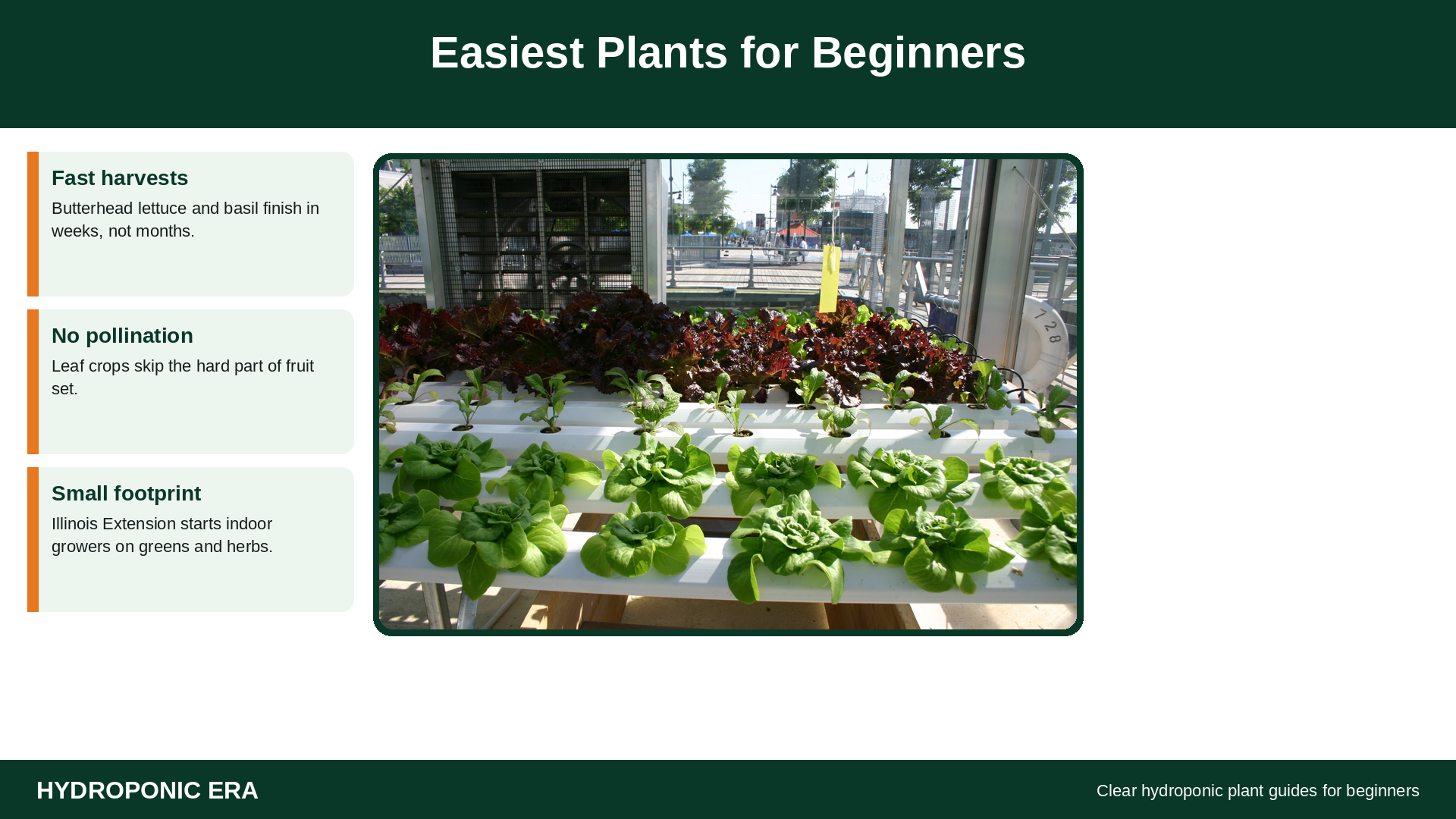
The easiest of the best plants for hydroponics share three traits. They stay small. They do not need pollination. They tolerate a slightly wider nutrient and pH band than fruiting crops.
University of Illinois Extension tells new indoor growers to begin with leafy greens (lettuce, kale, spinach) and herbs because those crops grow quickly and take little space. University of Minnesota Extension makes the same split: short-season crops that do not produce fruit are the better indoor choice, especially in winter.
Use this first list of the best plants for hydroponics:
- Butterhead and oakleaf lettuce
- Loose-leaf lettuce and mixed salad greens
- Basil
- Mint
- Parsley and cilantro
- Kale, pak choi, and mustard greens
- Microgreens
Microgreens are the fastest harvest in the group. You cut them at the seedling stage, so you skip weeks of pH chasing. If you want a crop you can finish while you learn the rest of the room, start with our guide to how to grow microgreens hydroponically.
If you want one of the best plants for hydroponics that teaches the whole loop—mix, measure, harvest—grow butterhead lettuce. It is the standard crop in many home DWC and NFT setups, and it forgives small mistakes better than a first tomato.
Leafy Greens: Reliable Hydroponic Plants
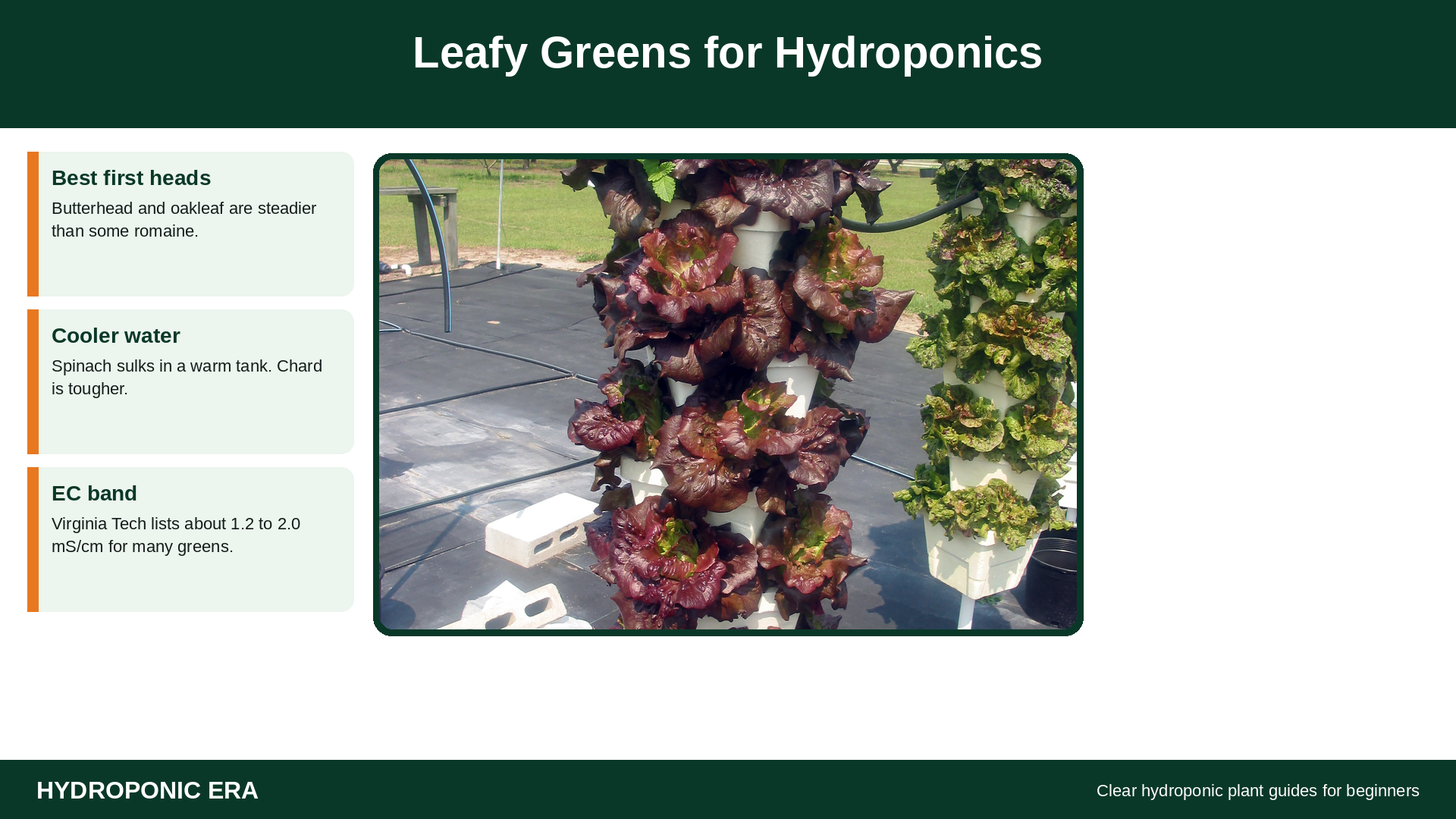
Leafy greens are the backbone of most home lists of the best plants for hydroponics. Virginia Tech notes that low-growing leafy greens and culinary herbs are what deep water culture systems grow most often. Butterhead, romaine, oakleaf, and multileaf lettuce all work. So do arugula, tatsoi, mache, and other salad greens.
Butterhead is usually the most forgiving head type. Oakleaf and loose-leaf cultivars are less prone to tipburn than some romaine. University of Tennessee’s leafy-crop guide points out that romaine can be trickier: tipburn shows up more often, and greenhouse romaine often makes a more open head than the tight hearts you buy at the store.
Spinach and kale do well when the solution stays cool. A warm tank makes spinach bolt or stall. Swiss chard is sturdier in a tower pocket and handles a little more heat. Mustard greens and pak choi add flavor without asking for fruiting-crop light.
Harvest young if you want a faster, cleaner crop. Baby greens need less light and less time than a full head. Several seeds in one net pot will fill in quickly if you plan to cut them early.
A practical starting band for many leafy greens is pH 5.5 to 6.2 and EC about 1.2 to 2.0 mS/cm, the range Virginia Tech lists for DWC greens. Keep the reservoir covered and out of direct sun so algae does not compete with the roots.
For a crop-by-crop routine, including spacing and harvest, see how to grow lettuce hydroponically.
Best Hydroponic Herbs for a First Garden
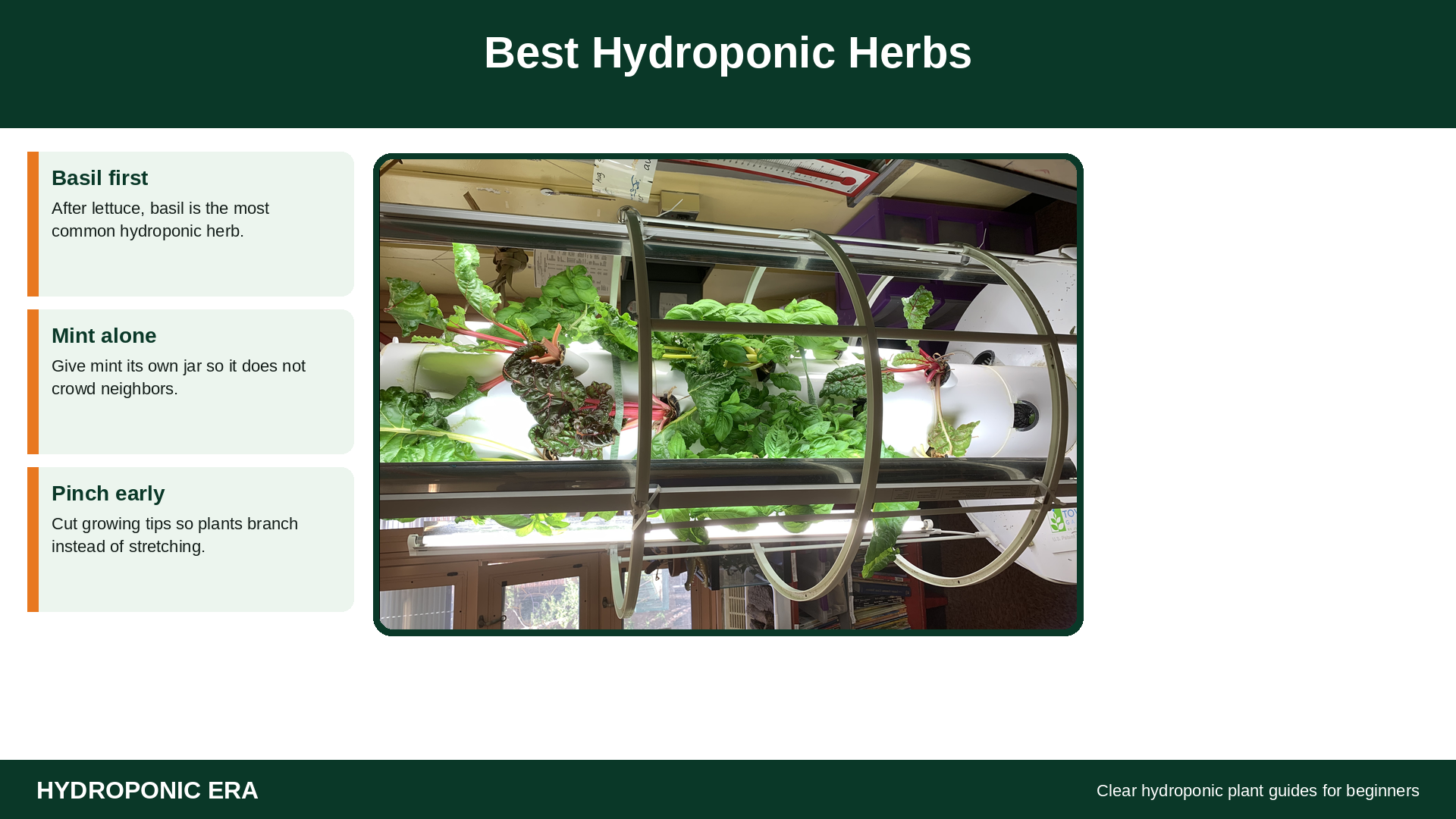
Herbs are the other easy group among the best plants for hydroponics. They stay compact, they can be cut more than once, and they fit a kitchen system or a tower pocket.
Basil is the second most widely grown leafy crop in hydroponic systems after lettuce, according to University of Tennessee. It likes more warmth and light than lettuce. If several crops share one tank, basil may want a slightly stronger feed and a brighter spot than butterhead.
Mint is vigorous. That is a gift and a warning. Give it its own jar or pocket so it does not shade or crowd neighbors. Our mint guide walks through a pest-light indoor routine: how to grow mint hydroponically.
Parsley, cilantro, chives, oregano, and dill all work as hydroponic plants. Cilantro bolts in heat, so keep it cooler than basil. Chives are slow at first, then reliable. Oregano and thyme stay smaller and like strong light.
Pinch herbs early so they branch. A single uncut basil stem becomes a lanky pole with a few leaves at the top. Cut growing tips, use the leaves, and let two new shoots replace one.
Herbs still need a complete hydroponic nutrient, not garden fertilizer. They also need real light. A dim kitchen bulb will not replace a grow light, even if the plant “survives.”
Fruiting Plants: Tomatoes, Peppers, and Strawberries
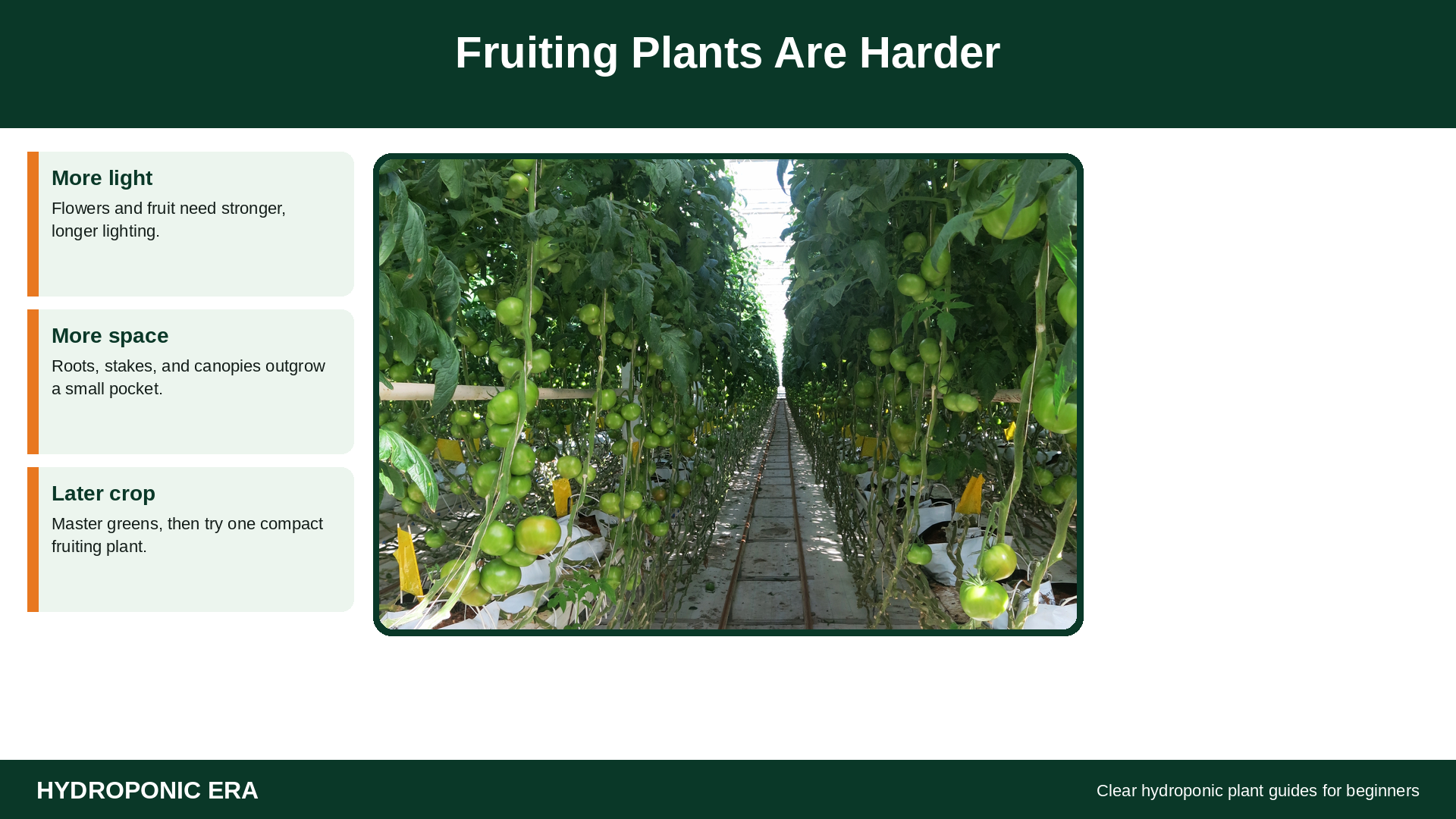
Tomatoes, peppers, and strawberries can be excellent hydroponic plants. They are not the best plants for hydroponics on week one, even though they are popular hydroponic plants later.
Illinois Extension is direct: larger fruiting plants take much longer and need more space than many people can provide indoors. Minnesota Extension says strawberries, tomatoes, cucumbers, and peppers are great outdoor summer crops, but indoor heat and lighting for those plants is often cost-prohibitive at home.
They are harder for four practical reasons:
- Light. Flowers and fruit need more intensity and more red light than a salad crop. A window that grows lettuce may not set peppers. See best grow lights for hydroponics before you commit.
- Root volume and support. A skinny tower pocket holds a lettuce root mass. A tomato wants a bucket, a stake, and pruning.
- Time and feed. Fruiting crops run for months. They often want a different N-to-K balance than lettuce, and they punish a neglected reservoir.
- Pollination. Indoor flowers need airflow, a brush, or a visit from you. Leaf crops skip that step entirely.
Tomatoes need support and a fruiting formula. If you try them indoors, choose a compact or determinate variety labeled for containers.
Peppers also need warmth, strong light, and help with fruit set. When you are ready, use the crop guide: how to grow peppers hydroponically.
Strawberries fit some towers once the system is stable, but they still need strong light and runner control. The published walkthrough is here: how to grow strawberries hydroponically.
If you want fruit later, master lettuce and basil first. Then move one fruiting plant into its own bucket so it does not rewrite the diet for every green in the tank.
Plants to Skip at First
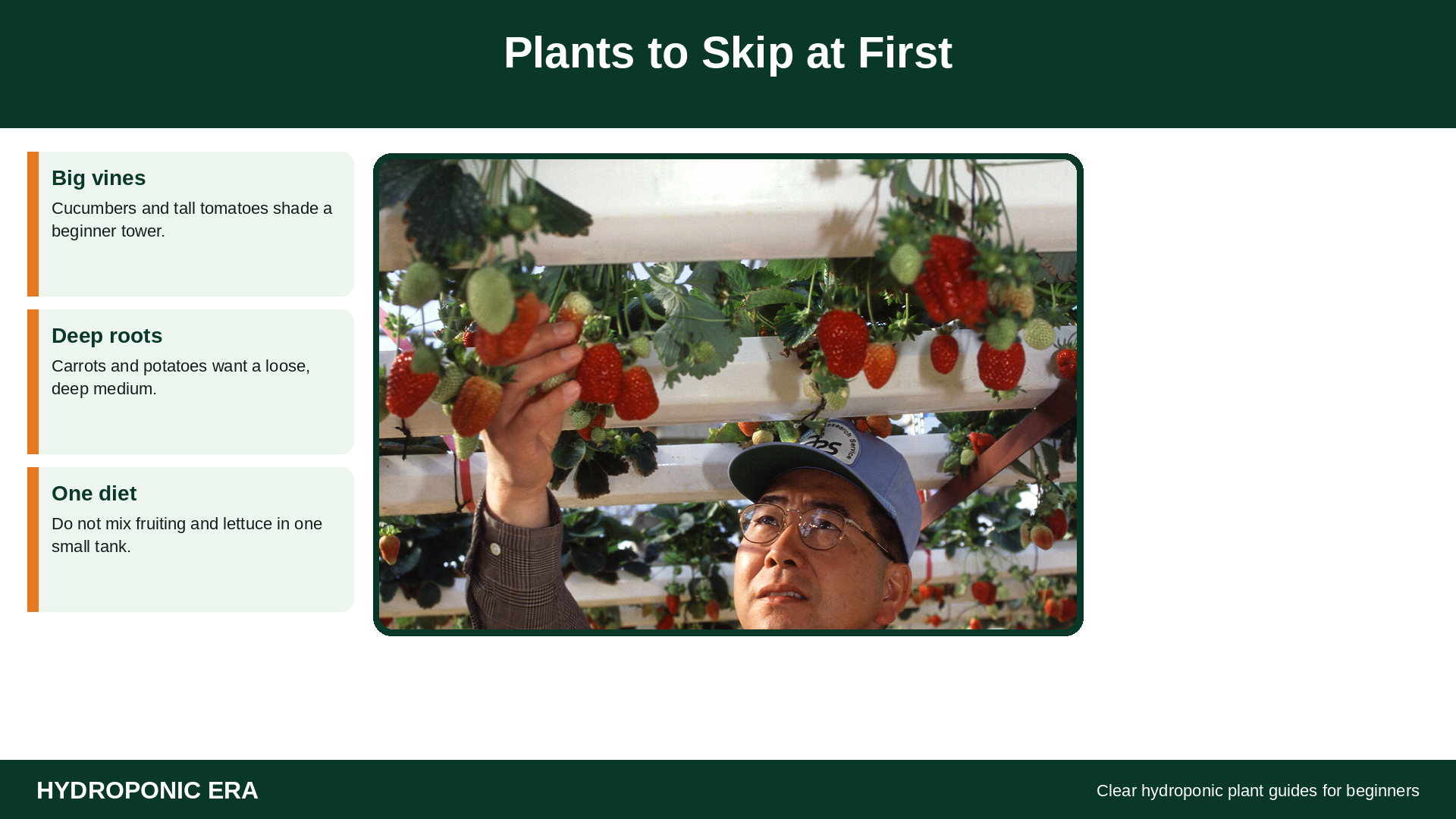
Skip crops that fight the system you actually have. They are not the best plants for hydroponics yet. Almost anything can be grown as a hydroponic plant in the right setup. The right setup is the point.
Leave these for later:
- Large indeterminate tomatoes and cucumbers in a small tower
- Root crops that need a deep, loose medium, such as carrots and potatoes
- Corn and other tall field crops
- Most fruit trees
- Heavy vining squash
- Crops that need a long cold period you cannot provide
Cucumbers can work in a large DWC tote or a drip bag, but they shade everything under them and drink fast. A first hydroponic tower garden should be greens and herbs, not a cucumber forest.
Also skip mixing a fruiting plant and lettuce in one small reservoir. Their EC and potassium needs diverge. Minnesota Extension is clear: keep crops with different fertilizer rates in different containers.
How to Match the Best Plants for Hydroponics to a System
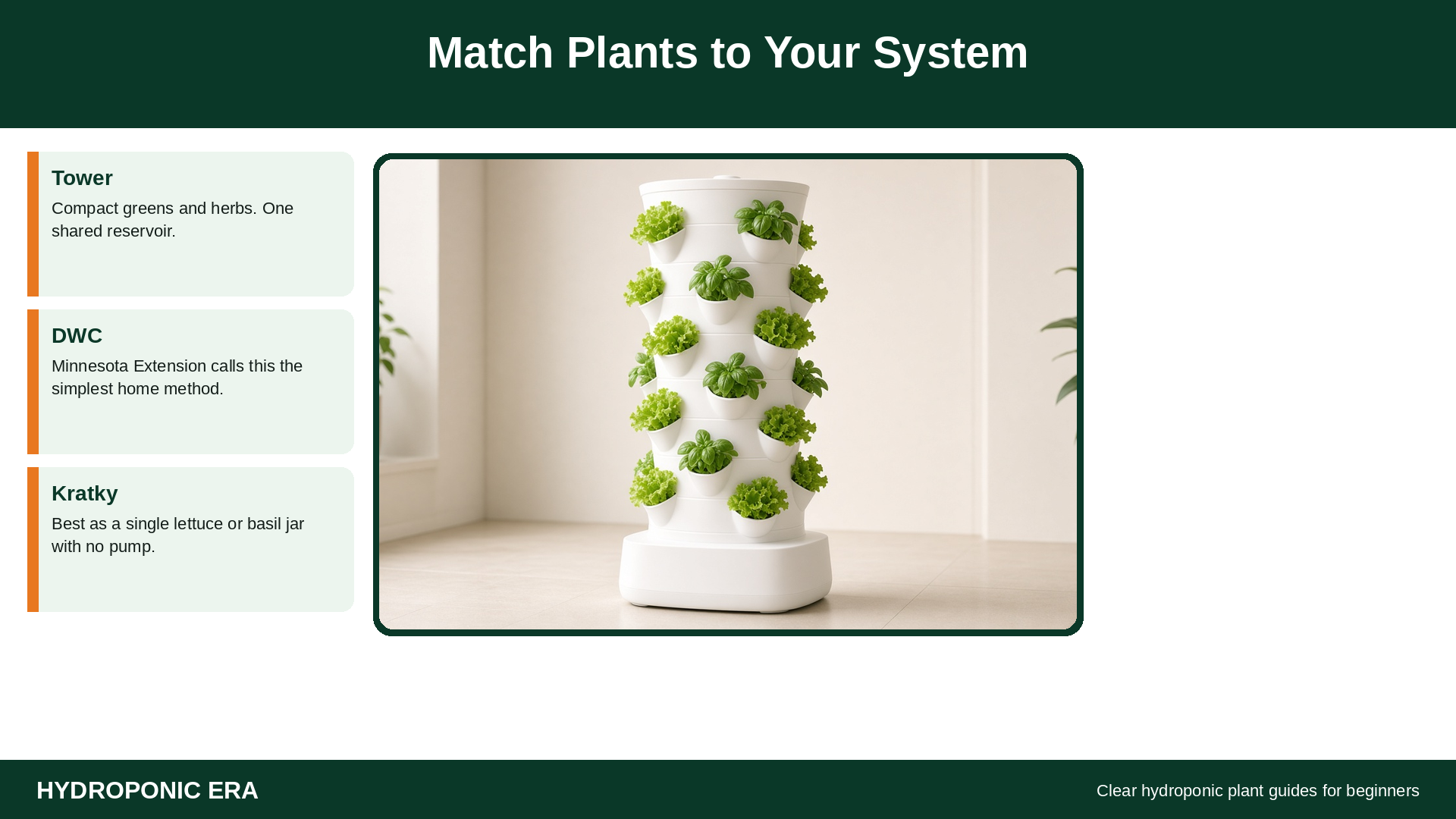
The best plants for hydroponics are the ones that fit the system, the light, and the time you have. A perfect variety in the wrong box still fails, even if it is on someone else’s list of the best plants for hydroponics.
Tower gardens. Vertical pockets favor compact greens and herbs. Lettuce, basil, kale, and chard sit well. Large tomatoes shade lower pockets and dry them out. A tower is a shared loop: one reservoir feeds every plant, so keep the crop list similar.
Deep water culture (DWC). Minnesota Extension calls DWC the simplest home method. Plants sit in net pots. Roots hang into an aerated tank. Lettuce, herbs, and other leafy greens thrive. Virginia Tech says fruiting crops such as tomatoes, peppers, and strawberries are grown in DWC only occasionally. A 5-gallon bucket can hold one pepper or a compact tomato later. Start with several lettuce heads in a tote.
Kratky. There is no pump. The water level drops and leaves an air gap for oxygen. That passive method suits a single lettuce, basil, or herb jar. It is a poor match for a long-season tomato unless you refill carefully and watch the roots.
NFT channels. A thin film of solution runs past the roots. Butterhead, arugula, kale, mustard, microgreens, and herbs have a good record in these channels. Fruiting plants usually need more media, more support, and a different plumbing plan.
| System | Best first plants | Wait on these |
|---|---|---|
| Tower | Lettuce, basil, kale, mint, chard | Large tomatoes, cucumbers |
| DWC tote or bucket | Butterhead, herbs, mixed greens | Several fruiting plants in one lid |
| Kratky jar | One lettuce or one basil | Long-season fruiting crops |
| NFT channel | Leaf lettuce, arugula, herbs | Heavy fruiting vines |
Match light next when you choose the best plants for hydroponics. Leafy greens can grow under modest full-spectrum LEDs. Fruiting crops need more intensity and more hours. If you are growing indoors year-round, stay with greens and herbs until the room, the light, and the reservoir feel routine.
Common Mistakes When Choosing Hydroponic Plants
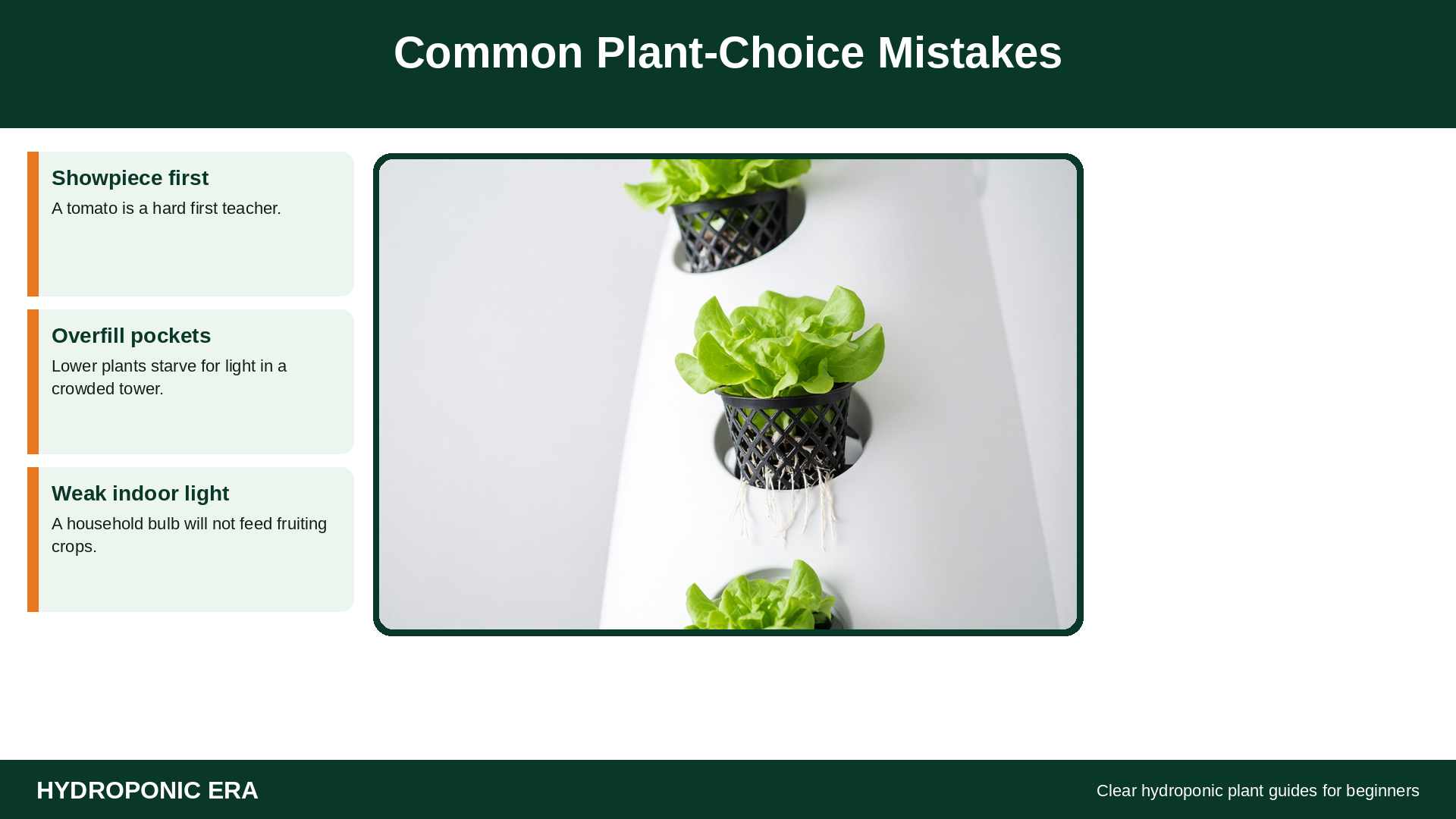
Most failed first systems fail on plant choice, not on a missing gadget. The best plants for hydroponics still fail in the wrong box.
Common mistakes:
- Starting with tomatoes because they look impressive
- Mixing fruiting and leafy crops in one small tank
- Crowding a tower until lower pockets get no light
- Growing a sun crop under a household lamp
- Choosing a field variety instead of a compact or hydroponic-adapted one
- Ignoring how many weeks the crop actually takes
- Changing plants, nutrients, and lights in the same week
Pick one of the best plants for hydroponics and finish a harvest. Butterhead lettuce from seed to bowl teaches more than three struggling pepper plants. Write down the variety. If it worked, grow it again before you expand the list.
If leaves yellow, measure pH and EC before you swap varieties. The hydroponic plants may be fine. The solution may not. Yellow new leaves with a high pH often mean lockout, not a bad crop choice.
Frequently Asked Questions

What are the best plants for hydroponics if I have never grown anything?
Lettuce, basil, and mint. They are fast, compact, and they do not need pollination. Those three hydroponic plants cover most beginner systems.
Can I grow tomatoes as my first hydroponic plants?
You can, but they are a harder teacher. They need more light, support, and time. Grow a leafy crop first so you learn the reservoir before you add fruit set.
Which hydroponic plants grow fastest?
Microgreens in about 7 to 14 days. Leaf lettuce and basil follow in a few weeks. Head lettuce takes longer than baby greens. Fruiting crops take months.
Do different hydroponic plants need different nutrients?
Use a complete fertilizer made for hydroponics. Leafy greens and fruiting crops often use different strengths. Do not mix them in one tiny reservoir if the label rates disagree.
What pH do most hydroponic plants want?
Most home crops do well from about 5.5 to 6.5. Illinois Extension uses that band as a home starting point. Virginia Tech’s DWC guide is a little tighter, about 5.5 to 6.2.
Can I grow the best plants for hydroponics in a small apartment?
Yes. A Kratky jar, a countertop garden, or a compact tower of the best plants for hydroponics fits most rooms if you add a grow light and protect the floor from splashes.
Should herbs and lettuce share a tower?
Yes, if the tower has one reservoir and you keep the list to leafy crops. Those are still the best plants for hydroponics in a shared loop. Save peppers and tomatoes for their own bucket.
Related reading
- Aeroponics for Beginners
- How to Control pH in Hydroponics for Beginners
- How Often to Change Hydroponic Water
- Why Hydroponic Leaves Turn Yellow
- Why Hydroponic Roots Turn Brown
Final Thoughts

The best plants for hydroponics are not the rarest. They are the ones that match your system and your week.
Start with lettuce, basil, and a few other of the best plants for hydroponics that stay leafy. Learn the reservoir, the light, and the harvest. Add peppers, strawberries, or a compact tomato when that loop feels ordinary.
A calm first garden beats an ambitious one that never finishes. Choose from the best plants for hydroponics you can harvest this month, then grow that crop again.
3 thoughts on “Best Plants for Hydroponics: Complete Beginner’s Guide”
Comments are closed.