
Active vs passive hydroponics is about whether the system uses moving parts to deliver water, nutrients, and oxygen. Active hydroponics uses pumps, air stones, or timers, as in deep water culture with an air pump, NFT, ebb and flow, drip, and aeroponics. Passive hydroponics has no pumps; it relies on wicking, gravity, or an air gap, as in the Kratky method, wick systems, and many semi-hydroponic houseplant setups. Active systems grow larger, faster plants; passive systems are cheaper, silent, and nearly maintenance-free for small crops.
Key takeaway: Start passive for lettuce and herbs. Move to active systems when you want fruiting crops, bigger yields, or more plants.
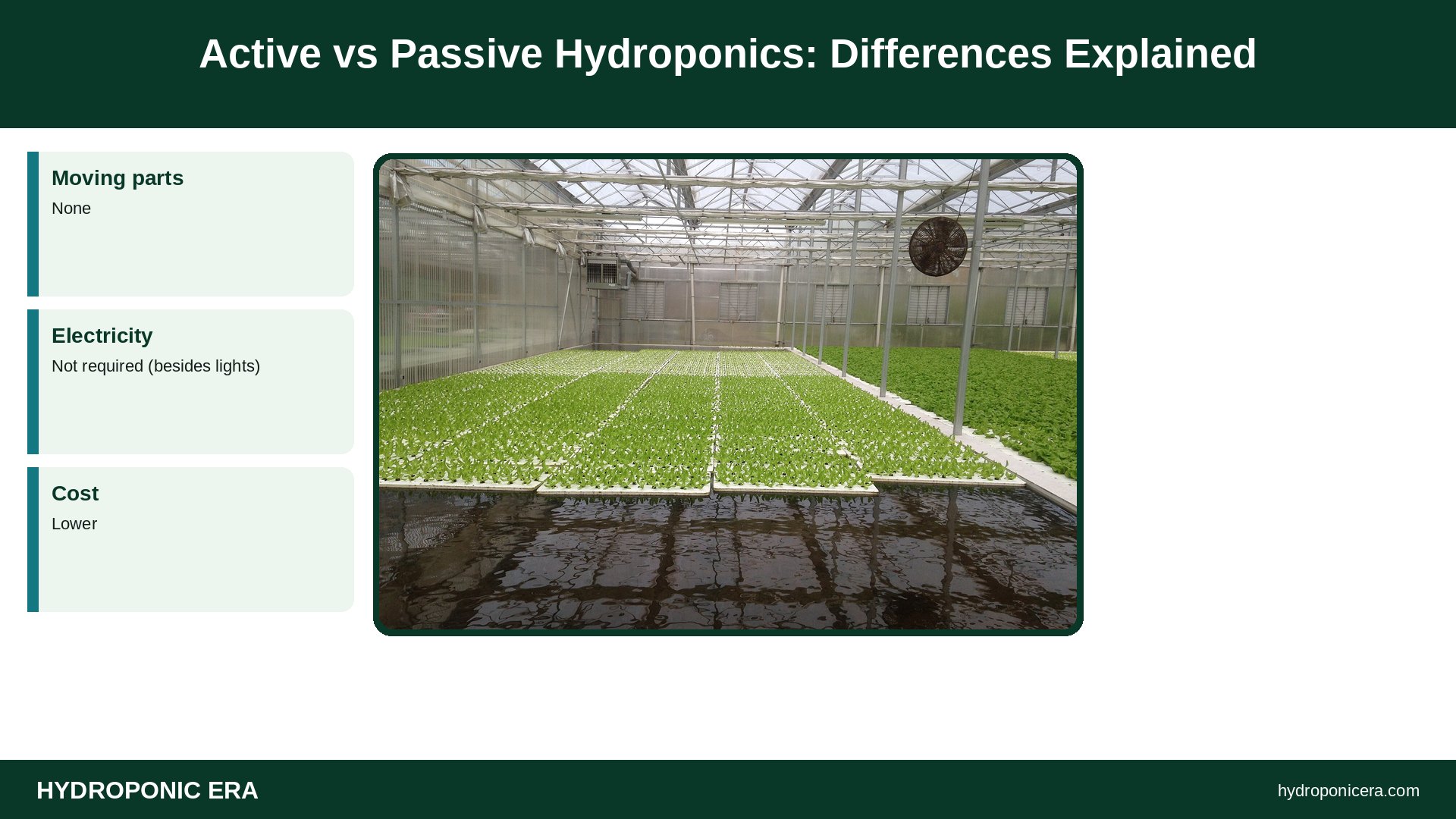
| Factor | Active hydroponics | Passive hydroponics |
|---|---|---|
| Moving parts | Pumps, air pumps, timers | None |
| Electricity | Required (besides lights) | Not required (besides lights) |
| Cost | Higher | Lower |
| Best crops | Tomatoes, peppers, cucumbers, large herbs | Lettuce, herbs, houseplants |
| Failure risk | Pump or power failures | Very low |
| Growth speed | Faster for larger plants | Good for small, quick crops |
What Makes a System Active
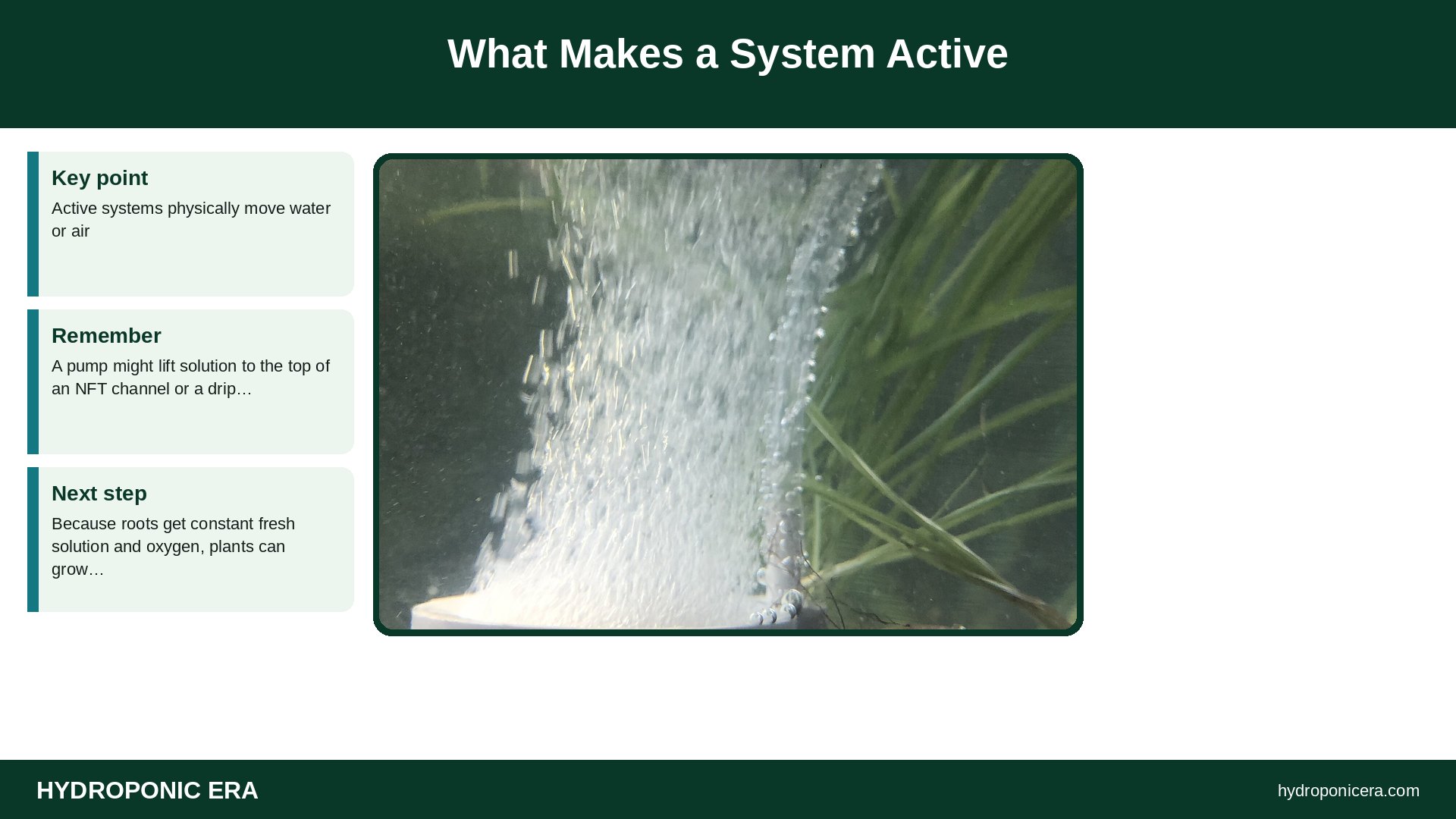
Active systems physically move water or air. A pump might lift solution to the top of an NFT channel or a drip line, or an air pump might bubble oxygen into a DWC reservoir. Because roots get constant fresh solution and oxygen, plants can grow very large. Examples include:
- Deep water culture with air stones
- Nutrient film technique
- Ebb and flow
- Drip systems and Dutch buckets
- Aeroponics
What Makes Passive Hydroponics Passive
Passive systems rely on physics instead of motors. In the Kratky method, the water level drops as plants drink, creating an air gap where upper roots breathe. In a wick system, a cotton or nylon wick pulls solution up into the medium. Semi-hydroponics with clay pebbles uses capillary action. These setups are cheap, quiet, and need no outlets near water.
Oxygen: The Real Difference
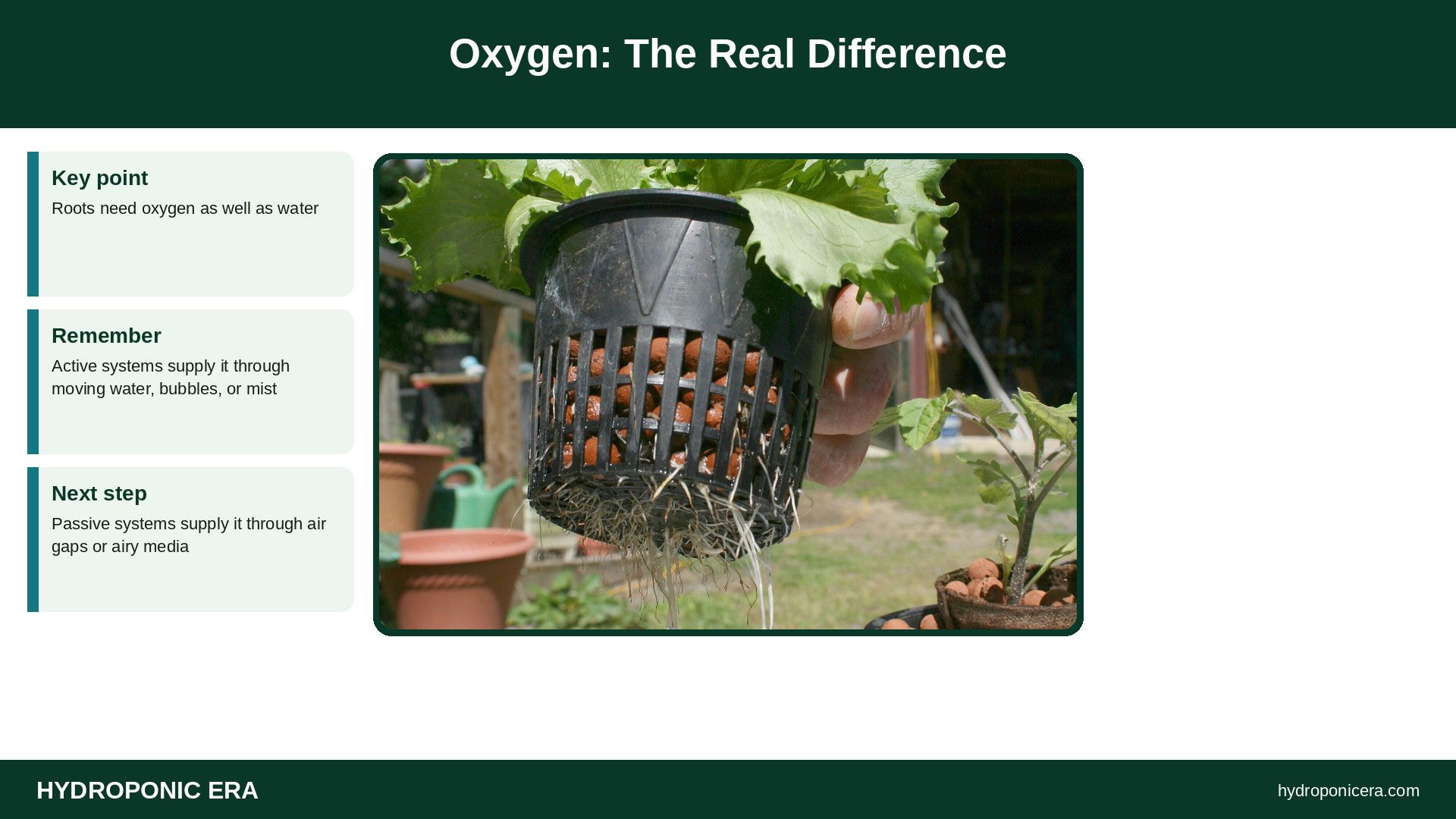
Roots need oxygen as well as water. Active systems supply it through moving water, bubbles, or mist. Passive systems supply it through air gaps or airy media. That works well for small plants with modest needs, but large, fast-growing plants can use up oxygen in a passive reservoir, especially when water is warm. Our guide to dissolved oxygen explains the science.
Pros and Cons of Active vs Passive Hydroponics
Active: Pros
- Supports large fruiting plants and dense planting
- Faster growth when well managed
- Easier to scale up to many plants
Active: Cons
- Higher cost and more parts to fail
- Noise from pumps; see pump noise fixes
- Power outages can damage crops quickly; see power outage recovery
Passive Hydroponics: Pros
- Very cheap and simple
- Silent, no electricity at the reservoir
- Great for beginners, classrooms, and kids
Passive Hydroponics: Cons
- Limited to smaller or slower plants
- Less control over oxygen and nutrient mixing
- Stagnant water can warm up and grow algae if not light-proofed
Which Crops Fit Each Approach?
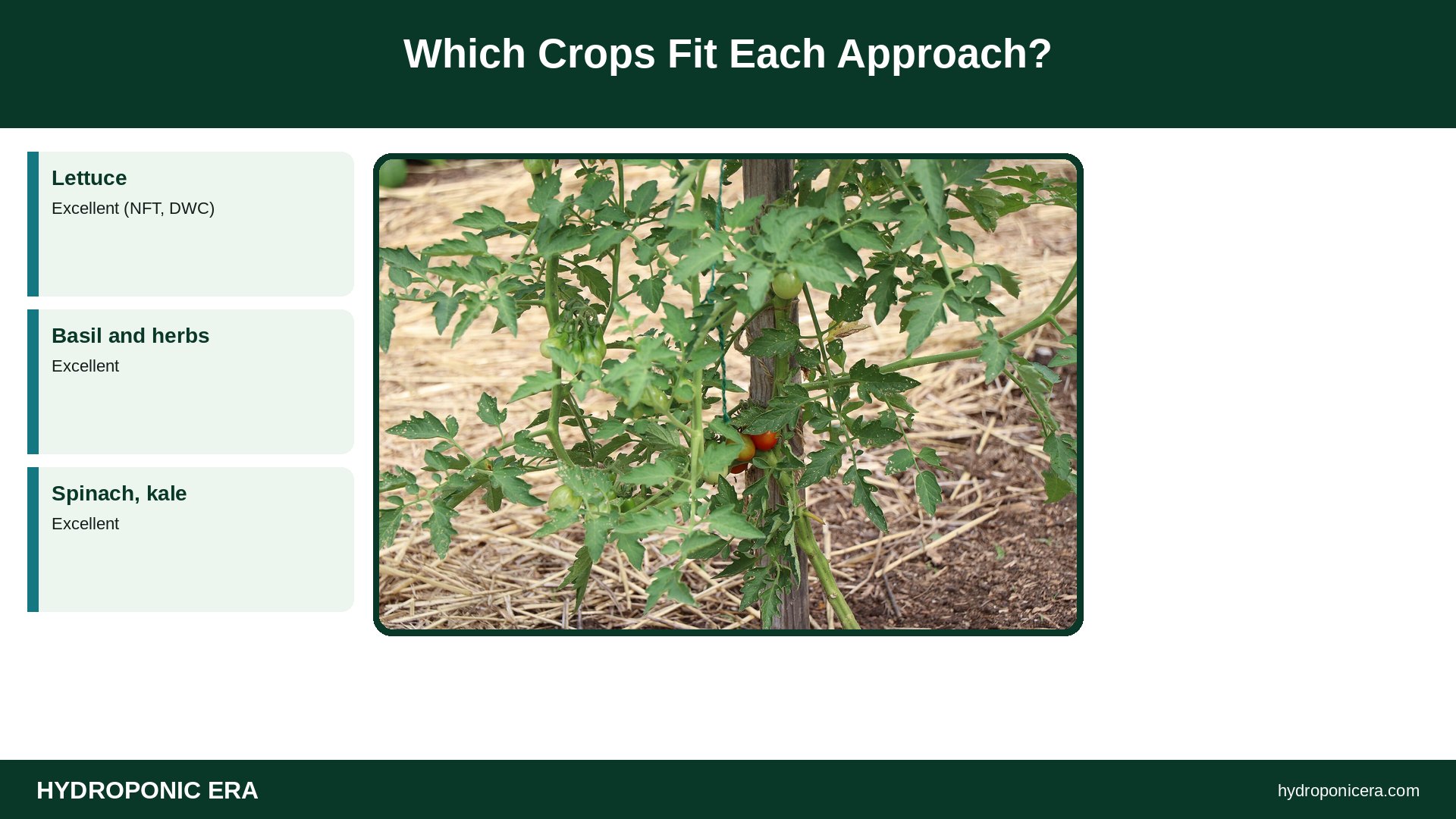
| Crop | Passive? | Active? |
|---|---|---|
| Lettuce | Excellent (Kratky) | Excellent (NFT, DWC) |
| Basil and herbs | Good | Excellent |
| Spinach, kale | Good | Excellent |
| Tomatoes, peppers | Possible with large Kratky containers, but limited | Best choice |
| Cucumbers | Difficult | Best choice |
| Houseplants | Excellent (LECA, water) | Rarely needed |
For crop ideas, see best plants for hydroponics.
Cost Comparison
A passive Kratky setup can be built from a storage tote, net cups, and nutrients. An active system adds a pump or air pump, tubing, a timer, and often more plumbing. Running costs differ too: pumps draw electricity around the clock, though small air pumps use little. Lights usually dominate the power bill in both cases. See cost to start home hydroponics.
Hybrid Approaches
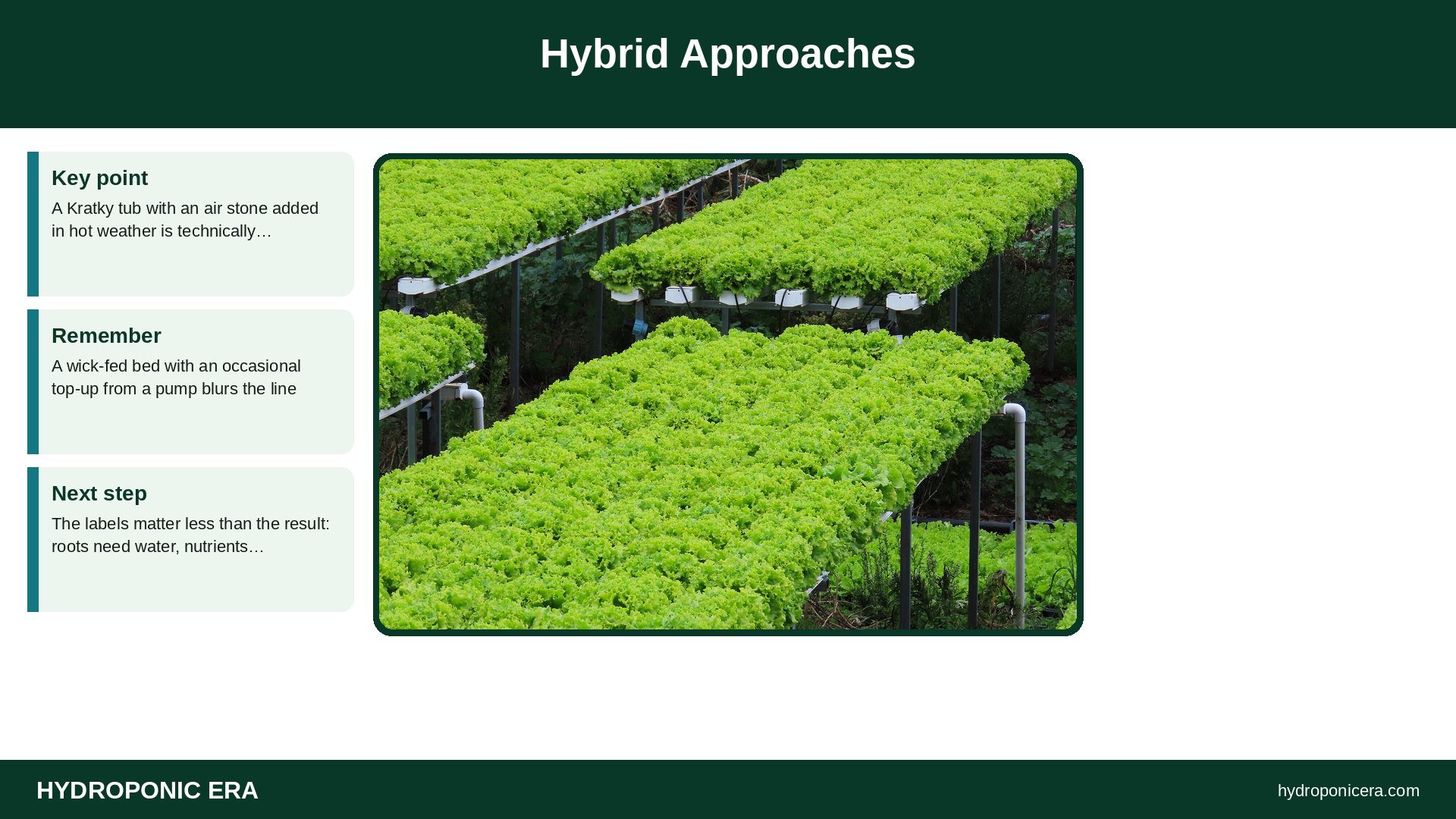
Many growers mix the two. A Kratky tub with an air stone added in hot weather is technically active. A wick-fed bed with an occasional top-up from a pump blurs the line. The labels matter less than the result: roots need water, nutrients, and oxygen in balance.
How to Choose Between Active vs Passive Hydroponics
- List the crops you want to grow.
- Decide how much time you can spend on checks and maintenance.
- Consider noise, outlets, and space.
- Start small. Many growers learn on passive Kratky lettuce, then build an active system for tomatoes.
Our hydroponic systems for beginners guide compares each type in more depth.
Real-World Examples
Passive in practice: a family starts six lettuce plants in a 10-gallon tote using the Kratky method. They fill it once with nutrient solution and harvest about five to six weeks later without adding anything, because the falling water level gives roots air. Total parts: a tote, net cups, rockwool, nutrients, and a light.
Active in practice: the same family wants tomatoes, which drink far more water and need steady oxygen. They set up two Dutch buckets with a small pump and timer. The plants grow large and fruit well, but the family now checks the pump, keeps spare parts, and plans for outages.
Both approaches worked. The difference was the crop and how much attention they were willing to give.
Maintenance Compared
| Task | Passive | Active |
|---|---|---|
| Check water level | Every few days | Daily for small reservoirs |
| pH and EC checks | Weekly or at start | Every 1–2 days |
| Equipment checks | None | Pumps, air stones, timers, tubing |
| Cleaning | Between crops | Between crops plus filters and lines |
Noise, Power, and Placement
Passive systems can go anywhere with light: a kitchen counter, a classroom, or a bedroom shelf. Active systems need outlets, and pumps or air pumps hum. Place active systems on a GFCI outlet and away from bedrooms if noise bothers you. See electrical safety.
Getting Better Results From Passive Hydroponics
Passive hydroponics works best when you respect its limits. Choose fast, compact crops, use a container large enough that the plant won’t drink it dry before harvest, and keep the solution cool and dark. In the Kratky method, don’t top the container all the way back up once roots have adapted to an air gap, or you may drown the upper roots. In wick systems, use several thick wicks and an airy medium such as perlite and coco so moisture keeps pace with the plant. With those habits, passive hydroponics produces lettuce and herbs that rival pumped systems.
When passive hydroponics stops keeping up, such as wilting at midday or slow growth as plants get large, that’s the sign to add an air pump or move to an active design.
FAQs: Active vs Passive Hydroponics
Is Kratky active or passive?
Passive. It uses no pumps; the falling water level creates an air gap for root oxygen.
Is DWC active or passive?
Standard DWC with an air pump is active. Without aeration, it becomes a Kratky-style passive system.
Which is better for beginners?
Passive systems are simpler for first crops of lettuce and herbs. Active systems are better once you want bigger plants.
Do passive systems grow slower?
For small greens, the difference can be small. For large fruiting plants, active systems usually grow faster.
Can I make a passive system active later?
Often yes. Adding an air pump to a Kratky tub turns it into DWC.
Sources
- University of Florida IFAS Extension — Leafy Greens in Hydroponics and Protected Culture for Florida
- USDA National Agricultural Library — Hydroponics resources
- Photo credits (Wikimedia Commons, edited with titles): Deep water culture by ArcadiYay (CC BY-SA 4.0); Air Stone Disk aquarium Germany 2024 by Nimmerwelk (CC BY-SA 4.0); 2009-03-30 Lettuce roots by Ildar Sagdejev (Specious) (CC BY-SA 4.0); Several green unripe and red ripe tomatoes growing on the vine. (086c449c-117b-44f6-a7c4-e2acbf284092) by NPS (Public domain); Hydroponic lettuce @ Plaine des Cafres 03 by Rémih (CC BY-SA 4.0)