
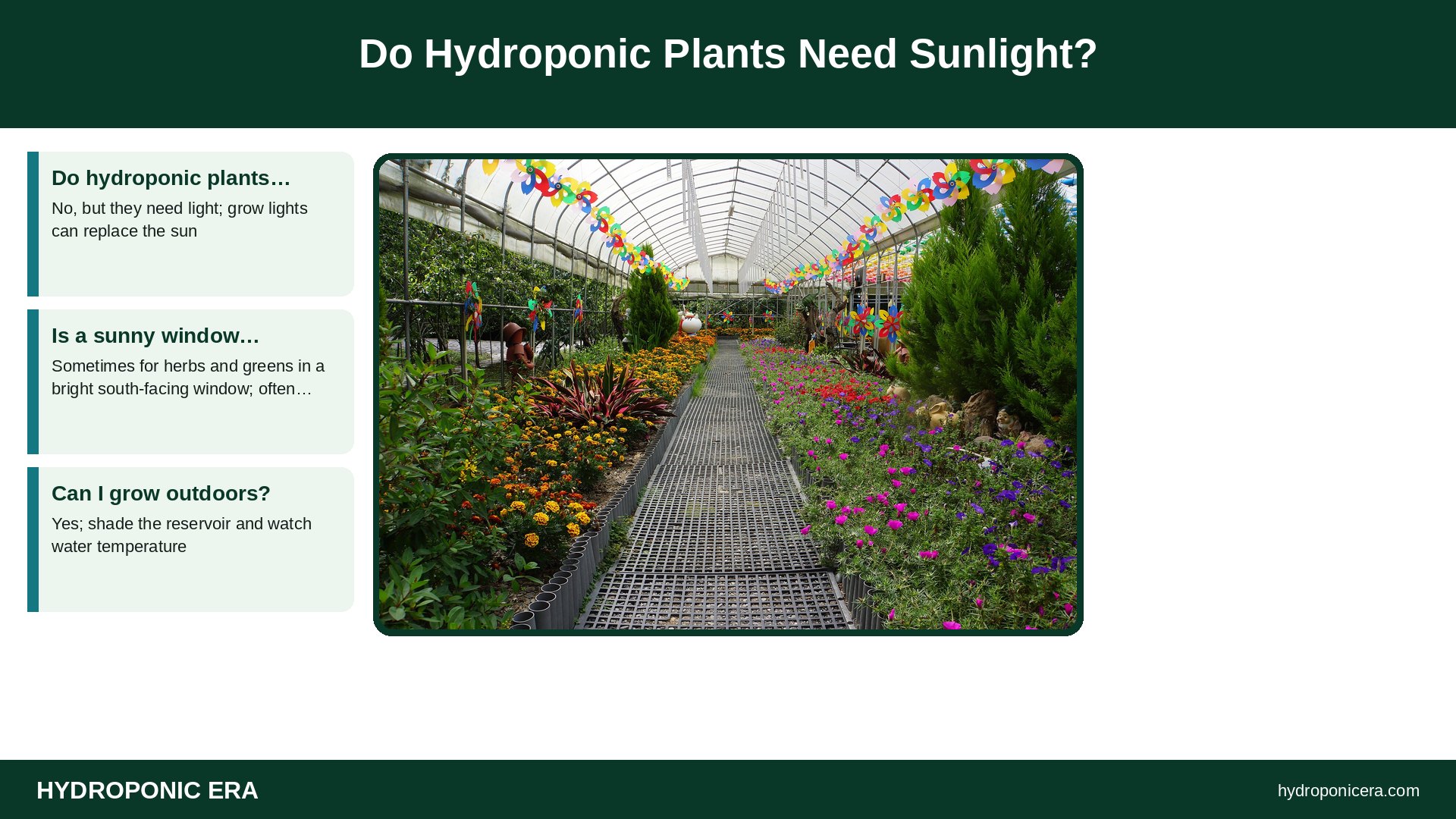
Hydroponic plants don’t need sunlight specifically, but they do need light. Plants use light for photosynthesis, and they can’t tell whether those photons came from the sun or a grow light. Indoors, an LED grow light can fully replace sunlight; outdoors or in a greenhouse, sunlight is free and powerful. What matters is getting enough light intensity for enough hours each day, measured as PPFD and DLI, for the crop you’re growing.
Key takeaway: Hydroponics replaces soil, not light. Whether the source is sunlight or an LED, plants need a sufficient daily light dose to grow well.
| Question | Short answer |
|---|---|
| Do hydroponic plants need sunlight? | No, but they need light; grow lights can replace the sun |
| Is a sunny window enough? | Sometimes for herbs and greens in a bright south-facing window; often not in winter |
| Can I grow outdoors? | Yes; shade the reservoir and watch water temperature |
| Hours of light | Many greens do well with 14–16 hours under grow lights |
| What to measure | PPFD (intensity) and DLI (daily total) |
Why Plants Need Light, Not Sunlight
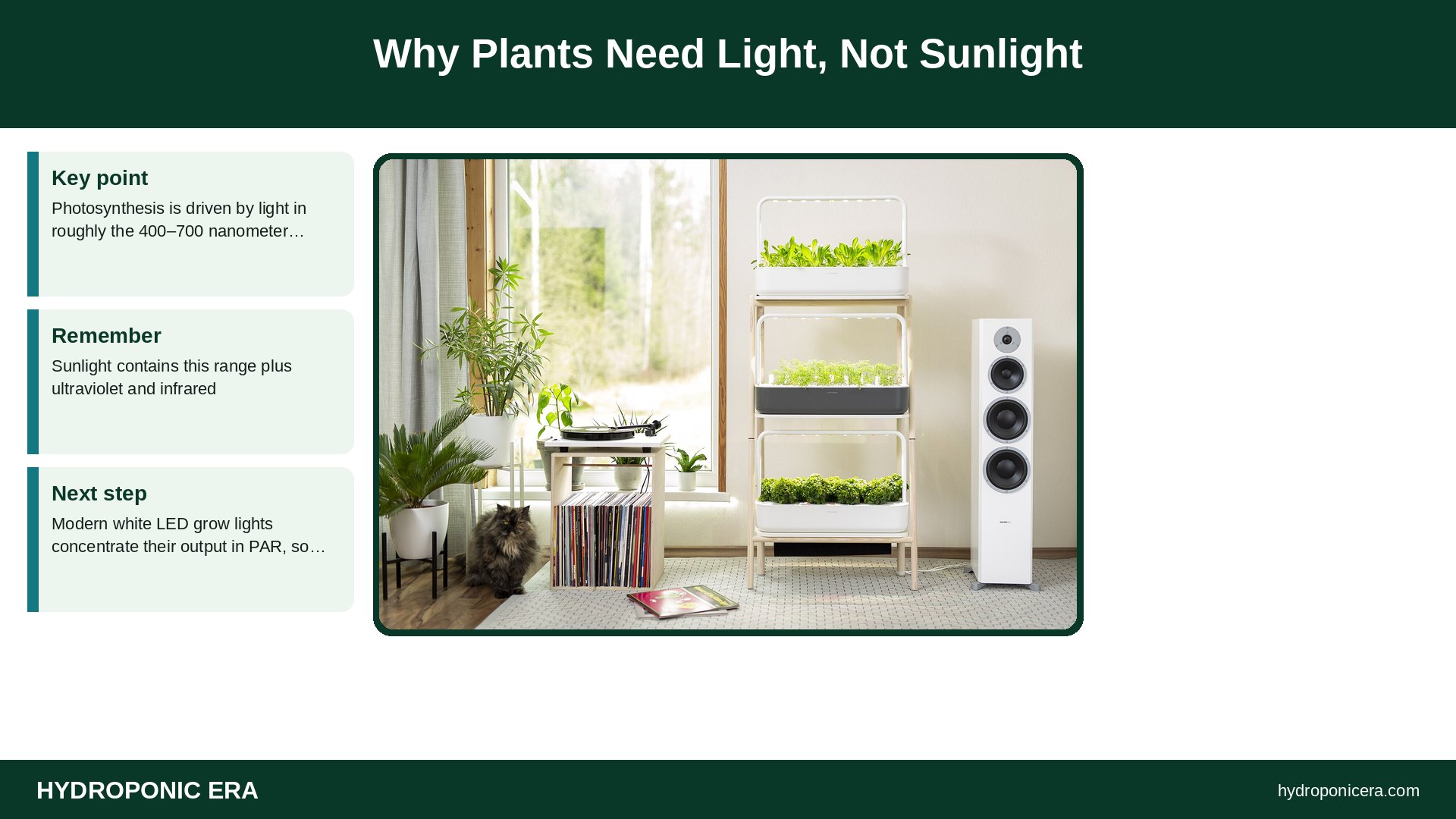
Photosynthesis is driven by light in roughly the 400–700 nanometer range, called photosynthetically active radiation (PAR). Sunlight contains this range plus ultraviolet and infrared. Modern white LED grow lights concentrate their output in PAR, so plants grown entirely under LEDs can be just as healthy as those in sunlight. NASA’s research on growing lettuce and other crops in space depends entirely on artificial light. See hydroponics in space.
How Much Light Do Plants Need?
Light needs are best expressed as DLI (daily light integral), the total photons per square meter per day. Rough DLI ranges that extension researchers often cite:
- Lettuce and leafy greens: around 12–17 mol/m²/day
- Herbs: moderate to high, depending on species
- Tomatoes, peppers, cucumbers: high, often 20–30 mol/m²/day or more
Full summer sunlight outdoors can exceed the needs of most crops. A window, however, delivers far less, especially in winter. Our PPFD and DLI guide explains the numbers.
Sunlight Through Windows
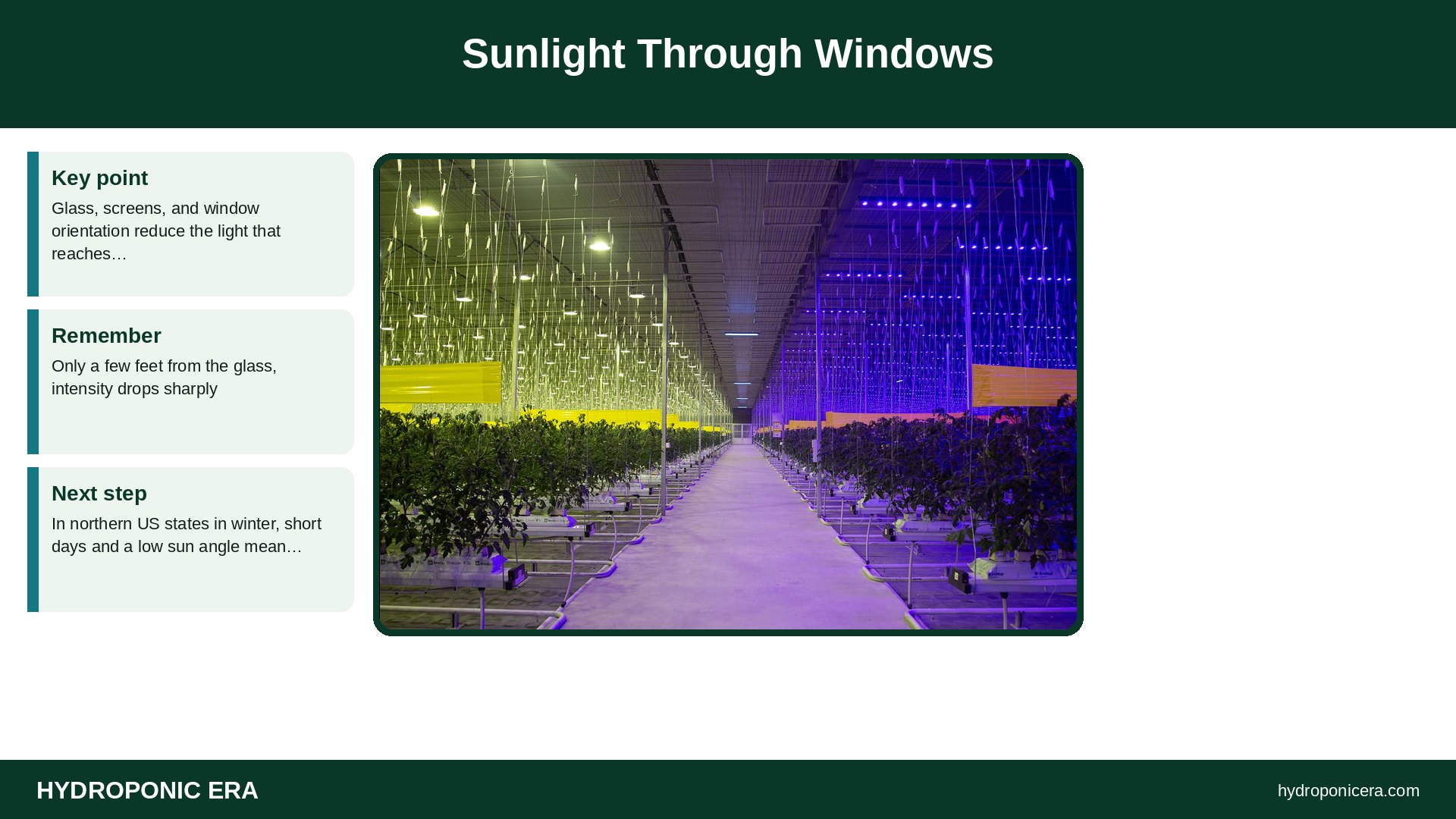
Glass, screens, and window orientation reduce the light that reaches plants. Only a few feet from the glass, intensity drops sharply. In northern US states in winter, short days and a low sun angle mean even a south-facing window may not provide enough light for lettuce to form a full head. Signs include leggy seedlings, pale leaves, and plants leaning toward the glass.
Windowsill growing works best for:
- Herbs such as mint, chives, and parsley in a bright south- or west-facing window
- Kratky lettuce in spring and summer
- Houseplants grown in water. See plants that grow in water
Grow Lights as a Sunlight Replacement
A grow light gives you control: consistent intensity, a fixed schedule, and no dependence on weather. For indoor hydroponics, LEDs are the standard choice. See best grow lights for hydroponics. Set a timer for a consistent photoperiod; our light schedule guide covers hours by crop.
Combining Sunlight and Grow Lights
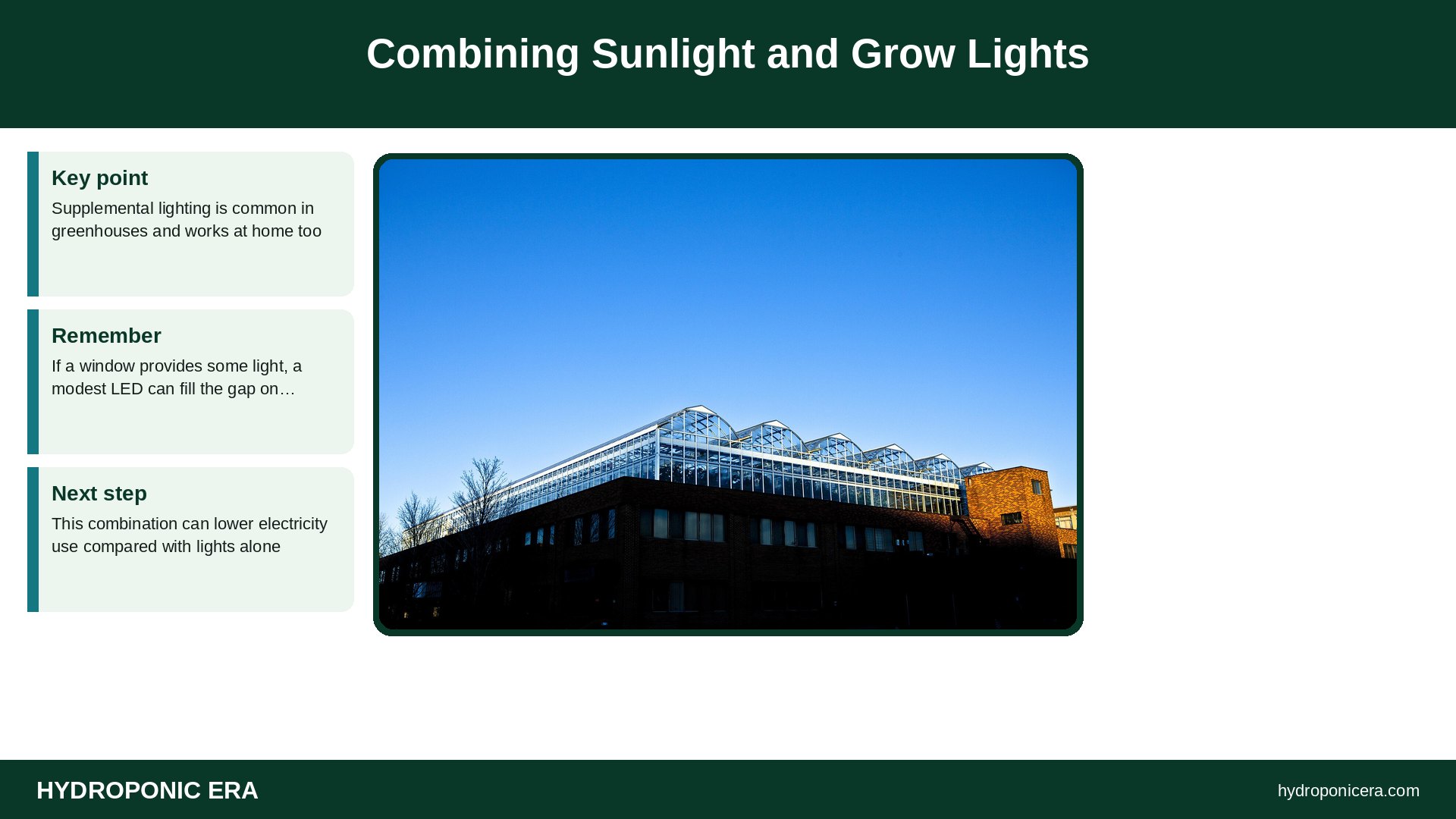
Supplemental lighting is common in greenhouses and works at home too. If a window provides some light, a modest LED can fill the gap on cloudy days and extend short winter days. This combination can lower electricity use compared with lights alone. Measure what plants receive and add light only where needed; see measuring canopy PPFD.
Growing Hydroponics Outdoors in Sunlight
Outdoor hydroponics on a patio, balcony, or rooftop uses free sunlight, but has its own challenges:
- Reservoir heat. Sun on a reservoir warms the solution and reduces oxygen. Shade, insulate, or paint containers white. See reservoir insulation.
- Algae. Any light reaching the solution grows algae. Use opaque containers and lids. See algae in reservoirs.
- Rain dilution and wind. Cover reservoirs and secure tall plants.
- Season length. Your USDA zone and frost dates still apply outdoors.
Our balcony hydroponics guide covers outdoor setups.
Sunlight Shouldn’t Reach the Roots
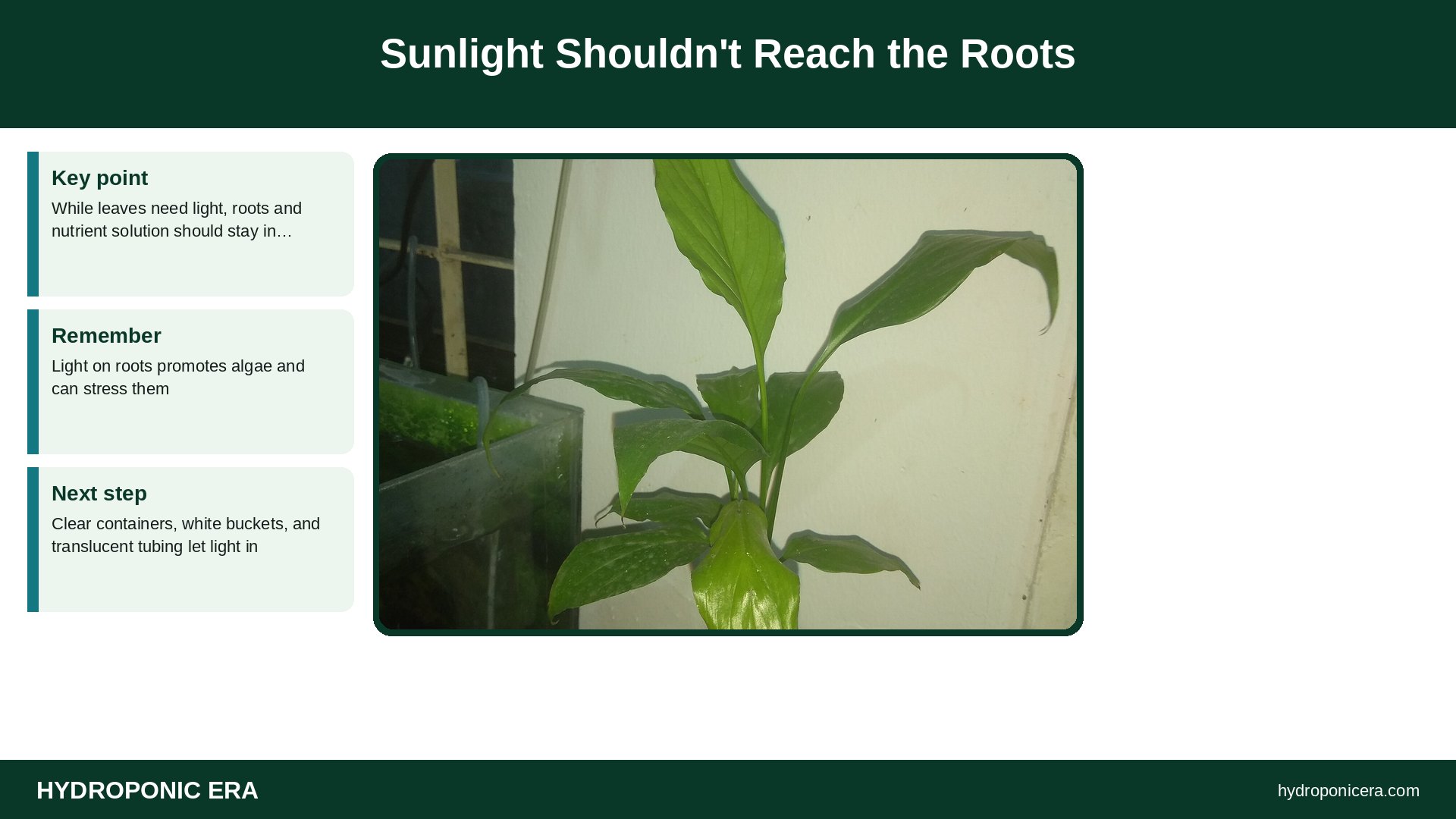
While leaves need light, roots and nutrient solution should stay in the dark. Light on roots promotes algae and can stress them. Clear containers, white buckets, and translucent tubing let light in. Light-proof reservoirs and use opaque lids; see reservoir light-proofing.
Too Much Light
Strong summer sunlight in hot climates, or a powerful LED hung too close, can bleach leaves or cause heat stress, especially in lettuce. Use shade cloth outdoors and adjust hanging height indoors. See light burn and heat stress.
Do Plants Need Darkness Too?
Most crops benefit from a dark period each day. Some short-day and long-day plants respond to night length for flowering. Lettuce under very long days may bolt sooner. Keep a consistent schedule and avoid light leaks at night if you grow photoperiod-sensitive plants; see light leaks and night interruption.
Quick Decision Guide
- Bright south window, herbs or greens, spring to fall: sunlight may be enough.
- Winter, north window, or fruiting crops: add or rely on grow lights.
- Basement or closet: grow lights are essential.
- Outdoor patio: sunlight works; manage heat and algae.
Seasonal Light Changes in the US
Day length varies a lot with latitude. In northern states, winter days can be under nine hours, while summer days stretch past fifteen. In southern states, the swing is smaller. That means a windowsill garden that thrives in June may stall in December. Many growers run windowsill systems without lights from spring to fall and add an LED for the darker months. See seasonal indoor adjustments.
Measuring Sunlight at Home
You can estimate how much sunlight a window delivers with a light meter or a phone app designed for PPFD. Take readings at plant height at several times on a clear day and again on a cloudy day. Comparing those readings with your crop’s target DLI tells you whether sunlight alone is enough or how much supplemental light to add. See measuring canopy PPFD.
FAQs: Sunlight and Hydroponic Plants
Can hydroponic plants grow without sunlight?
Yes, with grow lights providing enough intensity and hours. Many indoor farms use no sunlight at all.
Is sunlight better than grow lights?
Sunlight is free and intense, but variable. Grow lights are consistent and controllable. Plants grow well under either when the dose is right.
How many hours of light do hydroponic lettuce plants need?
Under grow lights, 14–16 hours a day is common. The right number depends on intensity and target DLI.
Can I use regular LED bulbs?
Household bulbs can grow some herbs if very close, but most are too weak for good growth. Grow lights designed with PAR data perform better.
Should my reservoir be in the sun?
No. Keep it shaded and opaque to prevent heat and algae.
Sources
- Virginia Cooperative Extension — Calculating and Using Daily Light Integral (SPES-720)
- University of Missouri Extension — Controlled Environment Agriculture: Understanding Grow Lights
- NASA — Growing Plants in Space
- Photo credits (Wikimedia Commons, edited with titles): Greenhouse in Qingjing Small Swiss Garden 清境小瑞士花園溫室 – panoramio by lienyuan lee (CC BY 3.0); Click & Grow Smart Garden 27 by Janar Raidla (CC BY-SA 4.0); Greenhouse in Kazakhstan by Gakon Netafim (CC BY-SA 4.0); Lufa Farms Montreal rooftop greenhouse in Sunlight by Lufa Farms (CC BY-SA 2.0); Spathiphyllum wallisii hydroponically grown by Kephalian (CC BY-SA 4.0)