
Brown spots on hydroponic leaves usually come from one of five causes: nutrient problems (especially calcium, potassium, or magnesium), pH drift that locks out nutrients, fungal or bacterial disease, light or heat burn, or pests such as thrips and spider mites. Where the brown spots appear, on old or new leaves, at edges or between veins, and whether they have yellow halos or fuzzy growth, narrows the cause quickly. Start by checking pH and EC, then inspect leaf undersides with a magnifier.
Key takeaway: Brown spots are a symptom, not a diagnosis. Note the location and pattern, test your solution, and look for pests before treating anything.
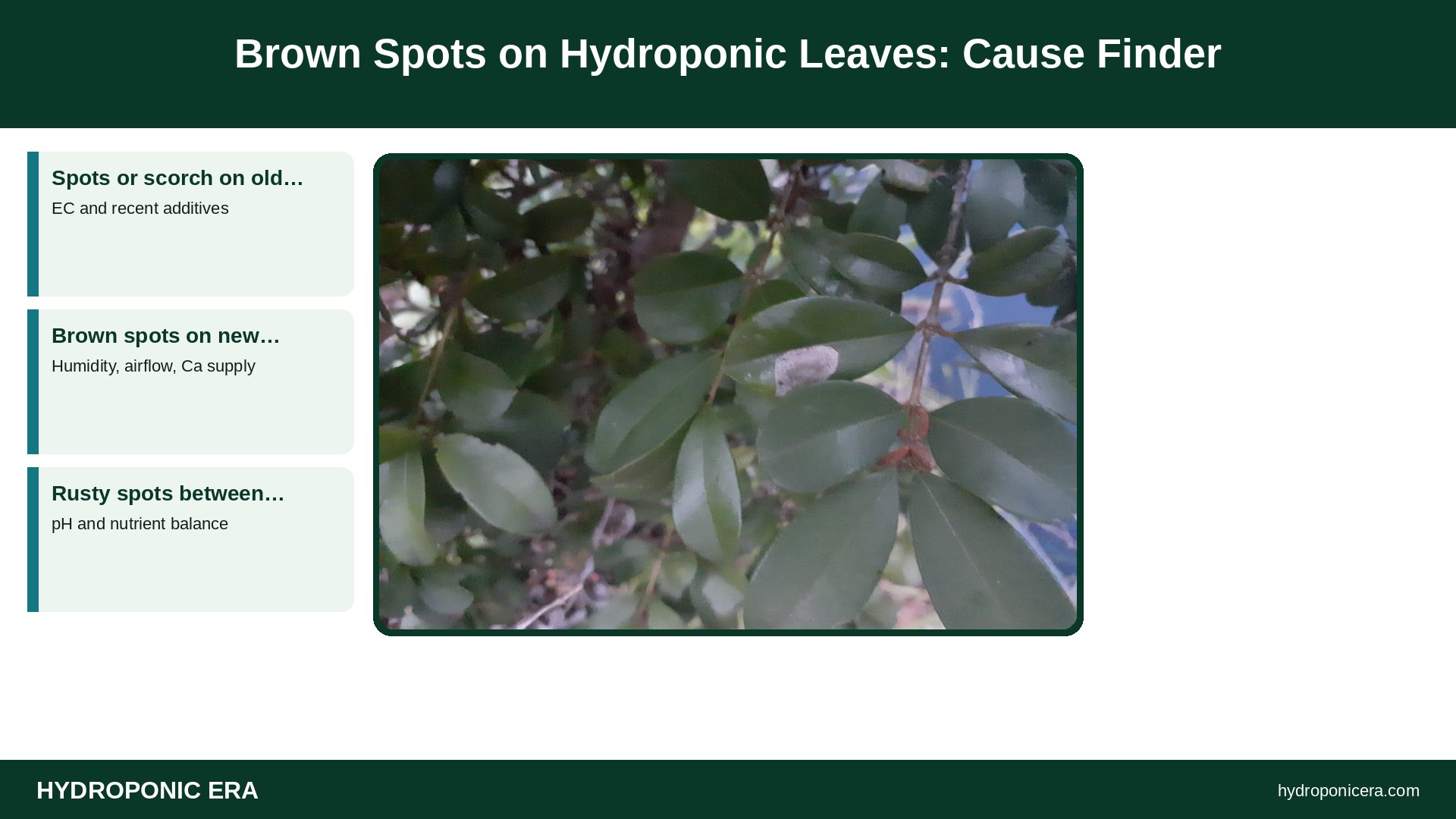
| Pattern | Likely cause | First check |
|---|---|---|
| Spots or scorch on old leaf edges | Potassium deficiency, nutrient burn, boron excess | EC and recent additives |
| Brown spots on new leaves, tips | Calcium issue (tip burn) | Humidity, airflow, Ca supply |
| Rusty spots between veins, older leaves | Magnesium or manganese issues | pH and nutrient balance |
| Spots with yellow halos | Fungal or bacterial disease | Humidity, wet leaves, sanitation |
| Tiny specks, stippling, silvering | Spider mites or thrips | Leaf undersides with a lens |
| Bleached then brown patches near light | Light or heat burn | Light distance, canopy temperature |
Step 1: Check pH and EC
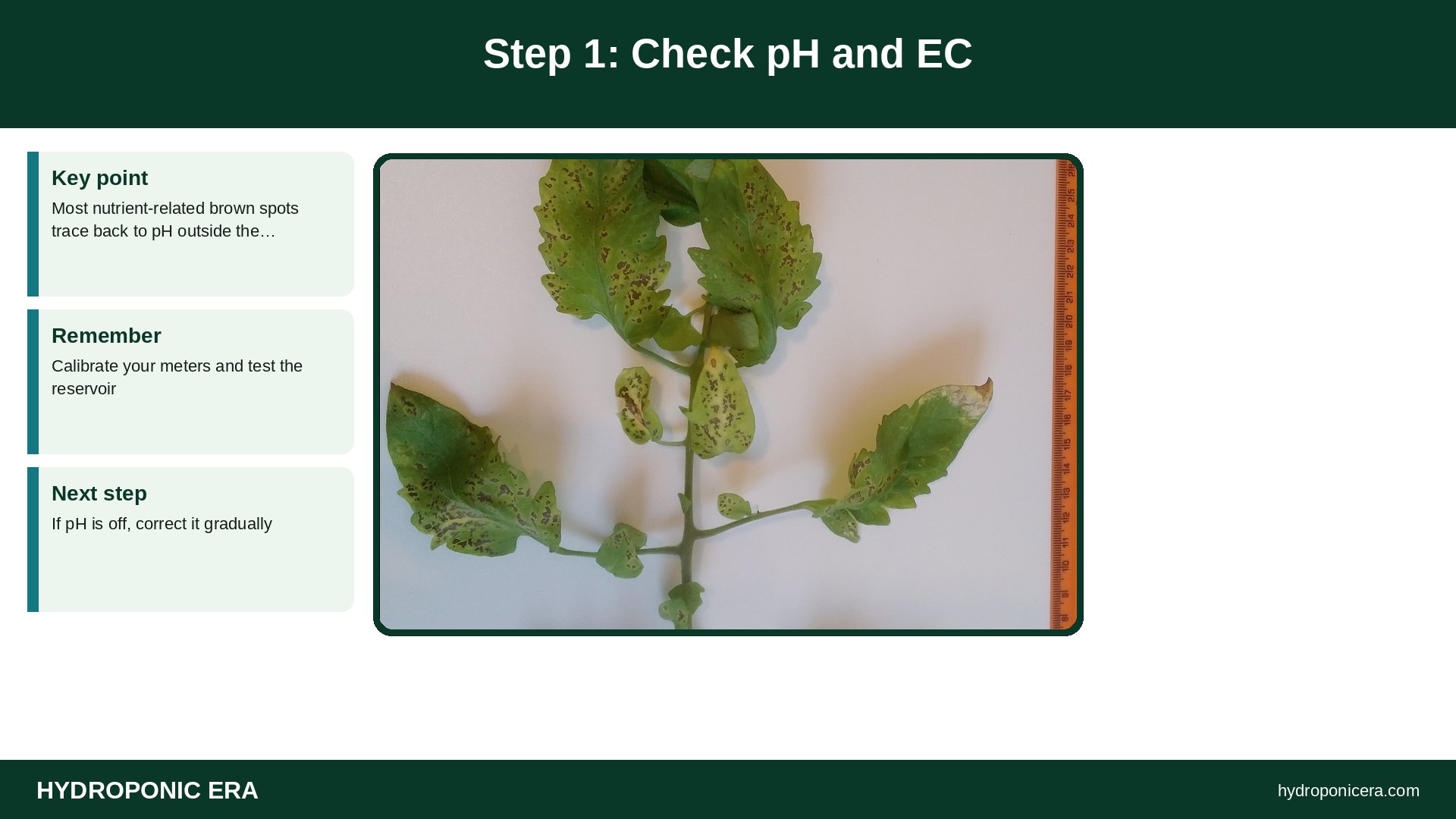
Most nutrient-related brown spots trace back to pH outside the typical 5.5–6.5 range or EC that’s too high or too low. Calibrate your meters and test the reservoir. If pH is off, correct it gradually. If EC is very high, dilute; if very low, feed. See fixing pH, EC and TDS, and nutrient lockout.
Step 2: Note Where the Spots Are
Older leaves first suggests a mobile nutrient (potassium, magnesium, nitrogen) moving to new growth, or a toxicity that accumulates in older leaves. New leaves first suggests an immobile nutrient such as calcium or iron, or damage from light and heat at the top of the canopy. Use our nutrient deficiency chart as a guide.
Nutrient Causes of Brown Spots
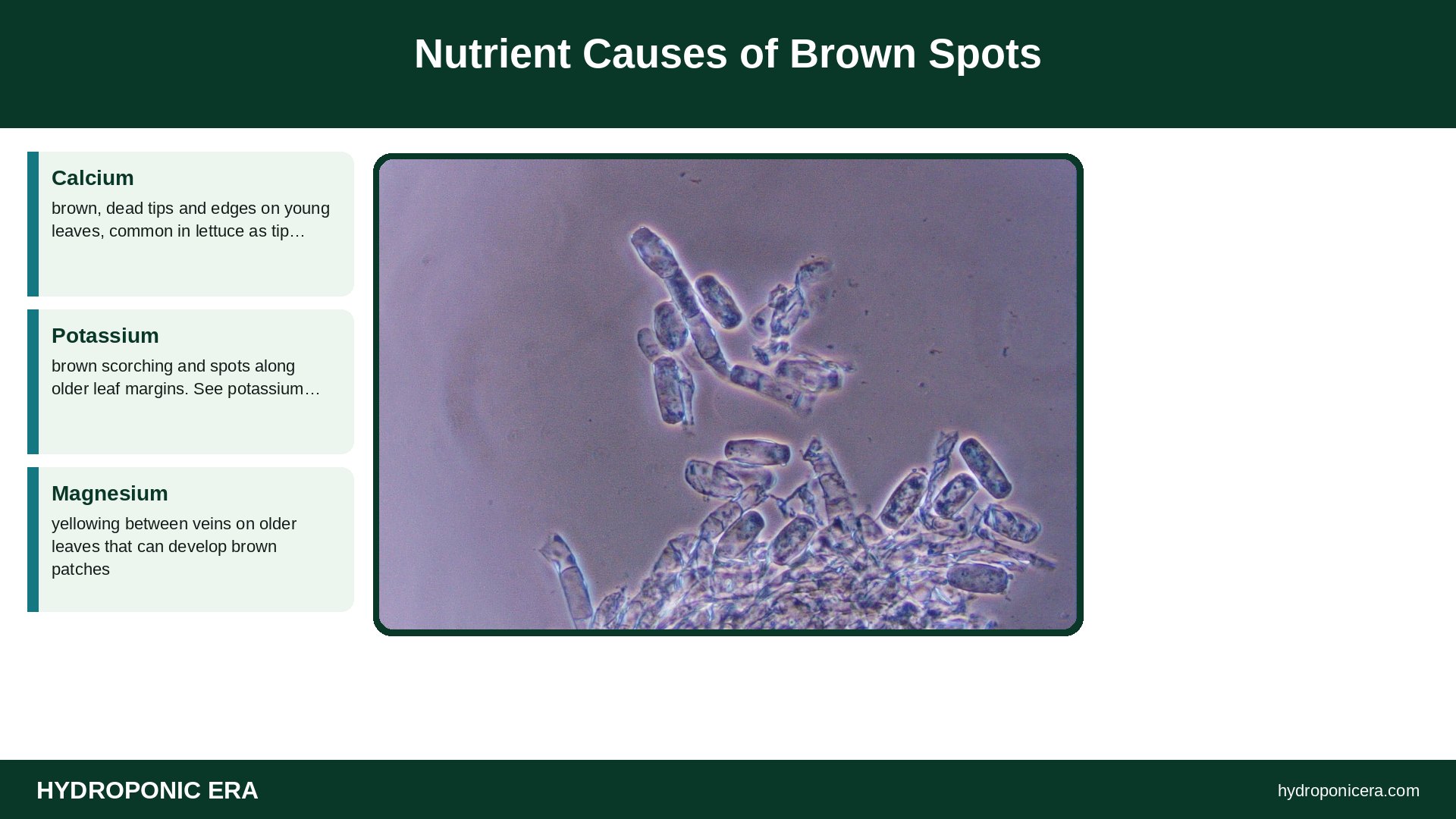
- Calcium: brown, dead tips and edges on young leaves, common in lettuce as tip burn. Often caused by poor airflow or high humidity, not low calcium in solution. See tip burn and calcium and magnesium deficiency.
- Potassium: brown scorching and spots along older leaf margins. See potassium deficiency.
- Magnesium: yellowing between veins on older leaves that can develop brown patches.
- Manganese: small brown or tan spots with interveinal chlorosis. See manganese deficiency.
- Excess nutrients: brown, crispy tips across many leaves. See nutrient burn.
Disease Causes
Fungal and bacterial leaf spots usually have defined edges, sometimes concentric rings, and often a yellow halo. They spread in humid conditions and on wet leaves.
- Fungal leaf spots (such as Septoria on tomatoes): round spots with dark borders, often starting low on the plant.
- Bacterial leaf spots: water-soaked, angular spots that turn brown or black.
- Botrytis (gray mold): brown, mushy patches with gray fuzz. See Botrytis.
- Downy mildew: yellow patches on top with fuzzy growth underneath, turning brown. See downy mildew.
Remove affected leaves, improve airflow, lower humidity, and avoid wetting foliage. See humidity and VPD.
Pest Causes
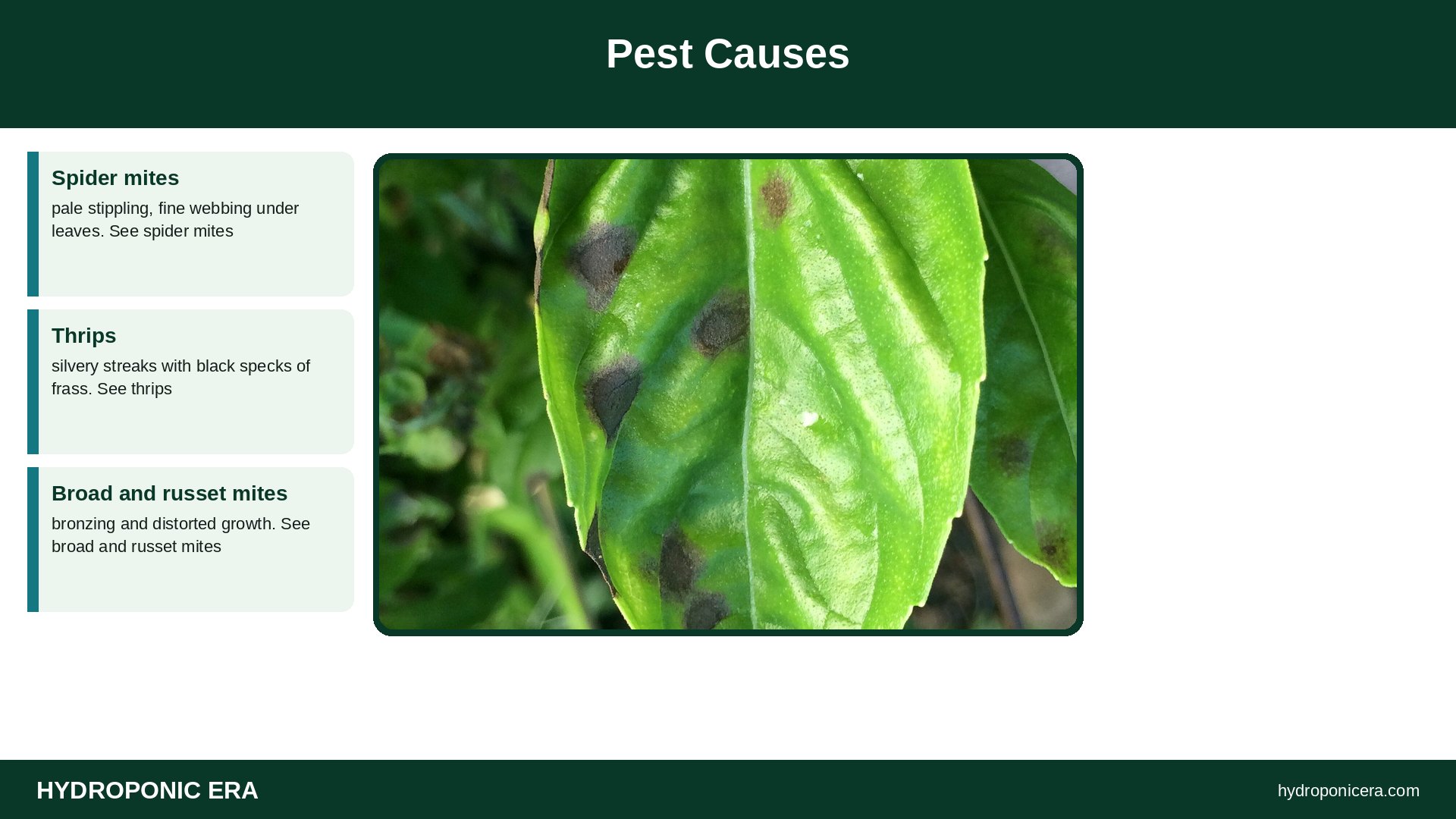
Pests often leave tiny spots that merge into brown, dry areas.
- Spider mites: pale stippling, fine webbing under leaves. See spider mites.
- Thrips: silvery streaks with black specks of frass. See thrips.
- Broad and russet mites: bronzing and distorted growth. See broad and russet mites.
Use a 10× hand lens on leaf undersides. Sticky traps help monitor flying pests; see sticky trap placement.
Light and Heat Damage
Leaves closest to a strong LED may bleach, then turn brown and crispy. Heat stress produces similar scorched patches. Raise the light, dim it, or improve ventilation. See light burn and heat stress.
Water Spots and Residue
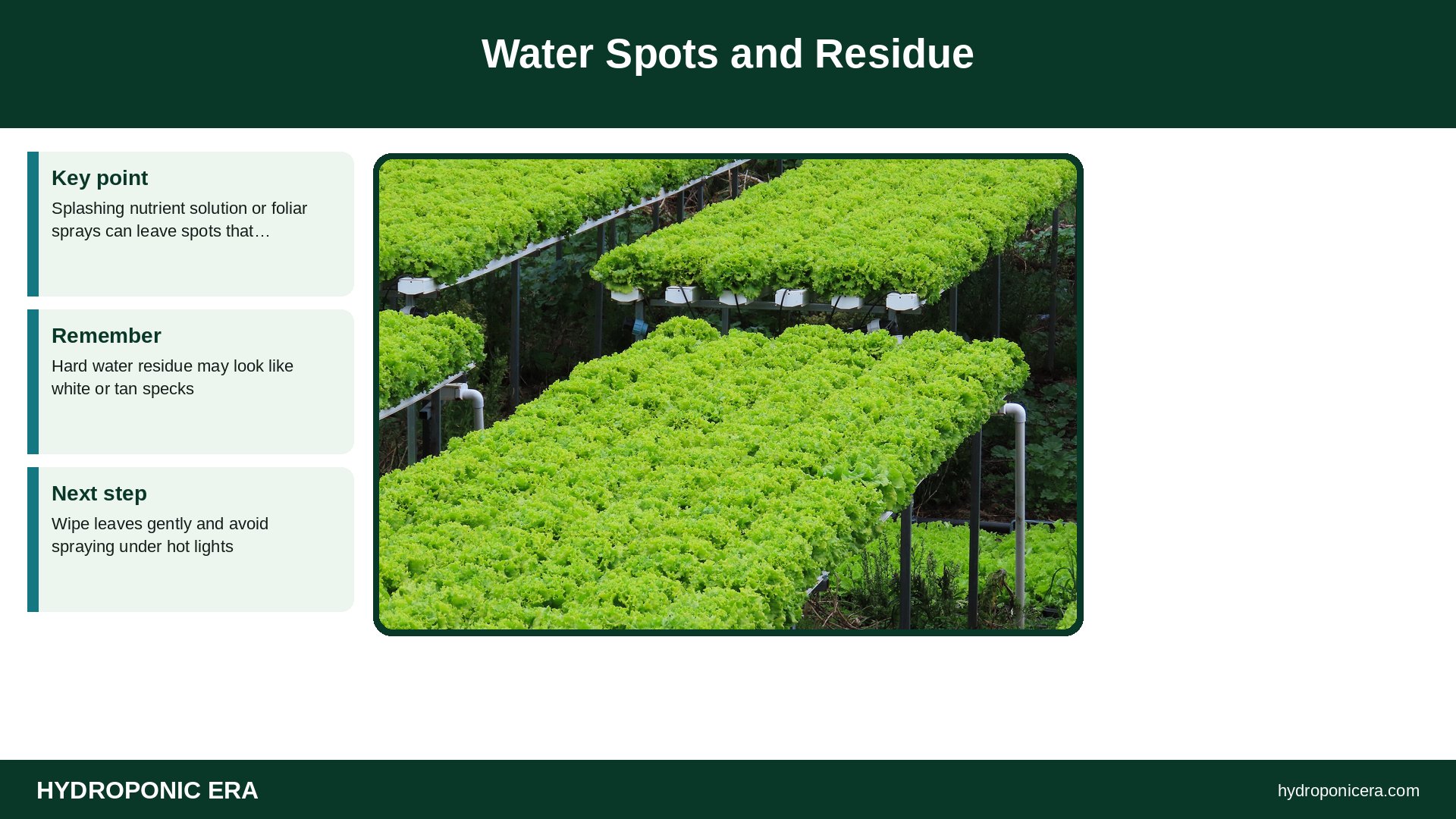
Splashing nutrient solution or foliar sprays can leave spots that brown under lights as salts concentrate. Hard water residue may look like white or tan specks. Wipe leaves gently and avoid spraying under hot lights. See white residue vs powdery mildew.
Quick Diagnostic Workflow
- Photograph affected leaves from top and bottom. See photo checklist.
- Test pH and EC; correct if off.
- Check leaf undersides for pests.
- Look for halos, fuzz, or water-soaked areas that suggest disease.
- Check light distance and canopy temperature.
- Review anything recently added to the reservoir.
- Remove badly affected leaves and monitor new growth for a week.
When to Start Over
If disease spreads despite changes, or pests are out of control on a small crop, it can be faster to harvest what’s usable, clean the system thoroughly, and restart. See teardown and restart protocol.
Photograph and Track the Spots
Brown spots are much easier to diagnose over several days than at a glance. Take a photo of the same leaves daily under the same light, ideally with a coin or ruler for scale. Note whether spots grow, merge, develop rings or halos, or stay the same. Write down pH, EC, water temperature, and any changes you made. Spreading spots with rings or halos point to disease. Spots that appear all at once after a spray or a heat spike and then stop growing point to chemical or light damage. Our photo checklist for diagnosing problems gives a simple template.
Brown Spots by Crop
- Lettuce: tip burn on inner leaves, bacterial leaf spot, and INSV are common causes.
- Basil: downy mildew, cold damage below about 50°F, and black spots from bacterial disease.
- Tomatoes: Septoria, early blight, and leaf mold on lower leaves.
- Peppers: bacterial spot and calcium-related disorders.
- Mint: rust, with orange-brown pustules under leaves. See the nutrient deficiency chart for nutrient look-alikes.
FAQs: Brown Spots on Hydroponic Leaves
Why do my hydroponic plants have brown spots?
Common causes are pH or nutrient imbalances, disease, pests, and light or heat damage. Location and pattern help identify which.
Can brown spots spread?
Disease and pest spots can spread. Nutrient spots usually stay where they are but appear on new leaves if the problem continues.
Should I remove leaves with brown spots?
Yes, if they’re badly damaged or diseased. Leave mildly affected leaves while you fix the cause.
Does calcium deficiency cause brown spots?
It often causes brown tips and edges on young leaves, especially in lettuce. Airflow and humidity are frequent underlying causes.
Can pH cause brown spots?
Yes. pH outside the target range can lock out nutrients and lead to spots and scorch.
Sources
- Penn State Extension — Hydroponics Systems and Principles of Plant Nutrition
- UC IPM — Bacterial Leaf Spot of Lettuce
- Photo credits (Wikimedia Commons, edited with titles): Leaf spot grey necrosis by Savina Jo (CC BY-SA 4.0); Septoria leaf spot symptoms on tomato leaf (Septoria lycopersici on Solanum lycopersicum leaf) by MerielGJones (CC BY-SA 4.0); Puccinia menthae Pers. 2174037 by Cesar Calderon from United States USDA APHIS PPQ (CC BY 3.0 us); Sweet basil – Ocimum basilicum – Pseudocercospora leaf spot by Scot Nelson (CC0); Hydroponic lettuce @ Plaine des Cafres 03 by Rémih (CC BY-SA 4.0)