
Hydroponic cucumber leaves turning yellow usually point to a nutrient problem (most often nitrogen, magnesium, iron, or potassium), pH drift that locks out nutrients, root problems from warm or oxygen-poor water, too little light, or pests such as spider mites. Which leaves turn yellow tells you a lot: older lower leaves suggest a mobile nutrient like nitrogen or magnesium, while yellow new growth suggests iron or a pH issue. Cucumbers are heavy feeders, so EC and pH drift faster than with leafy greens.
Key takeaway: Check pH and EC first, then look at which leaves are yellow and the pattern (whole leaf, between veins, or edges). That narrows it to one or two causes.
| Pattern | Likely cause | First fix |
|---|---|---|
| Older leaves evenly yellow | Nitrogen deficiency | Raise EC / feed |
| Older leaves yellow between veins | Magnesium deficiency | Check Mg supply, pH |
| New leaves yellow, veins green | Iron deficiency or high pH | Lower pH, check chelated iron |
| Yellow then brown edges on older leaves | Potassium deficiency | Fruiting-stage nutrient balance |
| Speckled yellow, fine webbing | Spider mites | Inspect undersides, treat |
| Wilting plus yellowing, brown roots | Root rot | Cool water, oxygen, sanitation |
| Oldest few leaves only, plant otherwise fine | Natural aging/shading | Remove lower leaves |

Step 1: Test pH and EC

Cucumbers drink a lot and can shift pH and EC quickly. Most growers keep pH around 5.5–6.5. If pH climbs high, iron and manganese become less available. If EC falls, plants run short of nitrogen and potassium. Calibrate meters and test daily during heavy fruiting. See controlling pH and pH rising vs falling.
Nitrogen Deficiency
Lower, older leaves turn pale and then evenly yellow, while new growth stays greener. Growth slows. Cucumbers need steady nitrogen during vine growth. Raise nutrient strength gradually and check that you’re using a complete formula. See nitrogen deficiency.
Magnesium Deficiency
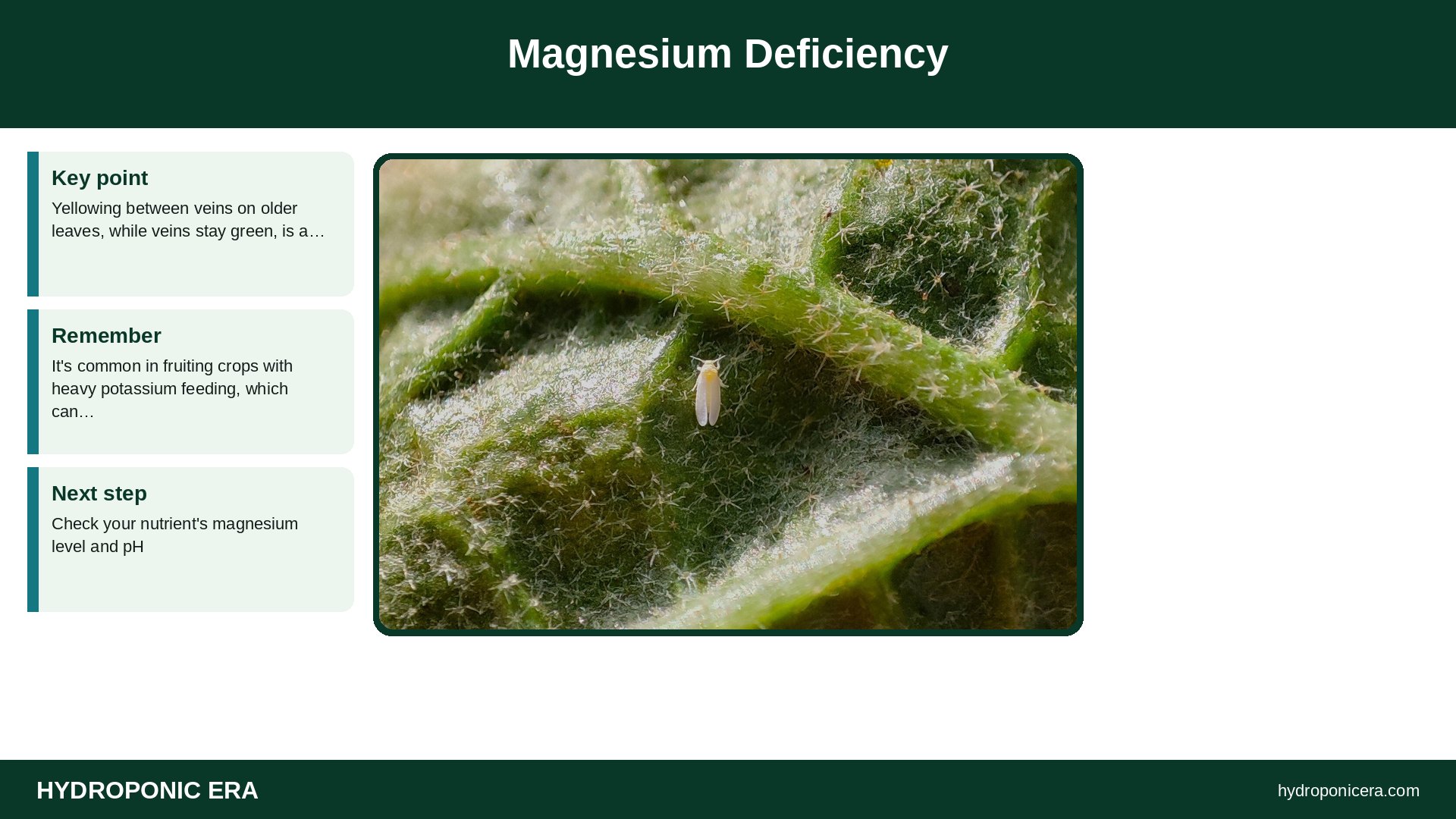
Yellowing between veins on older leaves, while veins stay green, is a classic magnesium sign in cucumbers. It’s common in fruiting crops with heavy potassium feeding, which can compete with magnesium uptake. Check your nutrient’s magnesium level and pH. A small Epsom salt addition can help if a deficiency is confirmed. See calcium and magnesium deficiency and Epsom salt in hydroponics.
Iron Deficiency
New leaves turn yellow while veins stay green. This often happens because pH is too high, not because iron is missing. Lower pH into range and make sure your nutrient contains chelated iron. See iron deficiency and iron precipitation after pH adjust.
Potassium Deficiency
Older leaves yellow at the edges, then brown and scorch. Fruits may be poorly shaped. Cucumbers need more potassium once fruiting begins. See potassium deficiency and leafy vs fruiting nutrient recipes.
Root Problems
Yellowing combined with midday wilting often means roots can’t take up water and nutrients. Check reservoir temperature and root color. Warm, oxygen-poor water invites rot. See Pythium root rot and wilting diagnosis. Fusarium wilt can also cause yellowing and wilting; see Fusarium wilt.
Pests
Spider mites cause fine yellow speckling that can turn whole leaves yellow-bronze, with webbing underneath. Whiteflies and thrips also cause yellowing. Inspect leaf undersides with a hand lens. See spider mites and whiteflies.
Light and Natural Aging

Cucumber vines grow fast and shade their own lower leaves. Older leaves that get little light naturally yellow and die. If only the oldest few leaves are yellow and the plant looks healthy otherwise, simply remove them. Training and pruning the vine improves light distribution. See trellising and pruning.
Powdery and Downy Mildew
Cucumbers are prone to mildews. Powdery mildew shows white powder on leaves; downy mildew causes angular yellow patches with fuzzy growth underneath. Both lead to yellowing and leaf loss. Improve airflow and reduce humidity. See powdery mildew and downy mildew.
Prevention
- Use a fruiting-stage nutrient once flowers appear.
- Check pH and EC daily during heavy growth.
- Keep reservoir water cool and aerated.
- Change solution regularly; cucumbers deplete nutrients unevenly. See how often to change water.
- Prune lower leaves and train vines for airflow and light.
For a full growing guide, see how to grow cucumbers hydroponically.
Cucumber Leaves vs Normal Variation
Not every color change in cucumber leaves is a problem. The first two seed leaves (cotyledons) always yellow and drop as the plant matures. Leaves near the base of a long vine yellow naturally as they become shaded. Mild mottling can also appear on some varieties. What matters is whether the yellowing spreads up the vine, shows a clear pattern, or appears on new growth. If cucumber leaves higher on the plant stay a healthy deep green and fruit keeps setting, a few pale lower leaves are normal.
Feeding Cucumber Leaves Through the Season
Cucumbers change their needs as they grow. During early vine growth they use more nitrogen; once flowering and fruiting start, potassium and calcium demand climbs. Many growers switch to a fruiting-stage formula when the first flowers open and raise EC gradually rather than in a big jump. Watch cucumber leaves after each change: if new leaves stay green and fruit fills well, the balance is right. If older cucumber leaves begin to yellow between veins after the switch, check magnesium, because extra potassium can compete with it.
A Weekly Check Routine
- Test pH and EC every day or two during fruiting.
- Look at the oldest and newest cucumber leaves and note any change.
- Flip several leaves to check undersides for mites, whiteflies, and mildew.
- Lift a net pot and inspect roots.
- Remove leaves below the lowest fruit to keep air moving.
FAQs: Yellow Hydroponic Cucumber Leaves
Why are my hydroponic cucumber leaves turning yellow?
Common causes are nutrient deficiencies (nitrogen, magnesium, iron, potassium), pH drift, root problems, pests, or natural aging of shaded lower leaves.
Should I remove yellow cucumber leaves?
Yes, if they’re old, shaded, or diseased. Removing them improves airflow.
Can high pH cause yellow cucumber leaves?
Yes. High pH can lock out iron and manganese, yellowing new growth.
Do cucumbers need more nutrients when fruiting?
Yes, especially potassium. Adjust to a fruiting-stage formula.
How fast should leaves recover?
Yellow leaves rarely turn green again. Look for healthy new growth within one to two weeks after fixing the cause.
Sources
- University of Minnesota Extension — Growing cucumbers in home gardens
- Penn State Extension — Hydroponics Systems and Principles of Plant Nutrition
- Photo credits (Wikimedia Commons, edited with titles): Cucumber greenhouse plants of Dr. Mahmoud Salem’s farm by Amnsalem (CC BY-SA 4.0); Harvested vegetables(Cucumbers) by Pascal Kings (CC BY 4.0); Bemisia tabaci under leaf of eggplant by Wee Hong (CC BY-SA 4.0); PH- und Leitfähigkeitsmessgeräte by Rotkaeppchen68 (CC0)