
Quick Answer
Iron precipitation after pH adjust explains rusty/orange sediment or sudden Fe fade after aggressive pH swings or concentrate collisions—and how to remix without repeating the mistake.
It is chemistry ops, not an iron-deficiency symptom chart. See iron deficiency, pH up/down, mixing, chelates.
Key takeaways for iron precipitation after ph adjust
- Iron precipitation after pH adjust is a practical home-hydro workflow—not filler.
- Local pH extremes at pour points precipitate Fe.
- Mix and circulate before judging color.
- Chelate form and water alkalinity matter.
- Prefer university/extension sources over forum myths.
- Do not keep dumping Fe into a precipitations loop.
- Original ops card keeps Iron precipitation after pH adjust decisions consistent.
- Iron precipitation after pH adjust fails when growers skip the boring checks.
Related HydroponicEra guides
- Iron deficiency
- pH up/down
- Mixing
- Chelates
- Cloudy
- Lockout
Why This Matters
Iron precipitation after pH adjust is a common “my tank turned rusty” moment. Penn State nutrition and OSU EC/pH guidance support careful measurement and mixing. Yellow leaves may follow—but start by fixing solution handling, not only spraying foliar myths.
Comparison / Decision Table
| Event | Risk |
|---|---|
| pH down dumped in one corner | Local crash → Fe fallout |
| Concentrates mixed together | Immediate precipitate |
| High pH hard water + weak Fe form | Availability loss |
| Gentle adjust + circulation | Lower risk |
Step-by-Step Workflow

- Stop adding more iron blindly.
- Note pH before/after and how you dosed.
- Circulate; see if haze settles.
- If heavy rust sediment: consider dump/remix clean.
- Remixed: nutrients in order, then pH slowly while stirring.
- Match chelate to your water/pH reality.
- Calibrate meters so you are not chasing ghosts.
- Watch new growth—not old leaves—for recovery.
- Avoid stacking Ca/Mg myths on top immediately.
- Log the bad pour so it does not recur.
Key Variables
| Variable | Effect | Link |
|---|---|---|
| Chelate type | pH stability | chelates |
| Alkalinity | pH fight | GH/KH, hard water |
| Dose method | Local extremes | pH up/down |
| Mix order | Precip | mixing |
Common mistakes with iron precipitation after ph adjust

- Pouring pH adjuster into still water
- Mixing stocks in one jug
- Reading rusty water as ‘more Fe needed’
- Never stirring after adjust
- Ignoring calibration
Troubleshooting

| Signal | Action |
|---|---|
| Rusty sediment + yellow new leaves | Remix; then see iron guide |
| Cloudy white after mix | Different precip—see cloudy triage |
| Stable clear after slow adjust | Keep the gentle method |
Practical Framework
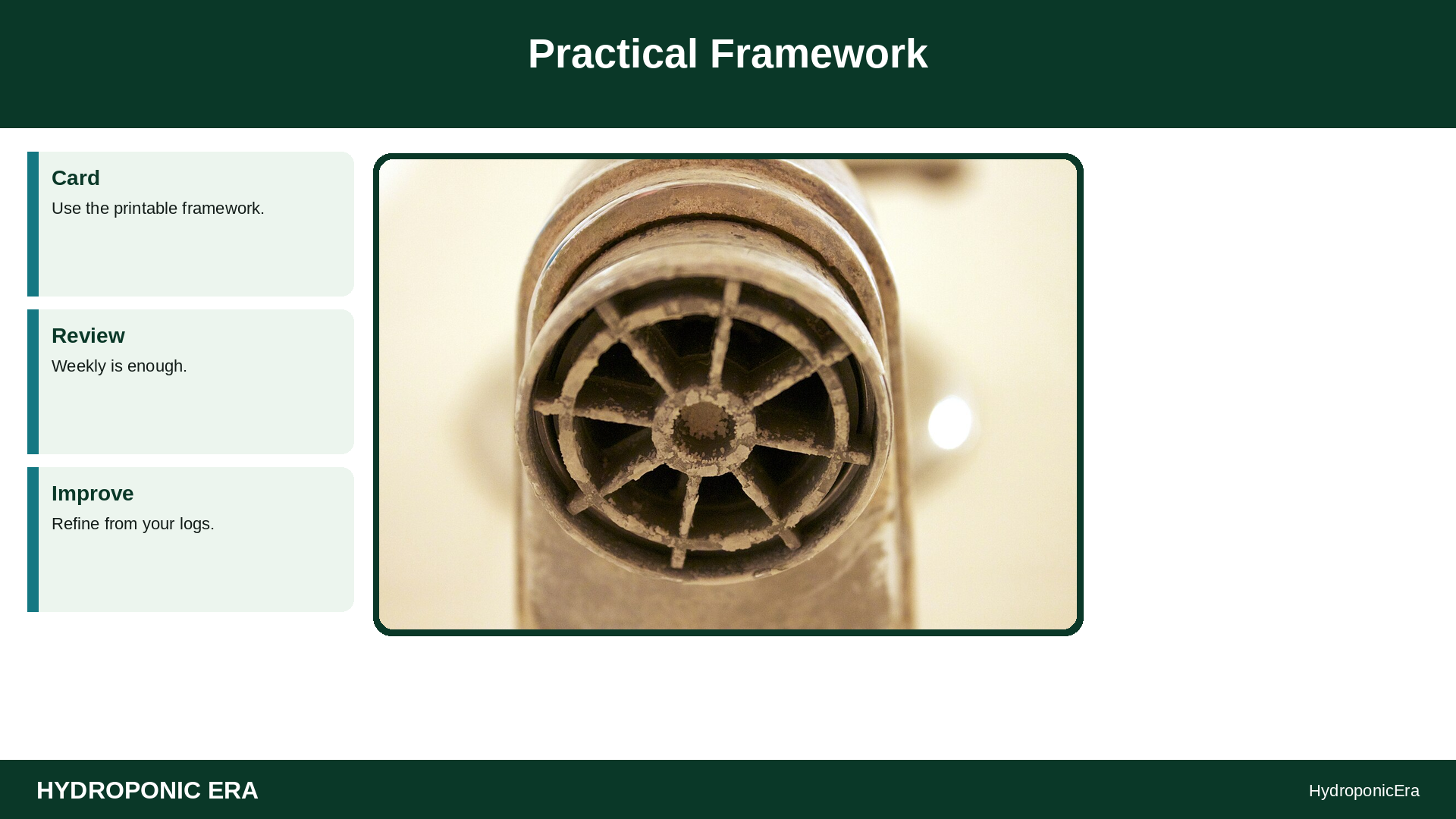
Pour card: dilute adjuster | stir | measure | wait. Closing practice for iron precipitation after pH adjust: never dose pH chemicals into a dead corner of the tote.
What to Check Before You Add More Iron
- Meter calibrated?
- Adjuster diluted/stirred?
- Chelate known?
- Sediment assessed?
- Remix plan ready?
Pour Technique That Prevents Local Crashes
Dilute pH adjusters and add while circulating. Dumping a strong acid bolus into a still corner creates a temporary micro-environment that knocks iron out of solution even if the eventual bulk pH looks fine. Stir, wait, remeasure. Match chelate form to your water’s pH story.
If heavy rust sediment forms, remix clean rather than spooning more Fe into a precipitation loop. Yellow new leaves may follow—treat chemistry first, then use the iron deficiency guide for plant-side confirmation.
Hard Water and Alkalinity
High alkalinity fights pH adjustments and encourages availability problems. GH/KH tests and hard-water/RO guidance pair naturally with this triage. Calibrate meters so you are not chasing false numbers with harsher pours.
FAQs about iron precipitation after ph adjust
Is this iron deficiency?
Deficiency is the plant symptom page; this is solution chemistry after pH events.
EDDHA pink OK?
Some products tint—know your bottle.
Dump always?
Heavy rust yes; mild haze maybe circulate and remeasure.
Foliar Fe?
Secondary; fix root-zone chemistry first.
Hard water link?
Yes—alkalinity fights pH.
Lockout?
Broader issue—see lockout guide.
Remix Discipline
When rust appears after pH drama, stop pouring more iron. Note how you dosed. Circulate; assess sediment. Heavy fallout usually deserves a clean remix with ordered mixing and gentle, stirred pH control. Match chelates to water reality.
Calibrate meters. Watch new growth for recovery after chemistry is sane. Hard water alkalinity fights you—test GH/KH. Local pour crashes are preventable with dilution and circulation. Connect plant yellowing to the iron deficiency guide only after solution handling is corrected. Keep a pour card on the lid: dilute, stir, measure, wait.
Keep changes incremental and measured.
HydroponicEra internal guides linked above cover adjacent deep topics; this article stays on its unique angle so topical authority stays clean without near-duplicate pages. When in doubt, sanitize, oxygenate, and verify meters before inventing exotic fixes.
Write a short after-action note each time this issue appears in your room. Patterns across seasons are more valuable than any single tip, and they turn home hydro from reaction into operations.
Implementation Notes for Home Growers
To put iron precipitation after ph adjust into practice this week, pick one system or shelf and run the workflow end-to-end once without improvising mid-stream.
Write the steps on a card, execute them, then note what broke in your space—ceiling height, noise limits, water alkalinity, or schedule constraints. That single controlled pass teaches more than reading three more threads.
Unique angle reminder: Rusty/orange precipitate chemistry after pH swings—not iron-deficiency symptom guide. Keep adjacent HydroponicEra guides one click away for depth, but do not merge this topic into a generic beginner rewrite.
If a meter disagrees with plant behavior, calibrate before you rewrite the plan. If sanitation is part of the story, finish the scrub—half-clean reservoirs reinvent the problem.
Weekly: re-read your card, check the one failure mode most likely in your room, and log a short after-action line. Over a month you will have comparable notes instead of vibes.
That is how home hydroponics becomes operations rather than emergency response. Share the card with anyone who helps water or harvest so standards survive busy days.
When results are good, resist the urge to change three variables at once. When results are poor, photograph first, then change the smallest lever that matches the diagnosis. This page’s checklists and tables exist to make that discipline easier under stress.
Extended Home-Grower Walkthrough
Use this extended walkthrough as a second pass after the Quick Answer. Walk the system with a notebook: write the date, crop, EC, pH, reservoir temperature, and one observation about roots or leaves.
Change only one control at a time when a problem appears. If last week’s fix did not show in new growth, revert and try the next smallest lever. Keep university and extension principles in mind—oxygen, sanitation, and measured nutrition beat product stacking.
Photograph the canopy and the reservoir surface weekly. Dated photos settle arguments about algae, tip burn, or stretch faster than memory. When a helper waters for you, leave a one-page card with do-not-touch items and the exact top-off rule.
Store calibration sachets next to the meters so “I will calibrate later” stops being the default. Review timers after any power event. Confirm air stones still roar. Confirm drains still drain.
At the end of the week, score the cycle 1–5 for ease and plant quality. Low scores should trigger a sanitation or climate review before you buy new hardware.
Link neighboring HydroponicEra guides when the symptom matches a cluster page. Prefer labeled procedures over improvisation under stress. Healthy boring routines are the real upgrade path for home hydroponics.
Keep iron precipitation after ph adjust visible on your weekly ops card so helpers follow one standard.
Revisit iron precipitation after ph adjust after any system change, relocation, or new crop introduction.
If notes disagree, rerun the iron precipitation after ph adjust checklist before buying more gear.
Apply iron precipitation after ph adjust as a repeatable habit—measure, log, and revisit after changes.
Apply iron precipitation after ph adjust as a repeatable habit—measure, log, and revisit after changes.
Apply iron precipitation after ph adjust as a repeatable habit—measure, log, and revisit after changes.
Apply iron precipitation after ph adjust as a repeatable habit—measure, log, and revisit after changes.
Sources
- Penn State Extension — Hydroponics Systems and Principles of Plant Nutrition
- Oklahoma State University Extension — Electrical Conductivity and pH Guide for Hydroponics
- Oklahoma State University Extension — Hydroponics
- NC State Extension — Soils and Plant Nutrients (Extension Gardener Handbook)
- University of Florida IFAS — CV265: Fertilizer Management for Greenhouse Vegetables
- Michigan State University Extension — Hydroponics as an agricultural production system
2 thoughts on “7 Proven Iron Precipitation After pH Adjust Fixes”