
Quick Answer
GH KH Water Tests Hydroponics (GH KH water tests hydroponics) is the practical focus of this guide for home growers.
GH and KH water tests for home hydroponics measure general hardness (mostly calcium and magnesium) and carbonate alkalinity (buffering capacity). EC/TDS alone cannot tell you whether your tap water will fight pH adjustments or arrive already loaded with Ca/Mg. Use GH/KH kits or a lab report alongside EC/TDS, pH control, and hard water / RO guidance.
Practical home goal: know your starting water so you choose between light remineralization, complete nutrients on soft water, or RO + mineral rebuild when hardness or alkalinity makes pH unstable.
Key Takeaways
- GH (general hardness) mainly reflects calcium and magnesium; KH (carbonate hardness / alkalinity) reflects buffering that resists pH change.
- Penn State’s irrigation water testing and water-quality toolkit materials explain why greenhouse growers read more than a single EC number.
- Oklahoma State’s irrigation water test report guidance helps interpret hardness and related values without inventing home ppm targets.
- High KH often means pH drifts up after you add acid—expect more frequent adjustments unless you change source water strategy.
- Very soft / RO water has low GH/KH: nutrients and pH can swing faster; many growers add a measured Ca/Mg source per label.
- Softener salt is not a hydroponic hard-water fix—sodium softener effluent is a different problem (see sodium buildup cluster page when published).
- Test source water, not only the nutrient tank, when diagnosing chronic pH fights.
- Pair GH/KH results with calibrated meters ({a(‘meters’,’pH/EC meters’)}) and {a(‘fixph’,’fix high/low pH’)} habits.
Related HydroponicEra guides
- Hard water and RO
- pH control for beginners
- pH and EC meters
- Fix high/low pH
- EC and TDS
- Calcium magnesium deficiency
- Reservoir setup
- Mixing nutrient solution
- Water change guide
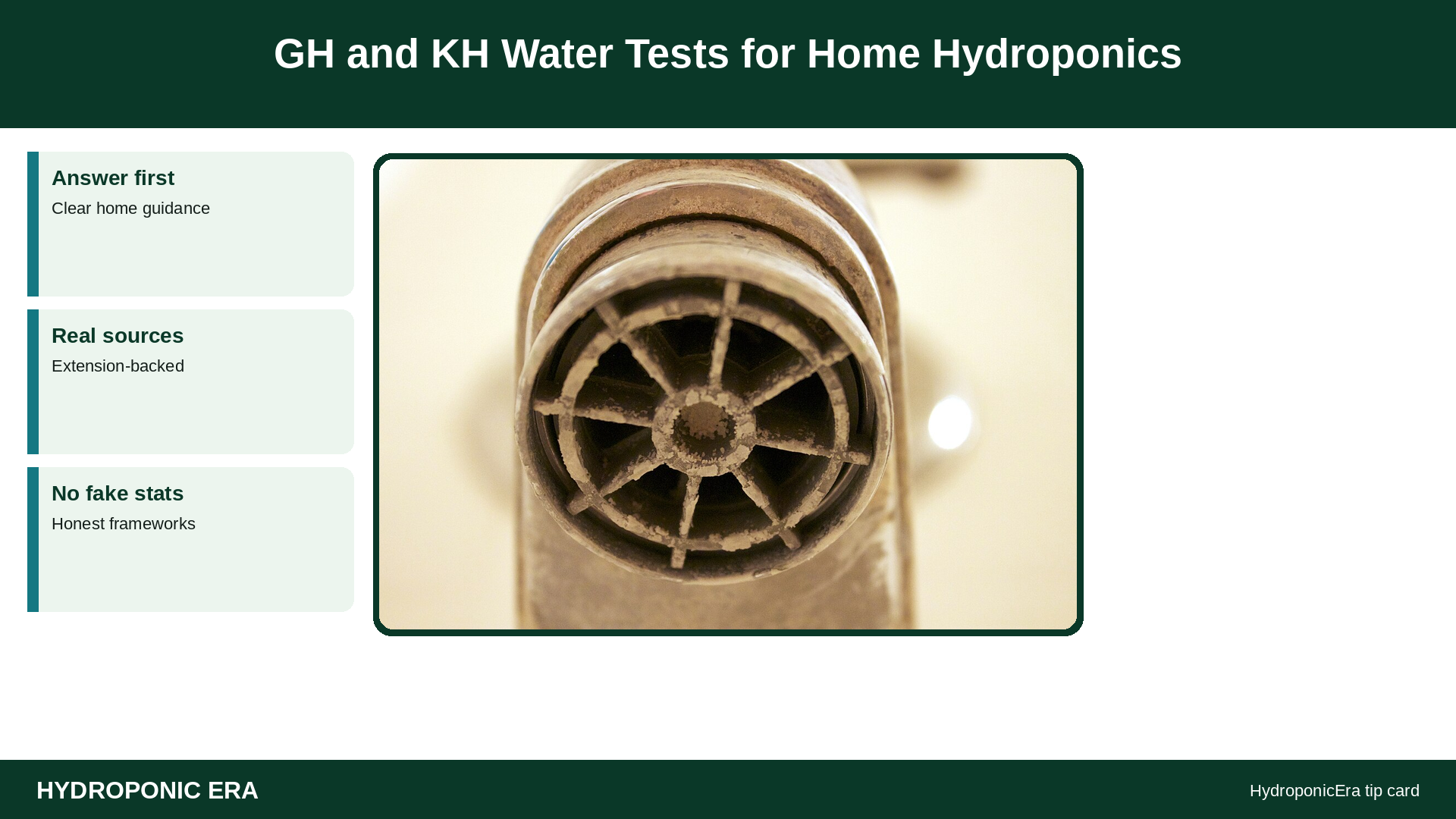
GH KH Water Tests Hydroponics: What GH and KH Actually Measure

Home test kits usually report GH and KH in degrees (°dH) or ppm as CaCO3 equivalents. Exact conversion depends on the kit scale—read the package. GH is a useful proxy for divalent cations (Ca + Mg). KH estimates carbonate/bicarbonate alkalinity that buffers pH.
Penn State Extension’s interpreting irrigation water tests and greenhouse water-quality toolkit resources emphasize that source water chemistry affects fertilizer availability and pH management. Oklahoma State’s irrigation water test report fact sheet walks growers through hardness-related fields found on lab reports.
Hydroponics does not remove the need for that literacy. Recirculating tanks concentrate whatever you start with. If you only watch EC rising, you may miss that alkalinity—not “mystery nutrients”—is forcing daily pH up/down corrections.
Use this page with hard water / RO: RO lowers most dissolved ions including GH/KH contributors; remineralization is then a deliberate choice, not an afterthought.
GH KH Water Tests Hydroponics: How to Test and Record GH/KH at Home
- Sample the source: untreated tap or well water before nutrients (and after any carbon filter if you use one).
- Use a fresh liquid kit or reliable strips within expiration; swirl and wait the stated time.
- Record GH, KH, and the kit units in your grow log with date and faucet ID.
- Measure EC/TDS and pH of the same sample (EC/TDS, meters).
- Optional lab test if you have well water, softener equipment, or chronic precipitate/pH fights.
- Retest seasonally if your municipal blend changes, or after plumbing work.
- Test RO permeate separately if you run reverse osmosis—expect very low GH/KH.
- Do not dose random Ca/Mg until you know whether hardness is already high.
- When pH keeps climbing, check KH before blaming the nutrient brand (fix pH).
- Keep one notebook row per water source so multi-room grows stay consistent.
GH KH Water Tests Hydroponics: Decision Table: What Your Results Suggest

| Pattern | What it often means | Home response (framework) |
|---|---|---|
| Low GH + low KH (RO / rain / very soft) | Little Ca/Mg/buffer | Complete nutrients + careful Ca/Mg; expect faster pH swings |
| Moderate GH, low–moderate KH | Workable for many leafy recipes | Measure EC; adjust pH after mixing |
| High KH | Strong pH buffer | Plan acid budget or RO; verify after mixing |
| High GH already | Ca/Mg load in source | Avoid stacking more Cal-Mag blindly; watch EC |
| Softener used for “hardness” | Na exchange risk | Do not feed softened water to plants |
Michigan State and UF/IFAS water-quality production materials reinforce reading chemistry holistically—EC, alkalinity, and specific ions interact. This table is a decision framework, not a fabricated ppm guarantee for every crop.
Related: Ca/Mg deficiency, lockout, reservoir setup.
GH KH Water Tests Hydroponics: GH/KH vs EC: Why You Need Both

EC tells you total ionic strength. It cannot distinguish helpful Ca from unwanted sodium, or say whether bicarbonate will fight your pH down. Two waters can share similar EC and behave differently in a recirculating reservoir.
Workflow: source test (GH/KH + EC + pH) → choose water strategy → mix complete nutrients → set strength → set pH → log drift. Mixing guide and pH beginners cover the solution side.
If leaves show interveinal chlorosis on new growth after you chase pH daily, revisit water alkalinity and iron availability together (iron deficiency, yellow leaves).
GH KH Water Tests Hydroponics: Common Mistakes

- Treating EC as a complete water analysis
- Adding Cal-Mag on already hard water because a bottle said so
- Using ion-exchange softened water in the reservoir
- Testing only the nutrient tank when the faucet chemistry is the root cause
- Ignoring KH when pH needs acid every few hours
- Assuming RO water needs no mineral plan
- Mixing units (°dH vs ppm) without converting
- Changing five additives overnight instead of fixing source strategy
Troubleshooting With GH/KH Context
| Symptom | Check | Next step |
|---|---|---|
| pH climbs daily | KH / aeration / algae | Water strategy + algae + opaque reservoir |
| pH crashes | Low KH + root activity / over-acid | Smaller acid doses; verify meter |
| White scale on heaters | High hardness | Clean gear; consider RO for that room |
| Tip burn / high EC | Source + feed stacking | nutrient burn, flush decision |
| New-leaf chlorosis | pH band + Fe | iron, fix pH |
Also see water changes, when to flush, and cleaning.
What to Check Before You Change Your Water Strategy
- Do you have a dated GH and KH reading for each water source?
- Are kit units recorded (°dH vs ppm)?
- Source EC/TDS and pH logged with the same sample?
- Softener on this faucet? (If yes, do not use for nutrients.)
- Are you stacking Cal-Mag on already high GH?
- Is chronic pH climb matching high KH?
- RO permeate tested separately if used?
- Calibrated pH/EC meters this month?
FAQs

Is GH the same as EC?
No. GH estimates hardness cations; EC measures total conductivity from all ions.
Do I need GH/KH if I use RO?
Yes—confirm RO is working (very low readings) and plan remineralization deliberately.
What KH is “ideal”?
No single universal home number. Focus on whether pH is stable and nutrients stay available in a soilless band (~5.5–6.5 per OSU framing).
Can strips replace a lab?
Kits are useful screens; labs help when well water or odd symptoms persist.
Does boiling remove KH?
Home myths vary; do not rely on boiling as a hydroponic water plan—use tested methods (filtration/RO/acid budgeting).
Where does this fit with nutrient mixing?
Test water first, then mix and adjust—see the mixing and pH guides.
GH KH Water Tests Hydroponics: Practical Checklist
GH KH Water Tests Hydroponics matters every week in a home system. Recheck GH KH water tests hydroponics after transplants, heat spikes, and canopy fill-in. Strong GH KH water tests hydroponics habits beat one-time guesses. When GH KH water tests hydroponics drifts, leaves crowd, roots stress, or harvest quality drops. Write GH KH water tests hydroponics targets into your log so you do not rely on memory. Teach helpers your GH KH water tests hydroponics checklist before you leave town. Improve GH KH water tests hydroponics in small steps—measure, adjust, then wait a day. Compare GH KH water tests hydroponics notes against light, airflow, and reservoir temperature.
Sources
- Penn State Extension — Interpreting Irrigation Water Tests
- Penn State Extension — A Water Quality Toolkit for Greenhouse and Nursery Production
- Oklahoma State University Extension — Understanding Your Irrigation Water Test Report
- Oklahoma State University Extension — Electrical Conductivity and pH Guide for Hydroponics
- Oklahoma State University Extension — Hydroponics
- Michigan State University Extension — Water quality considerations for greenhouse and nursery crops
- University of Florida IFAS — AE094: Water Quality for Crop Production Systems
- NC State Extension — Soils and Plant Nutrients (Extension Gardener Handbook)
2 thoughts on “GH and KH Water Tests for Home Hydroponics”