
Quick Answer
Sodium Buildup Recirculating Hydroponics (sodium buildup recirculating hydroponics) — Sodium Buildup Hydroponics (sodium buildup hydroponics) is the practical focus of this guide for home growers.
Sodium buildup in recirculating hydroponics comes from source water, water softeners (salt), and cumulative top-offs that leave Na behind while plants take other ions. Symptoms look like stress and slow growth; the reset is better water, dumps/changes, and not “more fertilizer.”
See hard water / RO, flushing, EC/TDS, and slow growth.
Key takeaways for sodium buildup recirculating hydroponics
- Water softeners that exchange with sodium are poor hydroponic sources.
- EC alone cannot tell Na from useful fertilizer ions.
- Recirculating loops accumulate what plants refuse.
- Penn State water-quality toolkit mindset: know what is in the water.
- RO or switch to non-softened tap (if otherwise suitable) are common fixes.
- Full reservoir changes remove accumulated Na better than hot feeding.
- Original Na card: softener? | source EC | change frequency | symptoms.
- No fabricated leaf Na lab values presented as home gospel.
Related HydroponicEra guides
Sodium Buildup Hydroponics: Where Sodium Comes From
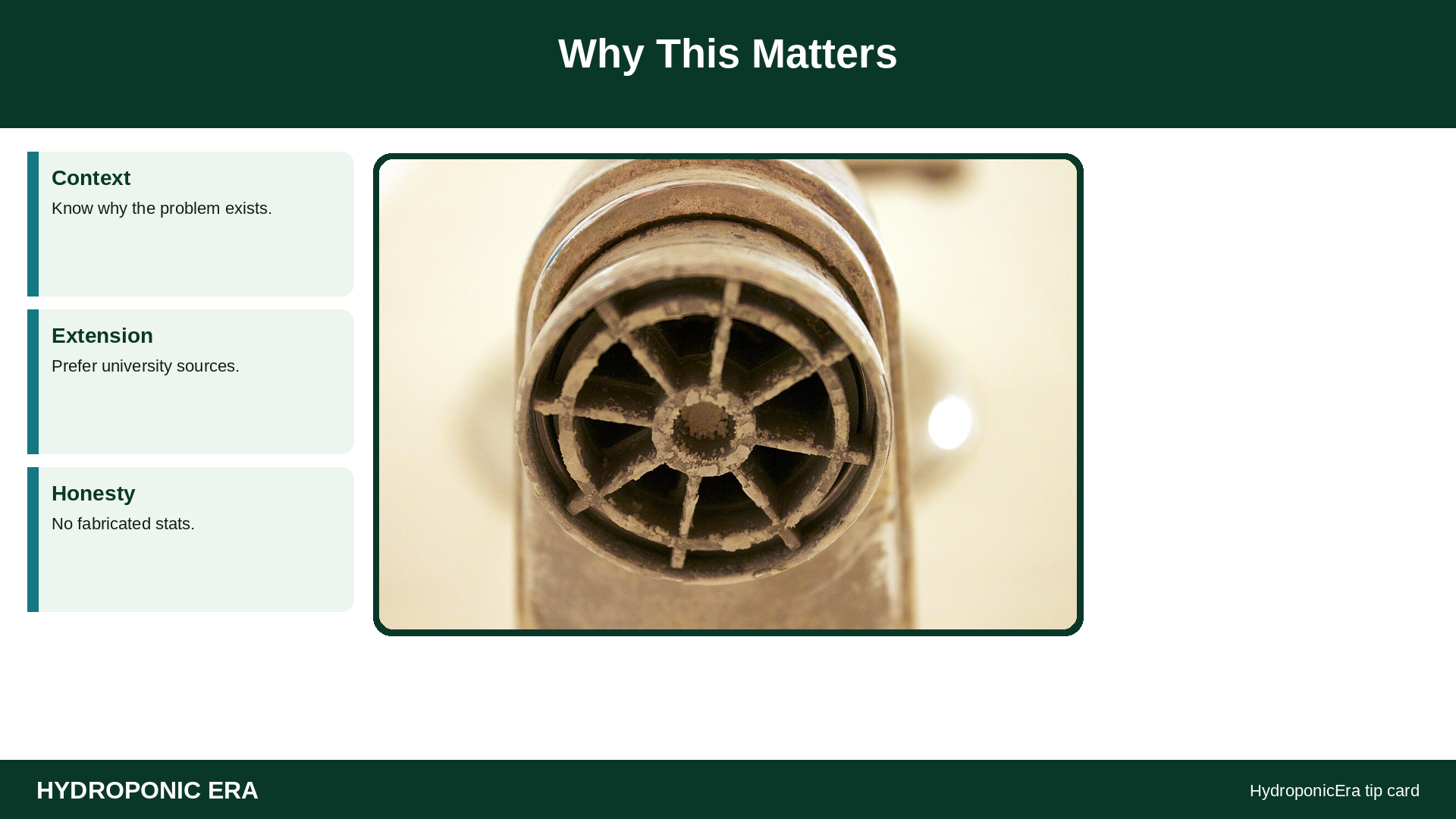
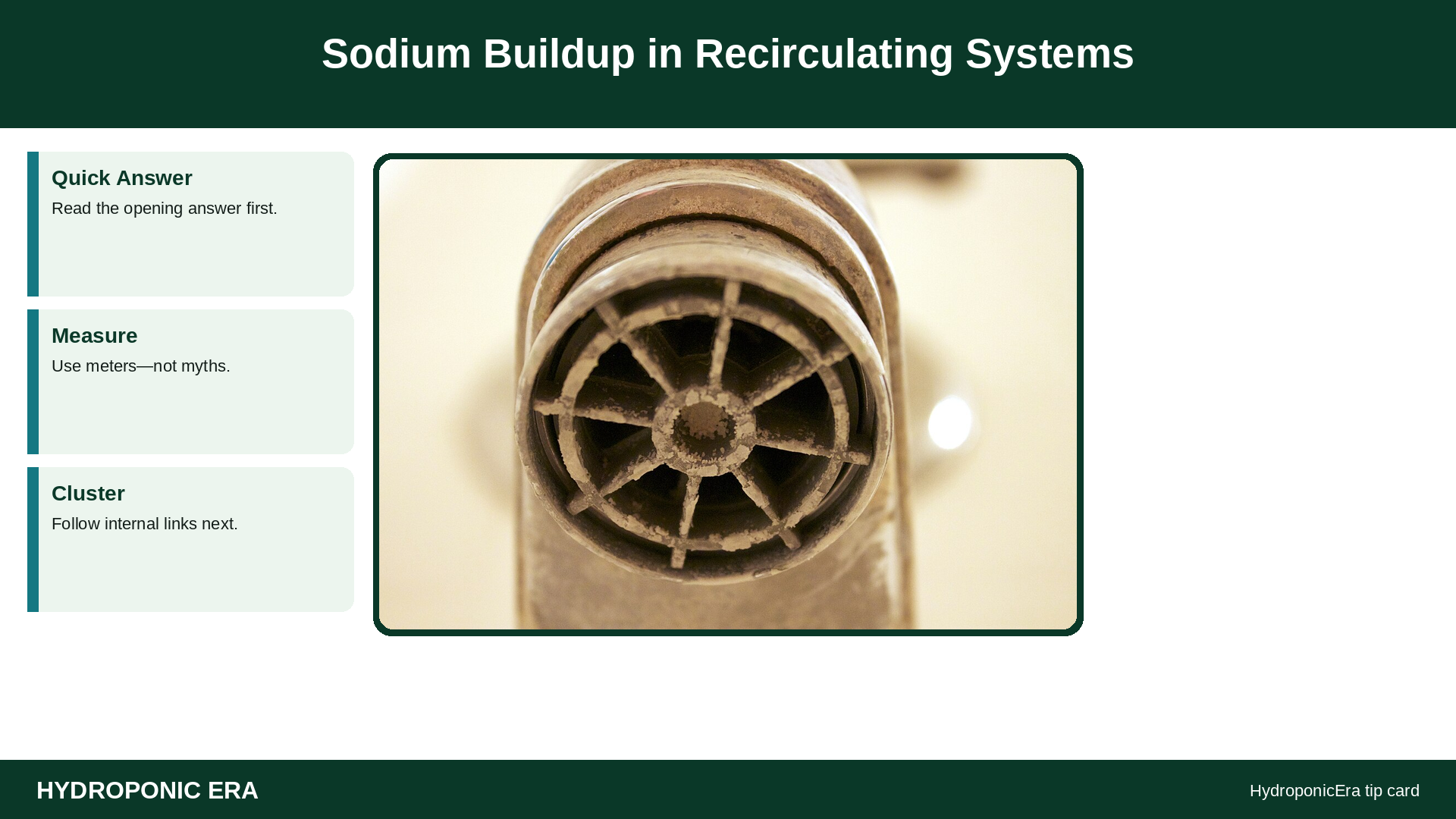
Municipal water varies. Softeners often replace hardness ions with sodium—great for soap, poor for soilless crops. Even without softeners, some source waters carry meaningful Na. In recirculation, ions plants uptake slowly can climb relative to others (recirc, EC).
Extension water-quality guidance for greenhouse/nursery production urges testing and understanding source water rather than guessing.
Sodium Buildup Hydroponics: Risk Table

| Source | Na risk | Action |
|---|---|---|
| Salt-based softener outlet | High | Do not use for hydro; bypass |
| Hard untreated tap | Variable | Test; maybe RO |
| RO permeate | Low Na | Remineralize with fertilizer |
| Long recirculation + top-offs | Climb over time | Periodic full changes |
Sodium Buildup Hydroponics: Step-by-Step Reset Strategy
- Ask: is this water softener effluent?
- If yes, immediately switch source (bypass or RO).
- Dump reservoir; clean if biofilm present ({a(‘clean’,’clean’)}).
- Refill with better water; mix complete nutrients.
- Measure EC/pH; avoid “pushing” EC to chase growth.
- For media systems, consider a flush cycle ({a(‘flush’,’flush’)}).
- Scout new growth over the next week ({a(‘slow’,’slow growth’)}).
- Increase full-change frequency until stable.
- Log source water identity on the reservoir card.
- Retest source seasonally if your utility blends change.
Sodium Buildup Hydroponics: Variables & Lookalikes
| Lookalike | Difference | Link |
|---|---|---|
| Nutrient burn | Tip crisp from high EC | burn |
| Lockout | pH/precipitate | lockout |
| True Na stress | Source/softener history | Water test / history |
| Heat slowdown | Temp notes | temp |
Sodium Buildup Hydroponics: Mistakes
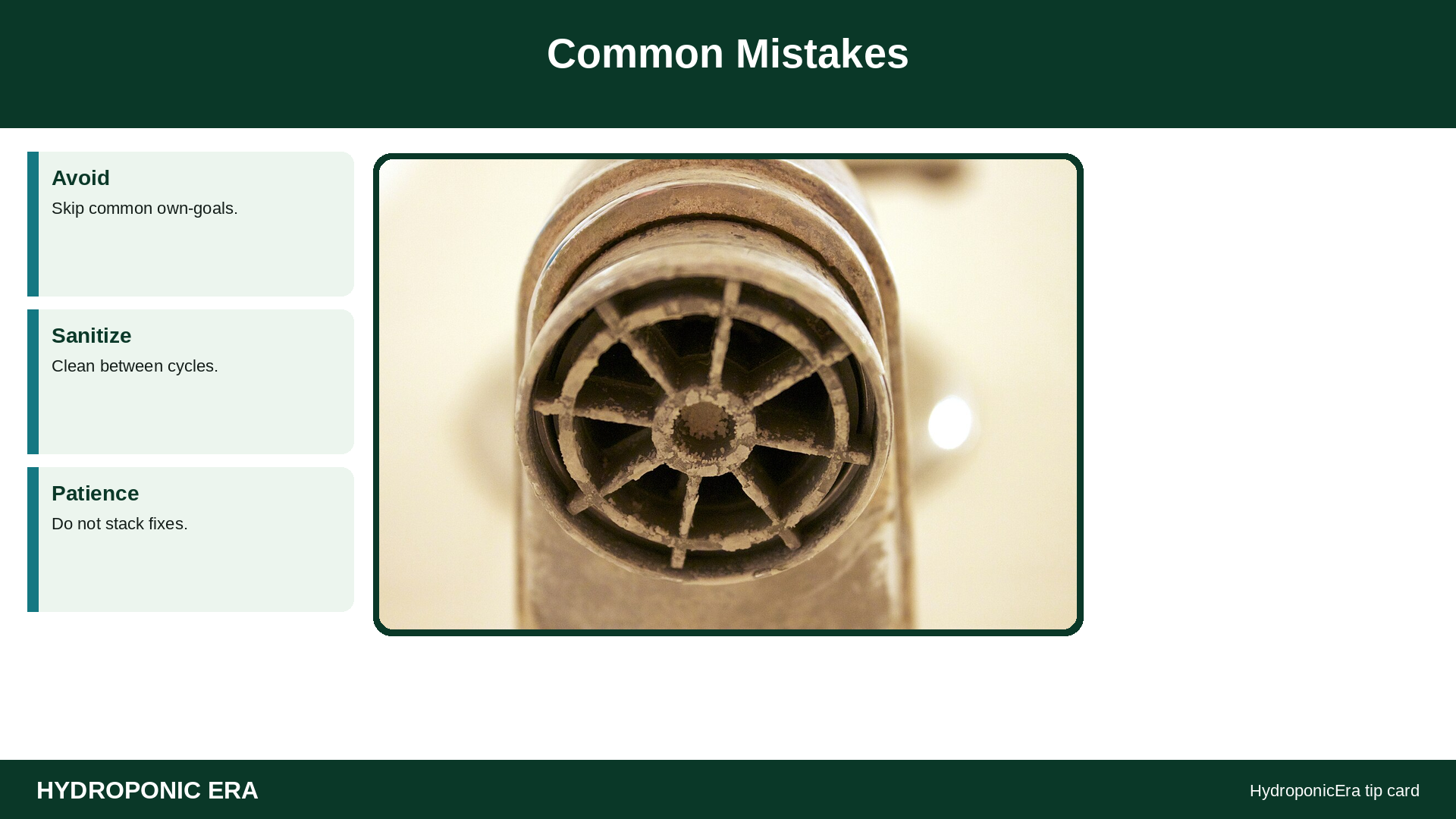
- Using softened water because it is “pure”
- Raising EC to fix Na stress
- Never dumping a recirculating tank
- Assuming RO waste means you should use softener water instead
- Ignoring utility blend changes
Troubleshooting

| Clue | Action | Link |
|---|---|---|
| Softener on the line | Bypass now | hard water |
| EC high, growth poor after long recirc | Full change; review source | changes |
| Media salty feel / tip burn | Flush + reset | flush |
Original Sodium Risk Card

Card: softener installed? (y/n) | hydro taps softener? (must be n) | source | RO? | last full change | notes. That card prevents the most common home Na own-goal. Pair with hard water/RO and recirculating.
What to Check Before You Increase Fertilizer Strength
- Softener bypass confirmed?
- Source water identified?
- Full change performed if suspect?
- EC not blindly raised?
- Media flushed if needed?
- Logs updated?
FAQs about sodium buildup recirculating hydroponics
Is softened water OK if filtered?
Salt-based softener output is still high-Na—do not use for hydro.
Does EC show sodium?
EC is bulk—cannot speciate Na at home easily.
Lab test worth it?
Yes if problems persist and source is unknown.
DTW help?
Can reduce accumulation vs long recirculation.
Rainwater?
Different contaminants possible—test/know risks.
Slow growth other causes?
Light, pH, roots, pests—see slow growth guide.
Softener Bypass Stories and Recirculation Discipline
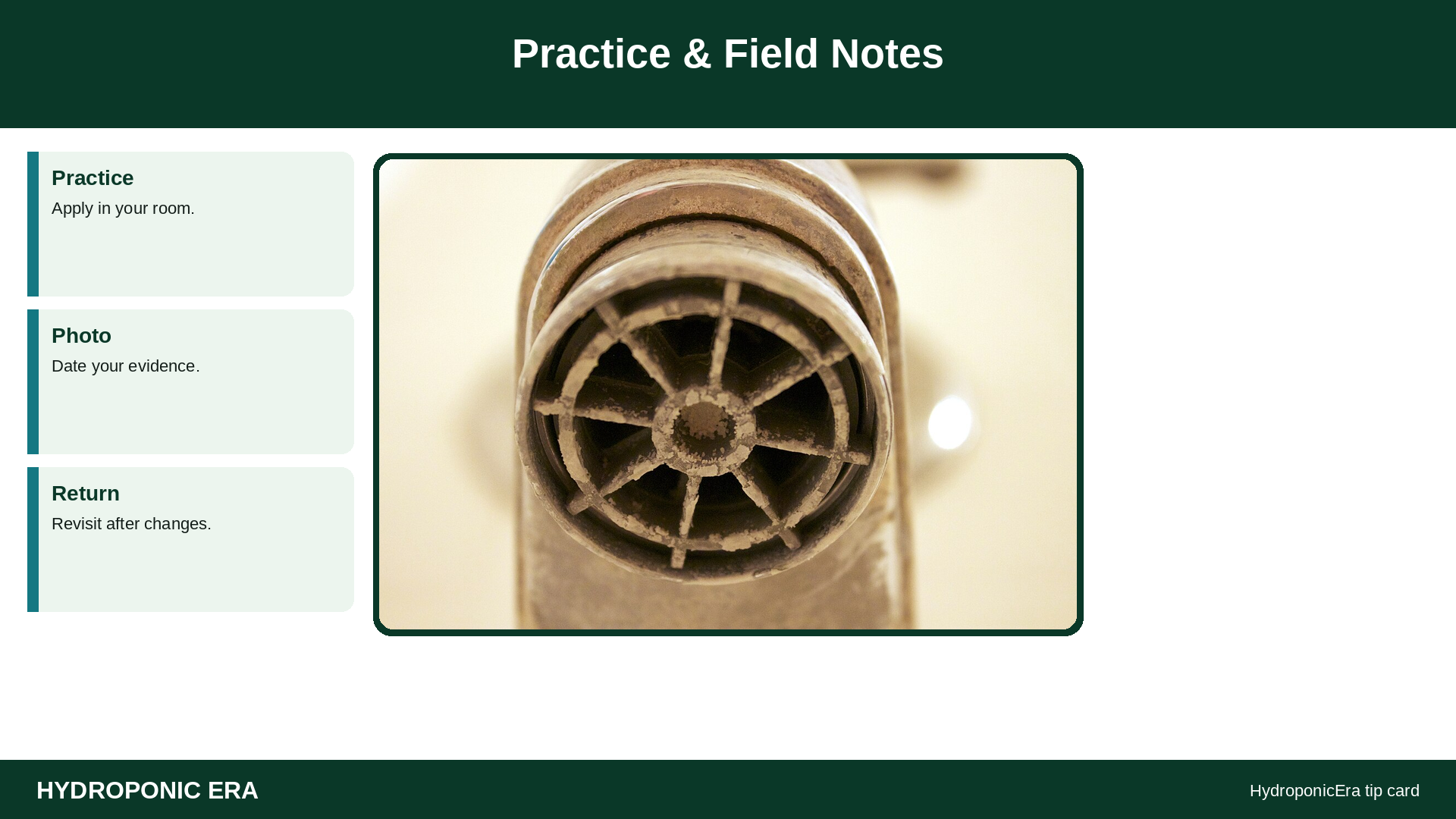
The highest-probability home sodium failure is quiet: a whole-house softener feeds the utility sink used for reservoir fills. Bypass that softener for hydro water or use RO on untreated cold water per your plumbing design. Soap-soft water is not plant-soft water.
Because EC cannot see “Na vs nitrate,” treat source identity as a first-class log field beside EC/pH (EC). If growth is poor and the softener is implicated, dump and reset before raising fertilizer (water changes, slow growth).
Media systems may hold salts after a reservoir reset—use flushing thoughtfully (flush). Recirculating leafy systems respond strongly to more frequent full changes until the source is fixed (recirc).
Original emergency card: “If softener feeds this hose → STOP FILLING.” Tape it at the spigot. That single sticker prevents repeat self-owns.
Lookalike triage remains: heat, lockout, pests, light. Fix water source first when softener history exists, then re-evaluate (lockout, burn).
Extension water-quality literacy (Penn State toolkit framing) plus OSU EC habits give you a professional posture without fake lab printouts.
Practice: for the next three fills, exclusively use a verified non-softened or RO source and note growth response in new leaves only.
Putting This Guide Into Practice
Confirm whether any fill hose sees softener effluent. If yes, bypass immediately. Dump and reset affected reservoirs; do not raise EC to “push through” (water changes, EC).
Add source identity to your log. Increase change frequency until stable. Flush media if salts linger (flush, recirc). Penn State water-quality literacy + OSU measurement habits frame the professional response.
Bottom line: sodium is a source and recirculation story—fix water first. Continue with hard water/RO and slow growth.
Advanced tip: if a lab water test is available through a local extension or private lab, request sodium explicitly when problems persist—home EC cannot speciate. Meanwhile, treat softener bypass as free and immediate (hard water/RO, water changes).
Second-pass note: fix source, reset reservoir, then reassess growth on new leaves. Pair with flush, recirc, and slow growth.
Operational Checklist Card
Print: softener on hydro line? MUST BE NO | source water ID | RO or bypass plan | last full change | do not raise EC to fight Na | new-leaf review date. Reset reservoirs after source fixes (hard water/RO, water changes, flush).
Final reminder: EC cannot see sodium—source identity is the first clue. Related: recirc, slow growth, EC.
Sodium Buildup Hydroponics: Practical Checklist
Sodium Buildup Hydroponics matters every week in a home system. Recheck sodium buildup hydroponics after transplants, heat spikes, and canopy fill-in. Strong sodium buildup hydroponics habits beat one-time guesses. When sodium buildup hydroponics drifts, leaves crowd, roots stress, or harvest quality drops. Write sodium buildup hydroponics targets into your log so you do not rely on memory.
Treat sodium buildup recirculating hydroponics as a weekly habit: scan, note, then adjust only when data says so.
Share sodium buildup recirculating hydroponics basics with anyone covering your system while you are away.
Print a short sodium buildup recirculating hydroponics note and leave it near the reservoir.
Update sodium buildup recirculating hydroponics after storms, heat waves, or DIY plumbing changes.
Good sodium buildup recirculating hydroponics beats last-minute guessing when something drifts overnight.
Archive last month’s sodium buildup recirculating hydroponics notes; patterns beat memory.
Teach one other person your sodium buildup recirculating hydroponics so coverage is not a single point of failure.
When sodium buildup recirculating hydroponics is clear, you waste less time chasing the wrong variable.
Revisit sodium buildup recirculating hydroponics whenever you change lighting, EC, or who waters the system.
Write one line on sodium buildup recirculating hydroponics after each reservoir check so patterns show up early.
Sources
- Penn State Extension — A Water Quality Toolkit for Greenhouse and Nursery Production
- Oklahoma State University Extension — Electrical Conductivity and pH Guide for Hydroponics
- Oklahoma State University Extension — Hydroponics
- Michigan State University Extension — Hydroponics as an agricultural production system
- Penn State Extension — Hydroponics Systems and Principles of Plant Nutrition
- University of Florida IFAS — CV265: Fertilizer Management for Greenhouse Vegetables
- Ohio State University Extension — HYG-1263
- University of Georgia Extension — B1314: Soilless Growing Media