
Quick Answer
For many small home hydroponic systems, a complete nutrient-solution change about every 1–2 weeks is a useful starting point—not a rigid rule. Between full changes, top up water as the level drops, and monitor pH and EC so you can adjust sooner when the solution drifts, clouds, smells off, or roots look stressed.
Topping up is not the same as a full change: top-ups keep volume up, while a full replacement resets nutrient balance and reduces salt buildup. Pair this schedule with pH control, nutrient mixing, and root checks described in our brown roots guide.
Key Takeaways
- Use ~1–2 weeks as a starting interval for full reservoir changes in many small systems; change sooner if pH/EC become unstable or water quality declines.
- Top-ups ≠ full changes—plants take up water and nutrients at different rates, so EC alone can hide imbalance.
- Check water level, plant/root condition, pH, and EC regularly (often daily in small home reservoirs).
- Warm water, light leaks into the reservoir, debris, and overfeeding make water quality problems more likely.
- System type matters: DWC, NFT, Kratky, drip, and aeroponics need different monitoring attention.
- Clean the reservoir during full changes; do not dump nutrient-rich water carelessly—reuse on soil plants when appropriate.
- If leaves yellow or roots brown/slimy, troubleshoot the whole system, not only the calendar.
Related HydroponicEra guides
- How to control hydroponic pH
- Hydroponic nutrients for beginners
- Why hydroponic roots turn brown
- Why hydroponic leaves turn yellow
- Deep water culture (DWC) beginner setup
- Hydroponic garden basics
- Grow lights for hydroponics
- Aeroponics for beginners
How Often to Change Hydroponic Water: A Practical Complete Guide

Introduction
If you’re growing plants without soil, one question eventually comes up: how often to change hydroponic water?
The answer isn’t simply “every seven days” or “every two weeks.” The ideal schedule depends on your hydroponic system, reservoir size, plant size, water quality, nutrient concentration, temperature, and how quickly your plants consume water.
For many small home hydroponic systems, a complete nutrient-solution change about every two weeks is a useful starting point. University extension guidance for small soilless systems often treats a complete nutrient-solution change about every 1–2 weeks as a practical starting point, because nutrient ratios can drift even when you keep topping up water and adjusting nutrients.
However, that doesn’t mean you should ignore the reservoir between changes. Plants continuously take up water and nutrients, so you should monitor the solution regularly and top it up when necessary.
This guide explains how often to change hydroponic water, what signs tell you a change is needed sooner, how to monitor pH and EC (see controlling hydroponic pH and using hydroponic nutrients), and how to change the solution without unnecessarily stressing your plants.
Why Do You Need to Change Water in Hydroponics?
Understanding why hydroponic water changes are necessary makes it much easier to develop the right maintenance routine.
In a hydroponic system, the nutrient solution is effectively the plant’s growing environment. Unlike soil, there is little natural buffering capacity to protect the roots from changes in nutrient concentration and pH.
Over time, several things can happen.
1. Nutrient ratios can change
Plants don’t necessarily consume every nutrient at the same rate. They selectively absorb nutrients according to their growth stage and environmental conditions.
As a result, a reservoir can have an acceptable EC while the individual nutrient balance is no longer ideal.
This is one reason how often to change hydroponic water cannot be determined by EC alone.
Penn State Extension notes that nutrient-solution management requires attention to the composition of the solution, not simply the total concentration.
2. Salts can accumulate
Fertilizers contain mineral salts. As plants consume water, some dissolved compounds can become increasingly concentrated.
High salt concentrations can cause nutrient imbalance and osmotic stress.
EC is useful because it provides an indication of the concentration of dissolved salts in the solution.
3. pH can drift
Hydroponic plants need nutrients to remain available within an appropriate pH range.
Oklahoma State University recommends monitoring pH and EC regularly and notes that hydroponic nutrient solutions are generally maintained in a slightly acidic range. Exact targets depend on the crop.
4. The water itself may contain unwanted minerals
Your starting water isn’t necessarily chemically neutral.
Tap water can contain minerals such as calcium, magnesium, sodium, bicarbonates, chlorides, and sulfates. These can affect the nutrient solution’s EC and pH.
For this reason, your source-water quality should be considered when deciding how often to change hydroponic water.
How Often Should You Change Hydroponic Water?
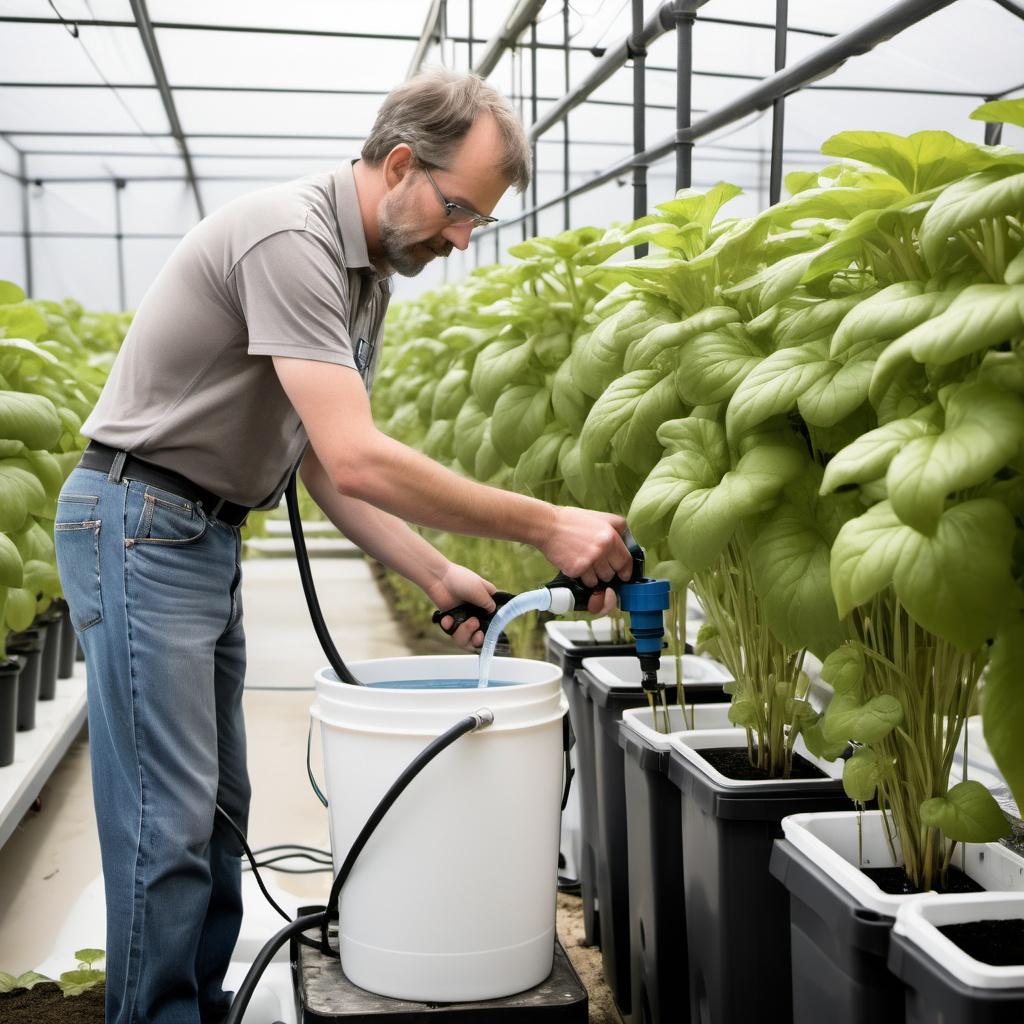
For many small hydroponic systems, changing the complete nutrient solution approximately every two weeks is a practical starting point.
However, this is a guideline rather than a universal rule.
A simple schedule for beginners
| Hydroponic task | Typical guidance frequency |
|---|---|
| Check water level | Daily |
| Check plant/root condition | Daily |
| Check pH | Daily or according to system needs |
| Check EC | Daily or according to system needs |
| Top up water | When reservoir level drops |
| Inspect reservoir | Several times per week |
| Complete nutrient-solution change | Often around every 2 weeks |
| Clean reservoir | During a complete change or when needed |
A practical habit for many home systems is to check pH and EC regularly (often daily in small reservoirs) and plan complete nutrient-solution replacements on a schedule you adjust with measurements—commonly around every 1–2 weeks as a starting point.
That makes two weeks a useful starting point when you’re learning how often to change hydroponic water.
But don’t blindly follow the calendar.
If your plants are consuming water rapidly, your reservoir is very small, the solution becomes cloudy, the roots look unhealthy, or your pH and EC become difficult to control, you may need to change it sooner.
On the other hand, a well-managed larger reservoir may behave differently.
The best answer to how often to change hydroponic water is therefore: use a schedule as a starting point, then adjust it according to measurements and plant condition.
What Factors Affect Hydroponic Water Change Frequency?

Several factors influence how often to change hydroponic water.
Reservoir size
A small reservoir changes more quickly because each plant represents a larger percentage of the total water and nutrient volume.
For example, a few mature plants in a small reservoir can cause pH, EC, and water level to change much faster than seedlings in a large reservoir.
Number and size of plants
Large, actively growing plants consume more water and nutrients than small seedlings.
As the plants mature, you may need to monitor the solution more frequently.
Plant type
Different crops have different nutrient requirements.
For example, lettuce, basil, tomatoes, cucumbers, and strawberries don’t necessarily use nutrients at the same rate.
Crop-specific EC and pH targets should therefore take priority over a generic schedule. Oklahoma State University’s crop table demonstrates that recommended EC and pH values differ considerably between crops.
Temperature
Warmer conditions can increase water consumption and may also create additional challenges for maintaining a healthy root environment.
Water quality
If your source water contains substantial dissolved minerals or has high alkalinity, maintaining stable nutrient solution chemistry can become more difficult.
Hydroponic system design
A DWC reservoir, NFT system, Kratky container, and ebb-and-flow system don’t behave exactly the same way.
This is why the question how often to change hydroponic water should always be considered together with the type of system you’re using.
How to Know When Hydroponic Water Needs Changing

Sometimes your reservoir needs attention before your normal change date.
Watch for these warning signs.
1. pH becomes difficult to control
If your pH repeatedly moves outside the range appropriate for your crop despite reasonable adjustments, investigate the underlying cause.
Don’t simply keep adding pH-up or pH-down indefinitely.
2. EC becomes unusually high
A rising EC can indicate that dissolved salts are becoming more concentrated.
If EC is consistently above your crop’s target, dilution with appropriate water may help. Oklahoma State University recommends lowering excessive EC by adding water and then checking the measurement again.
3. The solution becomes cloudy
Cloudiness can have several causes, including suspended particles, precipitation, microbial growth, or contamination.
If the solution looks abnormal, investigate rather than assuming it is harmless.
4. There is an unusual smell
A strong unpleasant odor can be a warning that the root environment or reservoir needs attention.
5. Roots look unhealthy — also see brown hydroponic roots and yellow leaves
Healthy roots generally shouldn’t be ignored if they suddenly become dark, slimy, damaged, or foul-smelling.
6. Plant growth suddenly declines
Nutrient imbalance, inappropriate pH, excessive salts, poor water quality, temperature problems, and root issues can all affect growth.
Penn State Extension emphasizes that hydroponic systems can respond quickly to nutrient problems, making regular monitoring important.
These signs can mean you should change your nutrient solution even if your normal schedule says it isn’t time yet.
How to Monitor Hydroponic Water Quality
If you want to know how often to change hydroponic water accurately, monitoring is more useful than relying entirely on a calendar.
Monitor pH
pH tells you how acidic or alkaline the nutrient solution is.
For many hydroponic crops, the solution is maintained in a mildly acidic range, but the exact target should be based on the crop and nutrient program. Oklahoma State University gives approximately 5–6 as a general nutrient-solution range and provides crop-specific values.
Monitor EC
EC, or electrical conductivity, provides an estimate of dissolved salts in the solution.
A higher EC generally indicates a higher concentration of dissolved salts.
However, EC does not tell you exactly which nutrients are present or whether their individual ratios are correct.
That’s an important limitation when deciding how often to change hydroponic water.
Check water level
Check the reservoir regularly.
If the water level drops significantly, top it up according to your nutrient-management approach.
Don’t assume that replacing evaporated or consumed water is the same as replacing the entire nutrient solution.
Monitor plant condition
Look at:
- Leaf color
- New growth
- Root appearance
- Wilting
- Leaf-tip damage
- Growth rate
- Signs of nutrient deficiency or toxicity
Plant symptoms should be considered alongside pH and EC readings rather than used alone.
Should You Change All the Hydroponic Water at Once?
When it’s time for a scheduled nutrient-solution replacement, a complete change is usually more straightforward than continuously trying to correct an old solution.
The reason is simple: after repeated top-ups and nutrient adjustments, the exact nutrient balance can become difficult to know.
Periodic full replacement helps reset nutrient balance when ratios drift outside useful ranges; many small systems use about every 1–2 weeks as a starting interval, then adjust based on crop, reservoir size, and readings.
For a small home system, a complete change can also give you an opportunity to:
- Empty the reservoir.
- Inspect the roots.
- Clean the reservoir.
- Check pumps and air stones.
- Remove debris.
- Prepare fresh nutrient solution.
- Recheck pH and EC.
However, don’t treat every small change in pH or EC as a reason to immediately dump the reservoir.
Good monitoring allows you to make measured adjustments between complete changes.
How to Change Water in a Hydroponic System
Once you know how often to change hydroponic water, the actual process is relatively simple.
Step 1: Prepare fresh water
Use water appropriate for your crop and nutrient program.
If you’re unsure about your source water, consider having it tested. Oklahoma State University recommends testing water for factors including pH, EC, and alkalinity.
Step 2: Prepare the nutrient solution
Add nutrients according to the manufacturer’s instructions or your chosen nutrient recipe.
Don’t guess fertilizer quantities.
Penn State Extension provides nutrient-solution guidance and explains that fertilizer concentration and water composition need to be considered when preparing solutions.
Step 3: Empty the old reservoir
Turn off pumps and other equipment as appropriate.
Drain the old nutrient solution safely.
Step 4: Clean the reservoir
Remove visible debris and residue.
If you are dealing with algae or contamination, clean the system appropriately before refilling.
Step 5: Refill
Add the appropriate amount of fresh water and nutrients.
Mix thoroughly.
Step 6: Measure EC
Check EC after the nutrient solution has mixed properly.
If EC is too high, dilute with water. If it is too low, adjust according to your nutrient program.
Oklahoma State University recommends checking the solution after adjustments rather than making repeated additions without measuring.
Step 7: Adjust pH
Once EC is where you want it, check pH and adjust gradually.
Step 8: Restart the system
Turn pumps, aeration, and other equipment back on.
Check again after the system has circulated and the reading has stabilized.
How Often Should You Change Water in Different Hydroponic Systems?
The answer to how often to change hydroponic water can vary by system.
| System | Typical water-change approach (guidance) |
|---|---|
| DWC | Monitor reservoir closely; a complete change around every 1–2 weeks can be a practical starting point |
| Kratky | Monitor water level and nutrient condition; change based on reservoir condition and crop stage |
| NFT | Monitor the central reservoir because nutrient solution continuously circulates |
| Ebb and Flow | Monitor the reservoir and replace solution based on nutrient condition |
| Drip hydroponics | Frequency depends heavily on reservoir size, crop, runoff, and nutrient management |
| Aeroponics | Requires particularly careful monitoring because roots depend on the nutrient solution delivery system |
These are starting points, not universal rules.
For commercial systems, nutrient management can be much more precise. Oklahoma State University describes several approaches, including automatic water addition with pH and EC control and partial or complete reservoir replacement.
How to Keep Hydroponic Water Clean Between Changes

Knowing how often to change hydroponic water is only part of good reservoir management.
You also need to keep the system clean.
Keep light away from the reservoir
Light entering the nutrient solution can encourage unwanted algae growth.
Use an opaque reservoir or otherwise prevent unnecessary light exposure.
Keep the reservoir covered
A covered reservoir helps reduce debris and unwanted contamination.
Keep equipment clean
Inspect:
- Air stones
- Air lines
- Water pumps
- Tubing
- Return lines
- Reservoir walls
- Net pots
Don’t let dead plant material remain in the system
Remove fallen leaves, damaged roots, and other organic debris.
Monitor temperature
Keep the root environment within a suitable temperature range for your crop and system.
Don’t overfeed
More nutrients do not automatically mean faster growth.
Excess soluble salts can contribute to plant stress and nutrient problems. Penn State Extension notes that excessive soluble salts can cause symptoms including wilting, leaf damage, and root problems.
Can You Reuse or Top Up Hydroponic Water?
Yes, but topping up isn’t exactly the same as performing a complete hydroponic water change.
When plants consume water, you can usually need to add water to maintain the reservoir level.
However, repeatedly topping up indefinitely can allow nutrient ratios to drift.
For example, a plant may consume some nutrients more quickly than others. Water may also evaporate, leaving dissolved minerals behind.
This is why growers should distinguish between:
Top-up: Adding water or nutrient solution to maintain the reservoir.
Partial replacement: Removing some old solution and replacing it with fresh solution.
Complete change: Removing the old solution and preparing an entirely fresh nutrient solution.
The appropriate method depends on your system and nutrient-management strategy.
For beginners, a practical approach is to monitor pH and EC regularly, top up as needed, and perform a complete nutrient-solution change on a planned schedule rather than topping up forever.
Frequently Asked Questions About Hydroponic Water Changes
How often should I change hydroponic water?
For many small systems, changing the complete nutrient solution approximately every two weeks is a reasonable starting point. However, plant size, reservoir size, crop, water quality, pH, EC, and system design can change the ideal schedule.
Can I change hydroponic water every week?
Yes. A weekly change isn’t inherently harmful if it is done correctly, although it may use more water and nutrients than necessary. The best schedule depends on your system and how stable the nutrient solution remains.
What happens if I don’t change hydroponic water?
Over time, nutrient ratios can drift, salts can accumulate, and pH and EC may become more difficult to manage. Problems can eventually affect plant growth and root health.
Should I check pH every day?
For actively managed hydroponic systems, daily pH and EC checks are a useful practice. Oklahoma State University specifically recommends checking both daily and checking them at approximately the same time of day.
Is topping up hydroponic water enough?
Not indefinitely. Topping up restores the water level, but it does not necessarily restore the original nutrient balance. Periodic replacement of the nutrient solution helps reset the solution composition.
Do different plants need different water-change schedules?
Yes. Different crops have different nutrient requirements and can consume water at different rates. Lettuce, herbs, tomatoes, cucumbers, and strawberries should not automatically be managed using exactly the same nutrient targets or maintenance routine.
Conclusion
So, how often to change hydroponic water?
For many small home systems, about every two weeks is a useful starting point for a complete nutrient-solution change, but it shouldn’t be treated as an unbreakable rule.
The better strategy is to combine a regular schedule with measurements.
Check your water level regularly. Monitor pH and EC. Watch the roots and leaves. Consider your crop, reservoir size, water quality, temperature, and system design. If the nutrient solution becomes unstable or shows signs of contamination or excessive salt accumulation, change it sooner.
Most importantly, don’t confuse adding water with performing a complete hydroponic water change. Top-ups help maintain the reservoir level, while periodic replacement helps reset the nutrient solution and reduce the problems associated with nutrient imbalance.
If you’re just starting, keep your routine simple:
Monitor → Top up → Measure → Adjust → Replace → Clean → Refill.
That approach gives you a much more reliable way to decide how often to change hydroponic water than relying on the calendar alone.
Related reading
- Hydroponic garden basics for beginners
- How to control hydroponic pH
- Hydroponic nutrients for beginners
- How often to change hydroponic water
- Grow lights for hydroponics
- Why hydroponic leaves turn yellow
- Why hydroponic roots turn brown
- Deep water culture (DWC) for beginners
- Indoor hydroponic garden guide
Sources
These university and extension resources discuss soilless/hydroponic nutrient-solution management, monitoring, and reservoir practices. Intervals in this article are typical guidance and should be adjusted for your crop, water quality, and system.
- University of Tennessee Extension — Leafy Crop Production in Small-Scale Soilless and Hydroponic Systems (W 844-B)
- University of Minnesota Extension — Small-scale hydroponics
- Oklahoma State University Extension — Hydroponics (nutrient management techniques)
- University of Kentucky — Test and Adjust Nutrient in Hydroponics
- UMass Extension — Hydroponic nutrient solution management
13 thoughts on “How Often to Change Hydroponic Water? Proven Complete Guide”