
Tomato yellow leaf curl virus (TYLCV) is a whitefly-spread virus that makes young tomato leaves curl upward, turn yellow at the edges and stay small, while plants stunt and drop flowers. There’s no cure: infected plants don’t recover, and early infections can wipe out fruit set. Prevention is the whole game: virus-free transplants, whitefly exclusion and control, resistant varieties, and prompt removal of infected plants.
| TYLCV fact | Detail |
|---|---|
| Virus type | Begomovirus (family Geminiviridae) |
| Vector | Silverleaf / sweetpotato whitefly (Bemisia tabaci) |
| Key symptoms | Upward curling, yellow leaf margins, small leaves, stunting, flower drop |
| Time to symptoms | Up to about 3 weeks after infection (NC State) |
| Cure | None; remove infected plants |
| US hotspots | Florida, the Southeast, Texas and parts of California |

Symptoms of Tomato Yellow Leaf Curl Virus
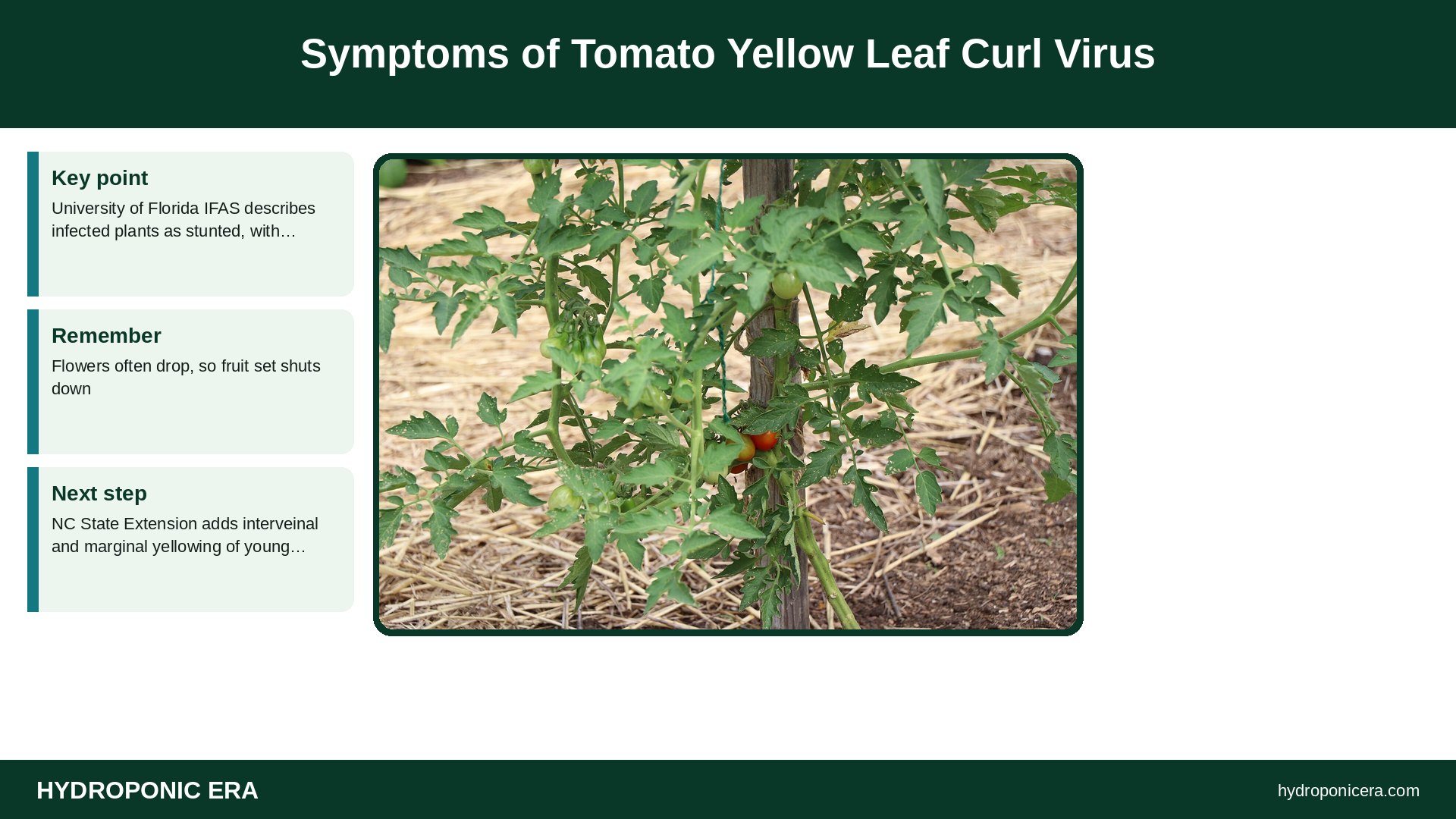
University of Florida IFAS describes infected plants as stunted, with leaves that are smaller than normal, curl upward and show bright yellow margins. Flowers often drop, so fruit set shuts down. NC State Extension adds interveinal and marginal yellowing of young leaves, a bushy look from shortened internodes, and notes that when young plants are infected, there may be no fruit at all. UC IPM describes stunted, erect, upright growth early on.
UF IFAS puts it bluntly: fruit set shuts down once a plant is infected, and early infection may result in little or no yield. That’s why protecting young plants from whiteflies matters most.
TYLCV vs Nutrient Deficiency and Leaf Curl
Several common problems look like tomato yellow leaf curl virus at first. NC State offers two quick tests:
- Which leaves? Potassium and magnesium deficiencies start on older, lower leaves. TYLCV symptoms start on young, upper leaves.
- What pattern? Deficiencies tend to be uniform across the crop. TYLCV is patchy, hitting scattered plants.
Physiological leaf roll from heat or heavy pruning curls older leaves without the yellow margins and stunting. See our leaf curl guide and leaf cupping guide. For confirmation, many state diagnostic labs test for the virus.
How Tomato Yellow Leaf Curl Virus Spreads

Whiteflies are the only practical route. NC State explains that whiteflies pick up the virus while feeding, and after a latent period of about 6 hours can transmit it within 15 to 30 minutes of feeding on a new plant. Adults can spread it for weeks and travel at least 10 miles.
It isn’t spread by touch or tools the way tomato brown rugose fruit virus is. NC State notes the virus has been detected on the surface of seed from infected plants, but it isn’t transmitted to seedlings after seed-surface disinfestation. The most common way it reaches a new garden is on infected transplants or through whiteflies flying in. UC IPM notes other plants, including some weeds and ornamentals, can carry it without obvious symptoms.
Know the Whitefly Behind Tomato Yellow Leaf Curl Virus
UF IFAS identifies the main vector as Bemisia tabaci MEAM1, the sweetpotato whitefly, often called the silverleaf whitefly in Florida. A second type, B. tabaci MED (Q biotype), has been established in Florida since at least 2016. The whitefly passes through an egg stage and four nymphal stages before becoming an adult, and eggs are usually laid on leaf undersides.
Its host range is broad: tomato, eggplant, watermelon and other cucurbits, beans, many ornamentals and weeds. That matters indoors, because a whitefly-infested houseplant or ornamental can carry adults into a tomato tent. UF notes the virus is picked up by nymphs or adults and retained for the rest of the insect’s life.
Where Tomato Yellow Leaf Curl Virus Is a Problem in the US
TYLCV is most common where the Bemisia whitefly survives winter: Florida, the Gulf Coast, the Southeast and parts of Texas and California. UC IPM says it was first identified in California in 2007 and has a limited distribution there, partly because the whitefly doesn’t tolerate Central Valley winters. Northern growers usually encounter it on transplants shipped from warmer regions, which NC State has documented in western North Carolina.
How to Prevent Tomato Yellow Leaf Curl Virus: 7 Steps
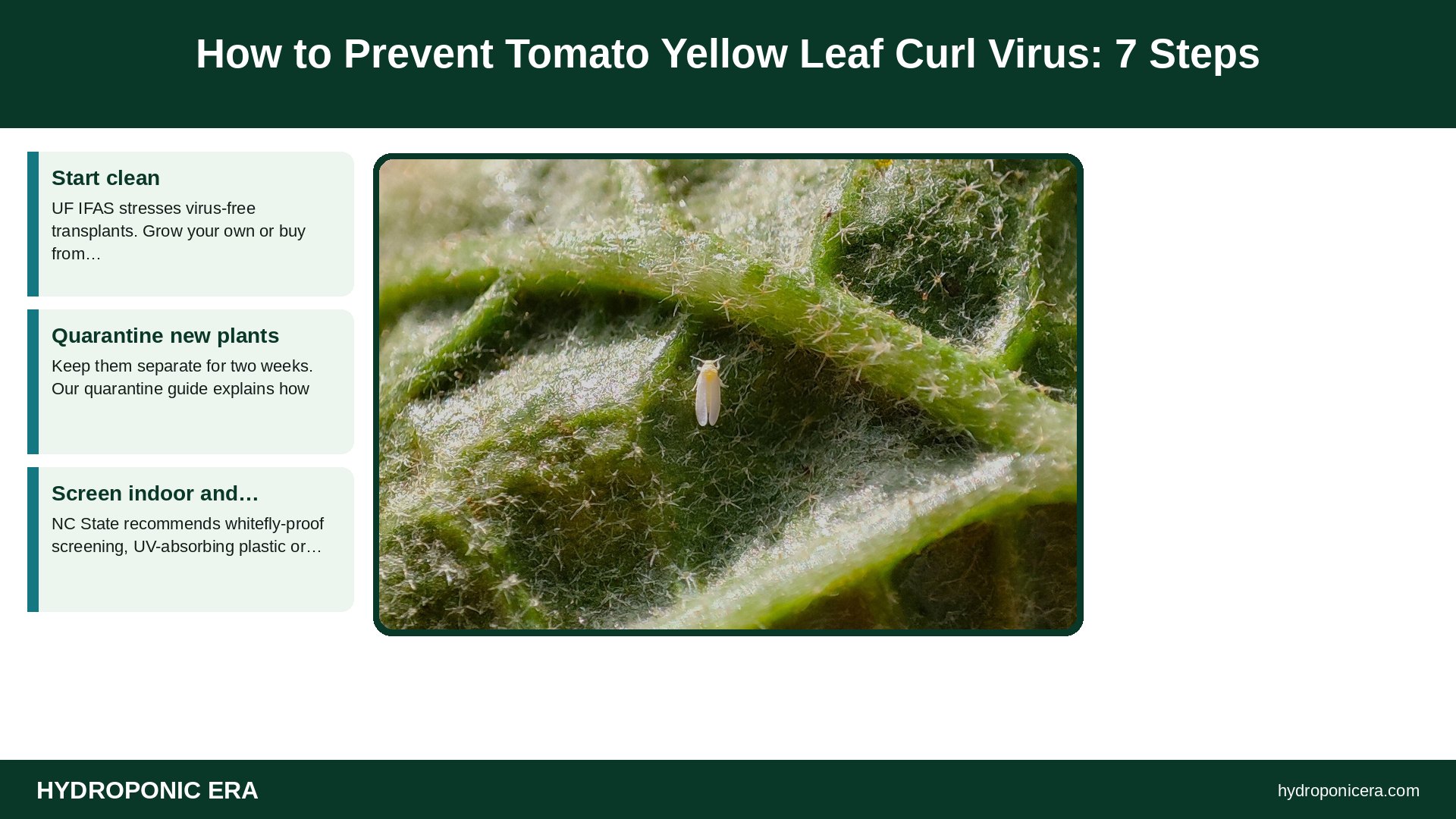
- Start clean. UF IFAS stresses virus-free transplants. Grow your own or buy from reputable local sources and inspect leaf undersides.
- Quarantine new plants. Keep them separate for two weeks. Our quarantine guide explains how.
- Screen indoor and greenhouse spaces. NC State recommends whitefly-proof screening, UV-absorbing plastic or 50-mesh covers in greenhouses.
- Monitor whiteflies. Yellow sticky cards show when adults arrive. See our sticky trap guide.
- Control whiteflies early. Our whiteflies in hydroponics guide covers options. Any insecticide must be labeled for tomatoes and your site.
- Grow resistant varieties. NC State says resistant cultivars are an economical option, but they’re less effective if infected early. UF notes tolerant varieties aren’t immune.
- Remove infected plants fast. UF IFAS advises treating whitefly adults before roguing and removing plants in plastic bags so whiteflies don’t carry the virus onward.
Tomato Yellow Leaf Curl Virus in Hydroponic Systems

Indoor hydroponic tomatoes have an advantage: whiteflies can only arrive on plants, people or through openings. Keep tents zipped, screen intakes, and never bring in tomato, pepper or ornamental plants with whiteflies. The virus doesn’t travel through nutrient solution, so a shared reservoir isn’t the risk; whiteflies moving plant to plant are.
If one plant shows symptoms, remove it in a bag, check the rest for whiteflies daily, and keep sticky cards up for several weeks. Don’t keep a sick plant “for the fruit”: it’s a source of virus for every whitefly that feeds on it.
Can Plants Recover From Tomato Yellow Leaf Curl Virus?
No. There’s no treatment that removes the virus from a plant. Infected plants won’t recover, they produce little new fruit, and they can keep spreading the virus. Both UF and NC State recommend removing and destroying infected plants.
FAQs: Tomato Yellow Leaf Curl Virus
Are tomatoes from TYLCV plants safe to eat?
The virus infects plants, not people. Fruit that develops normally can be eaten, though yields and quality drop.
Does tomato yellow leaf curl virus live in soil or water?
No. It spreads through whiteflies and infected plants, not soil, water or tools.
Can peppers get TYLCV?
UC IPM lists other solanaceous crops as hosts that may show no symptoms. They can still serve as a virus source.
Which tomato varieties resist TYLCV?
Seed suppliers list resistance, and NC State points growers to the Southeastern Vegetable Crop Handbook’s variety table.
Related HydroponicEra Guides
- Whiteflies in hydroponics
- Tomato brown rugose fruit virus
- Impatiens necrotic spot virus in lettuce
- How to grow hydroponic tomatoes
Sources
- UF/IFAS EDIS IN1430 — Managing Bemisia tabaci MEAM1 and Tomato Yellow Leaf Curl Virus in Florida Tomato
- UF/IFAS EDIS IN695 — Management of Whiteflies, Whitefly-Vectored Plant Virus, and Insecticide Resistance for Tomato Production in Southern Florida
- NC State Extension — Tomato Yellow Leaf Curl Virus
- University of California IPM — Tomato Yellow Leaf Curl
- Photo credits (Wikimedia Commons, edited with titles): Bemisia tabaci under leaf of eggplant by Wee Hong (CC BY-SA 4.0); Several green unripe and red ripe tomatoes growing on the vine. (086c449c-117b-44f6-a7c4-e2acbf284092) by NPS (Public domain); Pepper and tomato seedling trays at Boğaziçi University 2026 by Furkan Akkurt (CC BY-SA 4.0); Greenhouse filled with tomato plants and a bucket on the path by Shixart1985 (CC BY 2.0)