
Quick Answer: air pumps and air stones
air pumps and air stones dissolve oxygen into the nutrient solution and keep water moving so roots do not sit in stagnant, low-oxygen pockets—especially in deep water culture (DWC) and other water-heavy systems. Choose a pump with enough free-air capacity for your tubing losses and stone depth, place stones under the root zone, keep airlines check-valved against back-siphon, and replace tired stones that clog and starve bubbles. Aeration supports root health alongside cool reservoir temperatures, clean water changes, and sensible nutrient strength.
Read with dissolved oxygen and root health, DWC for beginners, reservoir temperature, and brown roots troubleshooting.
Key Takeaways
- Oklahoma State and UF hydroponic overviews treat oxygenation and water management as core soilless-production skills—not optional accessories.
- Warm water holds less dissolved oxygen; hot reservoirs need more aeration attention (pair with the temperature draft).
- Air stones increase bubble surface area; airline alone is weaker for the same pump.
- Check valves protect pumps when they sit below water level.
- Clogged stones look “fine” until roots brown—inspect bubble volume monthly.
- NFT and drip systems may rely more on thin films and drain-off oxygen than giant air stones, but DWC almost always wants dedicated aeration.
- Algae and biofilm compete for oxygen and clog stones—see algae draft.
Related HydroponicEra guides
- Dissolved oxygen and root health
- Deep water culture for beginners
- How often to change hydroponic water
- Growing media for hydroponics (draft)
- Hydroponic supplies for beginners
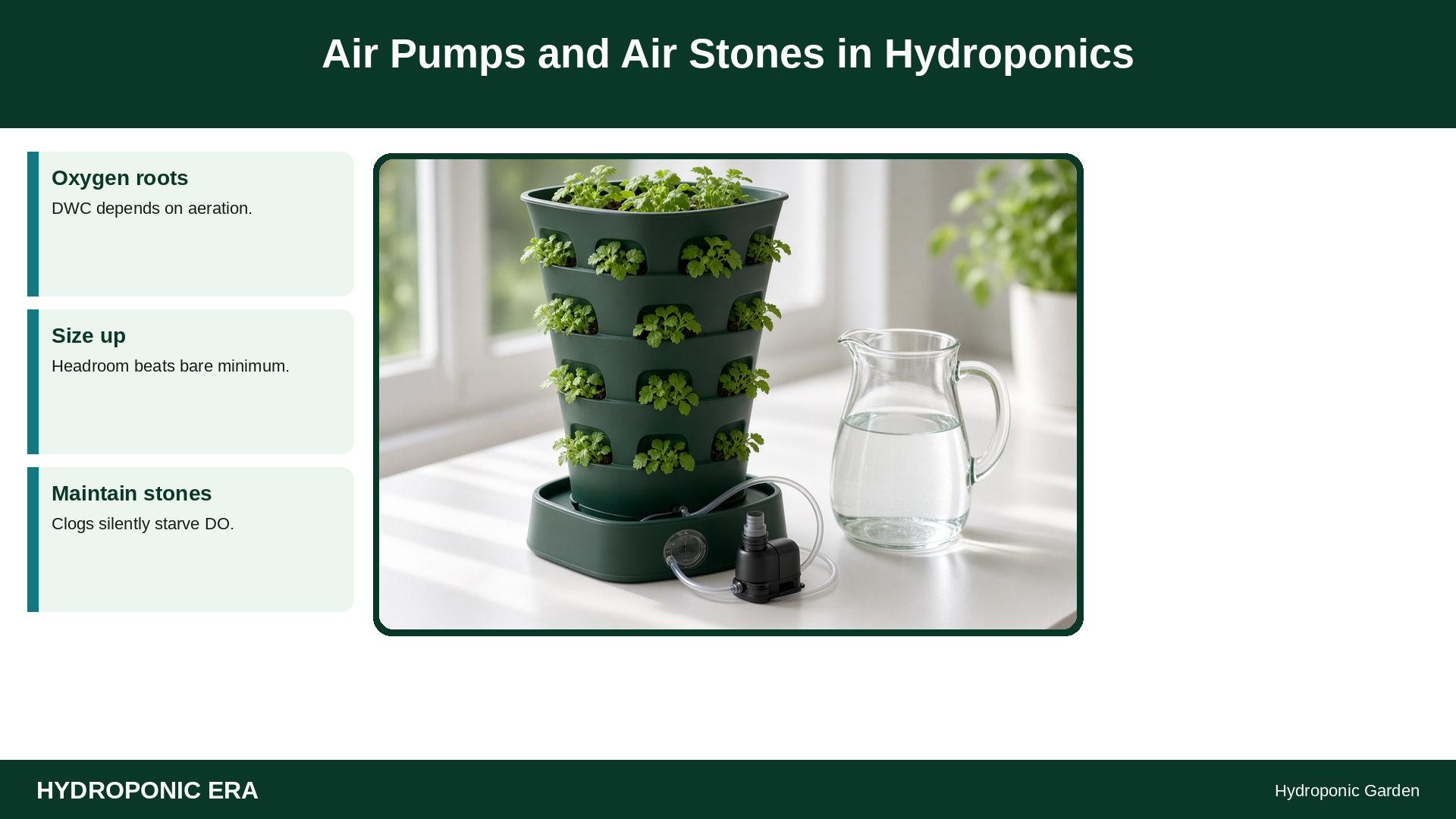
Why roots need air pumps and air stones
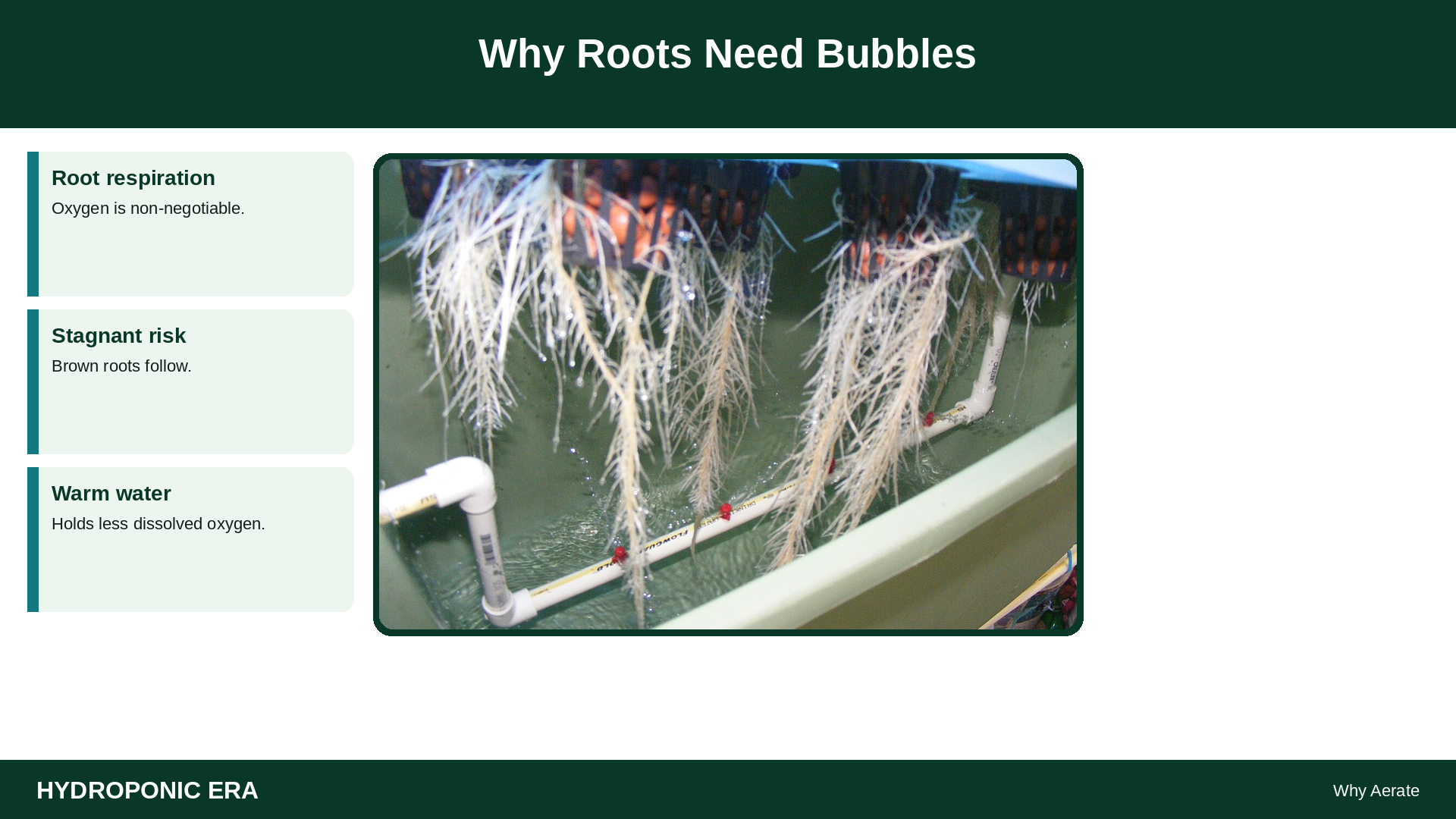
Roots respire. In soil, pore spaces supply oxygen between water films. In DWC, roots hang in solution, so oxygen must be dissolved into that water or refreshed continuously. When dissolved oxygen drops, roots can brown, growth stalls, and opportunistic microbes increase pressure—exactly the failure mode covered in HydroponicEra’s brown-roots and dissolved-oxygen drafts.
University of Minnesota’s small-scale hydroponics guidance and Oklahoma State’s hydroponics materials both keep returning to practical root-zone oxygen and water quality. Air pumps are the home grower’s simplest continuous tool for DWC-style systems.
Air Pump vs Air Stone vs Water Pump
| Part | Job | Beginner note |
|---|---|---|
| Air pump | Moves air into tubing | Rated in L/min or GPH free air; real output falls with depth and restrictions |
| Airline tubing | Delivers air | Keep runs reasonable; avoid kinks |
| Check valve | Stops back-siphon into pump | Essential if pump is below waterline |
| Air stone / diffuser | Breaks air into fine bubbles | More surface area → better gas exchange for a given airflow |
| Water pump | Moves nutrient solution | Different job; does not replace dedicated aeration in deep tanks |
How to Size and Set Up Aeration
- Identify system type. DWC/raft: dedicated air pump almost always. NFT: focus on reliable flow and thin film. Dutch bucket/drip: drain-to-waste or recirculating drain-off matters; some reservoirs still benefit from aeration.
- Estimate demand. Larger root masses and warmer water need more oxygen delivery. When unsure, design for visible vigorous bubbling under the roots without creating a violent geyser that damages young plants.
- Select pump capacity with headroom. Manufacturers rate free airflow; depth, stones, tees, and long tubing reduce delivered air. A pump that is “just enough” on paper often underperforms in a sealed lid.
- Use one stone per site or manifold carefully. Multiple stones need a pump that can feed them without one stone stealing all the air.
- Place stones under the root mass so bubbles rise through the root zone, not in a dead corner.
- Install a check valve on each line if back-siphon is possible.
- Keep the pump dry and ventilated so it does not overheat and fail silently overnight.
- Listen for failure. A dead pump is an emergency in DWC—especially in warm rooms.
- Maintain stones. Soak/clean mineral crust and biofilm; replace when bubbles weaken.
- Coordinate with temperature and cleanliness. Cooler, cleaner water is easier to oxygenate well.
Important Variables
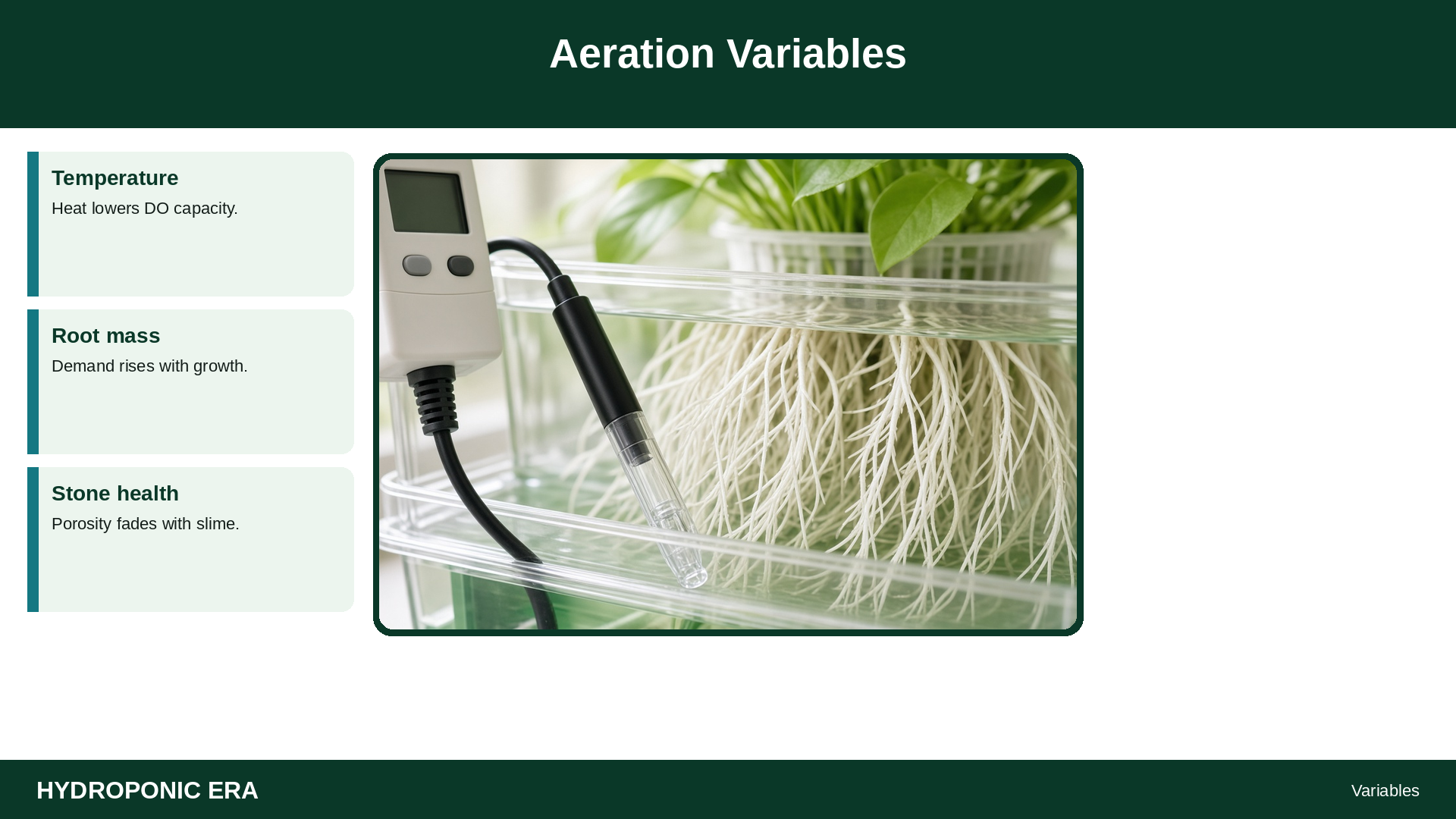
| Variable | Effect on aeration success | Action |
|---|---|---|
| Water temperature | Warmer water holds less DO | Target sensible reservoir temps; see temperature draft |
| Root density | More respiration demand | Increase airflow as plants mature |
| Stone porosity | Bubble size / clog rate | Clean or replace on schedule |
| Tank depth | More pressure against the pump | Size pump for depth |
| Biofilm / algae | Clogs + oxygen competition | Light-proof reservoir; clean regularly |
| Nutrient strength | Stressed roots need oxygen more | Avoid burn while fixing air |
Common Mistakes
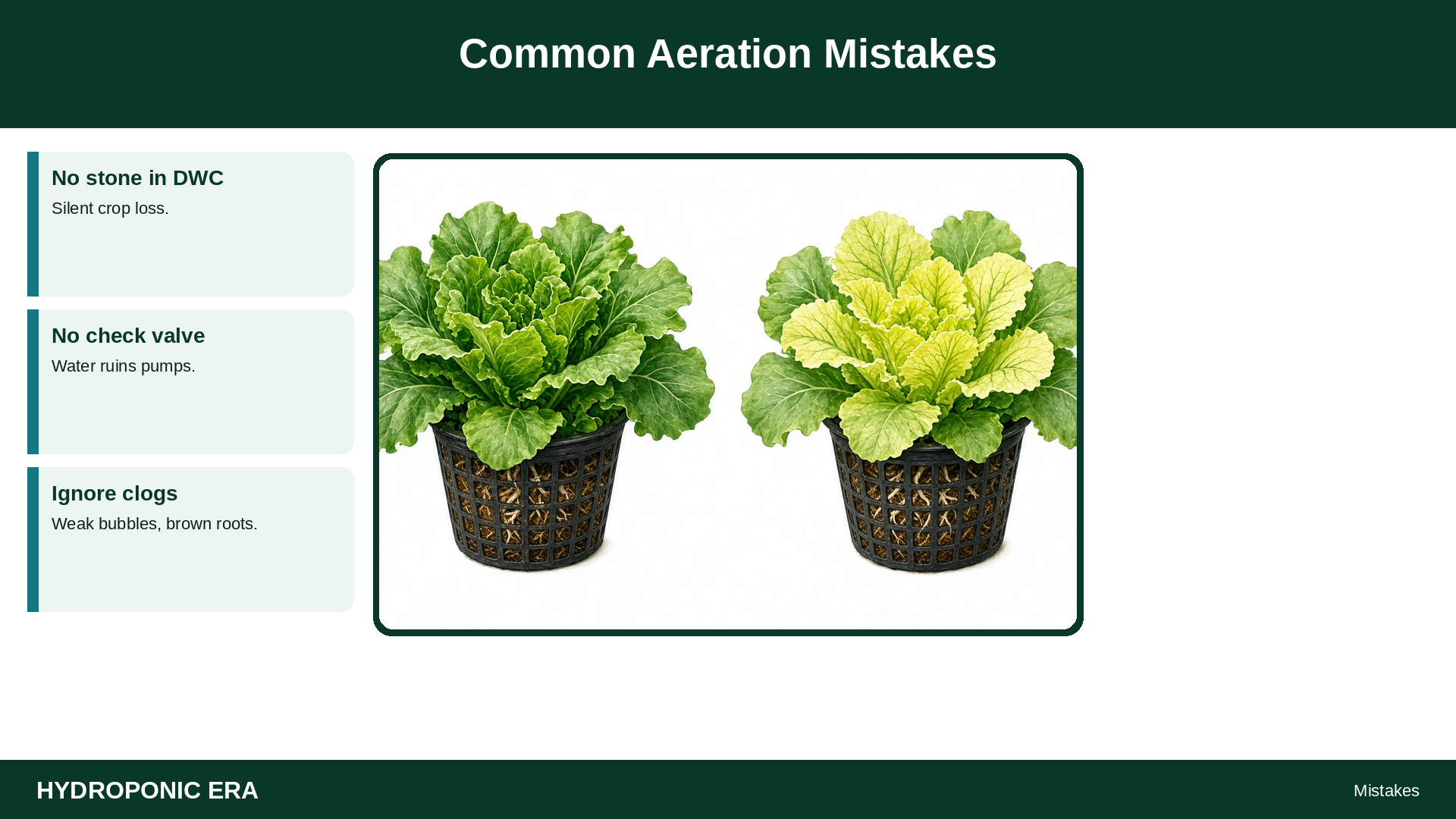
- Running DWC with no air stone “because the water looks clear”
- Mounting the pump below the waterline with no check valve
- One tiny USB pump for a huge root basket in summer heat
- Never cleaning stones until flow is a sad trickle
- Pointing bubbles at the wall instead of the roots
- Assuming NFT channel flow failures can be fixed with an air stone alone
- Ignoring overnight power outages for DWC (battery backup planning for critical systems)
Troubleshooting Weak Aeration
| Symptom | Likely cause | Fix |
|---|---|---|
| Few bubbles | Clogged stone, kink, dying pump | Inspect line → clean/replace stone → test pump in open air |
| Uneven stones on a splitter | Pressure imbalance | Adjust valves; upsizing pump; shorten runs |
| Pump humming, no air | Failed diaphragm / blocked outlet | Rebuild or replace pump |
| Roots brown despite bubbles | Heat, pathogens, still insufficient DO, toxic event | Check temperature, cleanliness, EC; read brown-roots + DO guides |
| Water in the pump | Back-siphon | Add check valve; raise pump; clear water from pump |
| Loud vibration | Pump on hard resonant surface | Foam pad; secure tubing |
Maintenance Schedule (Beginner)
| Cadence | Task |
|---|---|
| Daily (DWC) | Confirm audible pump + visible bubbles |
| Weekly | Check tubing kinks, valve position, reservoir temp |
| Each reservoir change | Rinse stones; wipe biofilm; inspect check valve |
| Monthly / as needed | Deep-clean or replace stones; test spare pump |
| Between crops | Full sanitize of lines and stones if disease showed up |
Spare strategy: Keep a backup air pump for DWC. They are inexpensive compared with losing a mature crop overnight.
Stone types: Cylinder and disc stones both work; prioritize reliable fine bubbles and cleanability over aesthetics. Ceramic stones clog differently than cheap mineral stones—judge by performance.
Manifolds: Gang valves help balance sites. Label lines in multi-bucket rooms so you can isolate a failing stone quickly.
Relation to media: In Dutch buckets filled with clay pebbles, oxygen often comes from drain-off and porous media more than from a giant stone in every bucket—but the shared reservoir can still benefit from aeration. See growing media and Dutch bucket.
Relation to EC/pH: Aeration does not fix nutrient burn or lockout. Measure chemistry separately with the nutrients, pH, and burn guides.
What to Check in Your Own System
- Can you see vigorous bubbles under the roots right now?
- Is the pump hot, weak, or silent?
- Is reservoir temperature elevated in the afternoon?
- Are stones crusted or soft with slime?
- Is there a check valve on submerged-risk lines?
- Do you have a spare pump tested in the last month?
Final Air Pump Checklist
- System type matched to aeration strategy
- Pump sized with headroom for depth and manifolds
- Stones placed under roots
- Check valves installed where needed
- Daily bubble confirmation habit
- Cleaning/replacement schedule
- Temperature and hygiene managed in parallel
Failure Modes Worth Planning For
The expensive failures are silent ones: a pump that dies at 2 a.m. in a warm DWC tub. Mitigation options include a backup pump on a shelf, a simple power alarm, or splitting critical sites across two pumps so one failure does not zero all airflow. None of these require lab gear—only a decision before harvest week.
Another failure mode is “bubbles I can see in the corner but not under the roots.” Stones migrate, airlines slip, or lids push stones aside during maintenance. After every reservoir service, confirm placement again.
Biofilm turns premium stones into decorative paperweights. During water changes, scrub stones and consider a dilute sanitizing protocol compatible with your system materials between crops—especially after root disease. Do not dump harsh sterilants into a tank with live plants.
Connect aeration to the rest of the stack: temperature control, light-proofing against algae, sensible EC, and clean changes. An air stone is necessary in DWC, but it is not a cure-all. Use the dissolved-oxygen draft as the physiology layer and this article as the hardware layer.
Noise, Placement, and Household Practicality
Air pumps vibrate. Place them on foam, inside a ventilated cabinet with airline ports, or on a shelf that does not amplify noise into living spaces. Overheating a sealed box will kill pumps—ventilation beats silence if those are in conflict.
Route airlines so lids still seal against light (algae control) while allowing quick stone removal. Labeled quick-disconnects save messy reservoir changes. Keep a small parts kit: spare stones, check valves, airline, gang valves, and clamps.
Connecting Aeration to Crop Choice
Heavy-feeding fruiting vines in DWC create large root mats that demand more oxygen than a single lettuce jar. If you insist on DWC cucumbers, plan larger air capacity and cooler water from day one—or choose Dutch bucket media culture instead. Leafy greens in cool rafts need less drama, but a failed stone still ruins a week of growth. Match hardware ambition to crop ambition.
Quiet reliability: air pumps and air stones maintenance
Loud does not mean effective. Maintain air pumps and air stones so oxygen delivery stays steady.
| Part | Weekly look | Replace / clean when |
|---|---|---|
| Air stone | Even bubble cone | Clogged, uneven, or sinking performance |
| Airline | No kinks; check valve direction | Cracks, back-siphon risk, persistent leaks |
| Pump | Steady tone; vents clear | Overheating, weak flow, water intrusion |
| Manifold / gang valves | Balanced outlets | One line starves while another blasts |
- Place stones where bubbles rise through the root zone, not only in a decorative corner.
- Account for tubing length and depth when sizing air pumps and air stones—rated free-air flow is not the same as flow at depth.
- Have a backup plan for power blips in warm rooms.
air pumps and air stones: practical review sheet
Use this review sheet to keep air pumps and air stones actionable after you finish the main guide.
- What did you measure today related to air pumps and air stones?
- What did you change with your hands (not just what you bought)?
- What will you re-check in 24–48 hours about air pumps and air stones?
- Which linked HydroponicEra guide should you reread next?
- What cleaning or logging step did you skip last cycle?
| Item | Today | Next check |
|---|---|---|
| Environment | ||
| Solution (pH/EC) | ||
| Roots / pests / biofilm | ||
| Plant response |
Print or duplicate this table in your notes app. The goal is not paperwork—it is fewer repeated mistakes around air pumps and air stones.
When results are unclear, slow down and restate the problem in one sentence that includes air pumps and air stones, then list the last three changes you made. Most home-system failures come from stacked changes without logs. Keep air pumps and air stones paired with basic hygiene: clean reservoirs, honest meter calibration, and root inspection. If you cannot explain your last adjustment, do not add another product. Re-read the troubleshooting section and apply one change at a time while you watch how air pumps and air stones interacts with pH, temperature, and oxygen.
When results are unclear, slow down and restate the problem in one sentence that includes air pumps and air stones, then list the last three changes you made. Most home-system failures come from stacked changes without logs. Keep air pumps and air stones paired with basic hygiene: clean reservoirs, honest meter calibration, and root inspection. If you cannot explain your last adjustment, do not add another product. Re-read the troubleshooting section and apply one change at a time while you watch how air pumps and air stones interacts with pH, temperature, and oxygen.
air pumps and air stones: habits that compound
These habits keep air pumps and air stones practical between deep cleans and big changes.
- Keep notes when you work on air pumps and air stones so small changes stay visible across weeks.
- Revisit air pumps and air stones after any reservoir reset, media change, or heat wave.
- Teach one other person your air pumps and air stones checklist—explaining it catches gaps.
- Photograph the system when air pumps and air stones looks correct; compare when it does not.
air pumps and air stones FAQs
Do I need an air stone if I already have a water pump?
In DWC, yes—you still want dedicated aeration. A water pump circulates solution; it does not automatically equal fine-bubble oxygenation of a deep root zone.
How many L/min do I need?
It depends on tank volume, depth, temperature, and root mass. Start with manufacturer guidance for aquarium/hydro sizes, then verify by root health and vigorous bubbling. Upsize if roots dull in warm conditions.
Can air stones cause pH drift?
Gas exchange and vigorous bubbling can influence dissolved gases and interact with your overall chemistry management. Still measure pH on a schedule; do not assume aeration replaces pH control.
Why are my roots brown even with an air pump?
Heat, disease pressure, high EC, stagnant corners, or a clogged stone can all contribute. Follow the brown-roots and dissolved-oxygen guides rather than only buying a louder pump.
Are USB aquarium pumps enough?
For a single tiny jar, maybe. For multi-plant DWC in warm rooms, usually no—use a proper multi-outlet hydro/aquarium pump with capacity headroom.
Sources
- Oklahoma State University Extension — Hydroponics
- University of Florida IFAS — HS405: Hydroponic Vegetable Production in Florida
- University of Minnesota Extension — Small-scale hydroponics
- University of Florida IFAS — HS1422: Growing Lettuce in Small Hydroponic Systems
- University of Florida IFAS — HS184: Building a Floating Hydroponic Garden
- Oklahoma State University Extension — Electrical Conductivity and pH Guide for Hydroponics
5 thoughts on “Air Pumps and Air Stones in Hydroponics: Sizing and Setup”