
Quick Answer: grow cilantro hydroponically
grow cilantro hydroponically as a cool-season leafy herb: start fresh seed in clean plugs, transplant into NFT, DWC, or a shallow media bed with mild nutrient strength, keep solution pH near a soilless band of about 5.5–6.0, give bright but not extreme heat, and harvest outer leaves or cut-and-come-again tops before the plant bolts. Cilantro (Coriandrum sativum) is the same plant that later produces coriander seed—once it flowers in warm conditions, leaf quality drops fast. Plan succession sowings every 2–3 weeks if you want continuous salsa-ready leaves.
Manage solution chemistry with the pH beginner guide and nutrients guide. For herb cluster context, see grow basil hydroponically (draft sibling) and hydroponic mint.
Key Takeaways
- Wisconsin Horticulture describes cilantro as a fast-growing annual that bolts readily in hot weather and will not survive a hard freeze—cool management beats “more fertilizer.”
- UF/IFAS Gardening Solutions notes cilantro does best in cooler seasons in Florida (fall/winter), tends to quit producing quality leaves when weather warms, and recommends succession sowing for a steady supply.
- Oklahoma State University’s hydroponics fact sheet lists herbs among crops commonly produced in soilless systems; treat cilantro as a leafy herb, not a fruiting vine.
- OSU’s EC/pH hydroponic guidance keeps solution pH roughly in the 5.0–6.0 availability band for soilless culture—aim near mid-band and stabilize rather than chasing daily swings.
- Prefer short crop cycles and frequent replants over trying to force one plant through summer heat under lights.
- Compare leaf-herb systems with hydroponic lettuce and DWC vs NFT vs Dutch bucket (draft sibling).
Related HydroponicEra guides
- Best plants for hydroponics
- Hydroponic garden beginners guide
- How often to change hydroponic water
- Best grow lights for hydroponics
- Hydroponic seedlings and transplanting (draft sibling)
- Reservoir temperature guidelines (draft sibling)

Why you grow cilantro hydroponically differently than basil
Cilantro and basil are both “herbs,” but they want different climates. Wisconsin Horticulture emphasizes that cilantro is a cool-season crop that bolts when hot; UF Gardening Solutions echoes the same pattern for Florida gardens—grow it when nights are cool, expect flowering when heat arrives, and keep sowing if you want leaves.
Basil tolerates warmer indoor tents; cilantro often tastes best when canopy air is cooler, light is strong but not scorching, and you harvest young. If your grow space routinely runs hot under LEDs, cilantro will still grow—but it may race to flower. That is plant physiology, not a failure of your nutrient brand.
The plant produces two kitchen products: fresh leaves (cilantro) and dried seed (coriander). Once the stem elongates and umbels form, leaf texture and flavor shift. Decide your goal before you plant: leaf harvests (most hydroponic hobbyists) versus intentionally letting plants set seed.
Choose a system to grow cilantro hydroponically
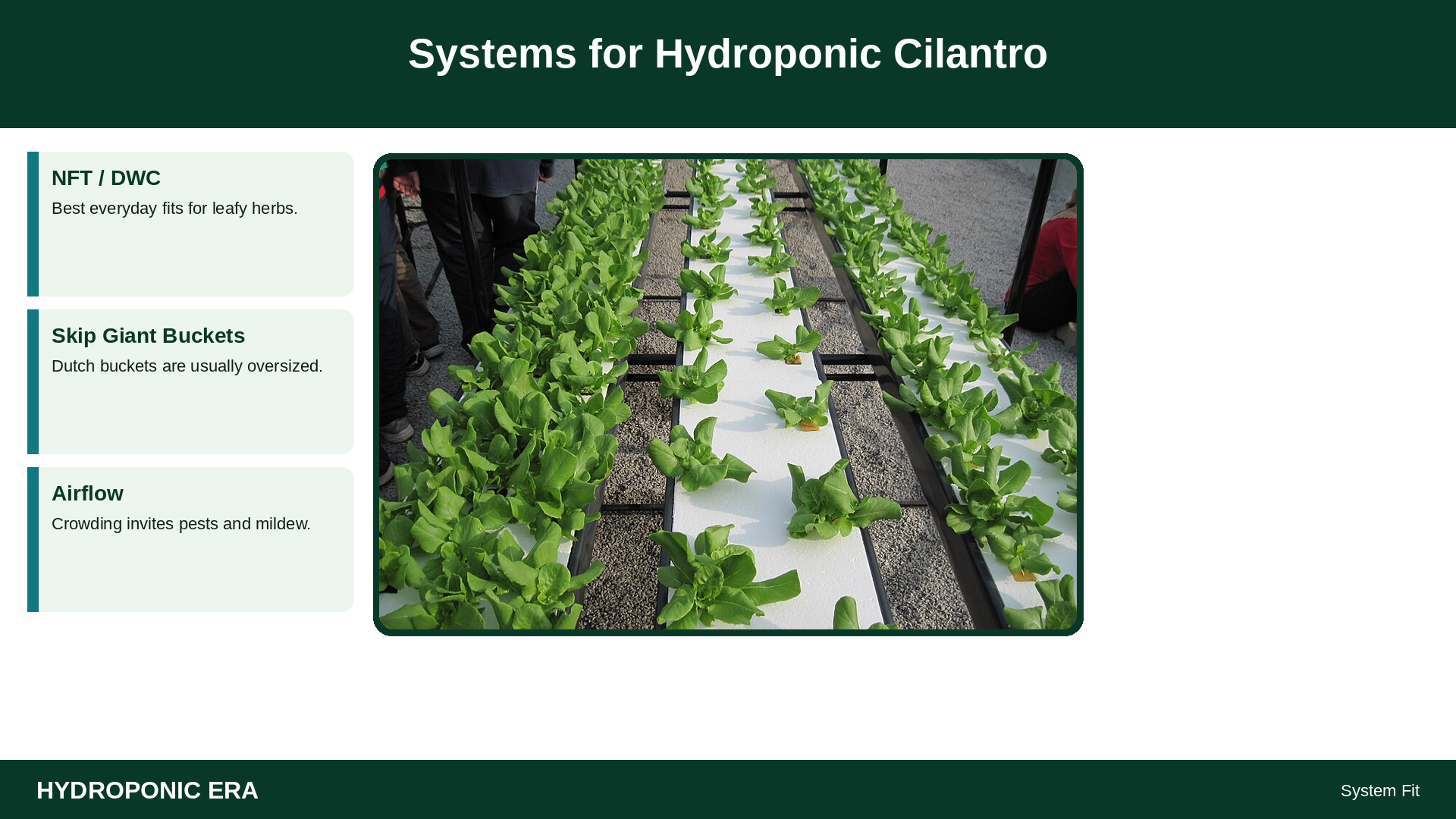
| System | Beginner fit for cilantro | Watch-outs |
|---|---|---|
| NFT channel | Excellent for dense leaf production | Keep slope/flow reliable; clear root mats between crops |
| DWC / raft | Good for small batches | Aerate well; watch reservoir heat under lights |
| Kratky (non-circulating) | OK for short leaf cycles | Less forgiving if you neglect top-offs in heat |
| Media bed / drip | Good | Avoid chronically soggy media that invites fungus gnats |
| Dutch bucket | Usually oversized for cilantro | Better reserved for tomatoes/cucumbers |
| Tower / pocket | Possible for short plants | Uneven light and tip dryness on upper pockets |
Oklahoma State’s hydroponics overview frames soilless culture as suitable for vegetables and ornamental/herb crops when you control nutrient solution and environment. UF’s small-system lettuce guidance (HS1422) and leafy greens protected-culture materials (HS1279) are useful analogs: cilantro is also a short leafy crop that rewards clean starts and stable fertigation more than heavy fruiting hardware.
If you are still choosing equipment, start with the hydroponic system beginner guide, NFT basics, and DWC basics.
Step-by-step: grow cilantro hydroponically

- Buy fresh seed. Cilantro germination drops with old seed. Skip mystery jars if you need reliable stands.
- Sow into clean inert plugs (rockwool, oasis-type foam, or similar) that fit your net pots. Keep evenly moist—not swampy.
- Give strong light as soon as sprouts appear so seedlings stay compact. Stretchy seedlings transplant poorly. See seedlings and transplanting.
- Transplant when roots show and true leaves are present. Support the stem; do not drown the crown.
- Start with mild vegetative nutrient strength. Cilantro is a leaf herb—max EC is not a badge of honor. Follow a complete hydroponic formula label.
- Set pH after mixing into a soilless availability band near 5.5–6.0 (OSU hydroponic EC/pH guidance centers the 5–6 range).
- Hold cooler canopy conditions when you can. Warm, still tents encourage bolting. Improve airflow and avoid parking reservoirs against hot ballasts/drivers.
- Harvest young and often. Take outer leaves or a cut above lower nodes; leave enough foliage to regrow if your cultivar allows.
- Succession sow. UF Gardening Solutions recommends sowing a few seeds every few weeks outdoors for steady supply—the same logic applies indoors.
- Refresh solution on a schedule matched to plant uptake—see water-change guidance. Between full crop cycles, clean thoroughly (cleaning and sterilizing draft).
Important Growing Variables
| Variable | Practical beginner guidance | Why it matters for cilantro |
|---|---|---|
| Temperature | Prefer cool-season conditions | Heat accelerates bolting (Wisconsin Horticulture; UF Gardening Solutions) |
| Light | Bright daily light; avoid heat stress from fixtures | Stretch + heat = early flower stalks |
| pH | ~5.0–6.0 solution band | OSU soilless hydroponic guidance |
| Nutrient strength | Mild to moderate leaf-herb strength | Burned tips are not “more flavor” |
| Root oxygen | Aerate DWC; keep NFT film moving | See dissolved oxygen draft |
| Reservoir temperature | Keep roots from cooking under lights | Reservoir temperature draft |
| Plant spacing | Enough airflow between plants | UF garden spacing note (~8 inches outdoors) translates to avoiding packed, wet canopies indoors |
| Crop timing | Plan short cycles + succession | One heroic plant rarely beats staggered sowings |
Penn State’s hydroponic plant-nutrition overview reminds growers that essential nutrients must be available in the root zone solution—pH and formulation errors show up as deficiency patterns even when “you added fertilizer.” If new leaves yellow while EC looks high, check lockout pathways in the nutrient lockout draft.
Harvesting Leaves vs Coriander Seed
For culinary leaves, harvest before the plant elongates into a tall flower stalk. Younger foliage is usually preferred for salsa and garnish. If you want coriander spice, allow plants to flower and set seed deliberately—do not expect peak leaf quality at the same time.
UF Gardening Solutions notes pinkish-white umbels that attract pollinators outdoors; indoors those flowers mainly signal the end of prime leaf harvests. After a flush of flowering, it is usually smarter to replace plants than to nurse woody stems.
Common Mistakes
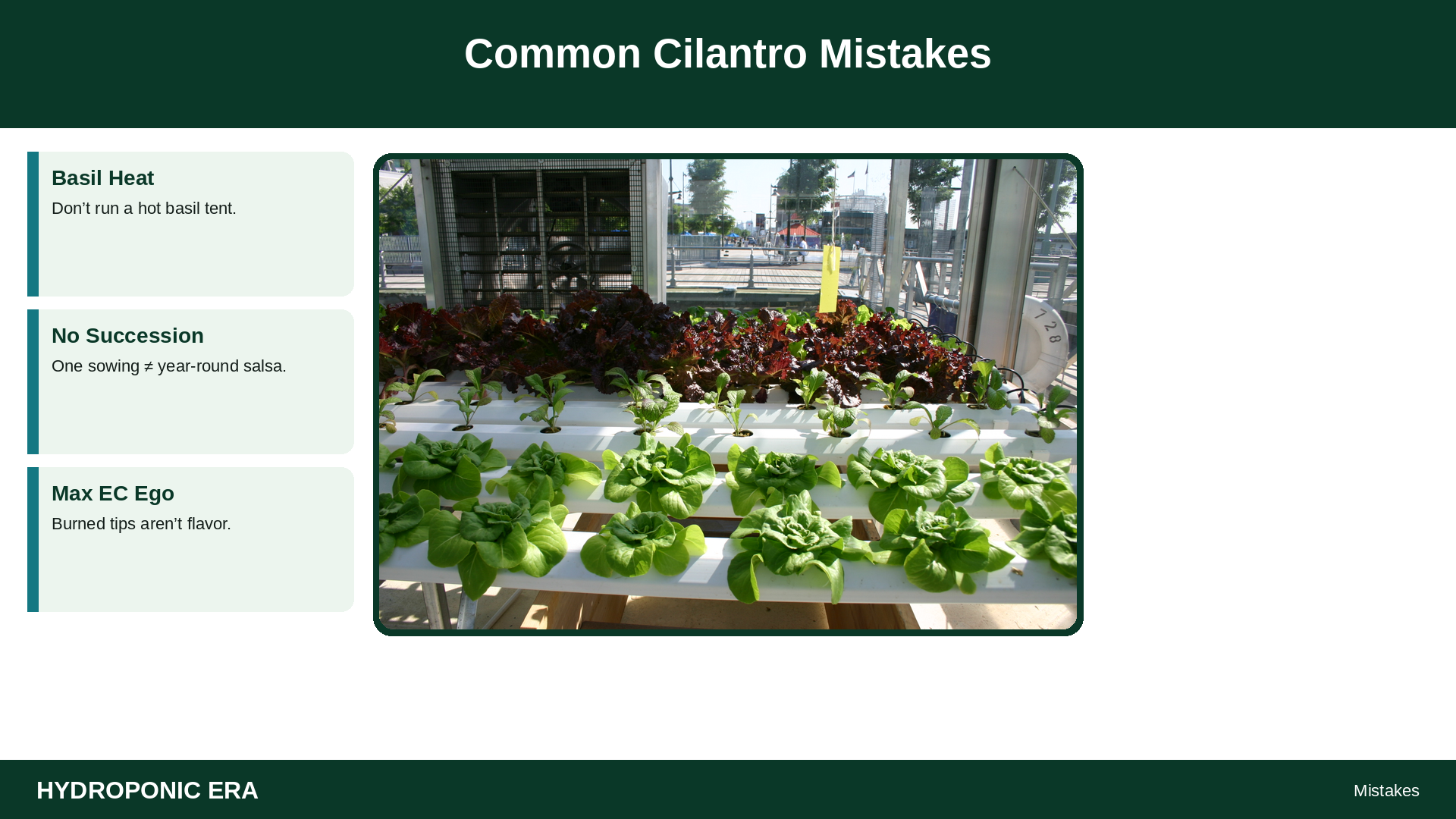
- Treating cilantro like heat-loving basil under a hot tent
- Skipping succession planting, then wondering why “the cilantro quit”
- Cranking EC too high at transplant and burning leaf margins
- Letting reservoirs bake, then blaming seed quality when plants bolt
- Reusing slimy net pots without cleaning between cycles
- Crowding plants until airflow collapses (disease and pest pressure rise)
- Ignoring fungus gnats in constantly wet media—see hydroponic pests draft
Troubleshooting Cilantro Problems
| Symptom | Likely causes | What to do |
|---|---|---|
| Rapid flower stalk / bolt | Heat, long stressful days, plant age | Cool the space if possible; harvest earlier; succession sow |
| Bitter or “off” leaves | Age, heat stress, irregular fertigation | Harvest younger; stabilize irrigation and temperature |
| Yellow new growth | pH availability / micronutrient issues | Verify pH; review lockout draft; avoid random additives |
| Leaf edge burn | High EC / nutrient burn | Dilute; see nutrient burn draft |
| Wilting with wet roots | Low oxygen / root disease pressure | Improve aeration; check brown roots guide |
| Sticky leaves / distorted tips | Aphids | Scout undersides; follow pests draft IPM steps |
| Poor germination | Old seed, cold plugs, uneven moisture | Fresh seed; warm even moisture; discard failures fast |
Broader yellowing patterns: yellow leaves guide. Algae slime on reservoirs: algae draft.
What to Check in Your Own Cilantro System
- Is canopy air cooler than a basil tent would be?
- Are you sowing every 2–3 weeks for continuous leaves?
- Is EC mild enough that leaf edges stay clean?
- Are roots pale and firm, with moving water or bubbles?
- Are net pots and channels cleaned between crop cycles?
- Is light bright without baking the reservoir?
- Are you harvesting before flower stalks dominate?
Nutrient and Water Management Specifics
Cilantro’s root system is modest compared with tomatoes, but it still depends on continuous access to a complete nutrient solution. Penn State’s hydroponic nutrition overview frames essential elements by function—when availability fails, deficiency symptoms appear even if bottles sit on the shelf. For beginners, that means: use a complete hydroponic formula, mix to a mild leaf-herb strength, measure, then adjust pH.
Between reservoir changes, top off with water or dilute solution depending on whether EC is rising or falling. Rising EC usually means plants are taking water faster than minerals—or evaporation is concentrating the tank. Falling EC can mean hungry plants or a mixing error. Pair this article with water-change timing rather than inventing a universal “change every X days” rule that ignores plant size and tank volume.
If you track dissolved solids, keep notes in one unit (EC or TDS) and one meter calibration habit. Inconsistent meters create fake “problems.” When tip burn appears, dilute first and verify pH before adding calcium “fixes” that may not be the constraint—see the calcium and magnesium draft and nutrient burn draft.
Light Schedule Without Cooking the Crop
Leafy herbs need enough daily light to stay compact and flavorful, but cilantro is sensitive to heat that often arrives with intense fixtures. Practical approach:
- Mount lights to manufacturer guidance and measure canopy temperature with your hand or a simple thermometer—not just “it looks bright.”
- Prefer steady photoperiods over chaotic on/off experiments while you learn the cultivar.
- If leaves bleach or edges crisp nearest the diodes, raise the light or dim before you raise EC.
- Use the grow lights guide and PPFD/DLI draft for measurement concepts; cilantro generally behaves like other leafy herbs rather than high-DLI fruiting vines.
Indoor gardens with mixed crops (basil + cilantro + lettuce) often fail cilantro first because the room is optimized for warmer plants. Separate cooler shelves or schedule cilantro in a cooler corner when possible.
Succession Planting Calendar (Framework)
Use this framework—not a rigid climate calendar—to keep leaves available:
- Week 0: Sow batch A in plugs.
- Week 2–3: Transplant batch A; sow batch B.
- Week 4–5: Begin leaf harvests on A; transplant B; sow batch C.
- When A elongates or flavor drops: Remove A, clean sites, move the next batch forward.
UF Gardening Solutions’ outdoor advice to sow a few seeds every few weeks maps cleanly to indoor hydroponics. The goal is overlapping leaf windows, not one giant harvest day.
For small commercial or CSA-style planning, the same framework scales: stagger channels or raft sections so you never harvest the entire system at once. That is crop planning discipline, not a promise of any particular yield number.
Media, Plugs, and Reuse Rules
Oklahoma State’s soilless growing mediums discussion and UF/IFAS media guidance (EP623) emphasize that media choice affects aeration, drainage, and sanitation. For cilantro:
- Single-use plugs are simplest for beginners.
- Reusable expanded clay can work in drip/media systems if cleaned between cycles.
- Do not “sterilize” by guessing random chemical mixes—follow labeled sanitizer directions and rinse requirements when you sanitize.
- Discard plugs that smell foul or carry fungus gnat larvae instead of dragging them into a clean reservoir.
After a full crop, use the between-crop checklist in cleaning and sterilizing a hydroponic system.
Beginner Shopping List (No Brand Hype)
- Fresh cilantro seed packet with a current pack date
- Inert plugs + net pots matched to your system
- Complete hydroponic nutrient (one- or multi-part) labeled for leafy growth
- pH meter or reliable kit + pH adjusters
- EC/TDS meter (optional but useful once you are past week one)
- Air stone + pump for DWC, or a working NFT pump with filter screen
- Opaque reservoir or light-blocking cover to slow algae
- Scissors reserved for harvest (clean blades reduce smear of sap and pathogens)
Supplies overview: hydroponic supplies for beginners and choosing a kit.
Bolting watch: grow cilantro hydroponically in warm rooms
Cilantro is a cool-season herb. When you grow cilantro hydroponically in a warm tent, plan successive sowings and gentler intensity.
| Signal | Meaning | Response |
|---|---|---|
| Sudden tall center spike | Bolting pressure | Harvest what is good; sow next cohort |
| Leafy but slow | Cool/mild conditions working | Keep steady; avoid hard EC pushes |
| Tip burn on fast growth | Environment / uptake stress | Review pH, humidity, and growth rate |
- Prefer cut-and-come-again or staged harvests over waiting for one giant plant in heat.
- Fresh seed and clean plugs matter—old seed frustrates growers who otherwise grow cilantro hydroponically well.
grow cilantro hydroponically: habits that compound
These habits keep grow cilantro hydroponically practical between deep cleans and big changes.
- Keep notes when you work on grow cilantro hydroponically so small changes stay visible across weeks.
- Revisit grow cilantro hydroponically after any reservoir reset, media change, or heat wave.
- Teach one other person your grow cilantro hydroponically checklist—explaining it catches gaps.
- Photograph the system when grow cilantro hydroponically looks correct; compare when it does not.
- Do not chase products until the basic grow cilantro hydroponically habits are consistent.
- If results stall, re-read the troubleshooting section with grow cilantro hydroponically in mind.
- Pair grow cilantro hydroponically with pH/EC logs rather than memory alone.
- Schedule a monthly review specifically about grow cilantro hydroponically and hygiene.
Review grow cilantro hydroponically together with your cleaning and measurement routine.
Review grow cilantro hydroponically together with your cleaning and measurement routine.
Review grow cilantro hydroponically together with your cleaning and measurement routine.
Review grow cilantro hydroponically together with your cleaning and measurement routine.
grow cilantro hydroponically FAQs

Can you grow cilantro hydroponically year-round indoors?
Yes, if you manage temperature and succession planting. Heat still pushes bolting under lights, so cool rooms or careful LED heat management matter more than calendar season alone.
What pH should cilantro use in hydroponics?
Stay in a typical soilless hydroponic band near 5.0–6.0 (Oklahoma State hydroponic EC/pH guidance). Pick a target near mid-band and correct slowly.
Is NFT or DWC better for cilantro?
Both work. NFT suits dense leafy production if flow stays reliable; DWC is simple for small batches if aeration and reservoir temperature are controlled. Dutch buckets are usually overkill.
Why does my hydroponic cilantro taste soapy?
UF Gardening Solutions notes some people perceive cilantro as soapy due to fatty aldehydes—genetics of the taster, not necessarily a nutrient error. Heat-stressed or bolted leaves can also taste harsher.
How do I keep cilantro from bolting?
Favor cooler conditions, avoid chronic heat at the canopy and reservoir, harvest young, and replace plants on a short cycle. You cannot permanently “stop” bolting with a bottled additive.
Can I get coriander seed from hydroponic plants?
Yes—allow flowering and seed set. Expect leaf quality to decline as the plant switches goals.
Sources
- Wisconsin Horticulture, Division of Extension — Cilantro / Coriander, Coriandrum sativum
- UF/IFAS Gardening Solutions — Cilantro
- Oklahoma State University Extension — Hydroponics (HLA-6442)
- Oklahoma State University Extension — Electrical Conductivity and pH Guide for Hydroponics
- Penn State Extension — Hydroponics Systems and Principles of Plant Nutrition
- UF/IFAS EDIS — Growing Lettuce in Small Hydroponic Systems (HS1422)
- UF/IFAS EDIS — Leafy Greens in Hydroponics and Protected Culture for Florida (HS1279)
- UF/IFAS EDIS — Hydroponic Vegetable Production in Florida (HS405)
1 thought on “How to Grow Cilantro Hydroponically: Cool-Season Herb Guide”