
Quick Answer: indoor pollination hydroponics
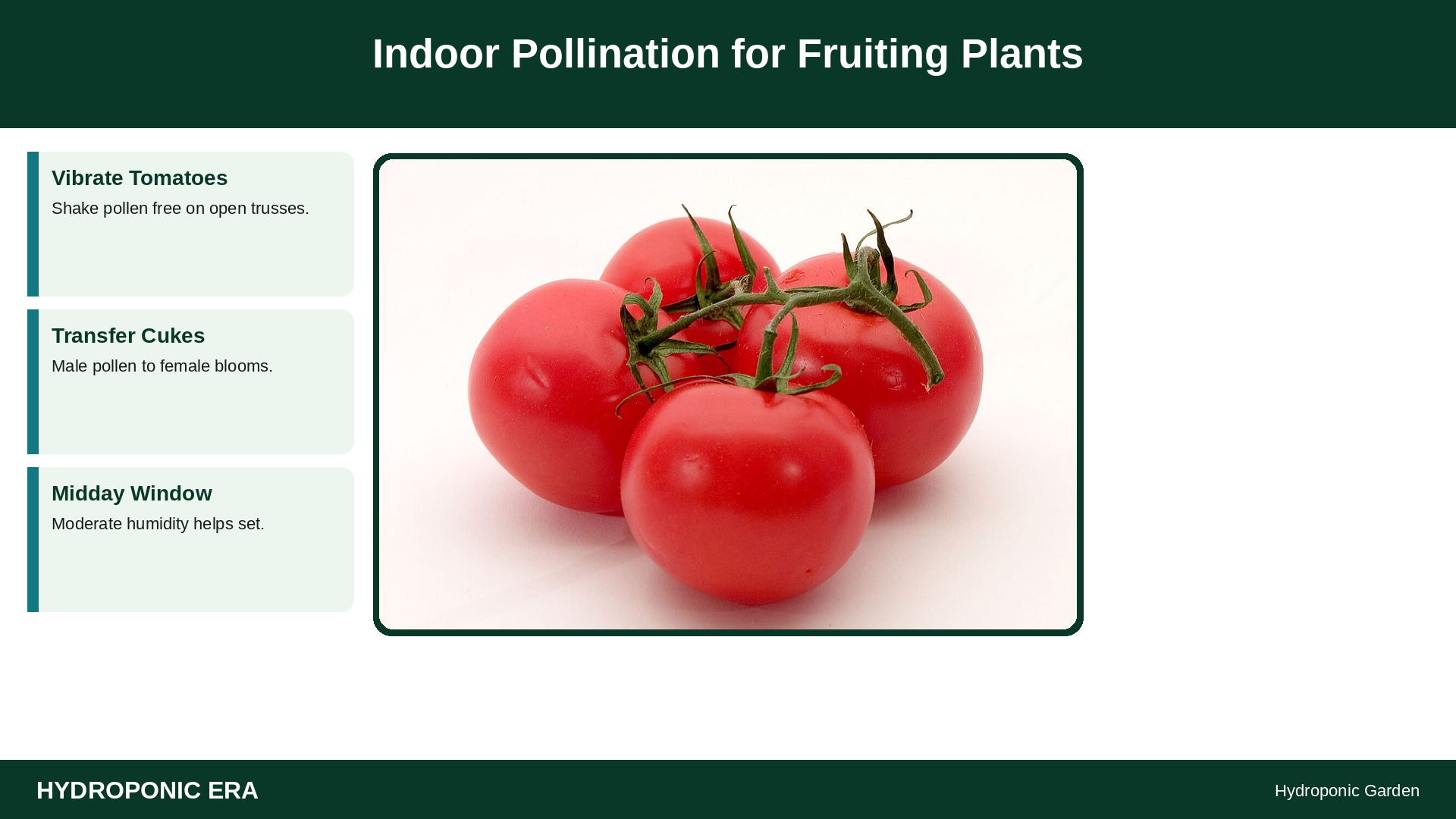
indoor pollination hydroponics means deliberately moving pollen when wind and wild bees are missing. Tomatoes and peppers usually need flower vibration (electric toothbrush, dedicated vibrator, or careful tapping) during midday humidity windows; many cucumbers need pollen transferred from male to female flowers unless you grow parthenocarpic (seedless) greenhouse types. Strawberries and other insect-dependent crops may need hand transfer or managed pollinators in larger spaces. Without a pollination plan, hydroponic vines can look healthy, flower heavily, and still set little fruit.
Crop context: hydroponic tomatoes, hydroponic peppers, grow cucumbers hydroponically (draft sibling), and hydroponic strawberries.
Key Takeaways
- UF/IFAS greenhouse tomato production guidance (CV266) states tomatoes are self-pollinated but still need vibration to release pollen onto the stigma indoors—outdoor wind is missing in sealed rooms.
- University of Connecticut IPM materials for greenhouse tomatoes recommend vibrating flower-cluster stems for a few seconds, every other day around midday, without crushing petals into the ovary.
- University of Kentucky’s small-scale soilless guide for tomatoes, peppers, and cucumbers notes hand pollination is most practical in small houses; commercial bumblebee hives can be oversized for tiny spaces and may damage flowers with excessive visits.
- Colorado State Extension (Pueblo County) explains perfect flowers (tomato, pepper) vs imperfect flowers (cucumber) and why brush transfer differs by crop.
- Humidity extremes reduce success: too dry and pollen may not stick; too wet and pollen may clump—extension greenhouse guidance often points to mid-day windows roughly in a moderate humidity band.
- Parthenocarpic cucumbers can fruit without pollination—read the seed packet before you blame your toothbrush.
Related HydroponicEra guides
- Dutch bucket hydroponics for beginners
- Best grow lights for hydroponics
- How to control pH in hydroponics
- PPFD and DLI light levels (draft sibling)
- Indoor hydroponic garden guide
Why indoor pollination hydroponics fruit needs help
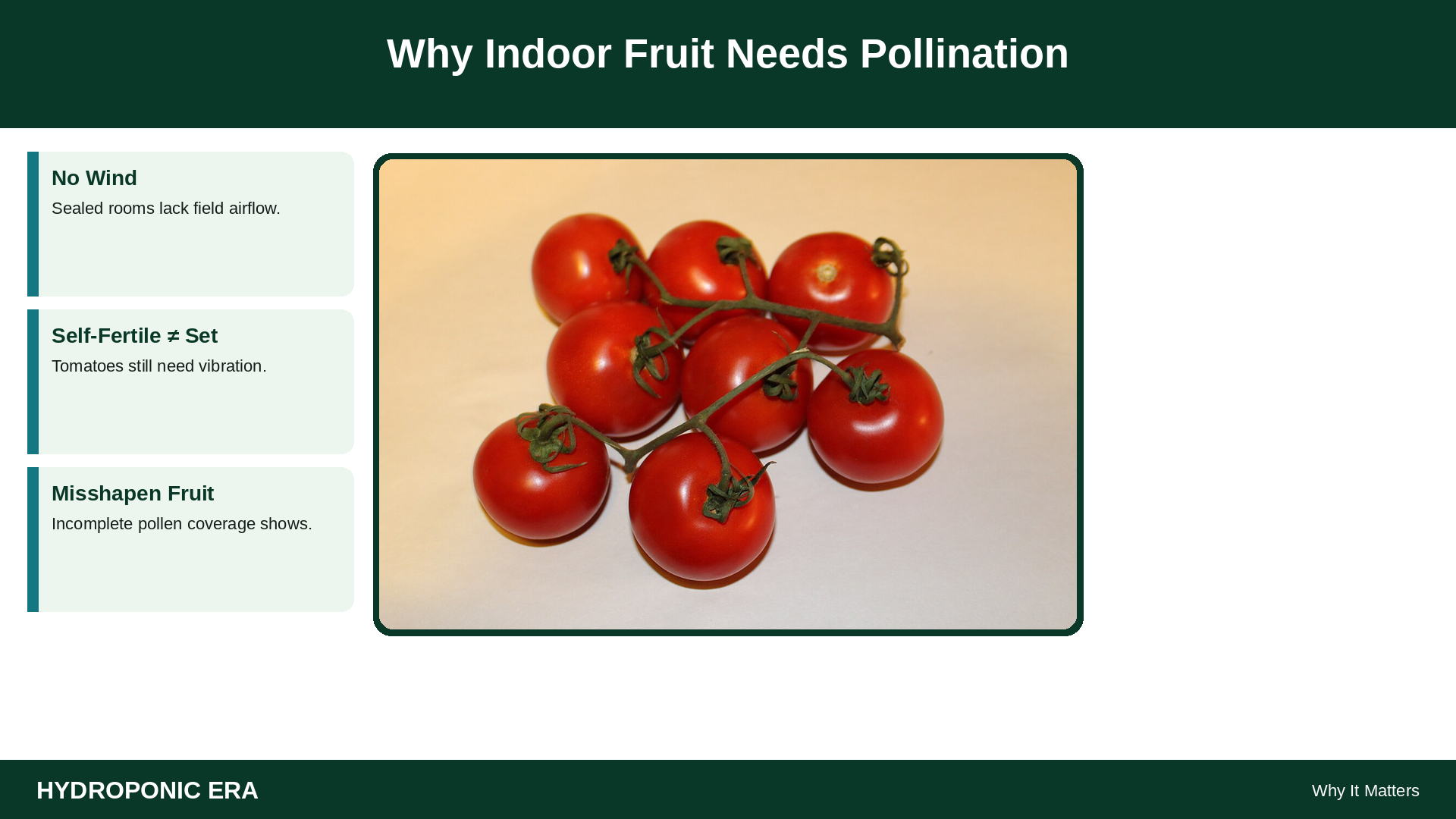
Fruit set is not automatic just because a plant is healthy in a reservoir. Pollen must leave the anthers and land on a receptive stigma (or, for some cultivars, fruit must form without fertilization). Sealed grow tents and many greenhouses lack the wind and insect traffic that field crops rely on.
UF/IFAS CV266 describes mechanical vibration and even air-blast/leaf-blower approaches for greenhouse tomatoes because density and enclosure reduce natural pollen shed. UConn’s greenhouse tomato pollination sheet adds that insufficient pollination can yield misshapen fruit—not only empty trusses.
Hydroponics solves water and mineral delivery; it does not invent pollination biology. Treat pollination as a scheduled cultural task, like checking pH.
Match Method to Crop
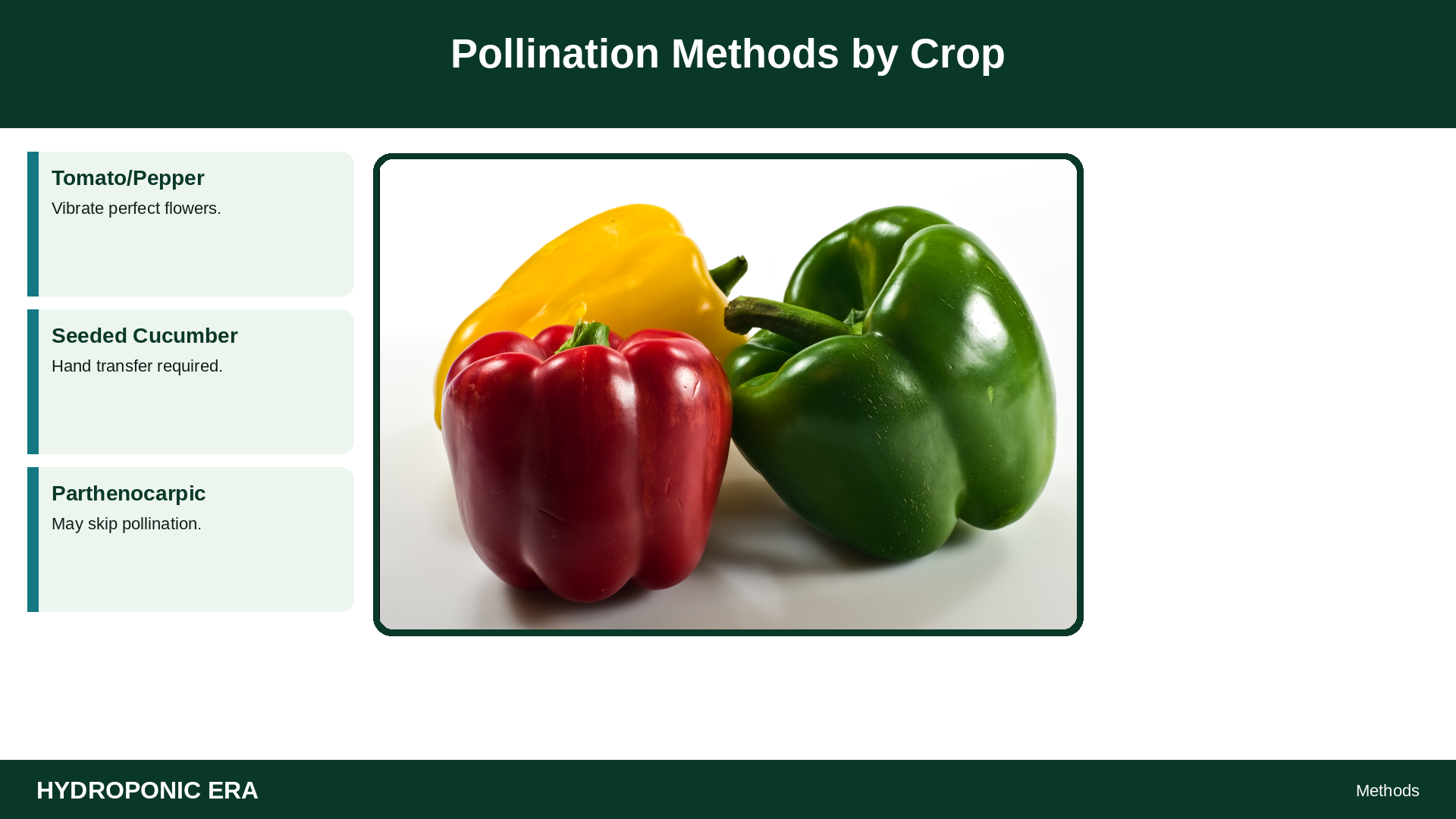
| Crop | Flower type (practical) | Typical indoor method | Notes |
|---|---|---|---|
| Tomato | Perfect (male + female parts in one flower) | Vibrate cluster stem / truss | UF CV266; UConn IPM; KY W844-C |
| Pepper | Perfect | Gentle vibration or soft brush within flower | KY notes 3–4× weekly often used in small systems |
| Eggplant | Perfect | Vibration / brush | Similar logic to tomato/pepper |
| Cucumber (seeded) | Male and female flowers separate | Transfer pollen male → female | Female flower has tiny fruit behind bloom |
| Cucumber (parthenocarpic) | Designed for seedless fruit | Often no pollination needed | Confirm cultivar |
| Strawberry | Needs pollen distribution across receptacle | Soft brush; fans help somewhat | Incomplete pollination → misshapen berries |
Colorado State Extension’s hand-pollination overview is a clear primer on perfect vs imperfect flowers. Pair it with crop pages rather than using one technique for every plant.
Step-by-Step: Tomato and Pepper Vibration
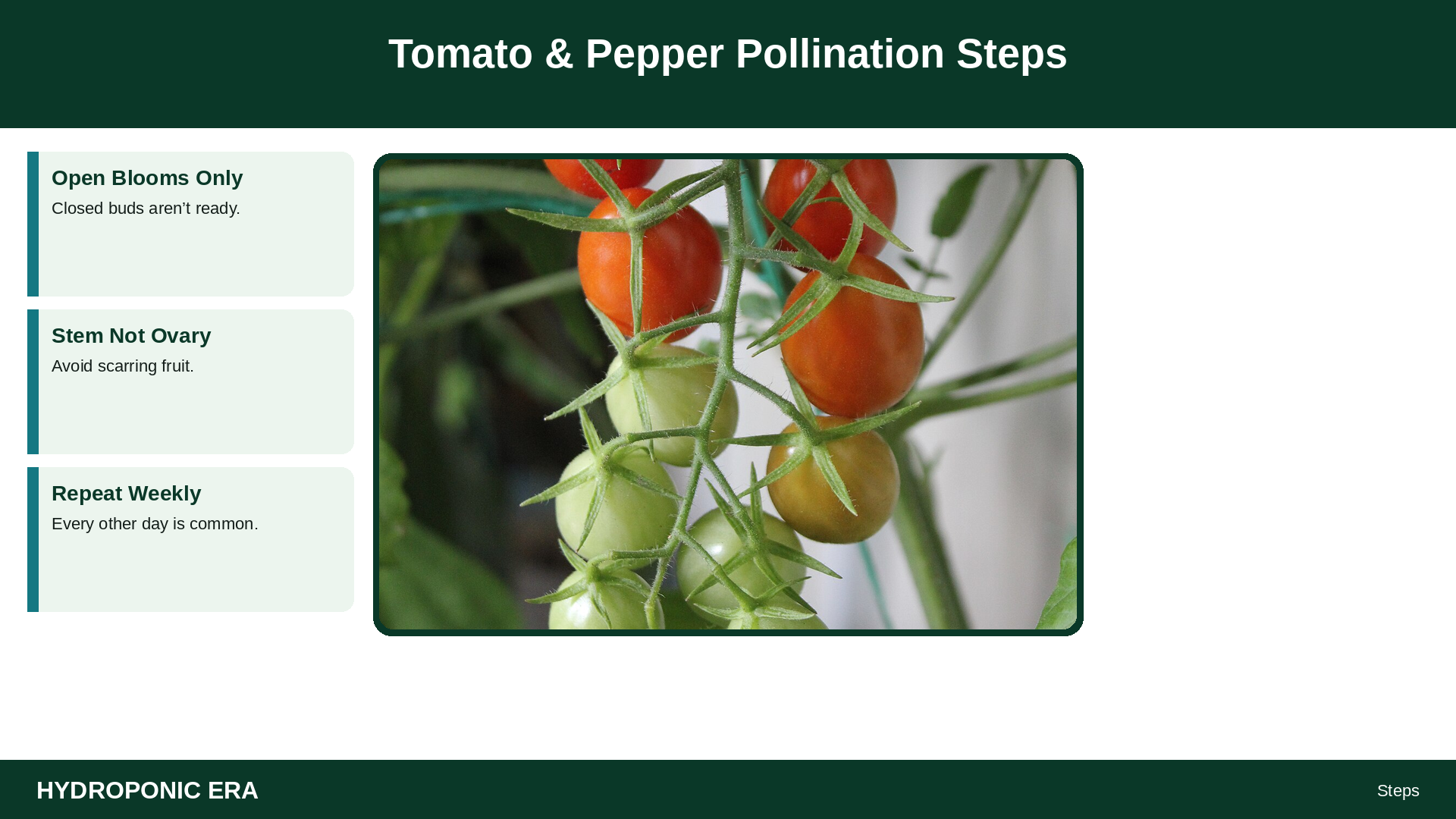
- Wait for open flowers. Closed buds are not ready.
- Choose timing. UConn suggests midday when relative humidity is often more favorable; KY notes roughly 60–80% RH as a helpful band for small soilless systems. Extremely dry or dripping-wet canopies reduce success.
- Use a clean vibrator tool. Battery pollinator, electric toothbrush, or similar—UF notes purpose-built tools reduce damage versus rough homemade gadgets.
- Touch the flower cluster stem (tomato) for about one to two seconds—not the soft ovary. UConn warns against poking flowers in ways that scar developing fruit.
- Repeat on every truss with open blooms every other day or about three to four times weekly (extension small-greenhouse practice ranges).
- Watch for fruit swell behind blossoms within days. Persistent drop after bloom may mean heat, low light, nutrition, or pollination gaps—not only “bad genetics.”
- Keep canopy airflow gentle. Fans help gas exchange; they are not a full substitute for vibration in dense tomato rows.
UF also describes air-blast or leaf-blower passes aimed at clusters as a faster option some growers use. In a tiny tent, start with a toothbrush—you will feel feedback and avoid blasting solution everywhere.
Step-by-Step: Cucumber Hand Transfer
- Identify male vs female flowers. Female blooms show a miniature cucumber behind the petals; males sit on a thinner stem without that ovary.
- Collect pollen with a soft brush, cotton swab, or by removing a male flower and touching anthers to the female stigma.
- Transfer the same day flowers are open and receptive.
- If using parthenocarpic greenhouse cucumbers, skip transfer unless the packet says otherwise—UF cucumber production materials and KY soilless notes distinguish seedless types.
- Support vines so flowers are reachable; tangled canopies hide blooms and reduce your consistency.
Environment Variables That Change Pollination Success
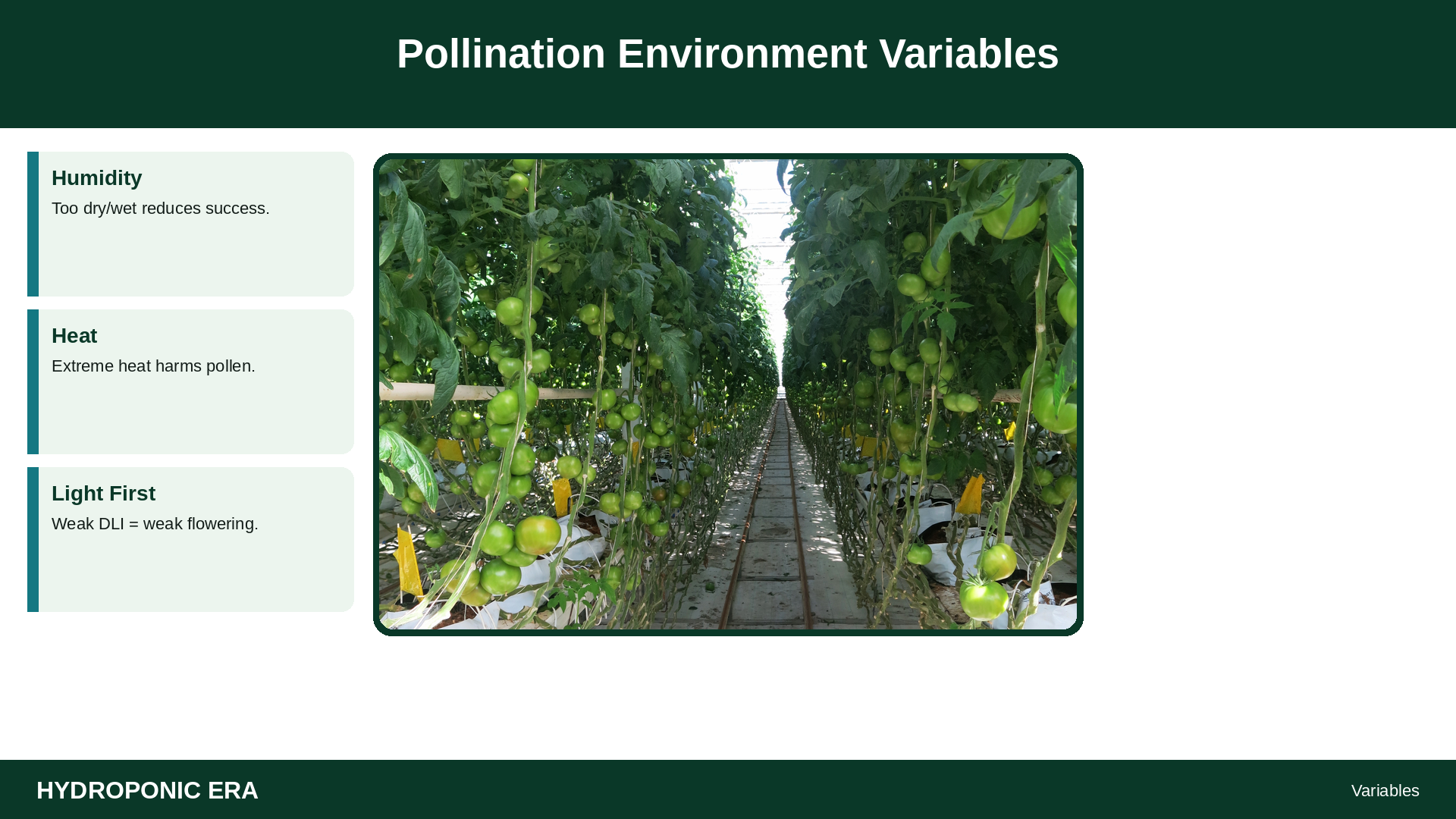
| Variable | What to watch | If it fails |
|---|---|---|
| Humidity | Mid-range midday windows preferred in greenhouse guidance | Adjust ventilation; avoid fogging flowers then vibrating immediately |
| Temperature | Extreme heat can reduce pollen viability (CSU notes high heat risks for tomatoes) | Cool the room; pollinate in milder hours |
| Light / DLI | Weak light → weak flowering | Fix lighting before blaming pollination tools |
| Nutrition | Severe stress aborts flowers | Stabilize EC/pH; see nutrients and lockout drafts |
| Plant training | Hidden flowers never get vibrated | Trellis and prune for access |
| Cultivar | Parthenocarpic vs standard | Read seed descriptions before troubleshooting |
Strong daily light still matters: fruiting crops are high-demand. Use PPFD/DLI guidance and the grow lights article alongside pollination habits.
Bumblebees and Larger Spaces
Commercial greenhouses often use bumblebees for tomato buzz-pollination. UConn and KY both note labor savings at scale—and KY warns that the smallest commercial hives can still be too large for very small greenhouses, leading to flower damage from excessive visits and poor cost fit when only a few plants are present. Hobby tents should default to hand methods unless you have a managed enclosure and a clear pollinator plan.
Do not release unmanaged insects into living spaces. Keep food-safety and household safety in mind if you ever expand beyond a hobby tent.
Common Mistakes
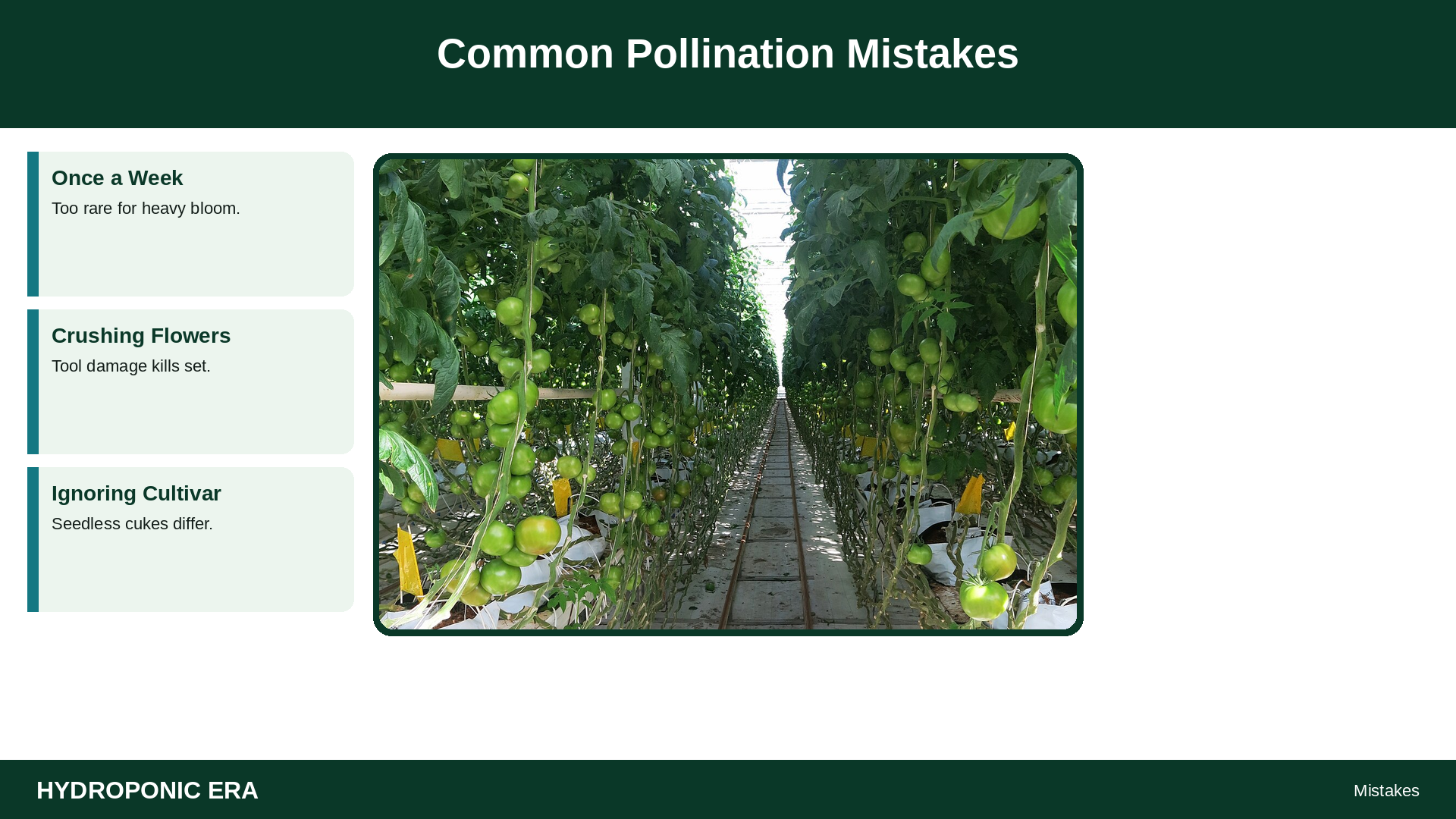
- Assuming flowers automatically become fruit indoors
- Crushing tomato flowers instead of vibrating the truss stem
- Pollinating only once a week on a heavy tomato crop
- Trying to hand-pollinate seedless cucumbers that never needed it—or skipping transfer on seeded types
- Blaming nutrients when the real gap is zero pollen movement
- Pollinating during extreme heat spikes when pollen is compromised
- Ignoring low light: empty flowers are not only a pollination story
Troubleshooting Poor Fruit Set
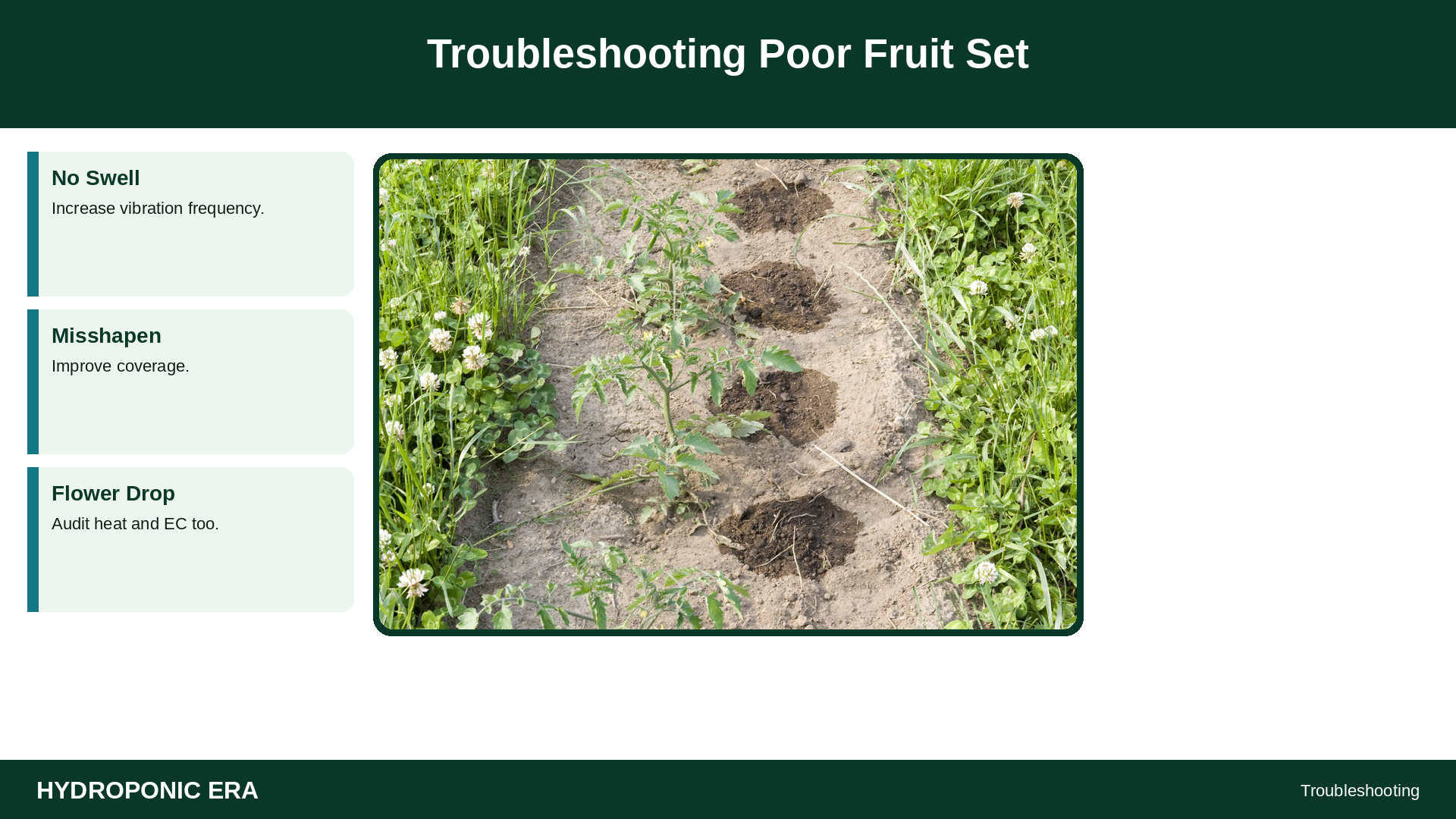
| Symptom | Check first | Next actions |
|---|---|---|
| Flowers drop, no fruit | Did you vibrate/transfer on schedule? | Increase frequency; verify humidity/heat |
| Misshapen tomatoes/berries | Incomplete pollination possible | More thorough vibration/brush coverage |
| Cucumber blooms without fruit swell | Male→female transfer missing | Hand pollinate or switch cultivar type |
| Lots of foliage, few flowers | Light / DLI / nitrogen balance | Improve light; review fertigation stage |
| Blossom end issues on fruit | Calcium uptake / irrigation consistency | Ca/Mg draft |
| Burned flower margins | High EC / heat / spray damage | nutrient burn draft |
What to Check in Your Own Fruiting Room
- Do you have a written pollination schedule (days/times)?
- Can you reach every open flower without damaging plants?
- Is midday humidity in a workable band?
- Are temperatures frying pollen on hot afternoons?
- Does each cultivar actually require pollination?
- Is daily light high enough for flowering crops?
- Are you confusing nutrient burn with poor set?
Decision Tree: Which Pollination Path?
- Growing only leafy greens/herbs? Skip this article’s workflow—focus on light and nutrients.
- Growing tomatoes/peppers in a tent? Start mechanical vibration 3–4× weekly.
- Growing seeded cucumbers? Learn male/female transfer.
- Want less labor on cucumbers? Choose parthenocarpic greenhouse cultivars.
- Operating a larger greenhouse? Compare labor of hand pollination vs managed pollinators using extension greenhouse guidance—not social-media hive hacks.
- Still no set after solid pollination habits? Audit heat, light, EC/pH, and root health next.
Strawberries and Other Specialty Cases
Strawberry flowers need pollen distributed across the receptacle for well-formed berries. Incomplete coverage produces puckered fruit even when plants look vigorous. In hydroponic gutters or towers, use a soft brush to sweep open flowers during bloom, and keep airflow gentle enough that pollen can move without desiccating blooms. See the strawberry hydroponic guide for system context.
Beans and peas often set more easily than tomatoes in small indoor spaces, but they still appreciate airflow and adequate light. Focus your labor where biology demands it: buzz-pollinated or vibration-dependent crops and monoecious cucurbits.
Hygiene for Pollination Tools
Reserve a toothbrush or brush for plants only. If you move between cultivars and care about keeping lines separate, clean or swap tips. Do not dip tools in nutrient solution and then into flowers. After chemical sprays (if you ever use labeled products), respect any re-entry or pollination timing constraints on the label—never invent “safe wait times.”
Food crops deserve clean hands and clean tools. Between-crop sanitation of the wider system still matters more for root disease than for pollen tools, but sloppy habits stack risks. Pair with system cleaning guidance.
Integrating Pollination into Daily Hydroponic Chores
A workable hobby routine:
- Morning: check pumps, reservoir level, obvious pests.
- Midday: pollinate open flowers (vibration/transfer).
- Evening: quick canopy glance for stress, wilt, or mite webbing.
- Weekly: measure pH/EC, prune for access, update notes on fruit set.
Commercial-leaning growers should document who pollinated which house and when. That is operations discipline, not bureaucracy for its own sake—missed days show up as empty trusses two weeks later.
When Pollination Is Not the Bottleneck
If you vibrate faithfully and still see flower drop, audit:
- Night/day temperatures outside the cultivar’s comfort zone
- Insufficient DLI for fruiting crops
- Wild EC swings or pH lockout
- Root oxygen problems and brown roots
- Pest feeding on buds (thrips/aphids)
Use dissolved oxygen, lockout, and pests drafts as the next layer—not more aggressive shaking that damages flowers.
Practice Drill for First-Time Growers
Before your first big tomato flush, practice on a single open flower cluster: vibrate the stem, watch for a light pollen dust, then mark the date. Three to five days later, check for ovary swell. That feedback loop teaches timing better than reading alone. If nothing swells after repeated correct technique, shift attention to heat and light before buying a new gadget.
For cucumbers, photograph male and female flowers once so you stop second-guessing. Keep those reference photos next to your system.
Recording Results So You Improve
Keep a simple pollination log: date, time, humidity estimate, tool used, cultivar, and fruit-set notes one week later. After three weeks you will see whether midday sessions outperform evenings in your room. That local dataset beats generic advice. Share notes with your future self when you change LED height or add a dehumidifier.
If you run multiple tents, do not assume identical schedules—microclimates differ. Pollinate the hotter tent earlier if late-day heat kills pollen viability.
Midday routine for indoor pollination hydroponics
Pick a consistent window to practice indoor pollination hydroponics when flowers are receptive.
- Check humidity—not sopping, not desert-dry for your crop.
- For tomatoes/peppers: vibrate flower clusters (toothbrush/vibrator/tap method) during the chosen window.
- For many cucumbers: move pollen male→female as required by flower type; know your cultivar’s flowering habit.
- Mark a calendar for 3–5 days of follow-through during bloom peaks.
- Scout for pests while you are already touching plants.
| Crop | Typical indoor need | Skip-this mistake |
|---|---|---|
| Tomato | Vibration / airflow assist | Assuming fruit sets without any pollen movement indoors |
| Pepper | Vibration / gentle agitation | Only misting leaves and calling it pollination |
| Cucumber | Know flower sex / pollen transfer needs | Treating every cucumber like a self-setting outdoor garden type |
Indoor pollination hydroponics skill is repetition, not a single viral trick video.
indoor pollination hydroponics: habits that compound
These habits keep indoor pollination hydroponics practical between deep cleans and big changes.
- Keep notes when you work on indoor pollination hydroponics so small changes stay visible across weeks.
- Revisit indoor pollination hydroponics after any reservoir reset, media change, or heat wave.
- Teach one other person your indoor pollination hydroponics checklist—explaining it catches gaps.
- Photograph the system when indoor pollination hydroponics looks correct; compare when it does not.
- Do not chase products until the basic indoor pollination hydroponics habits are consistent.
- If results stall, re-read the troubleshooting section with indoor pollination hydroponics in mind.
- Pair indoor pollination hydroponics with pH/EC logs rather than memory alone.
- Schedule a monthly review specifically about indoor pollination hydroponics and hygiene.
Review indoor pollination hydroponics together with your cleaning and measurement routine.
Review indoor pollination hydroponics together with your cleaning and measurement routine.
Review indoor pollination hydroponics together with your cleaning and measurement routine.
Review indoor pollination hydroponics together with your cleaning and measurement routine.
Review indoor pollination hydroponics together with your cleaning and measurement routine.
Review indoor pollination hydroponics together with your cleaning and measurement routine.
indoor pollination hydroponics FAQs
Do hydroponic tomatoes need pollination indoors?
Yes. They are typically self-fertile, but pollen still must move. UF/IFAS greenhouse tomato guidance recommends vibrating flower clusters because enclosed houses lack outdoor wind assistance.
How often should I pollinate indoor tomatoes?
Extension small-greenhouse practice commonly lands around every other day or about three to four times per week while flowers are open, preferably midday.
Can a fan replace hand pollination?
Fans help airflow but are usually not enough alone in dense indoor tomato canopies. Use vibration as the primary method in tents.
Do peppers need the same method as tomatoes?
Peppers also have perfect flowers and often respond to gentle vibration or soft brushing. Consistency matters more than fancy tools.
Why are my cucumber flowers not fruiting?
Seeded types need pollen on female flowers. Confirm you have both flower sexes and transfer pollen—or grow parthenocarpic cultivars.
Should hobby growers buy bumblebees?
Usually no for small tents. KY notes hive sizing and flower damage risks in small houses; hand methods are the practical default.
Sources
- UF/IFAS EDIS — Greenhouse Cucumber Production (CV268)
- University of Kentucky — Tomatoes, Peppers and Cucumbers in Small-Scale and Soilless Hydroponics (W844-C PDF)
- UConn IPM — Pollination of Greenhouse Tomatoes (PDF)
- Colorado State University Extension (Pueblo County) — Hand Pollination
- Oklahoma State University Extension — Hydroponics
2 thoughts on “Indoor Pollination for Hydroponic Fruiting Plants: Tomatoes, Peppers, Cucumbers”