
Quick Answer: hydroponic nutrient burn
hydroponic nutrient burn is leaf-edge or tip damage from excess fertilizer salts (high electrical conductivity) or from a sudden jump in nutrient strength. Classic signs include crispy brown margins, burnt tips on otherwise dark green leaves, and a recent history of “I added more nutes.” Fix it by confirming high EC, diluting or resetting the reservoir, restoring a crop-appropriate strength, and stabilizing pH—not by adding more stimulants. Distinguish burn from deficiency, lockout, and underwatering before you act.
Use with nutrients for beginners, pH control, lockout troubleshooting, and water changes.
Key Takeaways
- Oklahoma State’s EC and pH hydroponic guide treats electrical conductivity as the practical meter reading for total dissolved fertilizer strength.
- Penn State’s hydroponic nutrition principles cover nutrient excess as well as deficiency—more is not automatically better.
- Burn often follows seedling transplants into full-strength adult solutions.
- Rising EC between top-offs means plants are removing water faster than nutrients—or you are topping off with nutrient solution instead of water.
- Tip burn can also involve calcium distribution issues; do not assume every tip is salt burn—see Ca/Mg draft.
- After a reset, return to mild strength and climb gradually.
- Damaged leaf edges will not turn green again; judge recovery by new growth.
Related HydroponicEra guides
- Yellow leaves troubleshooting
- Algae in reservoirs (draft)
- Reservoir temperature (draft)
- Best plants for hydroponics

What hydroponic nutrient burn looks like

Typical burn pattern:
- Leaf tips or margins turn tan/brown and feel dry or crispy
- The rest of the leaf may be unusually dark green
- Symptoms often start on older or outer leaves but can appear widely after a big EC spike
- Growth may slow after the burn event
Compare with:
| Look-alike | Clues it is not simple burn | See also |
|---|---|---|
| True deficiency | Yellowing patterns, pale growth, low EC | Yellow leaves guide; Penn State nutrient roles |
| Lockout | EC “looks fine” but pH is wrong | Lockout draft |
| Ca tip burn | Inner tips on rapid greens; moderate EC | Ca/Mg draft; UC IPM tipburn context |
| Heat bleach | Light-side scorch under LEDs | Grow lights / PPFD guides |
| Root disease wilt | Wet roots, foul smell, limp canopy | Brown roots guide |
Why Burn Happens in Hydroponics

- Mixing too strong relative to plant size and crop type
- Topping off with nutrient solution until EC climbs unnoticed
- Evaporation concentrating salts in small warm reservoirs
- Stacked additives (Cal-Mag + bloom boosters + “enzymes”) on top of a complete base
- Inaccurate meters or never calibrating EC/TDS pens
- Sudden recipe changes without a transition
- Ignoring crop differences (lettuce vs cucumber strength needs)
OSU’s EC/pH fact sheet is the right mental model: manage strength with a meter, and manage availability with pH. Penn State’s excess discussion reminds growers that nutrients above plant need become a stress, not a gift.
Step-by-Step: Fix Nutrient Burn
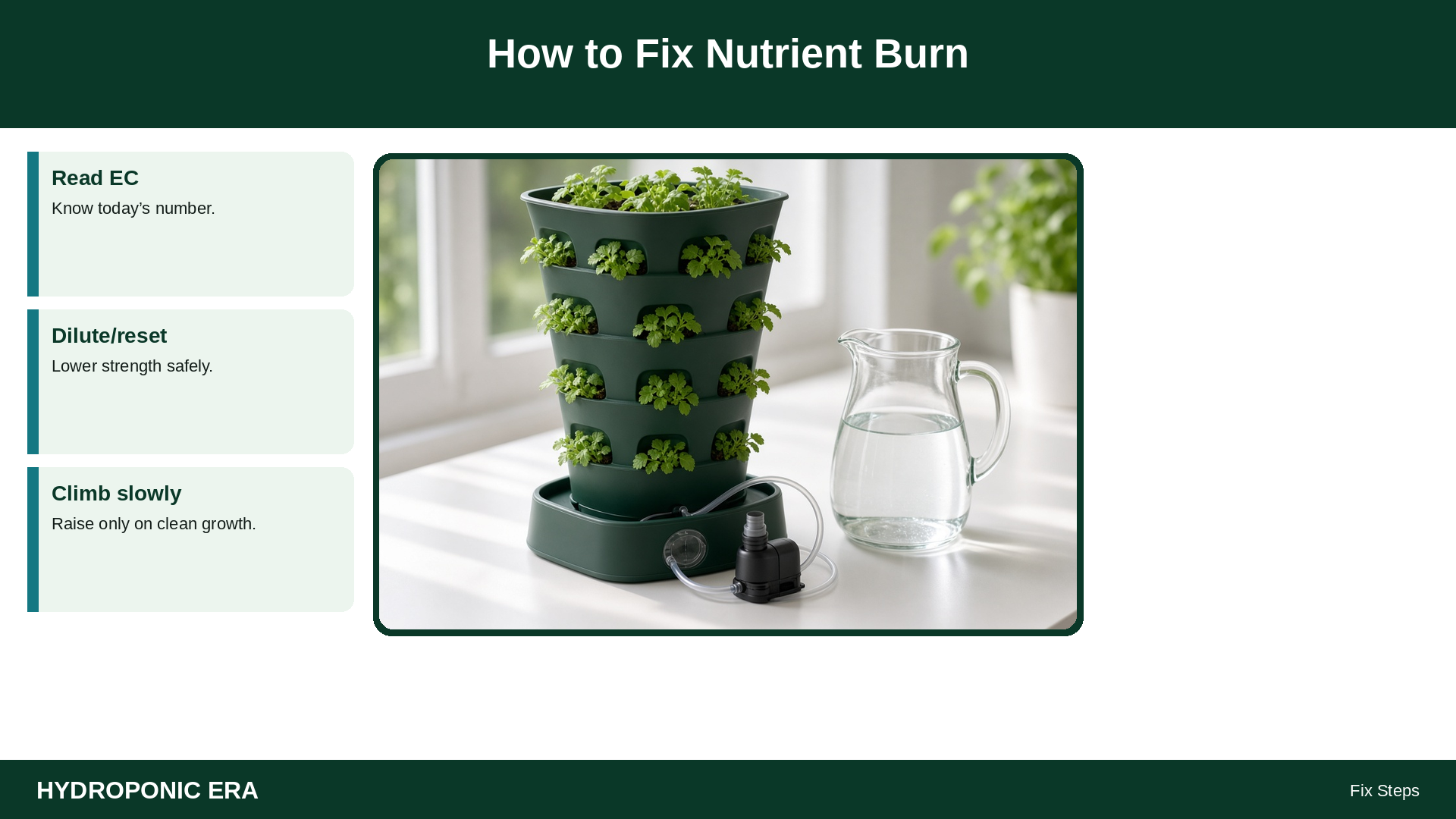
- Measure EC/TDS and pH immediately.
- If EC is clearly above your crop target, dilute with pH-adjusted water or perform a full reservoir reset.
- Remove only fully dead material if needed for hygiene; do not defoliate aggressively.
- Remix a milder complete nutrient solution appropriate for the current growth stage.
- Set pH into the soilless band (~5.0–6.0 per OSU guidance).
- Confirm roots are healthy. If roots are brown and slimy, fix oxygen/pathogen issues in parallel.
- Resume a logging habit: date, EC, pH, top-off water vs nutrient.
- Raise strength gradually only after new growth looks clean.
- Calibrate meters if readings seem unbelievable.
- Review additives—pause nonessential bottles during recovery.
Important Variables

| Variable | Burn connection | Beginner action |
|---|---|---|
| EC / TDS | Primary burn meter | Know crop-stage targets; log daily in small systems |
| pH | Can create lockout that looks like deficiency during recovery | Stabilize after every remix |
| Reservoir size | Small tanks swing faster | Top off with water when EC rises |
| Temperature | Warm tanks evaporate faster | See reservoir temperature draft |
| Crop type | Greens vs fruiting strength | Do not run tomato EC on baby spinach |
| Seedling age | Most burn-prone stage | Start mild |
Common Mistakes

- Reading TDS without knowing the meter’s conversion factor story
- “Feeding more” because leaves are yellow when EC is already high (possible lockout)
- Resetting without fixing the habit that caused the spike
- Expecting burned tips to heal cosmetically
- Mixing by teaspoons with no meter
- Copying someone else’s EC target for a different crop
Troubleshooting Table
| Situation | Interpretation | Action |
|---|---|---|
| Crispy tips + high EC | Classic nutrient burn | Dilute/reset; milder remix |
| Crispy tips + moderate EC + rapid lettuce growth | Possible Ca tip burn | Airflow + Ca/Mg framework |
| Yellow new leaves + odd pH | Lockout risk | Stabilize pH/EC; lockout guide |
| Burn after topping off with nutes only | Salt concentration | Top off with water; periodic full changes |
| Burn + foul roots | Compound stress | Oxygen/clean system + milder feed |
Prevention Routine
- Write target EC ranges for seedling / vegetative / fruiting stages
- Top off with plain water when volume drops and EC rises
- Full reservoir changes on a schedule matched to plant load
- Calibrate pens monthly (or per manufacturer)
- Introduce strength increases in steps
- Keep a one-line daily log in small systems
Worked example (framework, not a universal recipe): If a small basil DWC reads much higher EC than yesterday after evaporative loss, add pH-adjusted water until EC returns near your target, rather than adding more fertilizer. If chemistry is muddy after many top-offs, reset completely using the water-change guide.
Seedling rule: Many burn events start the day someone transplants plugs into “full bloom” strength. Begin mild, then climb.
Fruiting rule: Cucumbers and tomatoes may tolerate higher strength than spinach, but burnt leaf margins still mean you overshot for that plant in that environment. See crop guides for context, then meter your own tank.
Final Nutrient Burn Checklist
- EC/pH measured with a trusted meter
- Burn vs lockout vs Ca tip burn considered
- Dilution or reset completed
- Milder complete nutrient remixed
- Top-off habit corrected
- New growth monitored for 3–7 days
- Additives simplified during recovery
EC Habits That Prevent Most Burn Events
Most hobby burn stories share one plot: no daily meter check in a small tank. Adopt a three-rule habit set:
- Measure before you add. If you cannot quote today’s EC, do not add fertilizer.
- Top off with water when volume drops and EC rises. Plants often remove water faster than salts.
- Full-reset on a calendar scaled to plant load, not vibes—see the water-change guide.
Create stage cards on your phone: seedling EC range, leafy vegetative range, fruiting range. They do not need to be universal industry numbers—they need to be your consistent targets for your fertilizer brand and meter. When you change brands, rebuild the cards; different products deliver different ion mixes at the same EC.
During recovery from burn, judge success by the newest leaves. Photograph a marked leaf edge on day 0; compare day 7. If new growth is clean but old tips remain brown, you are on track. If new growth continues to burn at “mild” strength, recalibrate the meter and inspect for root disease or extreme heat amplifying stress.
Cross-link diagnoses: lockout can look hungry while EC is high; Ca tip burn can look like salt burn at moderate EC; heat bleach can look like burn under LEDs. Keep the lockout and Ca/Mg drafts in your troubleshooting loop.
Beginner Strength Ladder (Framework)
Use this as a behavior framework, not a universal ppm chart:
- Plugs / early seedlings: very mild complete nutrition after true leaves, or manufacturer seedling guidance.
- Early vegetative leafy plants: step up once roots are active and leaves are expanding without tip burn.
- Aggressive vegetative / pre-fruit: increase only if growth is pale from underfeeding—not if tips are already crispy.
- Fruiting: higher demand is real for cucumbers and tomatoes, but burnt margins still mean “too much for this plant today.”
If you change water source (tap to RO), expect the same milliliters of fertilizer to produce a different plant response because baseline minerals changed. Remeasure EC and watch leaves for a week after any water-source change.
Store opened nutrient bottles sealed and away from extreme heat. Degraded or poorly mixed concentrates create mysterious EC readings and localized hot spots in the reservoir if you dump undiluted product near roots. Always dilute into circulating water.
When to Reset vs Dilute
Dilute in place when the reservoir chemistry is otherwise clean, roots look healthy, and EC is only moderately high. Add pH-adjusted water, remix, and recheck.
Full reset when you have stacked many unknown additives, smell is off, roots look stressed, or you cannot explain the current reading. Dump, rinse, and rebuild a known mild solution. Document the new baseline so the same mystery does not return next week.
After either path, pause nonessential boosters for several days. Recovery is quieter when the ion recipe is simple and complete.
Dilution and reset steps for hydroponic nutrient burn
When edges crisp after a feeding mistake, treat hydroponic nutrient burn as a strength problem first.
- Stop adding fertilizer immediately.
- Measure EC/TDS and pH; write the numbers down.
- If EC is clearly high for the crop stage, dilute with pH-aware water or perform a controlled reservoir reset to a milder strength.
- Confirm roots are not fouled—burn and root disease can overlap visually on leaves.
- Resume a calmer feed; increase only after new growth looks normal.
| Clue | Burn more likely | Something else more likely |
|---|---|---|
| Recent “I added more nutes” | Yes | — |
| Only oldest leaves yellow slowly | Maybe not | Mobile nutrient issues / other stress |
| Foul roots + wilt | Maybe concurrent | Oxygen / pathogen / heat priority |
- Hydroponic nutrient burn is not fixed by adding “recovery” bottles on top of an already hot solution.
- Keep meters calibrated so you are not diluting based on fantasy ppm.
hydroponic nutrient burn: practical review sheet
Use this review sheet to keep hydroponic nutrient burn actionable after you finish the main guide.
- What did you measure today related to hydroponic nutrient burn?
- What did you change with your hands (not just what you bought)?
- What will you re-check in 24–48 hours about hydroponic nutrient burn?
- Which linked HydroponicEra guide should you reread next?
- What cleaning or logging step did you skip last cycle?
| Item | Today | Next check |
|---|---|---|
| Environment | ||
| Solution (pH/EC) | ||
| Roots / pests / biofilm | ||
| Plant response |
Print or duplicate this table in your notes app. The goal is not paperwork—it is fewer repeated mistakes around hydroponic nutrient burn.
When results are unclear, slow down and restate the problem in one sentence that includes hydroponic nutrient burn, then list the last three changes you made. Most home-system failures come from stacked changes without logs. Keep hydroponic nutrient burn paired with basic hygiene: clean reservoirs, honest meter calibration, and root inspection. If you cannot explain your last adjustment, do not add another product. Re-read the troubleshooting section and apply one change at a time while you watch how hydroponic nutrient burn interacts with pH, temperature, and oxygen.
When results are unclear, slow down and restate the problem in one sentence that includes hydroponic nutrient burn, then list the last three changes you made. Most home-system failures come from stacked changes without logs. Keep hydroponic nutrient burn paired with basic hygiene: clean reservoirs, honest meter calibration, and root inspection. If you cannot explain your last adjustment, do not add another product. Re-read the troubleshooting section and apply one change at a time while you watch how hydroponic nutrient burn interacts with pH, temperature, and oxygen.
When results are unclear, slow down and restate the problem in one sentence that includes hydroponic nutrient burn, then list the last three changes you made. Most home-system failures come from stacked changes without logs. Keep hydroponic nutrient burn paired with basic hygiene: clean reservoirs, honest meter calibration, and root inspection. If you cannot explain your last adjustment, do not add another product. Re-read the troubleshooting section and apply one change at a time while you watch how hydroponic nutrient burn interacts with pH, temperature, and oxygen.
When results are unclear, slow down and restate the problem in one sentence that includes hydroponic nutrient burn, then list the last three changes you made. Most home-system failures come from stacked changes without logs. Keep hydroponic nutrient burn paired with basic hygiene: clean reservoirs, honest meter calibration, and root inspection. If you cannot explain your last adjustment, do not add another product. Re-read the troubleshooting section and apply one change at a time while you watch how hydroponic nutrient burn interacts with pH, temperature, and oxygen.
hydroponic nutrient burn FAQs

Can plants recover from nutrient burn?
Yes—new growth can be clean after you correct strength. Burned edges usually stay scorched.
Should I flush with plain water only?
A controlled reset into a milder complete solution is usually better than prolonged starvation in plain water, especially for established plants. Avoid extreme swings.
Is TDS the same as EC?
TDS pens typically estimate dissolved solids from an EC reading using a factor. Prefer EC for consistency when possible, and know your meter’s mode.
Why did burn happen when I “followed the bottle”?
Labels assume conditions. Small hot reservoirs, RO vs tap water, and plant size change the real strength plants experience. Meter the tank.
Does nutrient burn attract pests?
Stressed plants can become more vulnerable generally. Fix the root cause; do not only spray leaves.
Sources
- Oklahoma State University Extension — Electrical Conductivity and pH Guide for Hydroponics
- Oklahoma State University Extension — Hydroponics
- Penn State Extension — Hydroponics Systems and Principles of Plant Nutrition
- University of Florida IFAS — HS405: Hydroponic Vegetable Production in Florida
- University of Florida IFAS — HS1422: Growing Lettuce in Small Hydroponic Systems
- UC IPM — Lettuce Tipburn (for tip-burn differential diagnosis)
7 thoughts on “Hydroponic Nutrient Burn: Signs and How to Fix It”