
Quick Answer
How to grow collard greens hydroponically: run collards like other leafy brassicas: cool-to-moderate temperatures, strong light, steady calcium and complete nutrition, and excellent root oxygen. NFT, DWC, and drip all work; harvest outer leaves cut-and-come-again.
Use HydroponicEra cluster links for pH, nutrients, lights, system choice, EC/TDS, and seedlings so this crop page stays practical rather than isolated.
Key Takeaways
- UF/IFAS HS1279 frames leafy greens in hydroponics/protected culture—collards fit the leafy brassica pattern.
- Cut-and-come-again harvest beats waiting for a head that collards do not form.
- Airflow and moderate EC reduce tip burn risk on large leaves.
- Match collard greens to a system that fits its root and climate habits—do not copy a lettuce recipe blindly.
- Oklahoma State soilless hydroponic guidance typically places solution pH near a plant-available band around 5.5–6.5 (verify with a calibrated meter).
- Use a complete hydroponic nutrient at a strength matched to crop stage—start milder for transplants than fruiting-crop bottles suggest.
- Strong, measured light matters as much as fertilizer—see PPFD/DLI thinking and the grow-lights guide.
- Root oxygen and reservoir hygiene prevent many mystery failures (dissolved oxygen, brown roots, cleaning guides).
- When leaves yellow, check pH and EC before assuming a single element is missing (lockout + yellow-leaves guides).
- Harvest style should match collard greens biology—remove outer leaves and keep the crown growing.
Related HydroponicEra guides
- Kale
- Mustard greens
- Bok choy
- Broccoli
- Tip burn
- Nitrogen deficiency
- Best plants for hydroponics
- DWC vs NFT vs Dutch bucket
- Growing media
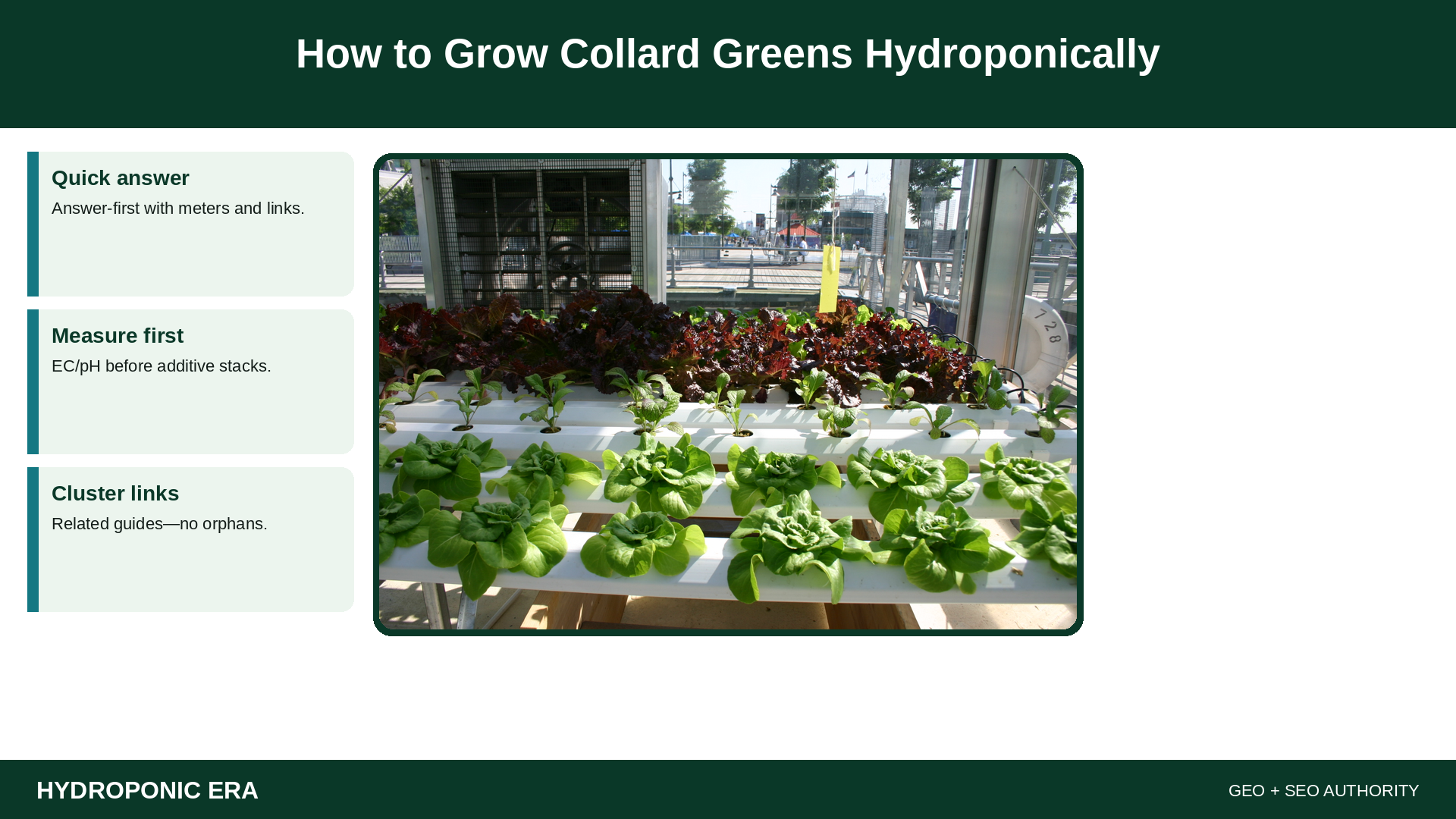
Grow Collard Greens Hydroponically: Why Collard greens Belongs in a Hydroponic Plan
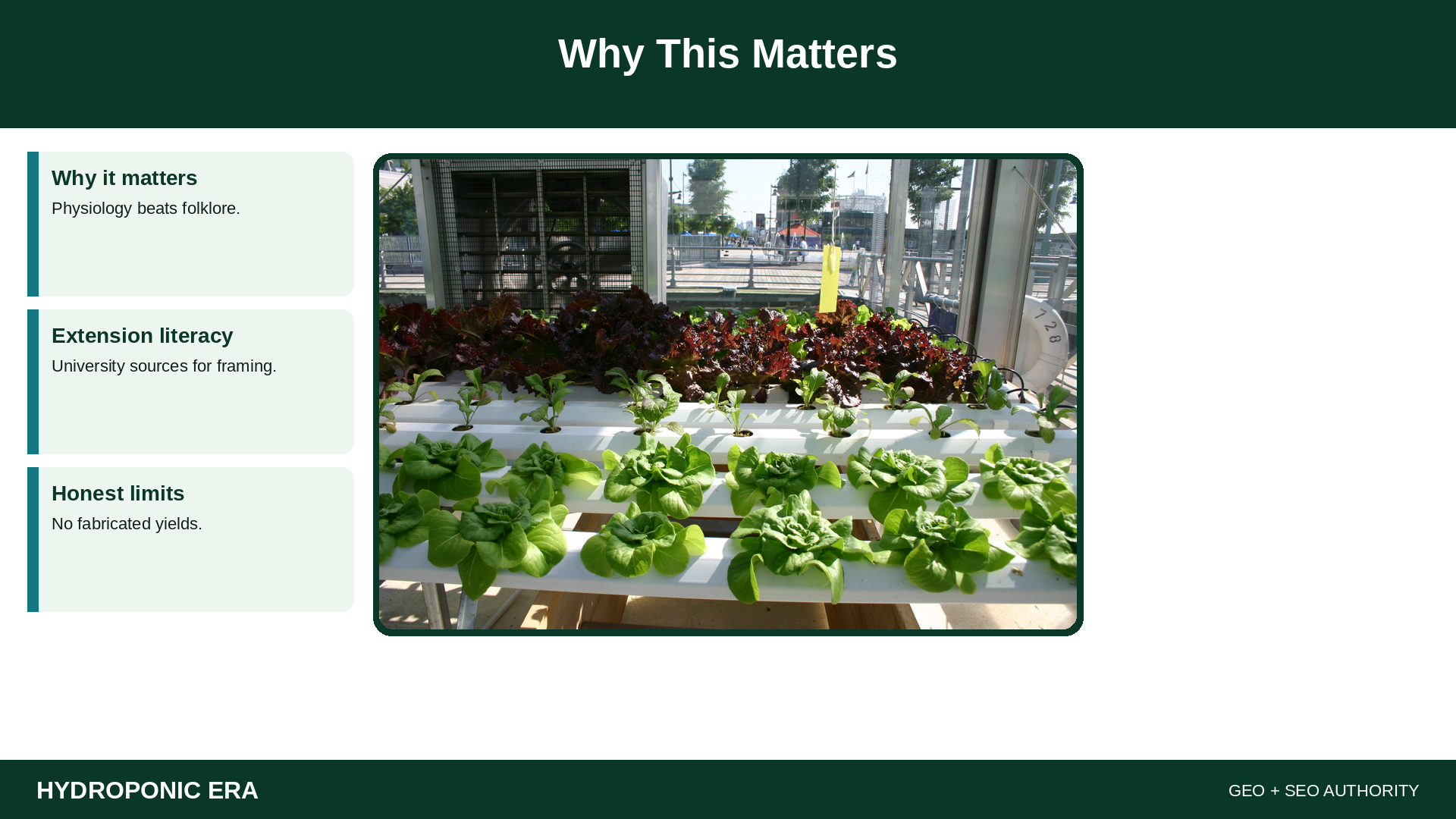
Collards are non-heading leafy brassicas related to kale and cabbage. UF/IFAS HS1279 discusses leafy greens in hydroponics and protected culture—useful framing for brassica greens. Compare kale, mustard greens, and bok choy for leafy brassica habits.
Tip burn and calcium issues show up when humidity, airflow, and EC are mismanaged—see tip burn and Ca/Mg. Nitrogen management for leafy hydroponic greens is discussed in UF/IFAS HS1265—use it as framing, not invented home ppm guarantees.
Collards reward patience and airflow more than exotic additives. If leaves look pale, use nitrogen deficiency, yellow leaves, and EC readings together.
Collard greens (Brassica oleracea (Acephala group)) still follows measurable plant physiology: light, root oxygen, solution chemistry, and harvest timing. Extension crop pages describe outdoor habits; hydroponics changes delivery of water and minerals, not the need for those fundamentals. Pair this page with best plants, starting at home, and beginner mistakes so expectations stay honest.
Grow Collard Greens Hydroponically: Choose a System for Hydroponic Collard greens

| System | Fit for Collard greens | Watch-outs |
|---|---|---|
| NFT | Excellent | Pump reliability |
| DWC / raft | Excellent | Oxygenate well |
| Drip | Excellent | Even moisture |
| Ebb and flow | Good | Media choice matters |
| Kratky | OK small plants | Scale limits |
Compare hardware in DWC vs NFT vs Dutch, DWC, NFT, Dutch bucket, and ebb and flow.
Grow Collard Greens Hydroponically: Step-by-Step: Collard greens in Hydroponics

- Start clean: fresh seed or disease-free starts and sterile plugs (germination methods).
- Germinate with even moisture and early light so seedlings do not stretch (seedlings guide).
- Transplant when roots hold the plug into net pots with appropriate media (net pots, media).
- Choose the system from the table above rather than forcing every crop into one jar.
- Mix a complete nutrient and measure EC/TDS (mixing guide, EC/TDS); set pH after strength.
- Provide crop-appropriate light using lights and PPFD/DLI guides.
- Maintain aeration, temperature, and hygiene (dissolved oxygen, air pumps, cleaning).
- Harvest with the crop’s biology in mind—remove outer leaves and keep the crown growing.
- Reset solution when EC drifts oddly, roots smell, or you change crops (when to flush, water changes).
- Keep notes on light, EC, pH, and symptoms so you learn your room.
- Harvest outer leaves while leaving the growing point intact for cut-and-come-again.
Grow Collard Greens Hydroponically: Important Growing Variables

| Variable | Practical guidance | Notes |
|---|---|---|
| Light | Match crop class (leafy vs fruiting vs rhizome) | PPFD/DLI, lights, photoperiod |
| pH | ~5.5–6.5 soilless band (OSU framing) | pH, fix pH, meters |
| Nutrient strength | Start mild; raise with growth | EC/TDS, burn |
| Oxygen / flow | Never ignore roots | DO, air pumps |
| Temperature | Crop-specific comfort | reservoir temperature |
| Hygiene | Opaque reservoirs; scheduled changes | algae, cleaning, reservoir setup |
| Airflow | Reduce tip burn risk | {a(‘humidity’,’humidity’)}, tip burn guide |
Penn State’s hydroponic nutrition principles remind growers that essential elements have functions—and that deficiency symptoms can be confused with lockout. Measure before you stack additives. If pale leaves appear, use yellow leaves, deficiency chart, and lockout together.
Grow Collard Greens Hydroponically: Harvest, Quality, and Ongoing Care for Collard greens

Harvest collards by taking large outer leaves and leaving the central growing point. Wash produce with home food-safety habits in mind (clean hands, clean knives, clean rinse water)—see food-safety thinking for home hydro when that guide is live, and keep reservoirs clean (cleaning).
Bitter or tough leaves often mean age, heat stress, or uneven watering—not a missing “flavor bottle.” Adjust climate and harvest younger leaves.
After harvest, maintain reservoir hygiene and watch for pests on soft new growth (pests, cleaning). If growth stalls, read slow growth and wilting before dumping random additives.
Common Mistakes

- Copying a lettuce feed/light recipe without adjusting for collard greens
- Hot nutrient strength on seedlings
- Ignoring pH drift until leaves look deficient
- Weak light blamed on bad nutrients
- Skipping root checks when plants wilt
- Overcrowding net pots or channels
- Clear reservoirs growing algae under LEDs
- Changing five variables overnight when collard greens only needed one fix
- Running fruiting-crop EC on young collards
- Ignoring tip burn until leaves look burned forever
- Overcrowding channels
- Skipping pest scouting on brassica undersides
Troubleshooting Collard greens Problems

| Symptom | Likely causes | What to do |
|---|---|---|
| Tip burn | Ca transport / RH / high EC | Improve airflow; moderate EC; see tip burn |
| Pale older leaves | N / low EC | Measure; see nitrogen guide |
| Purpling + cold | Cold stress / P uptake | Warm roots if cold; see phosphorus guide |
| Holes in leaves | Chewing pests | Scout; see pests guide |
| Wilting wet roots | Oxygen / Pythium risk | Air; clean; brown-roots guide |
Also see wilting, slow growth, yellow leaves, brown roots, and nutrient lockout when symptoms overlap.
What to Check Before You Change Nutrients
- Calibrated pH and EC readings today?
- Root color and smell normal?
- Light intensity/distance appropriate for this crop?
- Reservoir temperature in a safe band for oxygen?
- Harvest pressure vs plant recovery balanced?
- Irrigation leaving air in media (if media-based)?
- Any pests on leaf undersides or sticky residue?
- Did you change only one major variable since last check?
FAQs

Are collards easier than cabbage in hydroponics?
Often yes—no heading requirement; harvest leaves ongoing.
Best system?
NFT or DWC for leafy production; drip also works.
Shared with kale?
Yes commonly—similar leafy brassica needs.
Bolting?
Heat and stress can push flowering—keep cooler if possible.
Nutrient strength?
Leafy complete feed; measure EC; avoid chronic overfeeding.
Pests?
Aphids and caterpillars outdoors; indoors scout undersides.
Grow Collard Greens Hydroponically: Practical Checklist
Grow Collard Greens Hydroponically matters every week in a home system. Recheck grow collard greens hydroponically after transplants, heat spikes, and canopy fill-in. Strong grow collard greens hydroponically habits beat one-time guesses. When grow collard greens hydroponically drifts, leaves crowd, roots stress, or harvest quality drops. Write grow collard greens hydroponically targets into your log so you do not rely on memory. Teach helpers your grow collard greens hydroponically checklist before you leave town. Improve grow collard greens hydroponically in small steps—measure, adjust, then wait a day. Compare grow collard greens hydroponically notes against light, airflow, and reservoir temperature.
Sources
- University of Florida IFAS — HS1279: Leafy Greens in Hydroponics and Protected Culture for Florida
- University of Florida IFAS — HS1265: Nitrogen Fertilization of Hydroponic Leafy Greens
- Oklahoma State University Extension — Hydroponics
- Oklahoma State University Extension — Electrical Conductivity and pH Guide for Hydroponics
- Penn State Extension — Hydroponics Systems and Principles of Plant Nutrition
- Virginia Cooperative Extension — SPES-720: Calculating and Using Daily Light Integral (DLI)
- Michigan State University Extension — Hydroponics as an agricultural production system
- University of Minnesota Extension — Growing cabbage