
Quick Answer
ph rising vs falling is a daily drift signal: rising pH often tracks nitrate uptake and/or alkalinity buffering, while falling pH can track ammonium uptake, root activity, or acidifying dynamics—use the trend as a clue, not only a dose trigger. Pair with pH control, fix high/low pH, alkalinity, GH/KH, top-off vs change, and probe care.
Key takeaways for ph rising vs falling
- pH rising falling hydroponics is a practical home-hydro workflow—not filler.
- Direction of drift matters as much as the absolute pH number.
- Calibrated meters and logged times beat memory.
- Alkalinity (KH) changes how hard pH fights your adjustments.
- Prefer university/extension sources over forum myths.
- Correct uptake/chemistry story before stacking random pH bottles.
- Original ops card keeps pH rising falling hydroponics decisions consistent.
- pH rising falling hydroponics fails when growers skip the boring checks.
Related HydroponicEra guides
Why This Matters
ph rising vs falling interpretation treats the 24-hour slope as plant and water chemistry information. Oklahoma State’s EC/pH hydroponics guide and Penn State water-quality / nutrition materials stress that pH is managed, measured, and understood in context—not slapped with Up/Down until the display looks pretty.
This page does not invent private uptake formulas. It gives a home trend framework: log, classify rise vs fall, check alkalinity and nitrogen form habits, then adjust gently with circulation.
Comparison / Decision Table
| Trend | Common home clues | Watch-out |
|---|---|---|
| Rising daily | Active growth + nitrate-heavy feed; high alkalinity water | Do not acid-dump; check KH |
| Falling daily | Ammonium contribution, heavy root/microbial activity, low buffer | Do not chase with endless Up |
| Flat then sudden jump | Probe error, top-off chemistry, mixing mistake | Recalibrate before dosing |
| Oscillates wildly | Tiny reservoir + big plant load + harsh adjusters | Right-size tank; gentler doses |
Step-by-Step Workflow
- Calibrate pH meter; note buffer dates.
- Log pH at consistent times (e.g., lights-on and lights-off).
- Record source-water alkalinity/KH when possible.
- Note nitrogen product type (nitrate-forward vs mixed).
- If rising: dilute adjuster, add while circulating, remeasure after mix time.
- If falling: same gentle Up protocol; inspect roots for stress smells.
- Separate top-off water chemistry from reservoir trend.
- Do not stack chelate panic and pH panic in one hour.
- After three days of trend notes, decide reset vs tweak.
- Keep a one-line diary: rise/fall magnitude and action.
Key Variables
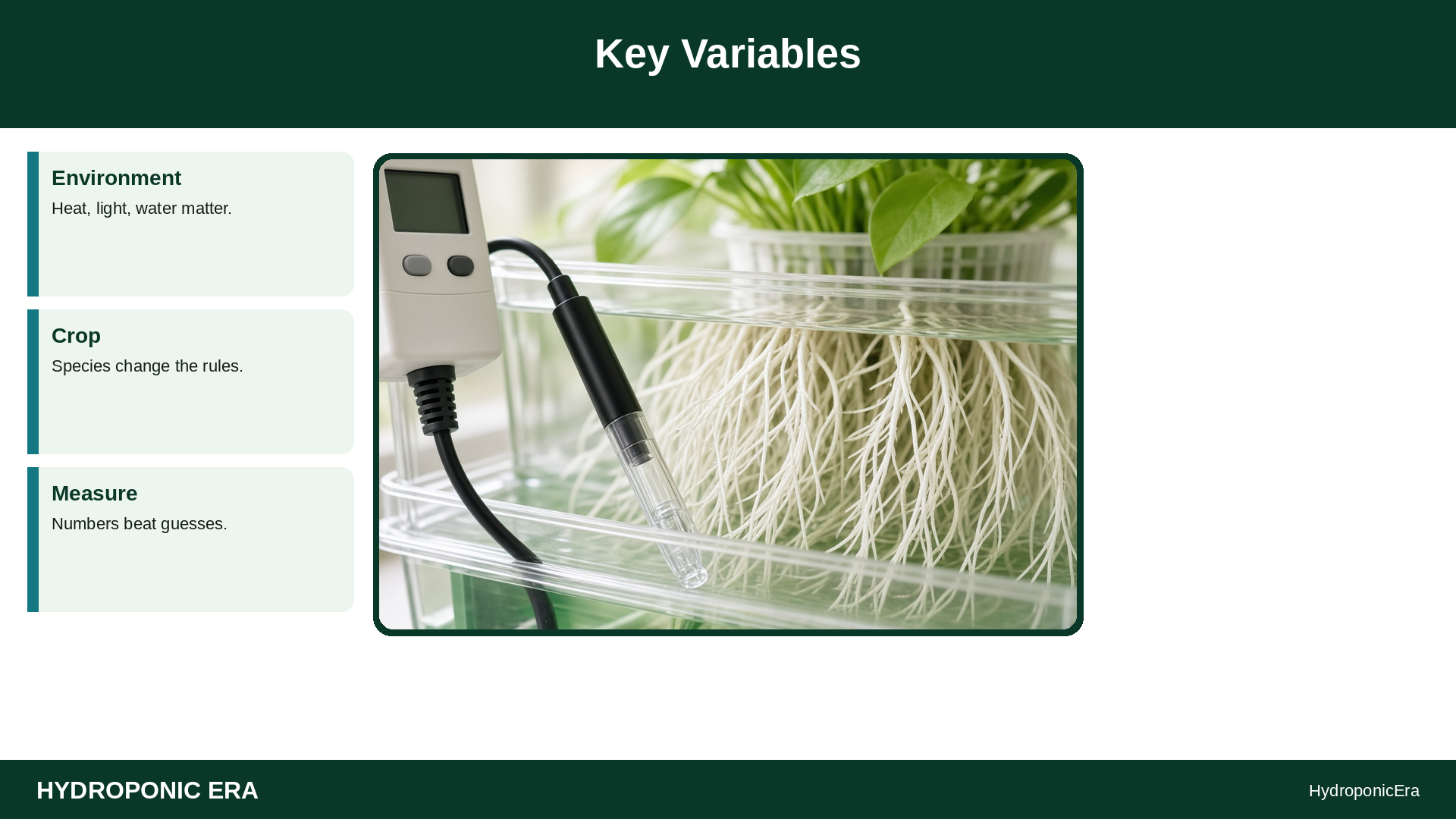
| Variable | Effect | Link |
|---|---|---|
| Alkalinity (KH) | Buffers against acid; encourages upward fight | alkalinity, GH/KH |
| N form / uptake | Can bias pH drift direction | NPK stages, nutrients |
| Reservoir size | Small tanks swing faster | reservoir |
| Probe health | Fake trends | probe care |
Common mistakes with ph rising vs falling

- Dosing pH Down every hour without a log
- Ignoring KH on hard municipal water
- Blaming plants when the probe sat dry overnight
- Mixing stock concentrates then reading pH before equilibrium
- Treating a 0.1 drift like an emergency
- Using uncalibrated cheap pens as gospel
Troubleshooting
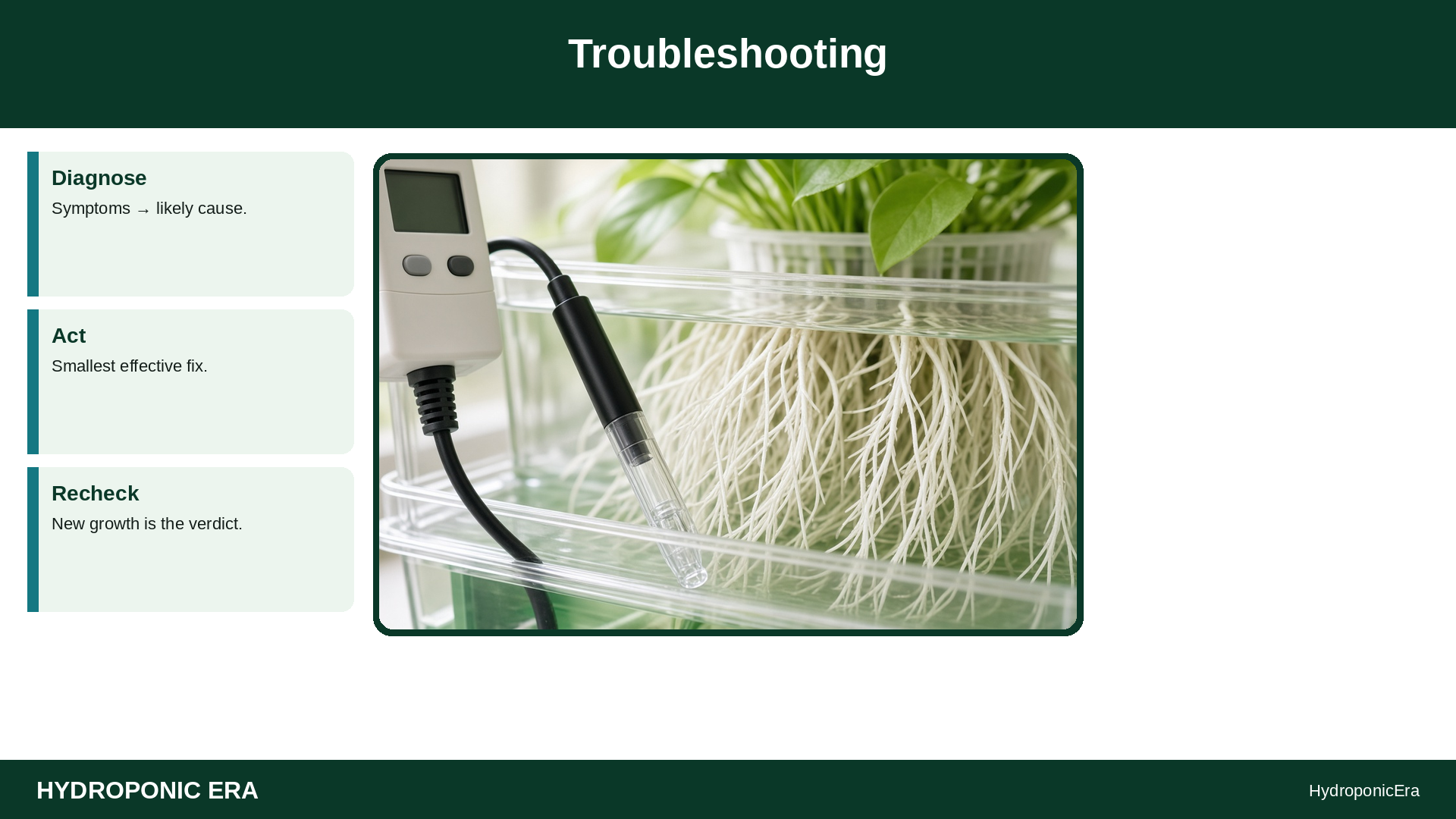
| Signal | Action |
|---|---|
| Rise >0.3–0.5/day with hard water | Check KH; gentler acid; consider water strategy |
| Fall with browning roots | Oxygen/temp/bio triage before more Up |
| Trend vanishes after recalibration | Fix meter habits—not nutrients |
| Iron chlorosis with high pH habit | See chelates + iron guides |
Practical Framework

Trend card: Calibrated? | Logged rise or fall? | KH known? | Gentle circulate dose | New growth judges.
Closing practice for pH rising falling hydroponics: the arrow on your log matters more than a single screenshot of 5.8.
What to Check Before You Dose pH Up or Down Again
- Meter calibrated this week?
- Same-time logs for 3 days?
- Source KH/alkalinity noted?
- Adjuster diluted and circulated?
- Roots/smell checked if falling?
- Chelate/pH interaction considered?
Logging Habits That Make Trends Real
Write pH at lights-on and at a consistent evening time for three days before declaring a pattern. Note top-offs, pH Up/Down doses, and whether you stirred. A single panicked reading after dumping adjuster into a still corner is not a “daily trend.”
Hard water with meaningful alkalinity often fights acid—see alkalinity management and GH/KH. Soft or RO water can swing the other way because buffer is thin. Match your water story to the arrow on the log.
Linking Drift to Plant Stage
Rapid vegetative growth with nitrate-forward feeds commonly drifts upward; that is a clue to gentle management, not proof the meter is broken. Falling pH with sour roots is a biology alarm—open the lid and smell before you celebrate “acid-loving plants.”

Practice & Field Notes
Tape a mini chart on the reservoir lid: date, a.m. pH, p.m. pH, KH if known, and one action. After a week you will see whether you live in a rising house, a falling house, or a meter-chaos house. Rising hard-water rooms need gentler acid and water strategy; falling septic-smelling rooms need oxygen and sanitation thinking.
Never judge a trend immediately after a large Un/Down slug. Circulate, wait, remeasure. Pair with fix high/low pH, probe care, and chelate awareness when high-pH habits bleach new leaves.
If two pens disagree by 0.4, stop dosing and calibrate both against fresh buffers. Arguments between uncalibrated tools invent fake trends.
Scenario Walkthrough
Morning pH 5.7, evening 6.2, next morning 6.4 despite no Up doses. Volume fell and you topped off with alkaline tap water. The rising plant uptake story is mixed with a top-off alkalinity story—see alkalinity and top-off habits. Fix: log top-off water pH/KH, dose gentler acids with circulation, and stop treating every tenth as a crisis.
Opposite case: pH slides 6.0 to 5.3 while roots smell off. Do not keep slamming Up. Open the sanitation playbook, check temperature and oxygen, and read falling pH as a stress clue.
Key Limits & Honest Scope
Uptake-driven pH stories are directional clues, not precise laboratory speciation of your tote. Home growers rarely measure every ion hourly. What you can do honestly: calibrate, log rise vs fall, know alkalinity class, dose gently, and inspect roots when pH falls with bad smells.
Different crops and nitrogen products change drift magnitude. Do not copy a stranger’s “always add X ml Down at 6pm” ritual without meters. Pair with pH control and fix guides for absolute-range management after the trend is understood.
If your reservoir is tiny relative to canopy size, expect sharper swings—right-size water volume before blaming plants for chemistry drama.
FAQs about ph rising vs falling

Is rising pH always bad?
It is information—manage within crop range, do not panic at every tick.
Does falling mean root rot?
Sometimes biology—always inspect roots, do not assume.
RO water and drift?
Low alkalinity can swing fast either way—measure and buffer thoughtfully.
How often to adjust?
Prefer fewer gentle corrections over constant hammering.
Can top-offs fake a trend?
Yes—log what you add.
Extension source for pH/EC?
OSU EC/pH hydroponics fact sheet is a solid primer.
Extended Home-Grower Walkthrough
Use this extended walkthrough as a second pass after the Quick Answer. Walk the system with a notebook: write the date, crop, EC, pH, reservoir temperature, and one observation about roots or leaves. Change only one control at a time when a problem appears. If last week’s fix did not show in new growth, revert and try the next smallest lever. Keep university and extension principles in mind—oxygen, sanitation, and measured nutrition beat product stacking.
Photograph the canopy and the reservoir surface weekly. Dated photos settle arguments about algae, tip burn, or stretch faster than memory. When a helper waters for you, leave a one-page card with do-not-touch items and the exact top-off rule. Store calibration sachets next to the meters so “I will calibrate later” stops being the default. Review timers after any power event. Confirm air stones still roar. Confirm drains still drain.
At the end of the week, score the cycle 1–5 for ease and plant quality. Low scores should trigger a sanitation or climate review before you buy new hardware. Link neighboring HydroponicEra guides when the symptom matches a cluster page. Prefer labeled procedures over improvisation under stress. Healthy boring routines are the real upgrade path for home hydroponics.
Keep ph rising vs falling on your ops card so helpers follow one standard.
Keep ph rising vs falling on your ops card so helpers follow one standard.
Keep ph rising vs falling on your ops card so helpers follow one standard.
Keep ph rising vs falling on your ops card so helpers follow one standard.
Keep ph rising vs falling on your ops card so helpers follow one standard.
Keep ph rising vs falling on your ops card so helpers follow one standard.
Keep ph rising vs falling on your ops card so helpers follow one standard.
Keep ph rising vs falling on your ops card so helpers follow one standard.
Keep ph rising vs falling on your ops card so helpers follow one standard.
Keep ph rising vs falling on your ops card so helpers follow one standard.
Keep ph rising vs falling on your ops card so helpers follow one standard.
Keep ph rising vs falling on your ops card so helpers follow one standard.
Keep ph rising vs falling on your ops card so helpers follow one standard.
Keep ph rising vs falling on your ops card so helpers follow one standard.
Keep ph rising vs falling on your ops card so helpers follow one standard.
Keep ph rising vs falling on your ops card so helpers follow one standard.
Sources
- Oklahoma State University Extension — Electrical Conductivity and pH Guide for Hydroponics
- Penn State Extension — Hydroponics Systems and Principles of Plant Nutrition
- Penn State Extension — A Water Quality Toolkit for Greenhouse and Nursery Production
- Penn State Extension — Alkalinity and water quality for greenhouse production (toolkit)
- Oklahoma State University Extension — Understanding Your Irrigation Water Test Report
- University of Florida IFAS — AE094: Water Quality for Crop Production Systems