
Quick Answer
pH EC probe care storage calibration habits keep meters honest: rinse, store pH bulbs wet in proper solution, never freeze or dry out probes, and calibrate on a schedule that matches how often you dose. Buying a meter is step one; keeping it truthful is the real skill.
See pH/EC meters, pH control, EC/TDS, fix high/low pH.
Key takeaways for ph ec probe care storage calibration
- pH EC probe care storage calibration prevents silent wrong dosing.
- A dry pH probe is a future lie factory.
- Calibrate with fresh buffers; expired sachets waste time.
- Rinse between solutions; blot—do not wipe abrasive cloths on bulbs.
- Original cadence: quick rinse daily | calibrate weekly (heavy use) | replace probes on drift.
- pH EC probe care storage calibration fails when meters live in a hot tent pocket.
- EC probes still need cleanliness—salt crust skews readings.
- Log calibration dates on a sticker on the meter.
Related HydroponicEra guides
Why Care Beats Another Meter

pH EC probe care storage calibration is the longevity layer on top of choosing meters. Extension EC/pH hydro guides assume readings are real. If storage is wrong, you will “fix” plants that were never broken.
Storage Comparison
| Probe | Storage | Never |
|---|---|---|
| pH | Wet storage solution / manufacturer guidance | Dry drawer for weeks |
| EC | Clean, dry or as manual states | Crusted with old nutrients |
| Combo pens | Follow dual rules carefully | Soaking EC side in pH storage by mistake |
Step-by-Step Care Routine

- Rinse probe with distilled/RO after each use.
- Calibrate pH to two points when dosing frequently.
- Use EC standard appropriate to your range.
- Replace buffers that look cloudy or expired.
- Store pH probe upright in storage solution.
- Keep meters out of direct LED heat.
- If readings jump wildly, clean bulb and recalibrate before changing nutrients.
- Retire probes that will not hold calibration.
- Sticker the last calibrate date on the tool.
- Train everyone who doses to the same rinse habit.
Variables
| Variable | Effect | Link |
|---|---|---|
| Heavy daily dosing | Calibrate more often | pH up/down |
| Dirty reservoirs | Film on bulb | biofilm |
| Travel kit | Caps dry out | meters |
| Hard water films | Skew EC | hard water |
Common mistakes with ph ec probe care storage calibration
- Distilled water long-term storage for pH bulbs
- Calibrating with unknown tap water as “7.0”
- Sharing one dirty rinse cup for everything
- Ignoring slow response times as “fine”
- Leaving the cap off overnight
- Buying a new meter instead of storage solution
Troubleshooting Bad Readings
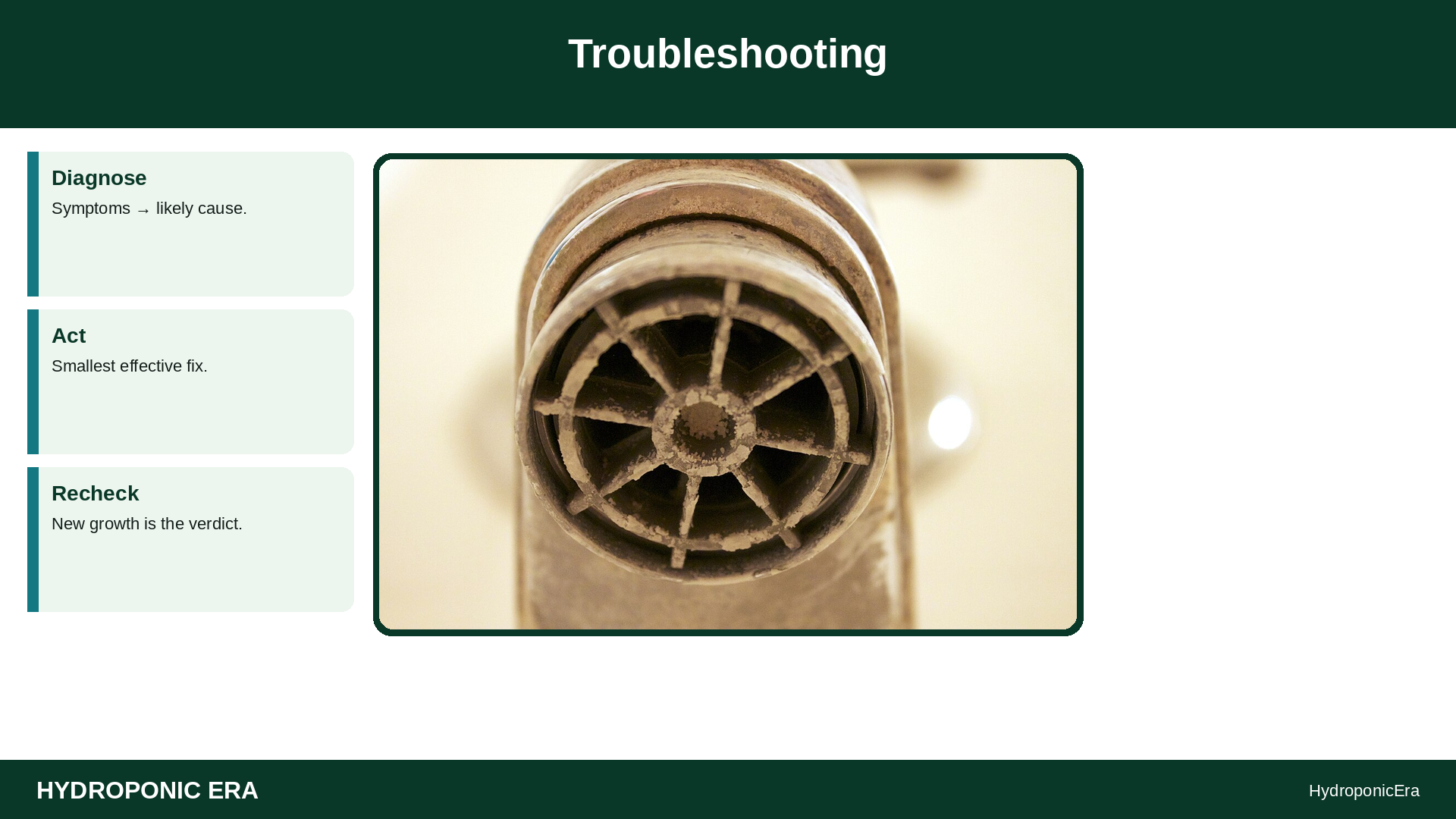
| Symptom | Try |
|---|---|
| pH drifts while sitting in buffer | Clean, recalibrate, replace if needed |
| EC always high vs known standard | Remove crust; recalibrate |
| Plants OK but meter screams | Trust plants briefly; fix meter before big dumps |
Original Framework: Meter Sticker

Sticker fields: Last pH cal | Last EC cal | Storage OK?. Closing practice for pH EC probe care storage calibration: no dosing decisions on an uncalibrated week.
What to Check Before You Trust Today’s Reading
- Storage solution present?
- Buffers in date?
- Rinse bottle clean?
- Cal date sticker current?
- Probe not cracked?
Calibration Habits That Stick
Heavy daily pH dosing deserves weekly two-point calibration or better. Light users can calibrate before each major reservoir mix.
Always use fresh buffers within date. Rinse with distilled or RO between buffer cups so you do not contaminate standards. Blot gently—do not scour the glass bulb with a rough towel.
EC probes need cleanliness too. Salt crust on the sensing area skews conductivity. If a known standard reads wrong after cleaning, recalibrate; if it still will not hold, replace the probe. Buying another meter while storing the pH bulb dry only repeats the failure.
Environment Abuse
Meters left on hot tent floors near LEDs drift and age faster. Caps left off overnight dry pH sensors. Travel kits need storage solution packed, not hope. Stick a calibration date on the tool so every person who doses shares the same honesty standard.
FAQs about ph ec probe care storage calibration

How often calibrate?
Heavy dosers: weekly or more; light users: before each major mix.
Distilled storage?
Not for most pH bulbs—use proper storage solution.
Combo pen tips?
Follow the manual; sides differ.
Is this buying advice?
See meters guide for purchase; this is care.
Probe replacement?
When calibration will not hold.
Kids using meters?
Adult calibration; kids can rinse with supervision.
Teaching Everyone Who Doses the Same Standard
A meter is a shared instrument. If one person stores the pH probe dry and another calibrates monthly, your reservoir becomes a coin flip. Post a one-page routine near the dosing station: rinse, measure, store wet (pH), cap on, calibrate on schedule, sticker the date.
Replace buffers that expire or cloud. Do not invent “pH 7 calibration water” from the tap.
When response time slows dramatically, clean and recalibrate; retire probes that will not hold. Combo pens need extra care because storage rules differ by side—read the manual once and tape the critical line to the wall.
Heat and direct LED exposure age electronics and solutions. Keep meters in a shaded caddy. Travel days need storage solution packed beside the probe, not “I’ll fix it when I’m back.”
Trust plants as a sanity check when meters scream nonsense after obvious abuse—but fix the meter before major nutrient dumps. Wrong meter math creates real lockouts.
Implementation Notes for Home Growers
To put ph ec probe care storage calibration into practice this week, pick one system or shelf and run the workflow end-to-end once without improvising mid-stream.
Write the steps on a card, execute them, then note what broke in your space—ceiling height, noise limits, water alkalinity, or schedule constraints. That single controlled pass teaches more than reading three more threads.
Unique angle reminder: Probe longevity SOP (storage solutions, KCl, dry-out)—extends meters guide without rewrite. Keep adjacent HydroponicEra guides one click away for depth, but do not merge this topic into a generic beginner rewrite.
If a meter disagrees with plant behavior, calibrate before you rewrite the plan. If sanitation is part of the story, finish the scrub—half-clean reservoirs reinvent the problem.
Weekly: re-read your card, check the one failure mode most likely in your room, and log a short after-action line. Over a month you will have comparable notes instead of vibes.
That is how home hydroponics becomes operations rather than emergency response. Share the card with anyone who helps water or harvest so standards survive busy days.
When results are good, resist the urge to change three variables at once. When results are poor, photograph first, then change the smallest lever that matches the diagnosis. This page’s checklists and tables exist to make that discipline easier under stress.
Extended Home-Grower Walkthrough
Use this extended walkthrough as a second pass after the Quick Answer. Walk the system with a notebook: write the date, crop, EC, pH, reservoir temperature, and one observation about roots or leaves.
Change only one control at a time when a problem appears. If last week’s fix did not show in new growth, revert and try the next smallest lever. Keep university and extension principles in mind—oxygen, sanitation, and measured nutrition beat product stacking.
Photograph the canopy and the reservoir surface weekly. Dated photos settle arguments about algae, tip burn, or stretch faster than memory. When a helper waters for you, leave a one-page card with do-not-touch items and the exact top-off rule.
Store calibration sachets next to the meters so “I will calibrate later” stops being the default. Review timers after any power event. Confirm air stones still roar. Confirm drains still drain.
At the end of the week, score the cycle 1–5 for ease and plant quality. Low scores should trigger a sanitation or climate review before you buy new hardware.
Link neighboring HydroponicEra guides when the symptom matches a cluster page. Prefer labeled procedures over improvisation under stress. Healthy boring routines are the real upgrade path for home hydroponics.
Keep ph ec probe care storage calibration visible on your weekly ops card so helpers follow one standard.
Revisit ph ec probe care storage calibration after any system change, relocation, or new crop introduction.
If notes disagree, rerun the ph ec probe care storage calibration checklist before buying more gear.
Apply ph ec probe care storage calibration as a repeatable habit—measure, log, and revisit after changes.
Apply ph ec probe care storage calibration as a repeatable habit—measure, log, and revisit after changes.
Apply ph ec probe care storage calibration as a repeatable habit—measure, log, and revisit after changes.
Apply ph ec probe care storage calibration as a repeatable habit—measure, log, and revisit after changes.
Apply ph ec probe care storage calibration as a repeatable habit—measure, log, and revisit after changes.
Apply ph ec probe care storage calibration as a repeatable habit—measure, log, and revisit after changes.
Sources
- Oklahoma State University Extension — Electrical Conductivity and pH Guide for Hydroponics
- Penn State Extension — Hydroponics Systems and Principles of Plant Nutrition
- Penn State Extension — A Water Quality Toolkit for Greenhouse and Nursery Production
- Oklahoma State University Extension — Hydroponics
- Michigan State University Extension — Water quality considerations for greenhouse and nursery crops
1 thought on “7 Smart pH & EC Probe Care, Storage & Calibration Habits”