
The EC to ppm conversion is simple once you know your meter’s scale: multiply EC in mS/cm by 500 for the NaCl (500) scale, by 640 for the 640 scale, or by 700 for the KCl or “442” (700) scale. So EC 1.0 mS/cm reads 500, 640, or 700 ppm depending on the meter. If your EC is in microsiemens (µS/cm), divide by 1,000 first. Because these are estimates, not true measurements of dissolved solids, compare charts by EC whenever you can.
Key takeaway: ppm = EC (mS/cm) × conversion factor. Find the factor in your meter’s manual and use the same one every time.
EC to PPM Conversion Table
| EC (mS/cm) | µS/cm | PPM (500 scale) | PPM (640 scale) | PPM (700 scale) |
|---|---|---|---|---|
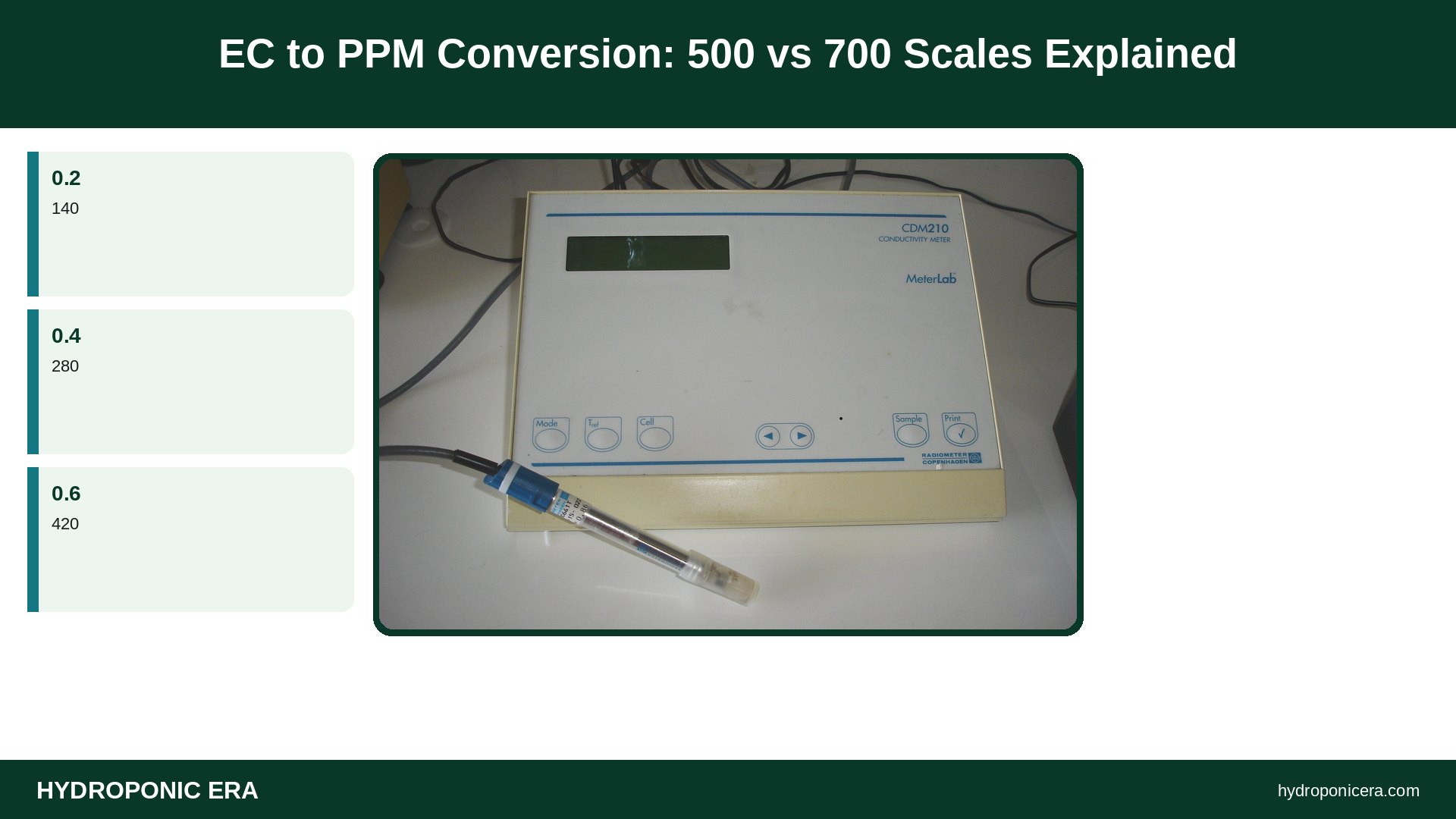
| 0.2 | 200 | 100 | 128 | 140 |
| 0.4 | 400 | 200 | 256 | 280 |
| 0.6 | 600 | 300 | 384 | 420 |
| 0.8 | 800 | 400 | 512 | 560 |
| 1.0 | 1,000 | 500 | 640 | 700 |
| 1.2 | 1,200 | 600 | 768 | 840 |
| 1.4 | 1,400 | 700 | 896 | 980 |
| 1.6 | 1,600 | 800 | 1,024 | 1,120 |
| 1.8 | 1,800 | 900 | 1,152 | 1,260 |
| 2.0 | 2,000 | 1,000 | 1,280 | 1,400 |
| 2.5 | 2,500 | 1,250 | 1,600 | 1,750 |
| 3.0 | 3,000 | 1,500 | 1,920 | 2,100 |
Why EC to PPM Conversion Needs a Scale
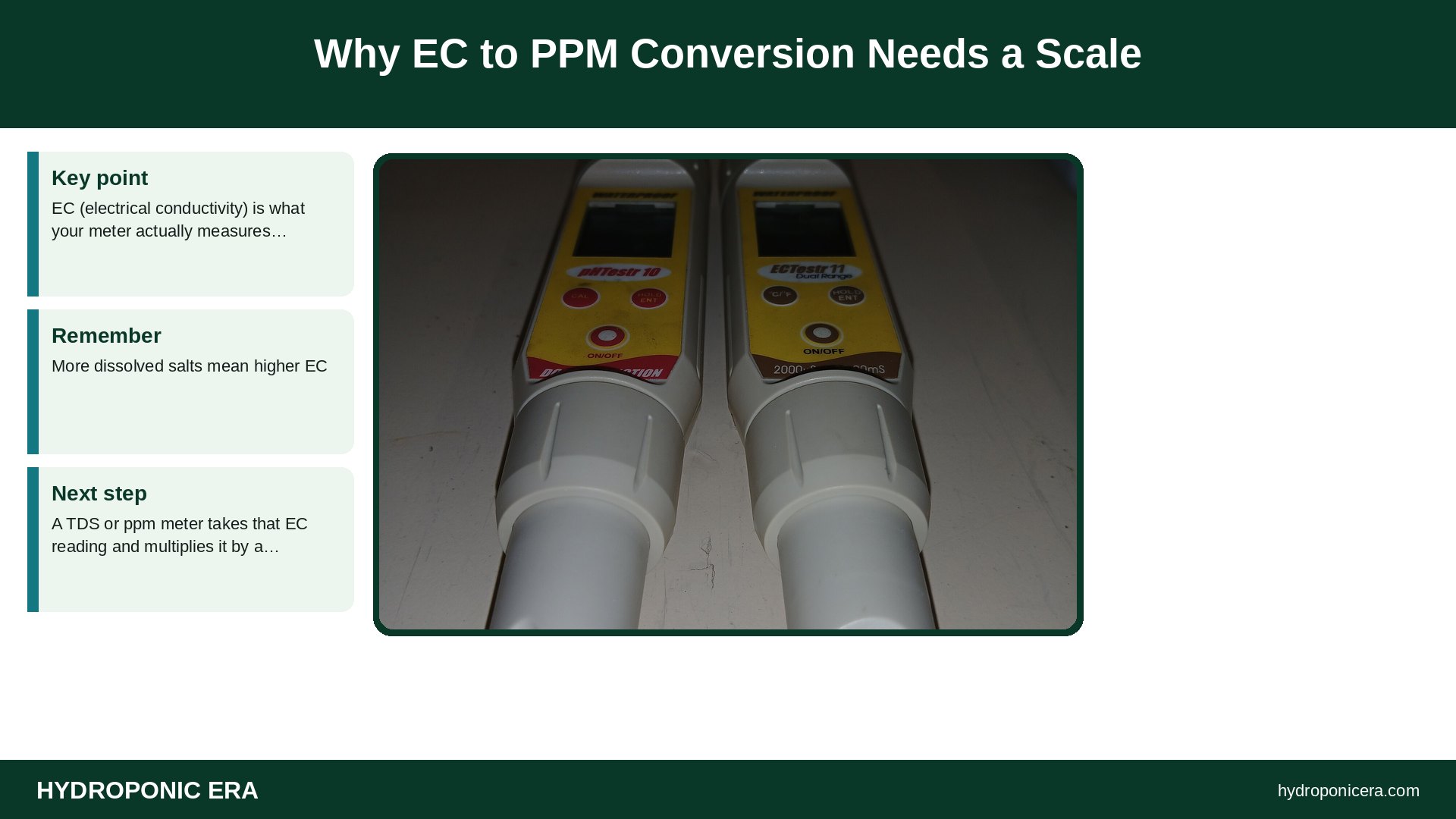
EC (electrical conductivity) is what your meter actually measures: how easily current passes through the water. More dissolved salts mean higher EC. A TDS or ppm meter takes that EC reading and multiplies it by a factor to estimate parts per million of dissolved solids.
The factor depends on which salt the maker assumes is in the water. Sodium chloride gives about 0.5; a mixed “442” standard (40% sodium sulfate, 40% sodium bicarbonate, 20% sodium chloride) gives about 0.65–0.7; potassium chloride gives about 0.7. None exactly matches a hydroponic nutrient, so ppm is always an estimate.
How to Find Your Meter’s Scale
- Check the manual or the box for “NaCl,” “442,” “KCl,” or a number like 0.5 or 0.7.
- Many US pen meters from Hanna use 0.5. Many Truncheon and some Bluelab meters show 700 scale.
- If your meter shows both EC and ppm, divide ppm by EC (in mS/cm) to find the factor.
- Calibrate with the solution the maker specifies. See probe calibration.
EC to PPM Conversion Formulas
- 500 scale: ppm = EC × 500
- 640 scale: ppm = EC × 640
- 700 scale: ppm = EC × 700
- From µS/cm: ppm = (µS/cm ÷ 1,000) × factor
- PPM back to EC: EC = ppm ÷ factor
- Between scales: 700-scale ppm = 500-scale ppm × 1.4
Example: a chart says lettuce at 840 ppm (700 scale). Your meter is 500 scale. 840 ÷ 700 = EC 1.2, and 1.2 × 500 = 600 ppm on your meter.
Units You Will See
| Unit | Equal to |
|---|---|
| 1 mS/cm | 1,000 µS/cm |
| 1 mS/cm | 1 dS/m |
| CF (conductivity factor) | EC × 10 |
| 1 mS/cm | 10 CF |
CF is common on Australian and UK charts. A CF of 12 means EC 1.2. Oklahoma State University Extension uses mS/cm (dS/m) in its hydroponic EC guide.
Using EC to PPM Conversion With Crop Charts
Many online charts list ppm without saying which scale. If a chart says tomatoes need 1,400–3,500 ppm, it is probably on the 700 scale; on a 500-scale meter that same range is 1,000–2,500. When in doubt, convert to EC and check against a source that publishes EC. See the hydroponic ppm chart, which lists both.
Temperature and Conversion Accuracy
Conductivity rises about 2% for every 1°C (about 1.1% per °F) of warming. Most meters correct readings to 77°F (25°C) automatically (ATC). Without ATC, a cold reservoir reads low and a warm one reads high. See temperature effects on EC readings.
Common EC to PPM Conversion Mistakes
- Following a 700-scale chart with a 500-scale meter, which underfeeds plants by about 30%.
- Mixing µS/cm and mS/cm.
- Forgetting to subtract the source-water reading. See source water baseline.
- Assuming ppm measures individual nutrients. It doesn’t; it reflects total salts, including sodium.
- Never calibrating.
For more on how the two units relate, see EC and TDS in hydroponics.
Worked Examples of EC to PPM Conversion
- Your meter reads 1,350 µS/cm. Divide by 1,000 to get EC 1.35. On a 500-scale meter that is 675 ppm; on a 700-scale meter it is 945 ppm.
- A nutrient label says 1,050 ppm (700 scale). 1,050 ÷ 700 = EC 1.5. On a 500-scale meter, aim for 750 ppm.
- A UK guide lists CF 18. Divide by 10: EC 1.8. That is 900 ppm (500) or 1,260 ppm (700).
- Your tap water reads 150 ppm on a 500 scale. That is EC 0.3. Add nutrients until the total reaches your target.
Should You Switch to EC?
Many growers find it easier to stop using ppm altogether. EC is the same on every meter, and extension guides, research papers, and many nutrient makers publish targets in EC. If your meter can show EC, set it to EC and write your targets in mS/cm. Use the EC to ppm conversion only when you need to read an older chart or talk with someone who uses a different meter.
Quick EC to PPM Conversion Reference for Crops
Lettuce at EC 1.2 is 600 (500 scale) or 840 (700 scale). Basil at EC 1.4 is 700 or 980. Tomatoes at EC 2.5 are 1,250 or 1,750. Seedlings at EC 0.6 are 300 or 420. Write the numbers for your crops on tape on the reservoir so you never have to convert in a hurry.
FAQs
How do I convert EC to ppm?
Multiply EC in mS/cm by your meter’s factor: 500, 640, or 700.
What is 1.5 EC in ppm?
750 (500 scale), 960 (640 scale), or 1,050 (700 scale).
Which EC to ppm conversion scale is correct?
None is “correct”; each is an estimate. Use the one your meter uses.
How do I convert µS/cm to ppm?
Divide by 1,000, then multiply by the factor; on the 500 scale, just halve it.
Is CF the same as EC?
CF is EC multiplied by 10.
Why do two meters read different ppm?
They use different conversion factors.
Sources
- Oklahoma State University Extension — Electrical Conductivity and pH Guide for Hydroponics
- Penn State Extension — Calculating Nutrient Solution Concentrations
- UF/IFAS Extension — Water and Nutrient Management Guidelines for Greenhouse Hydroponic Vegetable Production
- Photo credits (Wikimedia Commons, edited with titles): Electrical conductivity meter by Nuno Nogueira (Nmnogueira) (CC BY-SA 2.5); PH- und Leitfähigkeitsmessgeräte by Rotkaeppchen68 (CC0); Water droplets on a late cotoneaster (Cotoneaster coriaceus) leaf, Jardim da Fundação Calouste Gulbenkian, Lisbon, Portugal julesvernex2 by Jules Verne Times Two (CC BY-SA 4.0); Romaine lettuce by Rainer Zenz (CC BY-SA 3.0); Hydroponic g12 by Giancarlo Dessì (CC BY-SA 3.0)