
Quick Answer
temperature effects nutrient uptake means root-zone and solution temperature change how plants take up water and minerals—and how your EC meter behaves—so a perfect number in a hot tote is not the same situation as a cool tote. Warm solution often lowers dissolved oxygen and can push faster water use; cold roots slow growth. Use with reservoir temperature, EC/TDS, pH/EC meters, probe care, dissolved oxygen, and chillers.
Key takeaways for temperature effects nutrient uptake
- temperature effects nutrient uptake is a practical home-hydro workflow—not filler.
- EC meters need temperature awareness—many compensate; still calibrate honestly.
- Root temperature often matters more than air temperature for uptake behavior.
- Warm reservoirs couple high demand with lower oxygen—watch roots.
- Prefer university/extension sources over forum myths.
- Change one climate variable at a time when diagnosing EC weirdness.
- Original ops card keeps temperature effects nutrient uptake decisions consistent.
- temperature effects nutrient uptake fails when growers skip the boring checks.
Related HydroponicEra guides
Why This Matters

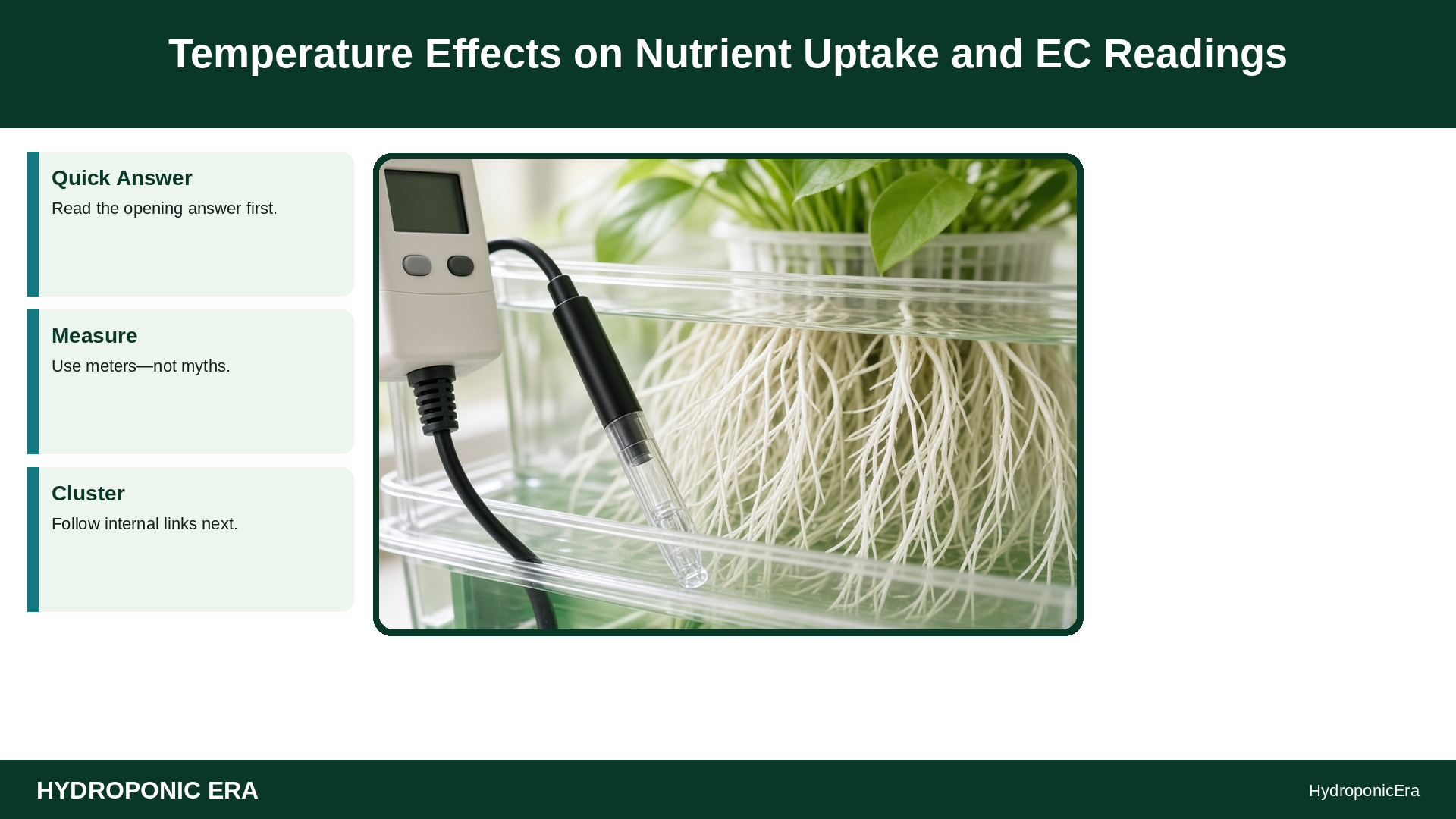
temperature effects nutrient uptake sits at the intersection of plant physiology and instrumentation. Oklahoma State’s EC and pH hydroponics guide frames salt concentration and pH as management pillars; temperature influences both plant demand and meter readings. Many handheld EC meters use automatic temperature compensation (ATC)—but ATC does not fix a hot, oxygen-poor root zone.
This article does not invent crop-specific uptake curves. It teaches you to read temperature as a co-variable whenever EC, wilt, or tip burn shows up.
Comparison / Decision Table
| Observation | Temp angle | Next check |
|---|---|---|
| EC climbs midday | Fast water use in heat | Top-off quality; canopy heat |
| EC stable, plants pale | Cold roots slowing uptake | Root-zone thermometer |
| Meter disagrees with yesterday | ATC / calibration / probe temp | probe care |
| Brown roots + warm tote | DO crash risk | DO, aeration, chill |
Step-by-Step Workflow

- Put a thermometer in the reservoir—not only the room air.
- Note lights-on vs lights-off solution temperatures for a few days.
- Confirm your EC meter’s ATC habit and calibration solution temperature guidance.
- Log EC at a consistent time of day.
- If roots are warm, prioritize oxygen and cooling before raising feed strength.
- If roots are cold, do not fix with ever-higher EC.
- Separate canopy heat stress from root heat stress in your notes.
- When changing chillers or insulation, re-baseline EC for a week.
- Recheck pH when temperature regime changes—drift patterns shift.
- Photograph root color whenever temperature swings hard.
Key Variables

| Variable | Effect | Link |
|---|---|---|
| Solution temperature | DO, microbe risk, demand | res temp, DO |
| Meter ATC / calibration | Reading trust | meters, probes |
| Crop class | Leafy vs fruiting thirst | lettuce, tomatoes |
| Air VPD / PPFD | Transpiration drive | VPD, PPFD |
Common mistakes with temperature effects nutrient uptake
- Chasing EC setpoints while ignoring a hot tote
- Calibrating probes in mismatched temperature solutions
- Blaming nutrients for cold-root stall
- Turning off air stones because EC looks fine
- Comparing night EC to noon EC without context
- Adding bloom booster during a heat wave
Troubleshooting
| Signal | Check |
|---|---|
| Midday wilt, OK overnight | Canopy heat + root oxygen, not only EC number |
| EC meter jumps after calibration | ATC, dirty probe, old calibration fluid |
| Tip burn in heat | tip burn + transpiration, not automatic more Ca product |
| Slow growth, dark cool basement | Root temperature floor before raising light hours |
Practical Framework
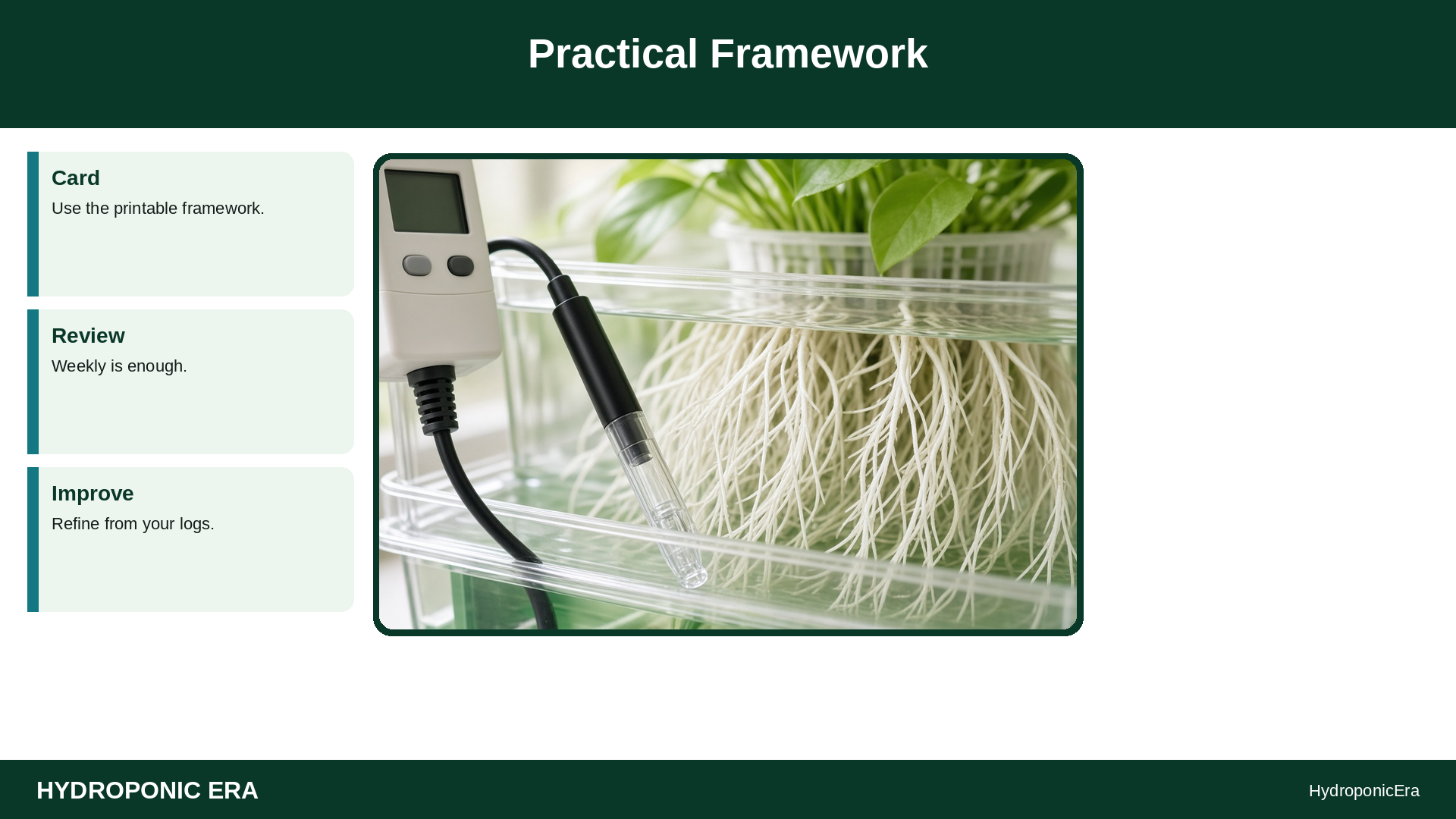
Temp–EC card: Res C | EC @ time | ATC on? | Root color | Action.
Closing practice for temperature effects nutrient uptake: never interpret EC without a temperature beside it.
What to Check When EC and Temperature Disagree With Plant Behavior
- Reservoir thermometer in place?
- EC logged at consistent time?
- Meter ATC/calibration known?
- DO/aeration OK if warm?
- Cold-root stall ruled out?
- Canopy vs root heat separated?
FAQs about temperature effects nutrient uptake
Does ATC mean temperature does not matter?
ATC helps the reading; plants still feel real root temperature.
Ideal reservoir temperature?
Follow your crop and DO goals—see reservoir temperature guide; avoid warm stagnant water.
Why does EC rise on hot days?
Plants often remove water faster than salts—top-off strategy matters.
Chiller first or stronger nutrients?
Stabilize temperature/oxygen before pushing EC.
pH too?
Yes—temperature regimes change drift; measure both.
Fruiting vs leafy?
Fruiting canopies often drive wilder midday swings—log by crop class.
Logging Template for Temp–EC Couples
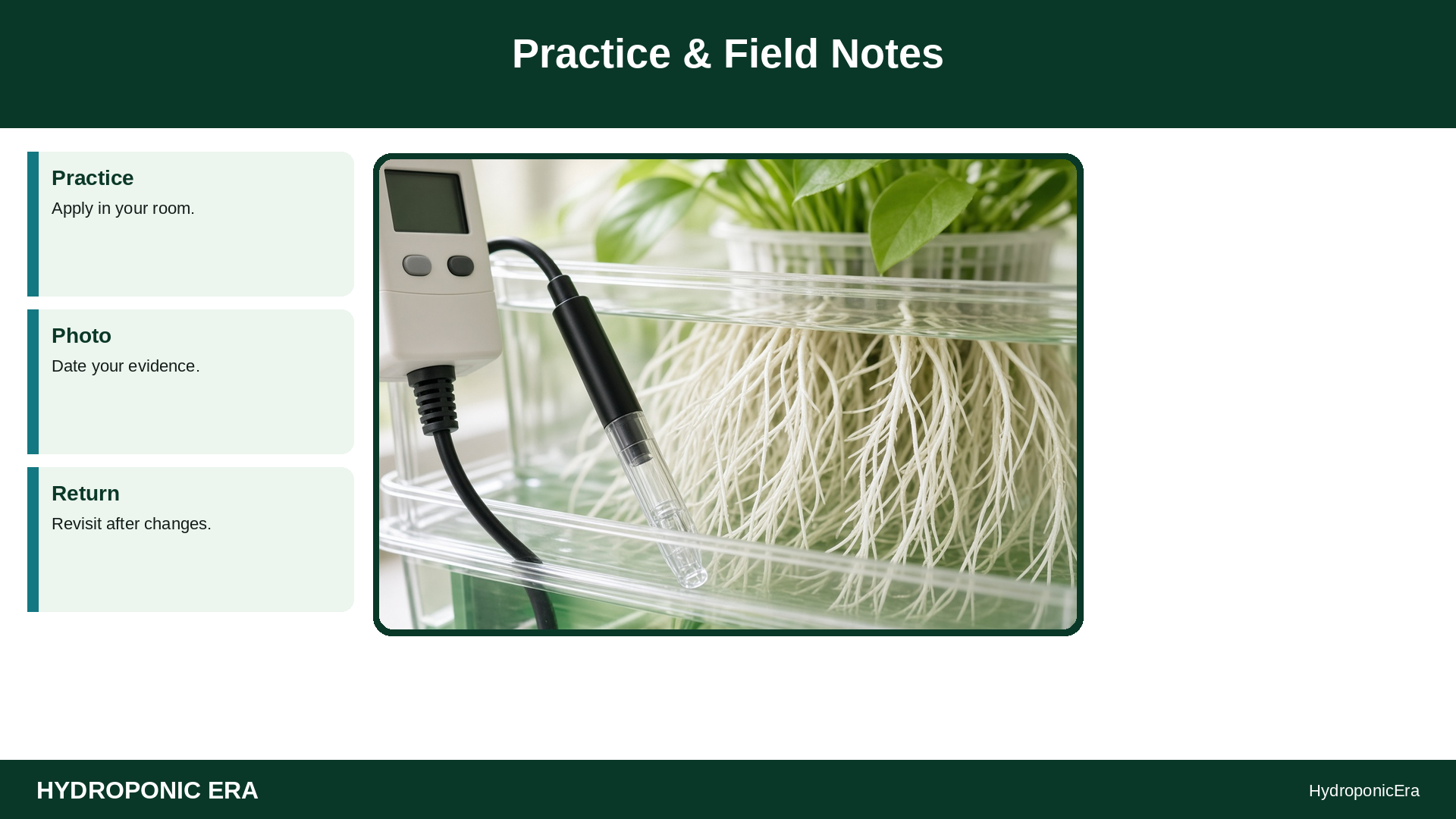
A simple daily line beats memory: time, reservoir °C, canopy feel (or VPD if you track it), EC, pH, and one plant note (wilt, tip burn, root color). Oklahoma State’s EC/pH hydroponics framing still assumes you can interpret salt readings in context; temperature is that context. If midday EC climbs while volume drops, you are mostly watching water removal—top-off water quality and freeboard matter more than panic-adding fertilizer.
Cold-root stalls look like “deficiencies” when they are really slow metabolism. Warm-root problems look like sudden wilt and browning when dissolved oxygen collapses. ATC on a meter helps the number; it does not oxygenate the tote. Re-baseline after you add a chiller, move the reservoir off a warm floor, or change photoperiod heat load.
Practical habit: compare EC only at the same clock time for three days before declaring a feed change. That alone prevents most false “my nutrients are wrong” spirals in hot rooms.
Place the reservoir thermometer where the pump intake actually draws—not only at the lid surface. If you use ATC meters, still record solution temperature beside EC so heat waves are visible in the log. After adding insulation or a chiller, expect a week of re-baselining before judging feed charts.
Root photos under white light beat memory when you later ask whether browning started with a heat spike.
Practice Notes for Home Systems
Keep changes sequential. If you alter reservoir temperature, nutrient strength, and photoperiod on the same day, you will not know which lever worked. Write the date, the single change, and the plant response on new growth—not on already-damaged leaves. Prefer opaque, light-proof reservoirs, calibrated meters, and clean measuring tools over boutique additives.
Internal links on this site exist to prevent orphan pages: open the related guides when a symptom points outside this article’s scope. Extension sources in the Sources list are the external backbone—use them when you need deeper greenhouse or crop-culture context, and do not invent ppm tables the citations do not support.
For edible crops, food-safety hygiene (clean hands, clean harvest tools, no storm-drain dumping of nutrients) is part of hydro ops, not an afterthought. If a step feels unclear for your municipality or building, pause and ask a local authority rather than improvising a risky shortcut.
Extended Home-Grower Walkthrough
Use this extended walkthrough as a second pass after the Quick Answer. Walk the system with a notebook: write the date, crop, EC, pH, reservoir temperature, and one observation about roots or leaves. Change only one control at a time when a problem appears. If last week’s fix did not show in new growth, revert and try the next smallest lever. Keep university and extension principles in mind—oxygen, sanitation, and measured nutrition beat product stacking.
Photograph the canopy and the reservoir surface weekly. Dated photos settle arguments about algae, tip burn, or stretch faster than memory. When a helper waters for you, leave a one-page card with do-not-touch items and the exact top-off rule. Store calibration sachets next to the meters so “I will calibrate later” stops being the default. Review timers after any power event. Confirm air stones still roar. Confirm drains still drain.
At the end of the week, score the cycle 1–5 for ease and plant quality. Low scores should trigger a sanitation or climate review before you buy new hardware. Link neighboring HydroponicEra guides when the symptom matches a cluster page. Prefer labeled procedures over improvisation under stress. Healthy boring routines are the real upgrade path for home hydroponics.
Keep temperature effects nutrient uptake on your ops card so helpers follow one standard.
Keep temperature effects nutrient uptake on your ops card so helpers follow one standard.
Keep temperature effects nutrient uptake on your ops card so helpers follow one standard.
Keep temperature effects nutrient uptake on your ops card so helpers follow one standard.
Keep temperature effects nutrient uptake on your ops card so helpers follow one standard.
Keep temperature effects nutrient uptake on your ops card so helpers follow one standard.
Keep temperature effects nutrient uptake on your ops card so helpers follow one standard.
Keep temperature effects nutrient uptake on your ops card so helpers follow one standard.
Practical note: temperature effects nutrient uptake belongs in weekly review notes.
Practical note: temperature effects nutrient uptake belongs in weekly review notes.
Sources
- Oklahoma State University Extension — Electrical Conductivity and pH Guide for Hydroponics
- Penn State Extension — Hydroponics Systems and Principles of Plant Nutrition
- Michigan State University Extension — Hydroponics as an agricultural production system
- Oklahoma State University Extension — Hydroponics
- University of Florida IFAS — CV265: Fertilizer Management for Greenhouse Vegetables
- Michigan State University Extension — Why greenhouse growers should pay attention to VPD