
Quick Answer
starting ec source water baseline means treating blank-water electrical conductivity as the floor under your feed target. If tap already reads 0.4 mS/cm and you mix as if it were zero, you accidentally run hotter than the bottle chart implies. Home overfeeding often starts as uncounted baseline salts—not “greedy plants.”
Pair with EC/TDS, hard water/RO, RO sizing, meters, and mixing.
Key takeaways for starting ec source water baseline
- Starting EC source water hydroponics uses blank EC as the arithmetic floor.
- Target feed EC is usually “added nutrients,” not total meter reading—know which your chart means.
- Hard water raises the floor; RO lowers it toward zero.
- Oklahoma State and Penn State water/EC materials support measuring before guessing.
- Original method: blank → mix → total → inferred feed = total − blank (when units match).
- Starting EC source water hydroponics fails when growers calibrate meters but never log source.
- Seasonal utility switches can move your floor without warning.
- Sodium-softened water can inflate EC with ions plants dislike.
Related HydroponicEra guides

Why Baseline EC Is Not Optional
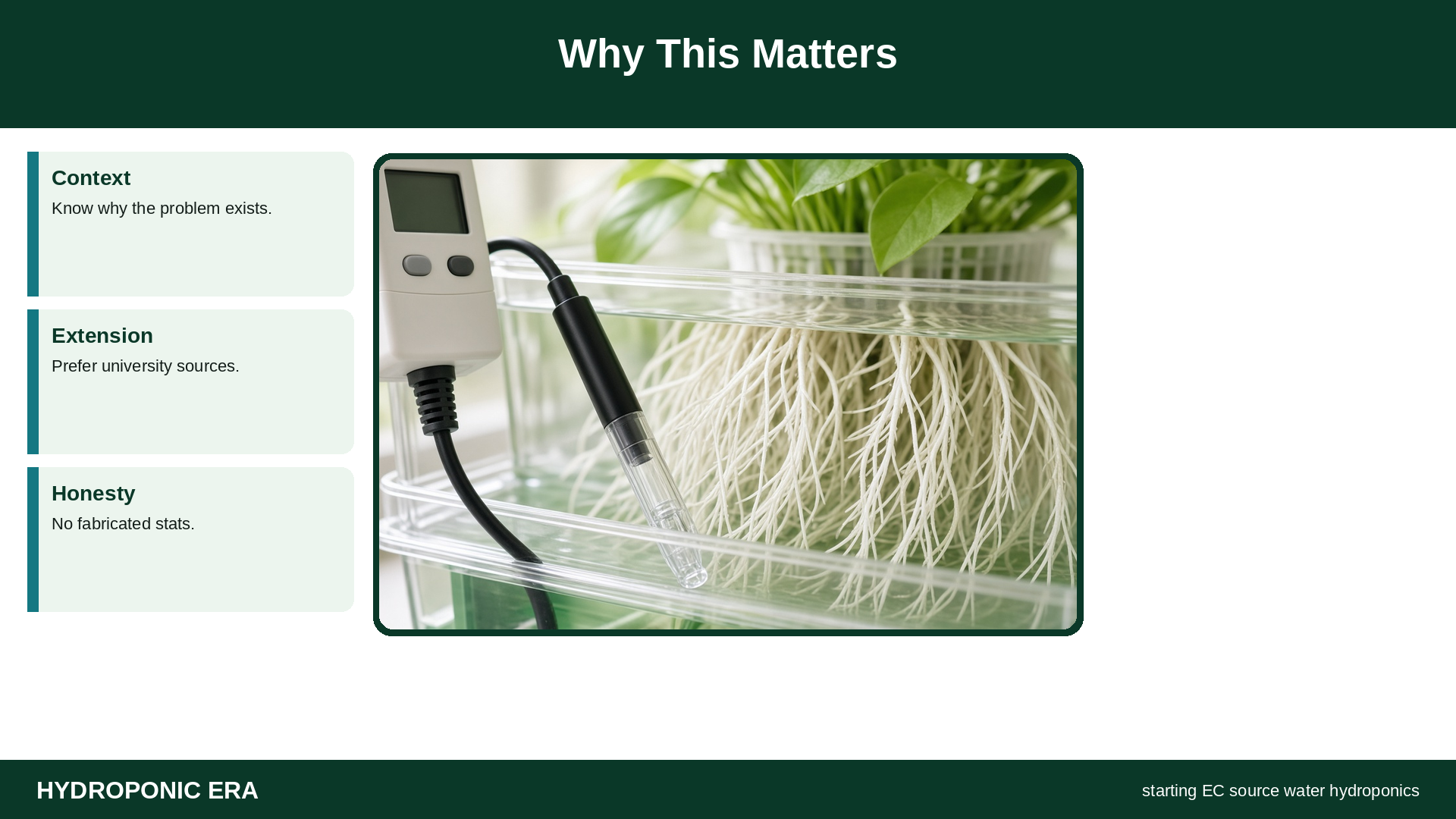
starting ec source water baseline prevents chart mismatch. Bottle “1.2 EC” targets often assume near-zero starting water or specify whether numbers are absolute. Extension EC/pH hydroponic guides teach meter literacy; they do not erase municipal minerals. If you skip blank readings, tip burn and lockout become mysterious.
Baseline Math Table

| Blank EC | Meter after mix | Approx. added feed | Note |
|---|---|---|---|
| 0.1 | 1.3 | ~1.2 | RO-like floor |
| 0.5 | 1.3 | ~0.8 | Chart “1.2” would overshoot if misread |
| 0.8 | 1.6 | ~0.8 | Consider RO blend; see hard water |
| Unmeasured | Any | Unknown | Flying blind |
Step-by-Step Baseline Workflow

- Calibrate EC meter; match temperature compensation habits ({a(‘meters’,’meters’)}).
- Measure source water alone—same vessel you fill from.
- Log blank EC with date and source (tap/RO/rain/well).
- Mix nutrients with correct order; remeasure total EC.
- Interpret bottle charts: absolute vs added-nutrient language.
- If blank is high, decide blend/RO before chasing “weak feed” myths.
- Recheck blank after utility notices or seasonal taste changes.
- For recirculating systems, track how top-offs change the floor over weeks.
- Do not compare ppm scales across brands without knowing the factor.
- Write blank + target on the reservoir lid.
Variables

| Variable | Effect | Link |
|---|---|---|
| Hardness / alkalinity | Raises blank EC and pH buffer | GH/KH |
| RO recovery blend % | Sets your controllable floor | RO |
| Softener sodium | EC without useful nutrition | sodium |
| Meter scale (500 vs 700) | False “ppm” arguments | EC/TDS |
Common mistakes with starting ec source water baseline
- Mixing to chart EC on hard tap without blank math
- Trusting TDS pens without calibration
- Changing RO membranes and forgetting blank dropped
- Blaming nutrients for tip burn that is baseline + feed stacked
- Logging only reservoir EC, never source
- Assuming rainwater is always 0.0 without measuring
Troubleshooting

| Symptom | Baseline angle | Action |
|---|---|---|
| Tip burn at “mild” chart settings | Blank ignored | Subtract blank; lower feed |
| Weak growth on RO | Floor near zero + underfeeding | Confirm chart units; nudge feed |
| EC climbs with poor color | Na or imbalance | sodium, recipe review |
| Wild week-to-week readings | Utility swing | Retest blank; consider RO |
Original Framework: Floor Card
Card fields: Date | Source | Blank EC | Target total | Target added | Meter brand/scale. Update when membranes or seasons change.
Closing practice for starting EC source water hydroponics: the meter always includes the floor—whether you admit it or not.
What to Check Before You Raise Feed Strength
- Meter calibrated?
- Blank EC logged today?
- Chart absolute vs added understood?
- High blank → RO/blend decided?
- Lid card updated?
- Top-off water blank considered?
Writing Targets So Charts Stop Lying
Starting EC source water hydroponics clarity means labeling lids with blank EC and whether your target is total or added. Example: blank 0.4, want ~1.0 added → total near 1.4 if units match. When blank jumps after a utility change, retarget before plants tip-burn. Keep meter scale notes (EC preferred over ambiguous ppm).
Blend RO percentages intentionally: 50/50 is a strategy, not a vibe. Remeasure blank whenever membranes or sources change (RO, hard water).
Recirculating Drift Awareness
As plants drink and you top off, the relationship between blank and feed shifts. Periodic full changes reset the story. Starting EC source water hydroponics logs make those resets intelligent instead of panicked.
Starting EC Source Water Hydroponics: Meter Hygiene
Rinse probes, store per manual, and calibrate on schedule. A dirty EC pen manufactures fake baselines. Prefer mS/cm logging to avoid 500 vs 700 ppm arguments. When comparing notes with friends, exchange EC plus blank water—not “I run 800 ppm” alone.
If blank EC is high and crops stress at moderate totals, RO or rain strategies may be structural fixes (rainwater). Keep the floor card updated after vacations when someone else topped off with mystery water.
FAQs about starting ec source water baseline

Is blank EC the same as GH?
No—EC is total ionic strength; GH is hardness ions specifically.
Should targets be total or added?
Follow the fertilizer maker; be consistent in your logs.
RO to zero always?
Not mandatory—blend when tests and crops allow.
ppm or mS/cm?
Prefer EC (mS/cm) to avoid factor wars.
Well water?
Same method—blank first; see well-water tree.
Does temperature matter?
Yes—use compensated readings consistently.
Extended Home-Grower Walkthrough
Use this extended walkthrough as a second pass after the Quick Answer. Walk the system with a notebook: write the date, crop, EC, pH, reservoir temperature, and one observation about roots or leaves. Change only one control at a time when a problem appears. If last week’s fix did not show in new growth, revert and try the next smallest lever. Keep university and extension principles in mind—oxygen, sanitation, and measured nutrition beat product stacking.
Photograph the canopy and the reservoir surface weekly. Dated photos settle arguments about algae, tip burn, or stretch faster than memory. When a helper waters for you, leave a one-page card with do-not-touch items and the exact top-off rule. Store calibration sachets next to the meters so “I will calibrate later” stops being the default. Review timers after any power event. Confirm air stones still roar. Confirm drains still drain.
At the end of the week, score the cycle 1–5 for ease and plant quality. Low scores should trigger a sanitation or climate review before you buy new hardware. Link neighboring HydroponicEra guides when the symptom matches a cluster page. Prefer labeled procedures over improvisation under stress. Healthy boring routines are the real upgrade path for home hydroponics.
Keep starting ec source water baseline on your ops card so helpers follow one standard.
Keep starting ec source water baseline on your ops card so helpers follow one standard.
Keep starting ec source water baseline on your ops card so helpers follow one standard.
Keep starting ec source water baseline on your ops card so helpers follow one standard.
Keep starting ec source water baseline on your ops card so helpers follow one standard.
Keep starting ec source water baseline on your ops card so helpers follow one standard.
Review starting ec source water baseline whenever you change crop, climate, or water source.
Review starting ec source water baseline whenever you change crop, climate, or water source.
Review starting ec source water baseline whenever you change crop, climate, or water source.
Review starting ec source water baseline whenever you change crop, climate, or water source.
Review starting ec source water baseline whenever you change crop, climate, or water source.
Sources
- Oklahoma State University Extension — Electrical Conductivity and pH Guide for Hydroponics
- Penn State Extension — A Water Quality Toolkit for Greenhouse and Nursery Production
- Penn State Extension — Interpreting Irrigation Water Tests
- Oklahoma State University Extension — Understanding Your Irrigation Water Test Report
- Michigan State University Extension — Water quality considerations for greenhouse and nursery crops
- Oklahoma State University Extension — Hydroponics
1 thought on “Starting EC: Accounting for Source Water Baseline”