
Quick Answer
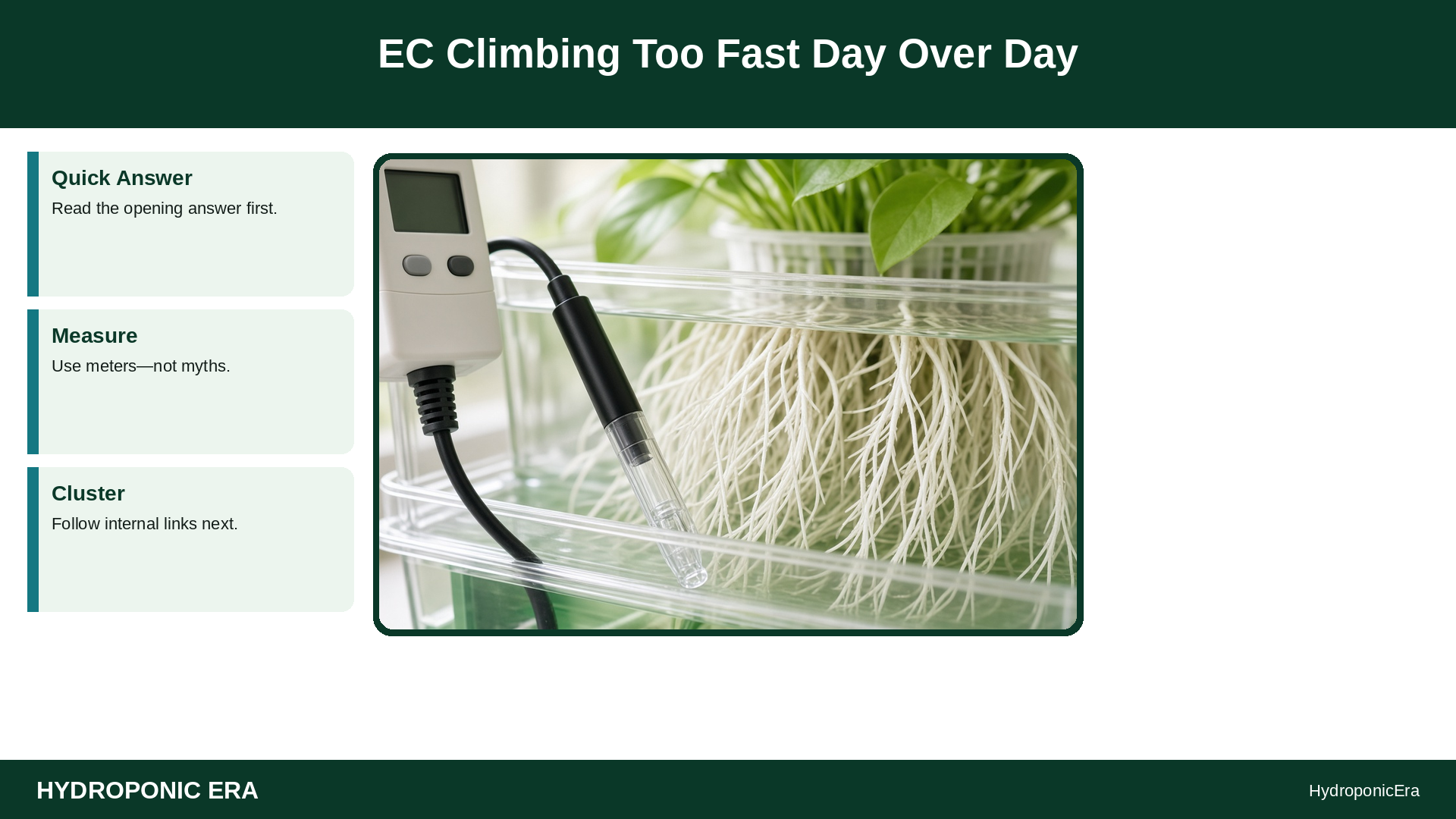
ec climbing too fast means solution concentrating faster than plants (and your top-off plan) can keep ratios sensible—usually from high transpiration, plain-water top-offs that leave salts behind, leaks-to-waste mix-ups, or metering errors—triage before tip burn. Pair with EC/TDS, top-off vs changes, auto top-off, nutrient burn, temperature & EC, and probe care.
Key takeaways for ec climbing too fast
- EC rising too fast hydroponics is a practical home-hydro workflow—not filler.
- Rising EC day-over-day is an ops alarm, not a badge of “strong feed.”
- Top-off with plain water concentrates remaining salts as volume drops.
- Confirm meter temperature compensation and calibration.
- Prefer university/extension sources over forum myths.
- Act before leaf margins toast—dilute or partial reset thoughtfully.
- Original ops card keeps EC rising too fast hydroponics decisions consistent.
- EC rising too fast hydroponics fails when growers skip the boring checks.
Related HydroponicEra guides
Why This Matters
ec climbing too fast triage protects canopies when conductivity climbs while plants still look “hungry” to beginners. Oklahoma State’s EC/pH guide and Penn State nutrient-program materials frame EC as a management signal tied to water use and fertilizer strength—not a score to maximize.
Home pattern: lights and heat drive transpiration, reservoir volume falls, you top off with water, salts concentrate, EC climbs, margins burn. Another pattern: you think you diluted but measured wrong. Fix the story before adding more bottles.
Comparison / Decision Table
| Cause | Clue | First move |
|---|---|---|
| Transpiration concentrate | Volume drops fast; warm/dry room | Top off sooner; watch VPD/heat |
| Under-top-off | EC up, level low | Restore volume with planned water |
| Meter / temp error | Jump after probe abuse | Recalibrate; note ATC |
| Accidental concentrate add | EC spike after mixing | Partial dump + remix |
Step-by-Step Workflow

- Log EC and reservoir level at the same time daily.
- Confirm probe clean and calibrated; note solution temperature.
- If level fell, top off per your SOP before adding nutrients.
- If EC still high after level restore, dilute toward target or partial change.
- Inspect for evaporation + heat (lights close, no lid, room dry).
- Check you did not dose stock twice.
- Watch leaf margins for early burn.
- Prefer one correction, then remeasure after mix time.
- If climb repeats daily, right-size ATO or change frequency.
- Log what worked so the next heat wave is boring.
Key Variables

| Variable | Effect | Link |
|---|---|---|
| Transpiration / VPD | Faster concentration | humidity/VPD, heat |
| Top-off habit | Salt left behind | top-off |
| Solution temperature | Meter + uptake behavior | temp & uptake |
| Starting strength | Less headroom before burn | starting EC |
Common mistakes with ec climbing too fast

- Adding more nutrients because “EC high means plants ate everything” (often false for climb)
- Never topping off until the roots are exposed
- Trusting a fouled EC probe
- Ignoring heat while chasing bottle brands
- Full dump every day instead of learning ATO
- Celebrating rising EC as “aggressive grower mode”
Troubleshooting

| Signal | Action |
|---|---|
| EC +0.3–0.5/day with falling volume | Top-off discipline + climate check |
| Tips burning, EC high | Dilute/partial reset; see burn guide |
| EC jump with stable volume | Mixing error or meter—verify |
| ATO empty / stuck | Fix ATO; manual top-off meantime |
Practical Framework

Climb card: Level + EC logged | Probe OK? | Top-off first | Dilute if still high | Heat/VPD checked.
Closing practice for EC rising too fast hydroponics: concentration is a water story before it is a fertilizer story.
What to Check When EC Climbs Day Over Day
- Daily EC + level logged?
- Probe calibrated?
- Top-off water ready?
- Heat/VPD reasonable?
- Burn symptoms scouted?
- ATO working if installed?
Transpiration Math Without Spreadsheets
If reservoir volume drops visibly each lights-on period, salts concentrate unless you replace the lost water. Plain-water top-offs are normal for many recirculating homes—just remeasure EC after mixing. Heat, low humidity, and oversized canopies accelerate the climb; cool leafy rooms climb slower.
Auto top-off helps volume discipline but does not forgive an oversized starting EC. If climb repeats daily even with full volume, your starting strength or climate load is too aggressive for the crop.
Meter Honesty
Temperature and dirty probes create fake cliffs. Clean, calibrate, and note ATC behavior using the probe care habits before you dump a tank that was never truly climbing.

Practice & Field Notes
Plot EC beside reservoir liters (or tote marks) for five days. A climb with falling volume is concentration; a climb with stable volume is dosing or meter error. That single distinction prevents the classic beginner move—adding more nutrients because “EC high means they ate it.”
In hot tents, schedule top-offs like watering outdoor containers: earlier and more often. ATO reduces drama if float valves are trusted and filtered. Watch leaf margins with the nutrient burn guide ready, not as a first panic button.
After any dilution, stir thoroughly and wait before trusting the display. Stratified tanks lie.
Scenario Walkthrough
Monday EC 1.4, Tuesday 1.7, Wednesday 2.0 while the tote mark drops two liters daily under strong LEDs. Plants look thirsty at lights-on. This is concentration, not heroic feeding. Top off to the mark with plain water, remeasure, and only then decide on a small dilution if still above target. Inspect VPD/heat. If margins already toast, follow burn recovery with gentler light until new growth is clean.
If EC jumps 0.6 with unchanged volume after you mixed stocks, you double-dosed or misread the meter—verify before plants pay.
Key Limits & Honest Scope
EC climb rates depend on climate, canopy size, starting strength, and top-off discipline. There is no single universal “too fast” number for every crop and meter scale (mS/cm vs ppm scales differ). Use your own logs: if climb coincides with volume loss, think concentration; if not, think dosing/meter error.
Temperature-compensated readings matter—see temperature effects on uptake/EC. Do not chase Instagram EC flexes. Protect leaf margins with early dilution when burn appears, then fix the water-loss story that caused the climb.
ATO systems help volume but still need EC surveillance. Stale tanks with odd ratios may need a full change even when the climb narrative is understood.
FAQs about ec climbing too fast
Does rising EC mean plants are starving?
Often the opposite—salts concentrating. Confirm with volume and symptoms.
Top off with nutrient or water?
Usually plain water to replace transpiration; follow your system SOP.
When to full change?
When ratios, smell, or chronic climb say the tank is stale—not every tick.
ATO help?
Yes for volume—still monitor EC.
Hot tent?
Expect faster climbs; manage climate and top-offs.
Different meters disagree?
Calibrate both; trust standards, not arguments.
Extended Home-Grower Walkthrough
Use this extended walkthrough as a second pass after the Quick Answer. Walk the system with a notebook: write the date, crop, EC, pH, reservoir temperature, and one observation about roots or leaves. Change only one control at a time when a problem appears. If last week’s fix did not show in new growth, revert and try the next smallest lever. Keep university and extension principles in mind—oxygen, sanitation, and measured nutrition beat product stacking.
Photograph the canopy and the reservoir surface weekly. Dated photos settle arguments about algae, tip burn, or stretch faster than memory. When a helper waters for you, leave a one-page card with do-not-touch items and the exact top-off rule. Store calibration sachets next to the meters so “I will calibrate later” stops being the default. Review timers after any power event. Confirm air stones still roar. Confirm drains still drain.
At the end of the week, score the cycle 1–5 for ease and plant quality. Low scores should trigger a sanitation or climate review before you buy new hardware. Link neighboring HydroponicEra guides when the symptom matches a cluster page. Prefer labeled procedures over improvisation under stress. Healthy boring routines are the real upgrade path for home hydroponics.
Keep ec climbing too fast on your ops card so helpers follow one standard.
Keep ec climbing too fast on your ops card so helpers follow one standard.
Keep ec climbing too fast on your ops card so helpers follow one standard.
Keep ec climbing too fast on your ops card so helpers follow one standard.
Keep ec climbing too fast on your ops card so helpers follow one standard.
Keep ec climbing too fast on your ops card so helpers follow one standard.
Keep ec climbing too fast on your ops card so helpers follow one standard.
Keep ec climbing too fast on your ops card so helpers follow one standard.
Keep ec climbing too fast on your ops card so helpers follow one standard.
Keep ec climbing too fast on your ops card so helpers follow one standard.
Keep ec climbing too fast on your ops card so helpers follow one standard.
Keep ec climbing too fast on your ops card so helpers follow one standard.
Keep ec climbing too fast on your ops card so helpers follow one standard.
Keep ec climbing too fast on your ops card so helpers follow one standard.
Keep ec climbing too fast on your ops card so helpers follow one standard.
Sources
- Oklahoma State University Extension — Electrical Conductivity and pH Guide for Hydroponics
- Penn State Extension — Hydroponics Systems and Principles of Plant Nutrition
- Penn State Extension — Hydroponics Systems: Nutrient Solution Programs and Recipes
- Oklahoma State University Extension — Hydroponics
- Michigan State University Extension — Hydroponics as an agricultural production system
- University of Florida IFAS — CV265: Fertilizer Management for Greenhouse Vegetables