
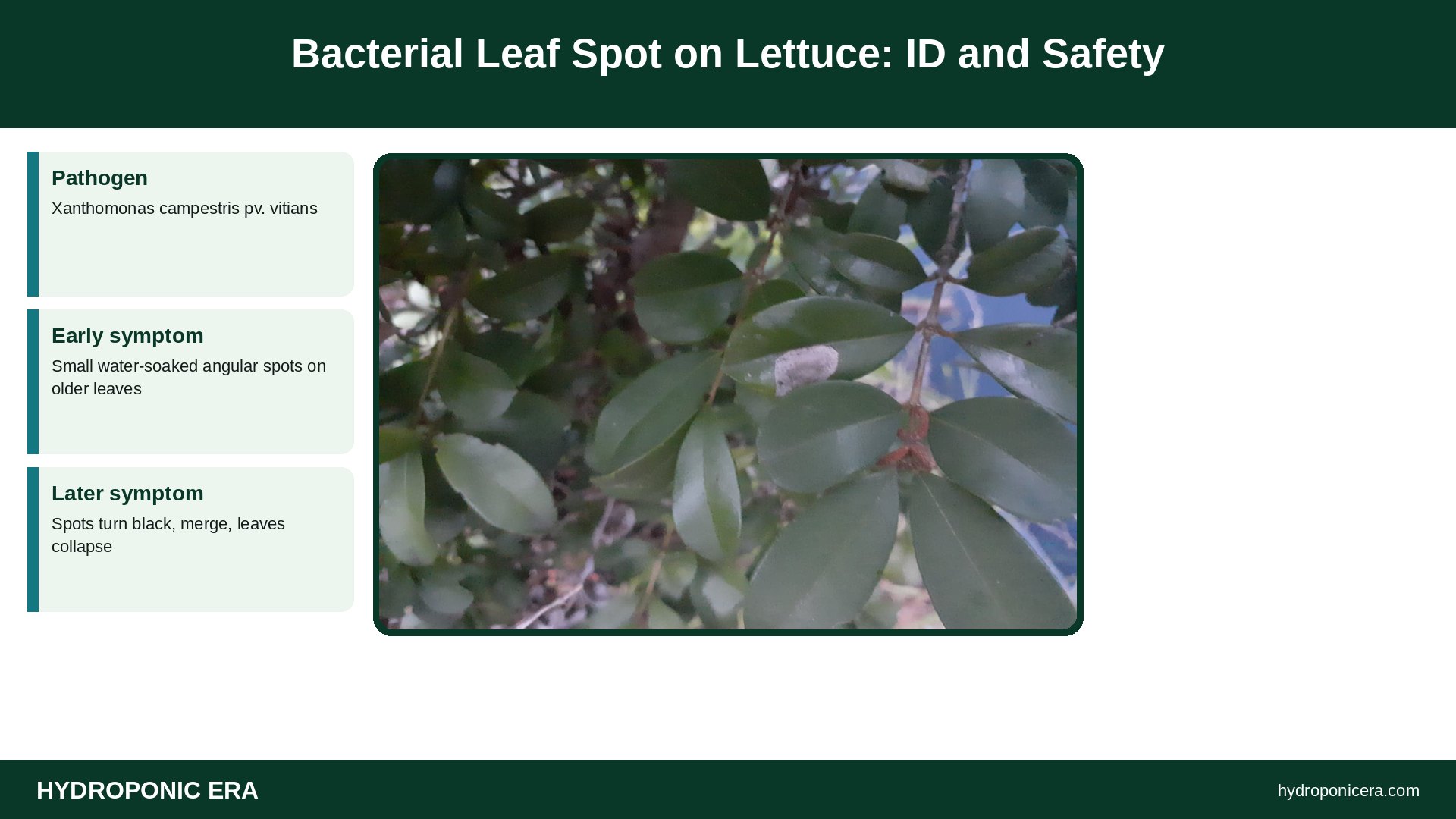
Bacterial leaf spot on hydroponic lettuce is caused mainly by Xanthomonas campestris pv. vitians. It starts as small, water-soaked, angular spots on older leaves that turn black or dark brown, sometimes with yellow halos, and it spreads by splashing water, contaminated seed, hands, and tools. There’s no cure for infected leaves, so control depends on clean seed, dry foliage, good airflow, lower humidity, sanitation, and removing infected plants. Copper sprays offer limited control and aren’t a substitute for prevention.
Key takeaway: Keep lettuce leaves dry, start with clean seed, sanitize between crops, and pull infected plants quickly.
| Aspect | Details |
|---|---|
| Pathogen | Xanthomonas campestris pv. vitians |
| Early symptom | Small water-soaked angular spots on older leaves |
| Later symptom | Spots turn black, merge, leaves collapse |
| Spread | Water splash, seed, hands, tools, debris |
| Favored by | Wet leaves, high humidity, overhead watering |
| Control | Clean seed, dry foliage, sanitation, removal |
How to Recognize Bacterial Leaf Spot
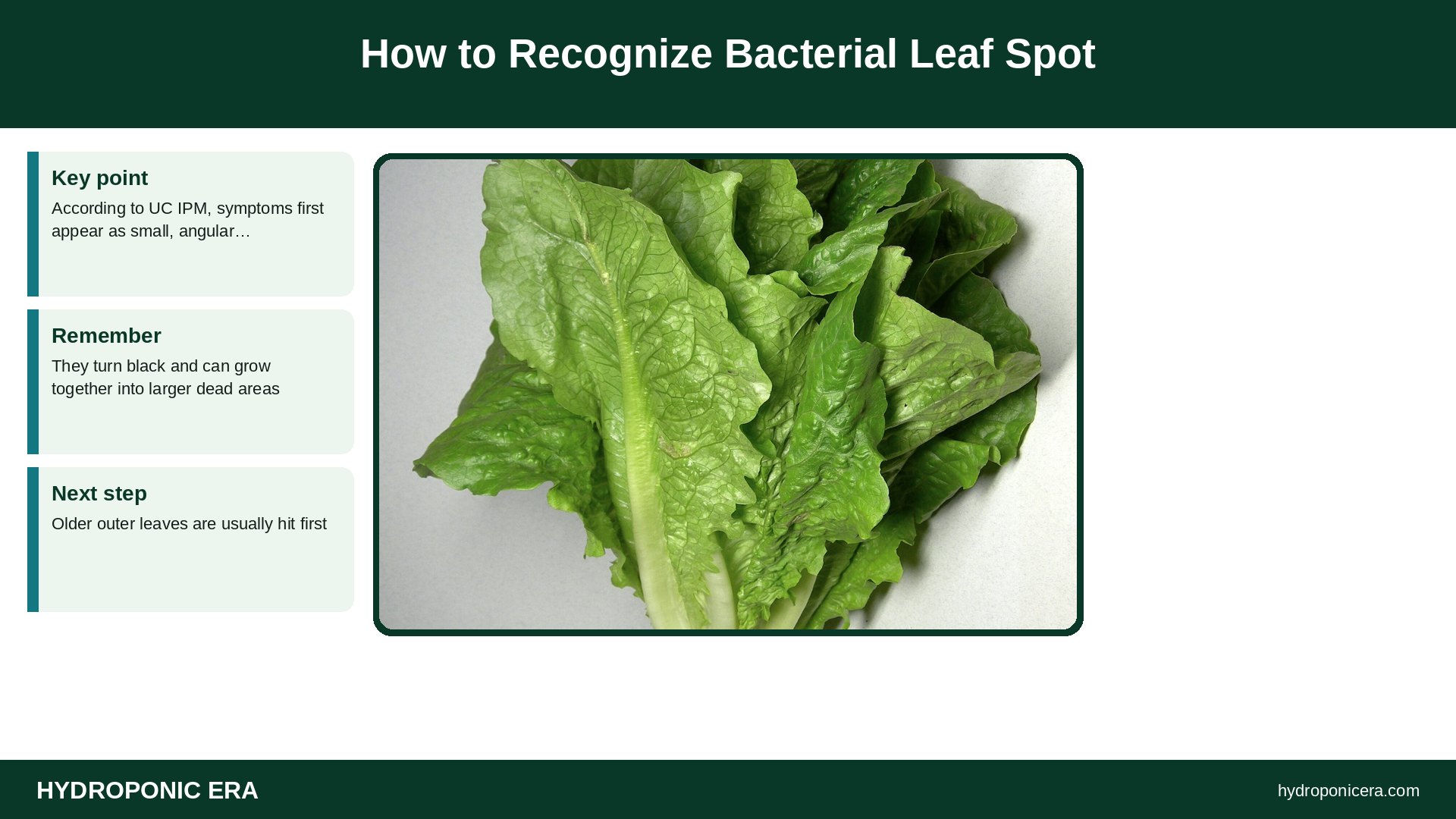
According to UC IPM, symptoms first appear as small, angular, water-soaked spots, often limited by leaf veins. They turn black and can grow together into larger dead areas. Older outer leaves are usually hit first. Unlike fungal spots, there’s no fuzzy growth. Compare with downy mildew, which has a fuzzy underside, and INSV, which causes tan or brown spotting on younger leaves.
How It Spreads
The bacteria live on seed, plant debris, and leaf surfaces. Splashing water, misting, handling wet plants, and contaminated tools carry them from plant to plant. In hydroponic systems, foliage that stays wet from condensation or overhead spraying creates ideal conditions. The pathogen enters through natural openings and wounds.
Prevention in Hydroponic Systems
Start With Clean Seed
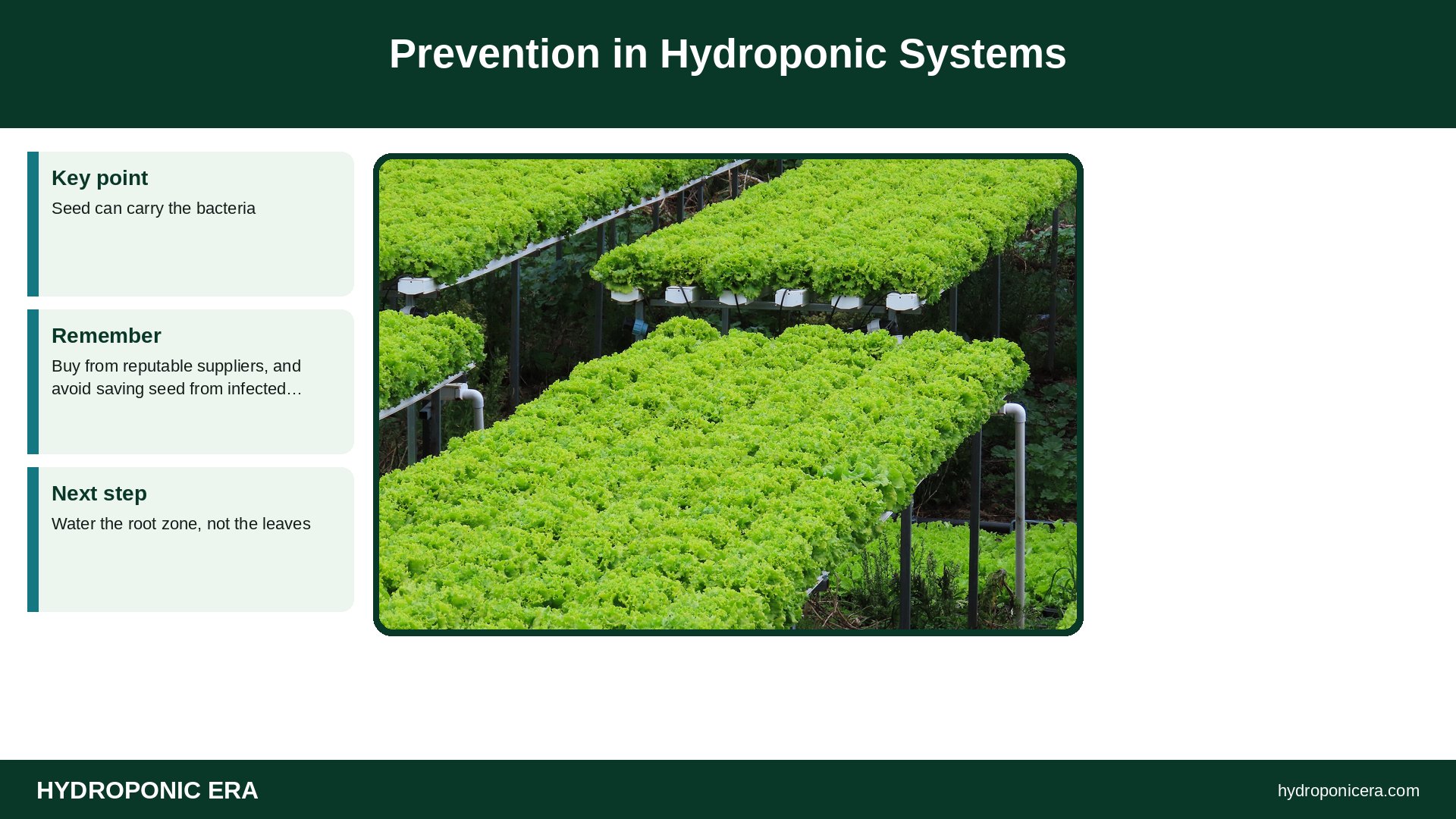
Seed can carry the bacteria. Buy from reputable suppliers, and avoid saving seed from infected crops.
Keep Leaves Dry
Water the root zone, not the leaves. Avoid misting lettuce. Control condensation by keeping temperatures and humidity stable and avoiding big night-time drops that cause dew.
Lower Humidity and Improve Airflow
Use fans to keep air moving across the canopy and space plants so leaves dry quickly. See humidity and VPD.
Sanitation
Clean and disinfect channels, rafts, trays, and tools between crops. Wash hands before handling plants, and work with healthy plants before suspect ones. See how to clean a hydroponic system.
What to Do If You Find It
- Remove and bag infected leaves or whole plants.
- Avoid handling healthy plants after touching infected ones.
- Sanitize tools and surfaces.
- Reduce humidity and increase airflow immediately.
- Monitor nearby plants daily.
- At the end of the crop, clean the system thoroughly.
Do Copper Sprays Work?
UC IPM notes that copper sprays provide only limited control. They may slow spread but won’t cure infected tissue. If you consider any pesticide, read the label carefully, use only products labeled for lettuce, and follow harvest intervals. Many home growers find prevention far more effective.
Can You Eat Lettuce With Bacterial Leaf Spot?
The spots make leaves unattractive and can lead to decay. Remove affected leaves. For sale, damaged leaves aren’t marketable. See food safety questions when selling.
Other Causes of Spots on Lettuce
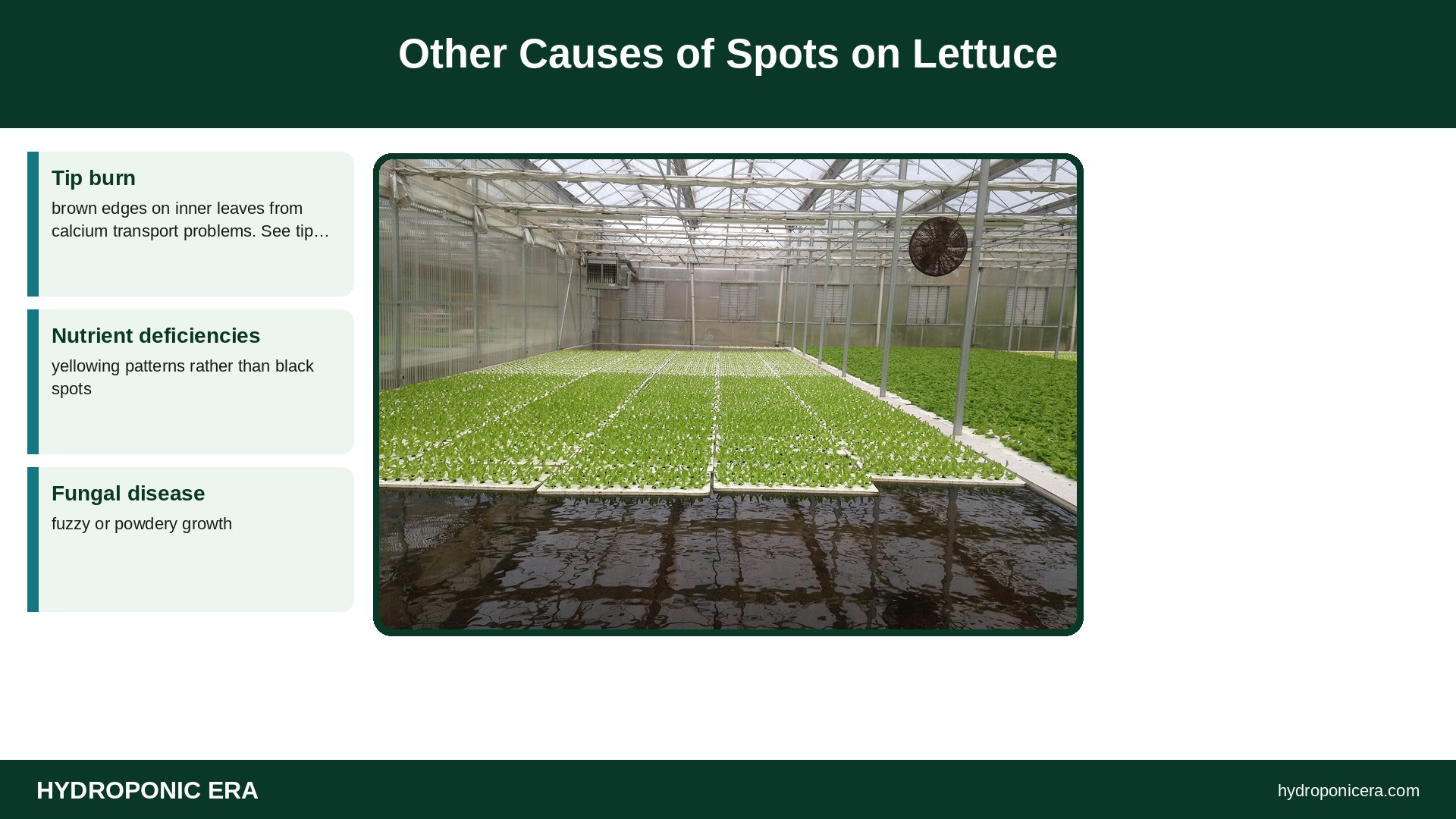
- Tip burn: brown edges on inner leaves from calcium transport problems. See tip burn checklist.
- Nutrient deficiencies: yellowing patterns rather than black spots.
- Fungal disease: fuzzy or powdery growth.
- Chemical burn: spots where sprays landed.
For overall lettuce care, see how to grow lettuce hydroponically.
Bacterial Leaf Spot vs Look-Alikes: A Closer Look
Several lettuce problems can be confused with bacterial leaf spot, and the fix differs for each.
- Downy mildew: pale yellow angular patches on the upper surface, with white to gray fuzzy growth underneath, especially in the morning.
- INSV: tan to brown spots and dead patches, often with distorted growth, spread by thrips.
- Tip burn: brown, dry margins on young inner leaves, without water-soaked spots.
- Edema or water damage: blistered or corky spots where water sat on leaves.
Bacterial leaf spot has angular, water-soaked spots that turn black, usually starting on older outer leaves. A hand lens helps: there’s no fungal fuzz. If you’re unsure, your county extension office can help identify a sample.
Why Bacterial Leaf Spot Shows Up Indoors
Indoor lettuce rarely gets rain, so bacterial leaf spot usually arrives on infected seed or transplants, or spreads from contaminated trays and tools. High humidity and condensation then let it move between plants. If bacterial leaf spot appears in several crops in a row, the source may be leftover debris in channels or rafts, a seed lot, or a habit like misting. Change one thing at a time: new seed, a deeper clean, or a new watering method.
Managing Humidity to Prevent Bacterial Leaf Spot
Bacteria need a film of water on the leaf to infect. Indoors, that film often comes from condensation when warm, humid air meets a cooler leaf at night. Keeping relative humidity moderate, running fans around the clock, and avoiding big temperature drops when the lights switch off all reduce how long leaves stay wet. A small hygrometer at canopy level shows whether humidity spikes at night. See dehumidifiers for indoor hydroponics.
Records That Help
Note the seed lot, sowing date, and where infected plants sat in the system. If bacterial leaf spot clusters in one corner or under one fan dead zone, conditions there are the likely cause.
Cleaning Between Lettuce Crops
After a crop with bacterial leaf spot, remove all plant debris, scrub channels, rafts, and net pots, and disinfect them before replanting. Replace starter media and discard leftover plugs from the infected batch. Run the next crop with new seed and dry foliage to confirm the problem is gone.
FAQs: Bacterial Leaf Spot on Lettuce
What causes bacterial leaf spot on lettuce?
The bacterium Xanthomonas campestris pv. vitians, spread by water, seed, and handling.
Can bacterial leaf spot be cured?
No. Infected leaves won’t heal. Remove them and prevent spread.
Does bacterial leaf spot spread in the nutrient solution?
It mainly spreads on leaves via splashing and handling, but sanitation of the whole system is still important.
How do I prevent bacterial leaf spot?
Use clean seed, keep leaves dry, lower humidity, improve airflow, and sanitize.
Is it the same as tip burn?
No. Tip burn is a calcium-related disorder on leaf edges; bacterial leaf spot starts as water-soaked angular spots.
Sources
- UC IPM — Lettuce: Bacterial Leaf Spot
- University of Florida IFAS Extension — Leafy Greens in Hydroponics and Protected Culture for Florida
- Photo credits (Wikimedia Commons, edited with titles): Leaf spot grey necrosis by Savina Jo (CC BY-SA 4.0); Romaine lettuce by Rainer Zenz (CC BY-SA 3.0); Hydroponic lettuce @ Plaine des Cafres 03 by Rémih (CC BY-SA 4.0); Romaine lettuce by Rainer Zenz (CC BY-SA 3.0); Deep water culture by ArcadiYay (CC BY-SA 4.0)